
On this page
Start here
Quick answer
If a Liebherr refrigerator door will not close, remove any package or shelf item protruding into the door path, check that drawers and shelves are fully seated, and inspect the gasket for dirt or distortion. Confirm the appliance is level and the door closes without force. A damaged seal, hinge, cabinet, or persistent gap needs model-specific Liebherr service because a warm compartment and excess frost can follow.
Before you begin
Safety first
- Do not force the door or alter hinges and seals without the model instructions.
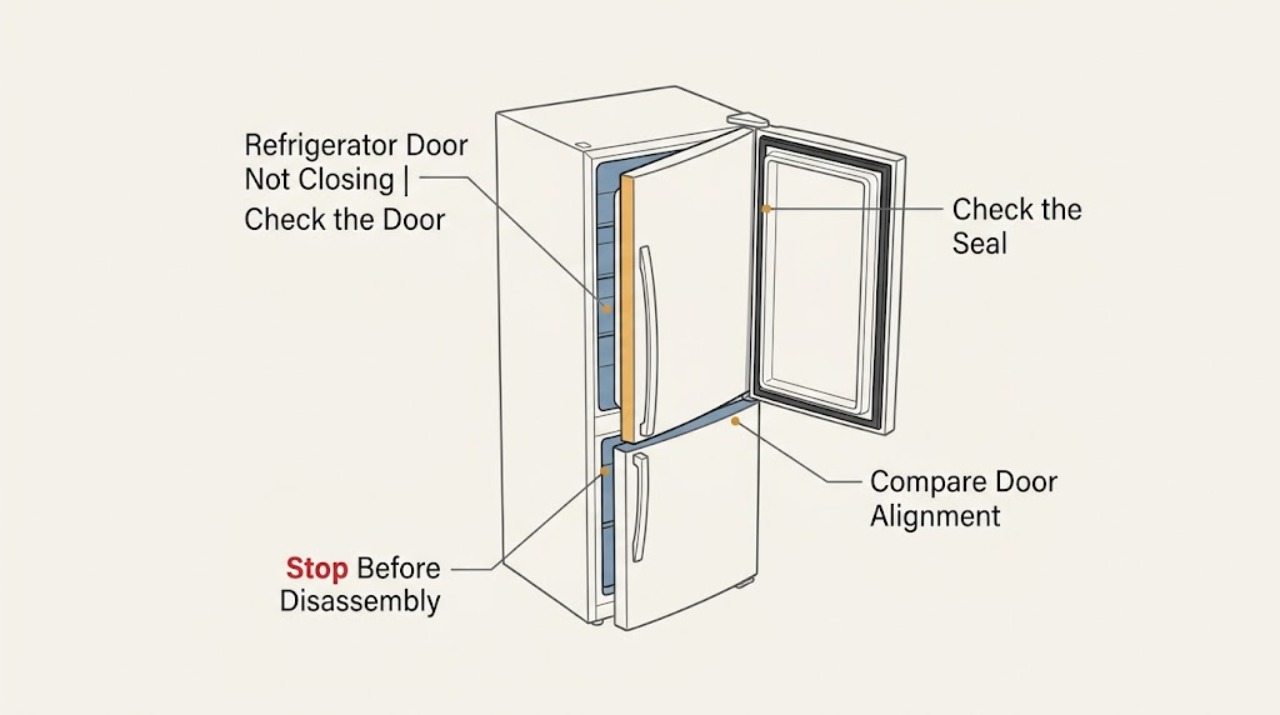
Work through in order
Diagnostic checks
Use only checks that match the exact appliance or system and its official guide.
-
Check 1
Close the door slowly and watch the full perimeter, especially door shelves, bottle storage, drawers, and the front edge of shelves, for a package or accessory that stops it.
Expected result: A container, shelf, drawer, or basket projects into the closing path, or the door reaches the cabinet without an obvious obstruction.
Next step: Rearrange the item and fully seat removable storage without overloading it. Do not force the door against a hard obstruction.
Why this matters
Why: A physical obstruction explains a repeatable gap at one location; a clear path shifts attention to level, gasket, or hinge alignment.
-
Check 2
With the door open, inspect the gasket and the surface it touches for crumbs, residue, folds, or a section that is pulled away from the cabinet. Clean the seal with clean water and a little dish soap if needed, then dry it.
Expected result: The seal is dirty or not lying flat, or it is clean and still leaves a gap.
Next step: Close the door gently and recheck the perimeter. Do not cut, glue, or replace a gasket without model identification.
Why this matters
Why: Liebherr recommends clean water for door seals; a clean, flat seal that still leaks points to alignment or damage rather than dirt.
-
Check 3
Check whether the appliance stands level and whether the door's gap changes when storage is removed. Look for a hinge-side scrape, a sagging door, or a cabinet that rocks.
Expected result: The appliance rocks or the gap changes with load, or the door remains misaligned when empty and level.
Next step: Correct only an accessible leveling adjustment allowed by the model instructions. Arrange service for hinge/cabinet damage or a persistent seal gap.
Why this matters
Why: Level and load can affect closing geometry; persistent misalignment when empty suggests hinge, gasket, or cabinet service.
Use your observations
Decision map
Find the observation that best matches what you see, then follow the next safe action.
-
PATH 01Next step
What you see
The door closes after a package or drawer is repositioned
Do this next
Keep the door shelf and drawer fronts within their intended positions and verify the seal after loading.
Why this path and its safety boundary
Why it matters: Storage interference was the supported cause.
-
PATH 02Next step
What you see
The gasket is clean but a continuous gap remains
Do this next
Avoid prolonged operation with the gap and contact Liebherr service.
Why this path and its safety boundary
Why it matters: A seal, hinge, level, or cabinet issue is more likely than a food-storage obstruction.
-
PATH 03Next step
What you see
The door is closed yet the compartment becomes warm or frost/condensation increases
Do this next
Minimize opening and request model-specific support if temperature does not normalize.
Why this path and its safety boundary
Why it matters: The seal may not be maintaining the intended closed condition, and the temperature symptom requires prompt attention.
Helpful context
Understand the symptom
A door gap is a cooling symptom too
Liebherr identifies an improperly closed door as a contributor to abnormal temperature. Treat the closing fault as a fit-and-seal diagnosis before changing cooling settings.
When checks do not resolve it
Need a professional?
Request support for persistent gaps, damaged hardware, or warm temperatures associated with the door.
Safety scope: Do not force the door or alter hinges and seals without the model instructions.
Have this ready
- Provide the model, obstruction location, gasket condition, level/load result, and temperature symptom.
Common questions
FAQ
How do I clean a Liebherr refrigerator door seal?
Liebherr recommends clean water, with a little dish soap for stubborn dirt. Clean the seal and the surface it touches, then check whether the door closes evenly.
Can a door that does not close cause temperature problems?
Yes. Liebherr lists an improperly closed door among factors that can make the refrigerator or freezer too warm. Correct the closing condition before changing settings.
Read the exact guide
Official sources
- FAQs – frequently asked questions about Liebherr refrigerators & freezersLiebherr · Liebherr door closure, temperature, and door-seal care guidance
- Service and support from LiebherrLiebherr · Liebherr refrigerator customer service
Community feedback
Share a repair observation
Share a plain-text repair observation. Accepted observations are published automatically; this page may take a moment to update.