
On this page
Start here
Quick answer
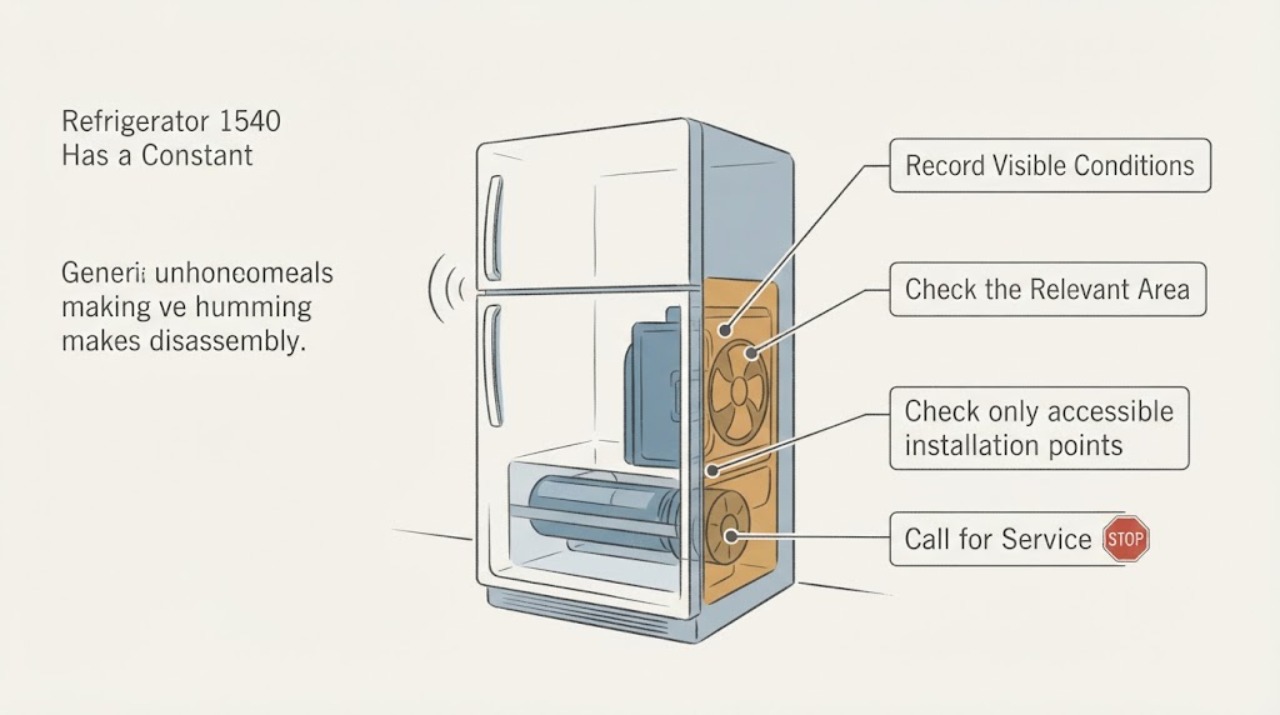
A faint hum from a Liebherr refrigerator can be normal: Liebherr describes compressor cooling, low fan airflow, and some switching noises as normal operating sounds. The task's incomplete model label “1540” does not identify an exact Liebherr manual, and a constant electrical-sounding hum should not be used to guess a transformer, board, compressor, or fan failure. First read the full model and 9-digit service number from the rating plate and match the exact Liebherr instructions. Without opening the built-in cabinet, observe whether the refrigerator is cooling normally, whether the sound changes with cooling demand or a fan cycle, and whether vibration is coming from the appliance or nearby objects. Stop and arrange qualified service if the hum is accompanied by a hot or damaged plug, electrical smell, sparking, repeated breaker trips, shock, loss of cooling, or a new worsening noise; never remove covers to inspect live parts.
Work through in order
Diagnostic checks
Use only checks that match the exact appliance or system and its official guide.
-
Check 1
Read the rating plate without removing panels and record the complete Liebherr model designation, 9-digit service number, and serial number. Use those details to open the matching Liebherr operating instructions before applying model-specific advice.
Expected result: The plate provides a full model and service number, or it only shows the incomplete “1540” description and the exact document cannot be matched.
Next step: If the identity is incomplete, keep the refrigerator closed and contact Liebherr support with a photo or transcription of the rating plate. Do not dismantle a built-in appliance to find another label.
Why this matters
Why: A complete identity determines whether the generic noise table applies to this refrigerator. “1540” alone is not evidence for a transformer, compressor, fan, or electrical-board diagnosis.
-
Check 2
From outside the appliance, note when the hum occurs and whether cooling remains normal. Do not put hands behind a built-in refrigerator or remove a cover; record whether the sound is a low steady hum, briefly louder when cooling starts, or accompanied by a fan-like airflow sound.
Expected result: The hum tracks cooling or fan operation and the refrigerator maintains its normal temperatures, or the noise is new, worsening, irregular, and accompanied by warming food or an alarm.
Next step: For a stable normal-sounding pattern, keep monitoring without opening the cabinet. For a changed pattern or cooling problem, stop trying to identify a component by sound and arrange Liebherr or qualified appliance service.
Why this matters
Why: Liebherr documents cooling hum, low fan airflow, and a brief start-up increase as normal noise patterns. A new noise paired with loss of cooling or an alarm is outside a normal-sound classification and needs service assessment.
-
Check 3
Check only accessible installation points: confirm the refrigerator is not visibly rocking, and move bottles or loose objects inside or beside it so they do not touch and resonate. Do not pull out or alter a built-in refrigerator unless the exact installation instructions and a qualified technician permit it.
Expected result: The appliance is unstable or an adjacent bottle, cabinet panel, or loose object vibrates with the hum, or the refrigerator is firm and the noise remains unchanged.
Next step: Correct only an accessible object or obvious contact. If leveling or built-in adjustment is required, use qualified service; if the refrigerator is firm and the hum persists, proceed with the service boundary rather than touching internal parts.
Why this matters
Why: Liebherr attributes vibration noises to an appliance that is not standing firmly and recommends aligning it; the guide also says to keep bottles and jars apart. This can explain transmitted vibration, but it does not establish an internal electrical fault.
-
Check 4
Screen for stop-service signs from a safe position: electrical odor, a hot or damaged plug or cord, visible sparking, repeated breaker trips, electric shock, loss of cooling, or an abrupt change in the hum. Do not remove the LED cover, rear panel, compressor cover, or control housing to investigate.
Expected result: Any electrical or cooling warning is present, or the refrigerator only has a faint stable hum with normal cooling and no abnormal heat, odor, spark, trip, or shock.
Next step: If any warning sign is present, stop using the refrigerator if it can be done safely and arrange qualified service; if there is smoke, fire, or an immediate electrical hazard, leave the area and use local emergency procedures. If no warning sign is present, keep the appliance closed, preserve the exact model identity, and contact Liebherr if the sound remains concerning.
Why this matters
Why: A stable documented operating-noise pattern can be monitored, but Liebherr warns that live electrical parts are under certain covers and directs LED repair to customer service or trained personnel. The opened manuals do not support a homeowner component diagnosis for an electrical-sounding hum.
Use your observations
Decision map
Find the observation that best matches what you see, then follow the next safe action.
-
PATH 01Next step
What you see
The full rating plate identifies a Liebherr refrigerator, the hum is low or briefly louder when cooling starts, temperatures are normal, and there is no vibration or electrical warning.
Do this next
Use the exact model manual, leave covers closed, and monitor. Contact Liebherr if the sound changes or causes concern.
Why this path and its safety boundary
Why it matters: This pattern is consistent with Liebherr's documented normal cooling, fan, or switching noises, although it does not identify the internal sound source.
-
PATH 02Next step
What you see
The refrigerator is firm but the hum is new, constant, worsening, or paired with warming food, a temperature alarm, or another operating change.
Do this next
Keep the doors closed, document the noise and temperatures, and arrange Liebherr or qualified appliance service. Do not open a built-in cabinet or infer a failed transformer, board, compressor, or fan.
Why this path and its safety boundary
Why it matters: The normal-noise table cannot distinguish an internal component fault from a changed operating condition; the symptom now needs model-specific service assessment.
-
PATH 03Next step
What you see
A bottle, cabinet panel, or other accessible object vibrates with the hum, or the appliance visibly rocks.
Do this next
Separate the accessible object and correct only an obvious safe contact. Arrange qualified service for leveling or built-in adjustment if the refrigerator cannot be moved safely.
Why this path and its safety boundary
Why it matters: Liebherr identifies unstable setup and contact between objects as sources of vibration noise; this observation does not prove an electrical defect.
-
PATH 04Next step
What you see
There is an electrical smell, hot or damaged plug, sparking, repeated breaker operation, shock, smoke, or another immediate hazard.
Do this next
Do not touch covers or continue testing. Stop use if safe, leave the area for smoke or fire, and arrange qualified appliance/electrical service or local emergency response as appropriate.
Why this path and its safety boundary
Why it matters: The issue has crossed the normal-operating-noise boundary. The opened Liebherr guide warns that live electrical parts can be under covers and does not provide a user repair for this symptom.
Helpful context
Understand the symptom
A low hum is not automatically an electrical fault
Liebherr's opened refrigerator guide separates normal operating noises from defect noises. It lists humming when the appliance is cooling, a low fan hum, and a brief increase when the refrigeration unit starts as normal in the documented model families. The same guide separately treats vibration from an appliance that is not standing firmly as an installation issue. Those categories support observation and service triage, but they do not prove which internal component produces a faint electrical-sounding noise in the assigned refrigerator.
Use the full rating-plate identity before model-specific advice
The lead says “Liebherr model 1540,” but the supplied label is not a complete model-family and suffix mapping. Liebherr's operating-instructions page asks for the appliance's 9-digit service number or serial number, and the FAQ explains where the serial tag is found on freestanding and fully integrated appliances. Keep this page conditional on the label actually identifying a Liebherr refrigerator and use the exact manual for controls, clearances, and service instructions.
When checks do not resolve it
Need a professional?
Contact Liebherr or qualified appliance service when the hum is new, worsening, not associated with a documented normal cooling or fan pattern, or accompanied by warming food, an alarm, unstable installation, electrical odor, hot or damaged power parts, sparking, repeated breaker trips, or shock. Do not open the built-in refrigerator, remove electrical covers, or order a transformer, fan, board, or compressor from a sound description alone.
Common questions
FAQ
Is a faint hum from a Liebherr refrigerator normal?
It can be. Liebherr describes hum from cooling, low fan airflow, and some motor or valve switching as normal noises. A constant or newly changed electrical-sounding hum still needs to be judged with the exact model identity, cooling performance, vibration, and safety signs; the word “hum” alone does not identify a part.
Does Liebherr model 1540 identify the exact refrigerator manual?
Not from the supplied label alone. Liebherr directs owners to the rating plate and the 9-digit service or serial number for operating instructions. Record the complete plate identity before using model-specific controls, clearances, or repair information.
Can I pull out a built-in refrigerator to find the humming part?
Do not pull out or dismantle a built-in appliance just to locate a hum. Observe from accessible positions, keep covers closed, and arrange qualified service if the sound is concerning or the installation must be disturbed.
What if the refrigerator cools normally but the hum is driving me crazy?
Record whether it tracks cooling or fan operation and check accessible contact or vibration without opening the cabinet. If the pattern remains unexplained or has changed, contact Liebherr support with the full rating-plate identity; a normal temperature does not prove that a new electrical-sounding noise is harmless.
Should I remove the rear or light cover to check for a transformer?
No. Do not infer a transformer or other component from the sound and do not remove covers. Liebherr warns that live electrical parts can be under some covers and directs repair to customer service or trained personnel.
Read the exact guide
Official sources
- Liebherr appliances FAQsLiebherr · Supports the general statement that humming, hissing, bubbling, and gurgling can be technical operating noises and that a concerning noise should be referred to customer service; it does not map the incomplete “1540” label to a model.
- User Guide: Fridge/Freezer (CN(ef/bs/fr/i))Liebherr · Supports the documented normal hum/fan/switching noise patterns, vibration/setup observation, service escalation, and warning that live electrical parts can be under covers. Exact model applicability must be confirmed from the assigned appliance rating plate.
- Operating instructionsLiebherr · Supports obtaining the exact manual from the 9-digit service or serial number and locating the serial tag; it is not used for an unseen model-specific repair procedure.
Community feedback
Share a repair observation
Share a plain-text repair observation. Accepted observations are published automatically; this page may take a moment to update.