
On this page
Start here
Quick answer
If a Liebherr refrigerator is freezing food, first check the refrigerator temperature setting and whether SuperCool or another special function was activated. Then move food away from the rear wall and vents, and note whether the problem is limited to a BioFresh drawer or affects the whole compartment. If the setting is normal and food still freezes, contact Liebherr service with the model and location of the cold spots.
Before you begin
Safety first
- Do not remove panels or access sealed refrigeration controls; protect food and follow the model manual.
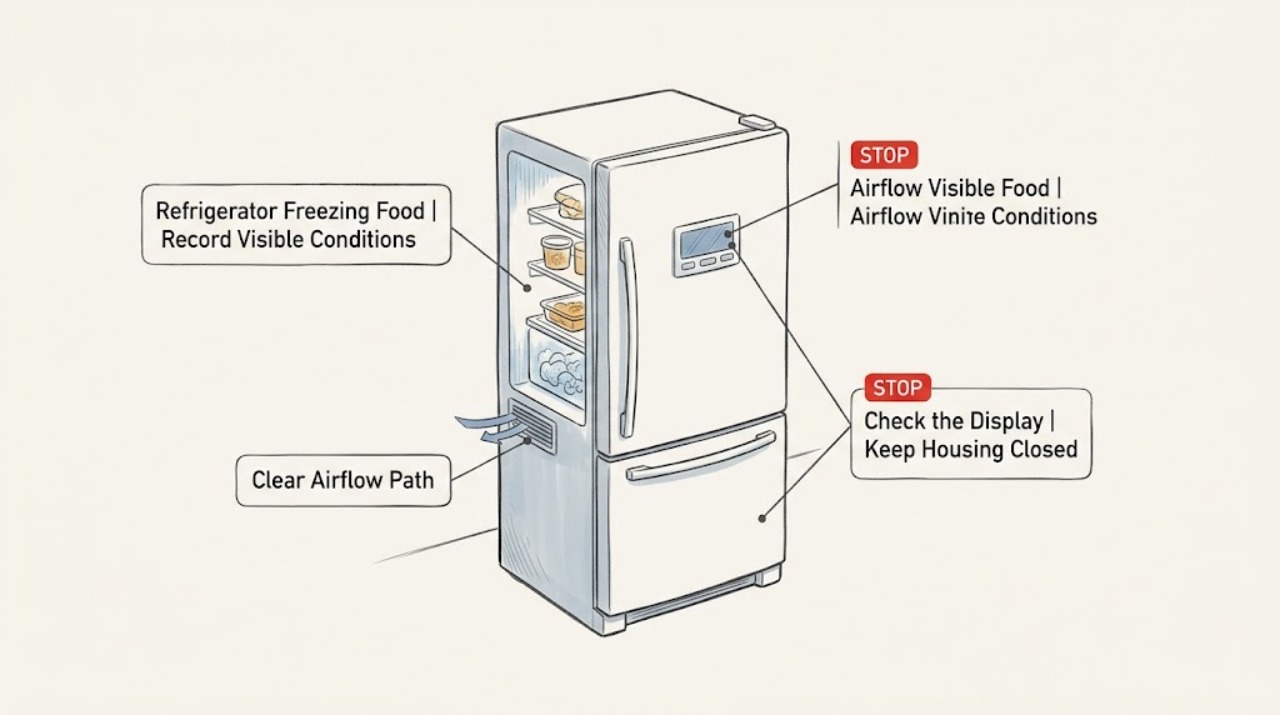
Work through in order
Diagnostic checks
Use only checks that match the exact appliance or system and its official guide.
-
Check 1
Check the refrigerator temperature display and note whether SuperCool or another rapid-cooling function is active. Record whether freezing began after a setting change or a large grocery load.
Expected result: A special cooling function is active or the setting is colder than intended, or settings appear normal.
Next step: Return to the intended normal setting through the model controls and allow time for stabilization. Do not make repeated rapid changes.
Why this matters
Why: Liebherr identifies an inadvertently activated SuperCool/SuperFrost function and the temperature setting as temperature causes; a normal setting needs placement and service checks.
-
Check 2
Map the frozen items: inspect whether they touch the rear wall, sit directly in an airflow path, or are concentrated in one drawer such as BioFresh rather than throughout the compartment.
Expected result: Freezing is localized near the rear wall/air path or is widespread across shelves and drawers.
Next step: Leave circulation space and move sensitive food away from the cold wall. If the entire compartment remains too cold, continue to service-level diagnosis.
Why this matters
Why: Localized freezing can follow placement and cold-air exposure; widespread freezing after a normal setting is less likely to be a single package-position issue.
-
Check 3
Check the door closing condition and ventilation around the appliance, and note any display warning or unusual operating behavior. Do not remove interior panels.
Expected result: The door is not closing properly, ventilation is restricted, or the door and ventilation are normal while freezing persists.
Next step: Correct a clear closing or ventilation issue and observe the temperature. Contact Liebherr service if the symptom remains.
Why this matters
Why: Liebherr lists door closure and ventilation among temperature influences, while persistent freezing with normal external conditions needs model-specific evaluation.
Use your observations
Decision map
Find the observation that best matches what you see, then follow the next safe action.
-
PATH 01Next step
What you see
Freezing stops after a special cooling function is turned off and the setting stabilizes
Do this next
Use that function only when needed and follow the model operating instructions.
Why this path and its safety boundary
Why it matters: An active rapid-cooling function was the supported explanation.
-
PATH 02Next step
What you see
Only food touching the rear wall freezes
Do this next
Rearrange food with circulation space and monitor the same shelf.
Why this path and its safety boundary
Why it matters: Placement and localized cold-air exposure are more likely than a whole-compartment control fault.
-
PATH 03Next step
What you see
The setting is normal but all areas freeze or the symptom persists
Do this next
Contact Liebherr service and provide the model, setting, function state, and affected locations.
Why this path and its safety boundary
Why it matters: An internal temperature-control or airflow issue cannot be safely identified from the exterior.
Helpful context
Understand the symptom
Location separates airflow from a setting
A single cold spot against a rear wall is a different clue from an entire compartment that is too cold. Liebherr says temperature depends on setting and stored quantity, and that SuperCool can temporarily lower the temperature.
When checks do not resolve it
Need a professional?
Request service for persistent or widespread freezing after external setting and placement checks.
Safety scope: Do not remove panels or access sealed refrigeration controls; protect food and follow the model manual.
Have this ready
- Provide the model, setting, active functions, affected shelf/drawer locations, door result, and time pattern.
Common questions
FAQ
Can SuperCool make a Liebherr refrigerator too cold?
Liebherr lists inadvertent activation of SuperCool/SuperFrost among causes of an appliance being too cold. Check the active functions before assuming a part has failed.
Why does food freeze only at the back of the refrigerator?
Food touching the rear wall or sitting in a cold-air path can be exposed to a colder spot. Rearrange it with circulation space; widespread freezing needs service if the setting is normal.
Read the exact guide
Official sources
- Service and support from LiebherrLiebherr · Liebherr refrigerator customer service
- NoFrost – perfect convenience and lasting freshnessLiebherr · Liebherr cold-air circulation and frost technology
- FAQs – frequently asked questions about Liebherr refrigerators & freezersLiebherr · Liebherr refrigerator temperature, door, ventilation, and SuperCool guidance
Community feedback
Share a repair observation
Share a plain-text repair observation. Accepted observations are published automatically; this page may take a moment to update.