
On this page
Start here
Quick answer
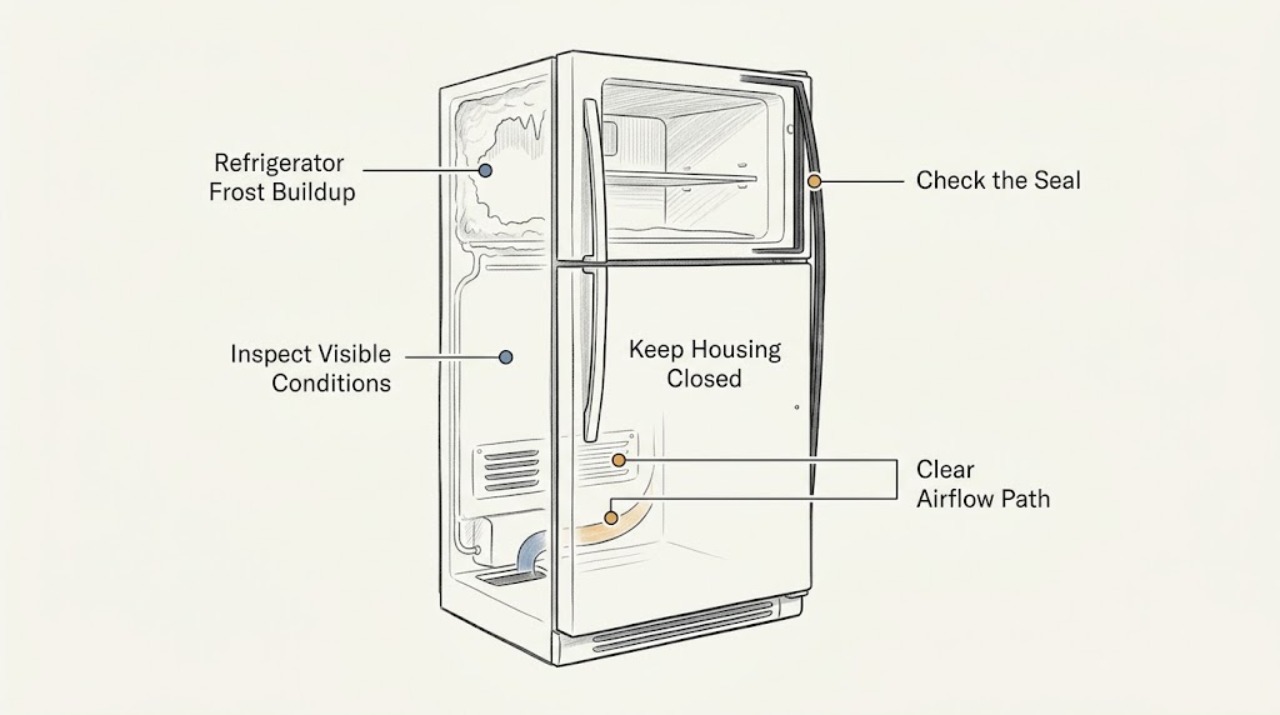
For frost buildup in a Liebherr refrigerator or freezer, first check that the door closes fully and the gasket is clean and continuous. Then look for food packages blocking the door or airflow and confirm that rear-wall defrost water can drain through its gutter opening. NoFrost models should not accumulate persistent ice; if frost returns after the external checks, contact Liebherr service and do not chip ice with a sharp tool.
Before you begin
Safety first
- Do not chip ice with sharp tools, remove panels, or alter sealed refrigeration components.
Work through in order
Diagnostic checks
Use only checks that match the exact appliance or system and its official guide.
-
Check 1
Close the door and inspect the gasket around the complete perimeter for dirt, folds, tears, or a section that does not contact the cabinet. Clean it with water and a little dish soap, then dry it.
Expected result: The seal has dirt or a gap, or it is clean and contacts evenly.
Next step: Recheck closure after cleaning. Do not glue, cut, or heat the gasket as a repair.
Why this matters
Why: A contaminated or distorted seal can admit humid air; an even seal shifts the diagnosis to loading, drainage, or a defrost-system issue.
-
Check 2
Inspect shelves, drawers, and door bins for a package holding the door open or blocking the cold-air path. Leave food clear of the rear wall and vents.
Expected result: A package prevents full closure or food is packed against a cold wall, or the load has clear space.
Next step: Reposition the item and observe whether new frost returns in the same location.
Why this matters
Why: The door and airflow obstruction can add moisture or create a local freezing point; clear space makes those causes less likely.
-
Check 3
Look at the rear-wall defrost gutter and its drain opening for visible food residue or blockage. Clean only the accessible opening using the model instructions; do not puncture hidden channels.
Expected result: Water droplets cannot drain through the opening, or the gutter is visibly clear.
Next step: Clear only accessible residue and monitor. If frost returns or the drain is inaccessible, request service.
Why this matters
Why: Liebherr says rear-wall defrost water should drain unhindered; a blocked opening can leave water that later refreezes.
Use your observations
Decision map
Find the observation that best matches what you see, then follow the next safe action.
-
PATH 01Next step
What you see
Frost stops after a dirty seal or door obstruction is corrected
Do this next
Keep the gasket clean and avoid loading against the door or rear wall.
Why this path and its safety boundary
Why it matters: Moisture entering through the closing path was supported.
-
PATH 02Next step
What you see
Water collects at the rear gutter and does not drain
Do this next
Clear only the documented accessible opening; contact service if it remains blocked or refreezes.
Why this path and its safety boundary
Why it matters: A defrost-drain restriction is more likely than normal NoFrost operation.
-
PATH 03Next step
What you see
A NoFrost appliance rebuilds ice after seal, load, and drain checks
Do this next
Contact Liebherr service and do not remove panels or chip hidden ice.
Why this path and its safety boundary
Why it matters: Persistent frost is outside expected NoFrost behavior and may involve an internal airflow or defrost fault.
Helpful context
Understand the symptom
Persistent frost is an air-and-moisture clue
Liebherr explains that defrost droplets normally drain through the rear-wall gutter, while NoFrost uses circulating air to remove humidity. A repeat frost pattern therefore calls for door, storage, and drainage observations rather than repeated scraping.
When checks do not resolve it
Need a professional?
Keep the appliance in service only for safe external checks; arrange support for recurrent frost or internal defrost/airflow symptoms.
Safety scope: Do not chip ice with sharp tools, remove panels, or alter sealed refrigeration components.
Have this ready
- Provide the model, frost location, seal condition, door obstruction, drain observation, and whether the appliance is NoFrost.
Common questions
FAQ
Should a Liebherr NoFrost refrigerator have persistent frost?
Liebherr describes NoFrost as preventing unwanted frost and ice buildup. Persistent frost after door, loading, and drainage checks deserves service rather than repeated scraping.
Where does defrost water go in a Liebherr refrigerator?
Liebherr says droplets on the rear wall are channeled through the defrost-water gutter to the evaporation tray. Keep the gutter opening unobstructed according to the model instructions.
Read the exact guide
Official sources
- Service and support from LiebherrLiebherr · Liebherr refrigerator customer service
- FAQs – frequently asked questions about Liebherr refrigerators & freezersLiebherr · Liebherr defrost-water drainage, door seals, and temperature guidance
- NoFrost – perfect convenience and lasting freshnessLiebherr · Liebherr NoFrost frost-prevention and service guidance
Community feedback
Share a repair observation
Share a plain-text repair observation. Accepted observations are published automatically; this page may take a moment to update.