
On this page
Start here
Quick answer
For a Liebherr refrigerator that will not dispense water, first identify whether it uses a reservoir or a plumbed water line, then check the visible tank, filter, hose, and dispenser area without removing panels. Liebherr documents blocked filters and air left in a newly installed water line as possible causes. A leak, damaged connection, or a full tank with no flow after the permitted checks needs qualified service.
Before you begin
Safety first
- Do not remove panels, disconnect a pressurized hose, or probe water-valve wiring. Close the water supply if safe when a leak appears.
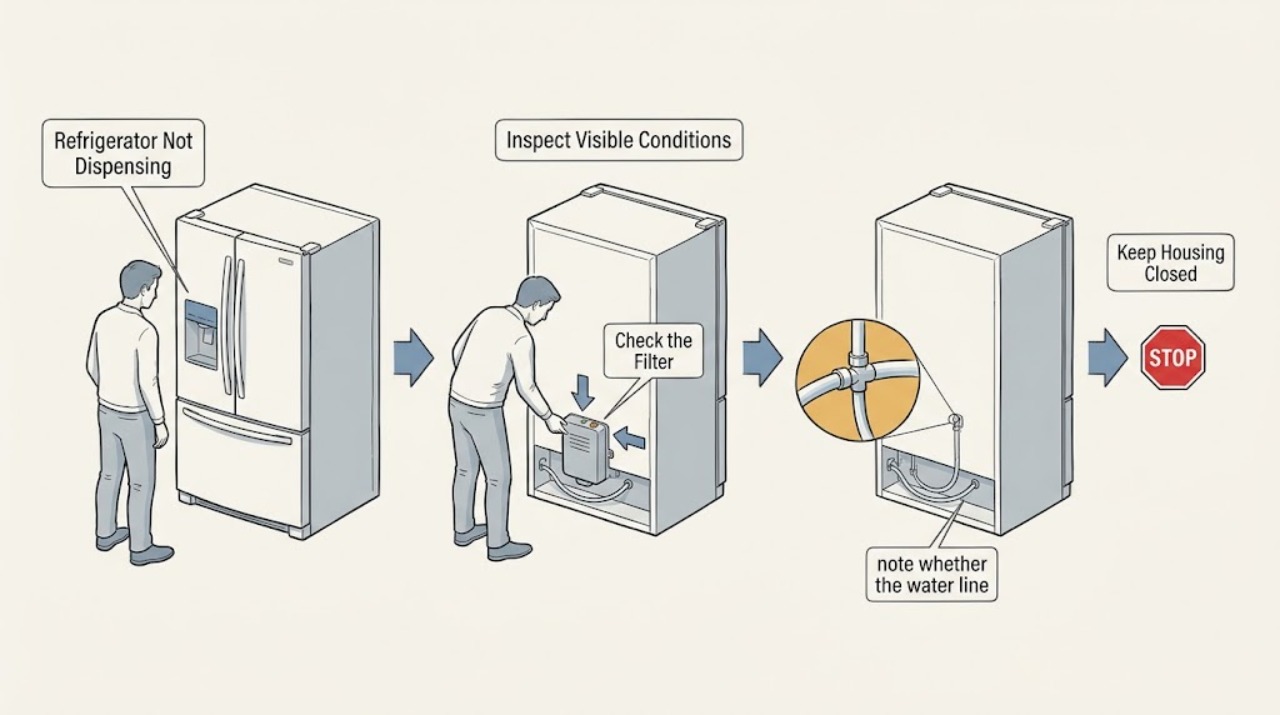
Work through in order
Diagnostic checks
Use only checks that match the exact appliance or system and its official guide.
-
Check 1
Check the exact dispenser arrangement from the front: look for an empty or misseated internal water tank, or for a visible supply hose and filter connection on a plumbed model.
Expected result: A tank is empty or not seated, or the model has a supply line and filter instead.
Next step: Refill and reseat only a user-removable tank as the manual permits; do not loosen a water-line fitting.
Why this matters
Why: A reservoir model needs water and correct seating; a plumbed model depends on the supply path and filter rather than a tank refill.
-
Check 2
For a plumbed model, inspect the accessible filter and hose connection for a visible kink, obvious blockage, or a connection leak without disconnecting the line under pressure.
Expected result: The filter area appears blocked, the hose is kinked, or the connection is dry and clear.
Next step: Follow the exact model instructions for a user-accessible filter check; shut off the supply and seek service for a leak or damaged fitting.
Why this matters
Why: Liebherr identifies a blocked filter at the hose or machine connection as a no-flow cause; a kink can also prevent delivery, while a leak is a stop condition.
-
Check 3
If the dispenser was installed or reconnected recently, note whether the water line was bled according to the installation instructions and whether the appliance has ever dispensed normally.
Expected result: The line was newly installed and contains air, or dispensing previously worked and then stopped.
Next step: Have a qualified installer verify the water-line installation; do not improvise a purge or open the appliance.
Why this matters
Why: Liebherr warns that unbled air can prevent an installation from working; a later failure shifts attention to filter, supply, or dispenser service.
-
Check 4
Make one brief dispenser request while holding the correct user control and listen for flow or pump activity, stopping immediately if water appears outside the intended outlet.
Expected result: Water flows normally, only a small amount flows, there is no response, or water leaks from the connection or cabinet.
Next step: Stop repeated requests, dry the area, close the water supply if safe, and arrange service for restricted flow, no response, or leakage.
Why this matters
Why: Normal flow ends the no-flow diagnosis; restricted or absent flow after the visible checks needs model-specific testing, while a leak requires an immediate stop.
Use your observations
Decision map
Find the observation that best matches what you see, then follow the next safe action.
-
PATH 01Next step
What you see
A reservoir is empty or not seated and dispensing returns after the permitted correction
Do this next
Keep the tank seated and follow the model's filling and cleaning instructions.
Why this path and its safety boundary
Why it matters: The water path was interrupted at the user-accessible tank.
-
PATH 02Next step
What you see
A plumbed model has a blocked filter or newly installed line with air
Do this next
Use only the model-approved filter or installation procedure and use a qualified installer for line work.
Why this path and its safety boundary
Why it matters: The supply path, not the dispenser control, is the leading explanation.
-
PATH 03Next step
What you see
The tank is full or the supply is present but there is no flow, a leak, or cabinet moisture
Do this next
Stop use, isolate water if safe, and request qualified appliance service.
Why this path and its safety boundary
Why it matters: A dispenser, valve, filter housing, or connection fault cannot be safely identified from outside.
Helpful context
Understand the symptom
Identify the water path before testing
Some Liebherr models use a water tank and others connect to a supply line. The same no-flow symptom therefore has different first checks. Use only the tank, filter, hose, and controls that the exact model exposes to the user.
Only after diagnosis
Potential parts
- water filter
Consider only when the exact model's instructions identify the filter as user-replaceable and the visible supply check supports restriction.
Confirm the appliance designation and filter specification before ordering.
When checks do not resolve it
Need a professional?
Arrange qualified Liebherr service for persistent no-flow, a leaking connection, or a dispenser that does not respond after the safe external checks.
Safety scope: Do not remove panels, disconnect a pressurized hose, or probe water-valve wiring. Close the water supply if safe when a leak appears.
Have this ready
- Provide the model identity, tank or plumbed configuration, filter history, installation timing, and whether the dispenser makes any sound or leaks.
Common questions
FAQ
Why does a new Liebherr dispenser have no water?
Liebherr notes that air may remain in a newly installed water line. Have the installation checked against the model instructions rather than opening the appliance.
Can I disconnect the refrigerator water hose to test it?
Do not loosen a pressurized connection as a troubleshooting step. Stop for leaks and use a qualified installer or service technician.
Read the exact guide
Official sources
- TroubleshootingLiebherr-Hausgeräte · Liebherr refrigerator water supply, filter, air in line, and service guidance
Community feedback
Share a repair observation
Share a plain-text repair observation. Accepted observations are published automatically; this page may take a moment to update.