
On this page
Start here
Quick answer
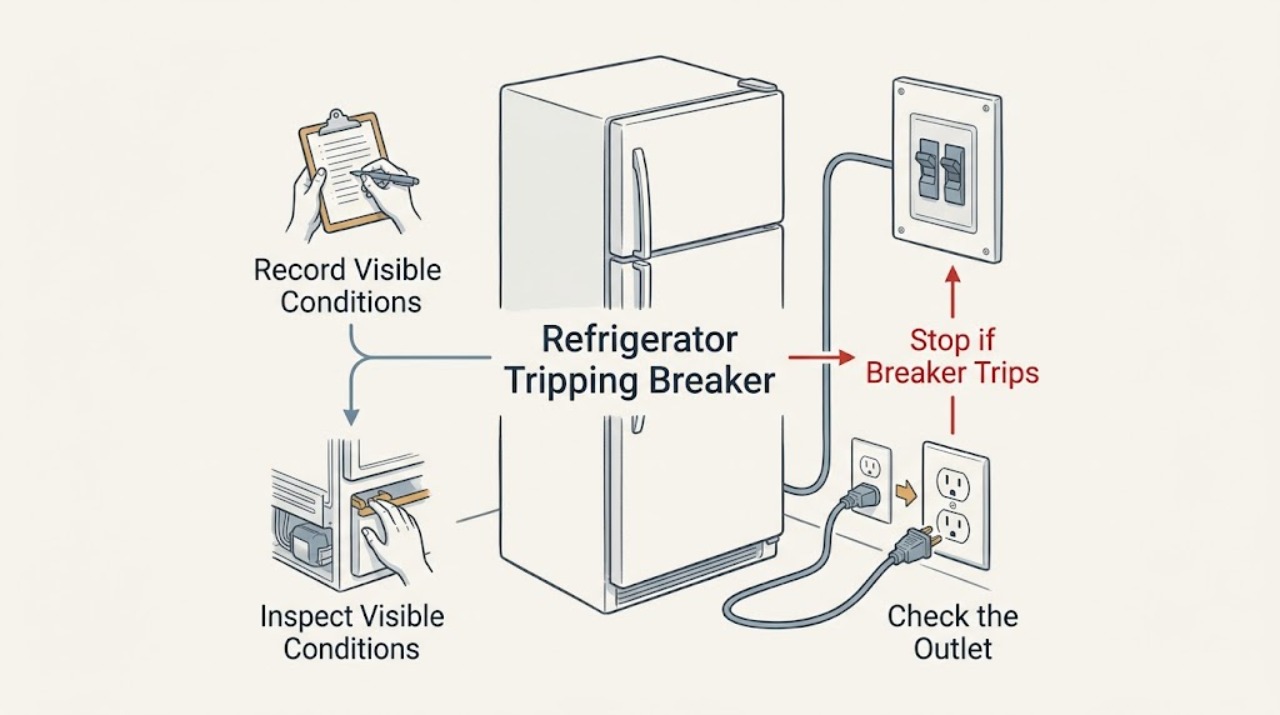
If a Liebherr refrigerator trips a breaker, stop treating the event as a normal restart. Note whether it trips immediately, after the compressor starts, or only when another load is on the circuit; inspect the plug and cord from outside for damage or heat. A repeat trip, burning smell, water near electricity, or a damaged cord means leave the refrigerator disconnected if safe and call a qualified electrician or appliance technician.
Before you begin
Safety first
- Do not bypass the breaker, open the appliance, probe mains parts, or use an extension cord as a workaround.
Work through in order
Diagnostic checks
Use only checks that match the exact appliance or system and its official guide.
-
Check 1
Leave the breaker and refrigerator controls alone long enough to record whether the trip happened on connection, when cooling started, or after the appliance had been running.
Expected result: The breaker trips immediately, only at start-up, or after an otherwise normal run.
Next step: Do not repeat the event as a test; continue only with a visual inspection when power is isolated safely.
Why this matters
Why: Timing separates an immediate connection or insulation concern from a start-up or heat-related event, but does not prove a specific component.
-
Check 2
With power isolated and without moving the appliance, look at the accessible plug and cord for cuts, crushed sections, discoloration, moisture, or heat damage.
Expected result: The connection is intact and dry, or any damage, heat, or moisture is visible.
Next step: Keep it disconnected and request qualified help for any damage or moisture; do not repair the cord yourself.
Why this matters
Why: A damaged or wet connection is an immediate safety concern; an intact exterior does not clear the appliance's internal circuit.
-
Check 3
Check whether other high-load appliances share the same outlet or circuit, without changing wiring or using an extension cord as a workaround.
Expected result: The trip occurs only when another load is present, or the refrigerator trips the circuit by itself.
Next step: Have a qualified electrician assess the circuit; never bypass the protective device or use an extension cord to continue operation.
Why this matters
Why: A shared-load trip points to circuit capacity or supply conditions; a refrigerator-only repeat trip keeps the appliance or its cord under suspicion.
-
Check 4
If a qualified person restores power after the external inspection, observe one normal start from a safe distance and stop immediately for another trip, odor, smoke, or unusual heat.
Expected result: The breaker holds, trips again, or a hazard sign appears.
Next step: Leave the refrigerator off after a repeat and arrange electrical or appliance service with the timing record.
Why this matters
Why: A single stable recovery does not prove the cause; any recurrence or hazard confirms that more testing is unsafe.
Use your observations
Decision map
Find the observation that best matches what you see, then follow the next safe action.
-
PATH 01Next step
What you see
The circuit trips only with another high-load appliance connected
Do this next
Use a qualified electrician to assess the circuit and do not add an extension cord.
Why this path and its safety boundary
Why it matters: The shared supply is a leading possibility rather than a proven refrigerator fault.
-
PATH 02Next step
What you see
The refrigerator trips immediately or at every start with the circuit otherwise clear
Do this next
Keep it disconnected and provide the timing to service.
Why this path and its safety boundary
Why it matters: The appliance, plug, cord, or circuit needs qualified diagnosis.
-
PATH 03Next step
What you see
A repeat trip occurs or there is heat, moisture, smoke, or burning odor
Do this next
Do not reset again; arrange qualified electrical or appliance service.
Why this path and its safety boundary
Why it matters: This is an electrical safety event, not a normal operating noise or reset problem.
Helpful context
Understand the symptom
A breaker trip is a stop signal
A refrigerator can be quiet during a normal cycle, but a protective device that opens is different from a normal compressor click. The useful evidence is timing, recurrence, and visible damage; do not identify a failed part by repeatedly resetting power.
When checks do not resolve it
Need a professional?
Arrange qualified diagnosis after the first protective-device trip unless the cause is clearly an unrelated circuit load; stop entirely after any recurrence.
Safety scope: Do not bypass the breaker, open the appliance, probe mains parts, or use an extension cord as a workaround.
Have this ready
- Provide the trip timing, other loads on the circuit, plug and cord condition, and any odor, moisture, heat, or smoke.
Common questions
FAQ
Can I reset the Liebherr refrigerator breaker to see if it works?
Only a qualified person should decide whether a single safe restoration is appropriate. Do not repeatedly reset a breaker; a repeat trip is a stop condition.
Should I use an extension cord after a refrigerator trip?
No. Treat the circuit event as unresolved and have the supply or appliance checked by a qualified professional.
Read the exact guide
Official sources
- MalfunctionLiebherr-Hausgeräte · Liebherr refrigerator power plug, fuse, no-operation checks, and trained service boundary
Community feedback
Share a repair observation
Share a plain-text repair observation. Accepted observations are published automatically; this page may take a moment to update.