
On this page
Start here
Quick answer
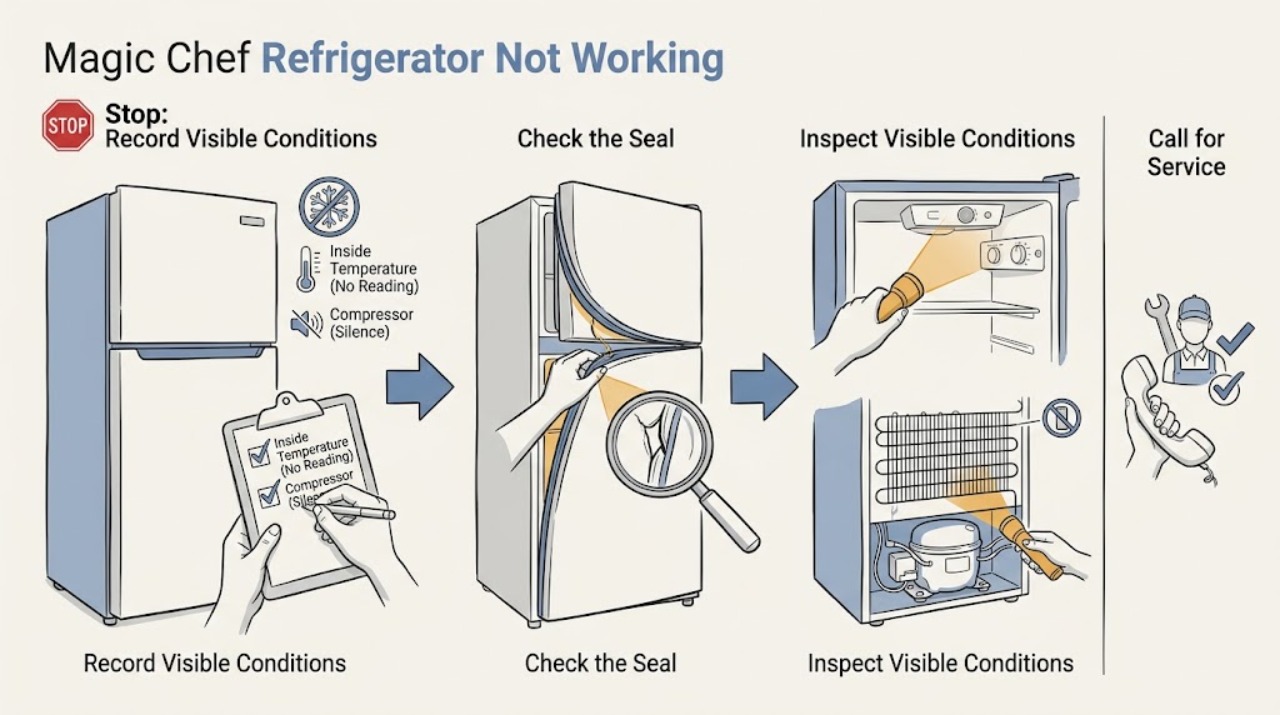
“Not working” can mean no power, no cooling, no ice, or a door or dispenser problem on a Magic Chef refrigerator. Start by naming the failed function, protect perishable food, and check only the matching controls, airflow, seals, and accessible supply conditions. A broad symptom that persists, or any smoke, burning odor, water near electricity, or repeated trip, needs qualified service rather than a guessed part.
Work through in order
Diagnostic checks
Use only checks that match the exact appliance or system and its official guide.
-
Check 1
Write down which function failed: interior light/control response, cooling temperature, ice production, dispensing, or door closure, and whether the problem began after a move or power interruption.
Expected result: Only one function is affected, or the whole appliance is dark and warm.
Next step: Use the matching check below and keep the doors closed to protect food.
Stop if: If the symptom is unclear, observe it again without changing several settings.
Why this matters
Why: A single-function symptom points to a narrower path; a dark and warm cabinet points first to supply or control.
-
Check 2
Check the temperature control, plug, door closure, and visible gasket condition from a dry safe position; do not remove panels.
Expected result: The control is off, the plug is loose, the door is obstructed, or the gasket has a visible gap.
Next step: Correct the accessible condition according to the manual and reassess one symptom at a time.
Stop if: Continue to the temperature and airflow clues.
Why this matters
Why: An operating setting, supply connection, or warm-air leak can make the refrigerator appear generally nonfunctional.
-
Check 3
Compare the refrigerator compartment with the freezer, if equipped, and look for blocked air passages, a heavy recent load, or frost around the air route.
Expected result: The freezer is cold while the refrigerator is warm, or frost and stored items restrict circulation.
Next step: Clear safe obstructions and use the model's defrost instructions; never chip ice with a sharp tool.
Stop if: Both compartments warm after basic checks require service-level diagnosis.
Why this matters
Why: Air distribution or frost is more likely than a complete loss of refrigeration.
-
Check 4
Observe the appliance for abnormal clicking, smoke, burning odor, cord heat, water at electrical parts, or a breaker that trips when it runs.
Expected result: Any electrical warning or repeated trip is present.
Next step: Stop using the refrigerator and arrange qualified electrical or appliance service; isolate power only when safe.
Stop if: If one non-safety symptom remains, give the service technician the exact function and observation pattern.
Why this matters
Why: A safety hazard overrides ordinary troubleshooting.
Use your observations
Decision map
Find the observation that best matches what you see, then follow the next safe action.
-
PATH 01Next step
What you see
The cabinet is dark and the breaker or plug condition is abnormal
Do this next
Perform one safe check and stop for qualified service if power does not remain stable.
-
PATH 02Next step
What you see
The cabinet has power but only cooling is affected
Do this next
Use the freezer/airflow pattern and arrange service if safe checks do not restore temperature.
-
PATH 03Next step
What you see
Only ice, dispensing, or door behavior is affected while temperatures are normal
Do this next
Use that feature's accessible checks and do not replace a general cooling part by assumption.
Helpful context
Understand the symptom
Turn a broad complaint into a useful symptom
Check the light and controls first, then separate temperature, ice, dispenser, and door symptoms. This prevents replacing a cooling component when the actual issue is a setting, blocked path, or electrical supply.
When checks do not resolve it
Need a professional?
Use qualified service for an unresolved multi-symptom or safety-related failure.
Common questions
FAQ
What should I check first when a refrigerator is ‘not working’?
Identify whether the light, cooling, ice, dispenser, or door function failed. Then check the matching control, power, seal, or accessible path instead of changing a part at random.
When is ‘not working’ an emergency?
Smoke, burning odor, heat or damage at the cord, water near electrical parts, or a repeat breaker trip is an electrical warning. Stop using the appliance and seek qualified service.
Read the exact guide
Official sources
- 17.6 cu. ft. Top-Mount Refrigerator in BlackMagic Chef · Magic Chef refrigerator feature and compartment context
- 4.5 CU.FT. REFRIGERATOR INSTRUCTION MANUALMC Appliance / Magic Chef · Magic Chef refrigerator operation, temperature control, maintenance, and safety
Community feedback
Share a repair observation
Share a plain-text repair observation. Accepted observations are published automatically; this page may take a moment to update.