
On this page
Start here
Quick answer
Treat a Magic Chef wine cooler that trips the breaker as an electrical safety symptom. Note whether the trip occurs when the plug is inserted, when cooling starts, or after running; inspect only the accessible cord and plug; and avoid extension cords or repeated resets. If the receptacle, cord, plug, or cooler is hot, wet, damaged, smoking, or trips again, disconnect it if safe and arrange qualified electrical or appliance service.
Before you begin
Safety first
- Never bypass the breaker, use a larger fuse, defeat grounding, or run the cooler through an extension cord to suppress trips.
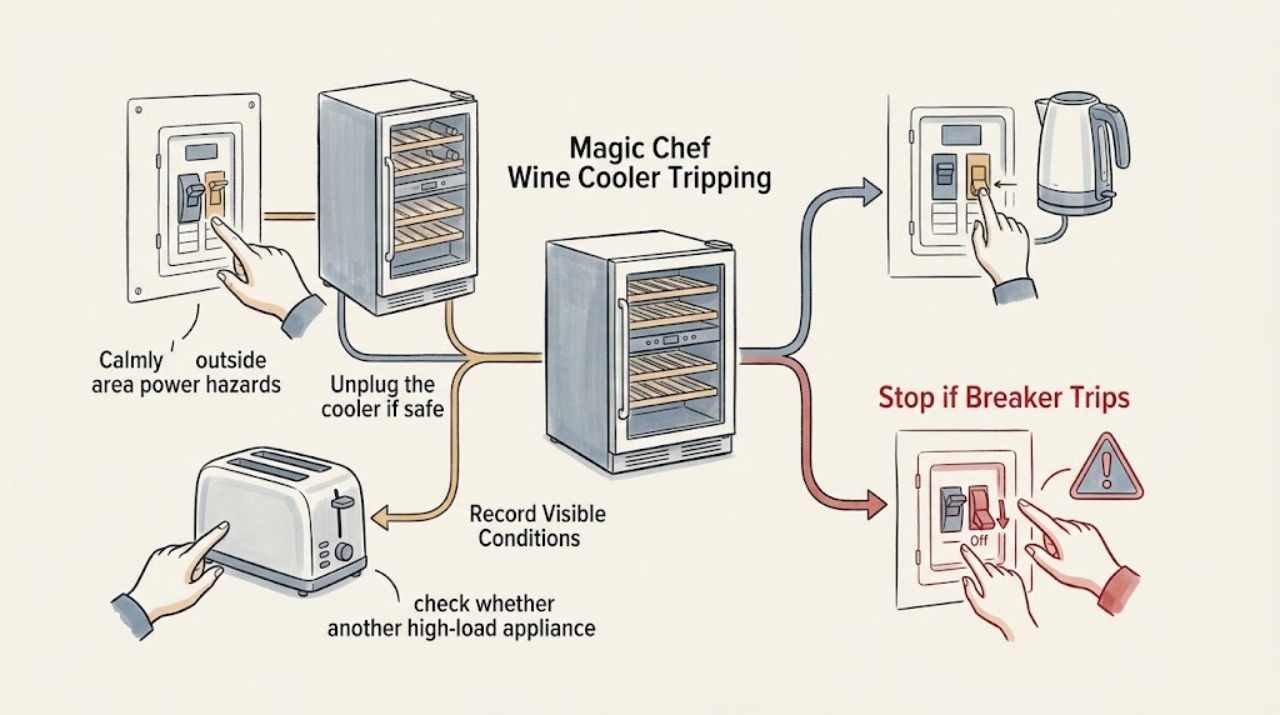
Work through in order
Diagnostic checks
Use only checks that match the exact appliance or system and its official guide.
-
Check 1
Unplug the cooler if safe and inspect the plug, cord, receptacle face, and nearby floor for scorching, melted plastic, moisture, or a loose connection.
Expected result: There is visible heat or damage, moisture, or no visible damage.
Next step: Keep the unit disconnected and use a qualified electrician or appliance technician when damage, moisture, or heat is present. Do not touch wet electrical parts.
Why this matters
Why: Damage or moisture makes another energizing attempt unsafe; an undamaged exterior still does not rule out an internal fault.
-
Check 2
Record when the breaker trips: immediately at plug-in, when the display or fan starts, when the compressor cycle begins, or only after prolonged operation.
Expected result: The trip is immediate, tied to a start event, or delayed and repeatable.
Next step: Write down the model and timing for service. Do not keep reconnecting the unit to reproduce the event.
Why this matters
Why: The timing distinguishes a connection/supply concern from a motor or appliance-load symptom, but it cannot identify a failed part without model-specific testing.
-
Check 3
If the receptacle and cord are cool and dry, check whether another high-load appliance shares the circuit without changing wiring or using an extension cord.
Expected result: The circuit is shared or the cooler has a dedicated suitable receptacle.
Next step: Have the circuit capacity and appliance checked by a qualified person. Do not replace a breaker with a larger rating.
Why this matters
Why: A shared or overloaded circuit can contribute to trips; a dedicated circuit with repeat trips points more strongly to the appliance or receptacle.
Use your observations
Decision map
Find the observation that best matches what you see, then follow the next safe action.
-
PATH 01Next step
What you see
The breaker trips immediately and the plug, cord, or receptacle is hot, damaged, or wet
Do this next
Do not energize it again. Keep people away from the area and obtain qualified electrical service.
-
PATH 02Next step
What you see
The exterior is intact but the breaker trips at a repeatable cooling-start point
Do this next
Leave the cooler unplugged and provide the trip timing and model number to a qualified appliance technician.
Helpful context
Understand the symptom
The timing of the trip is useful evidence
A trip at connection suggests a supply, cord, or input fault; a delayed trip can occur when a motor or cooling load starts. Timing narrows the handoff information but does not make opening the cooler safe.
When checks do not resolve it
Need a professional?
Give the electrician or technician the outlet type, trip timing, model number, and any signs of heat or moisture.
Safety scope: Never bypass the breaker, use a larger fuse, defeat grounding, or run the cooler through an extension cord to suppress trips.
Common questions
FAQ
Can I reset the breaker once to see whether the cooler works?
Only if the area is dry and there is no visible damage, heat, or odor, and only as a single safe check. If it trips again, leave the cooler disconnected and call for service.
Does a breaker trip prove the compressor failed?
No. The trip may involve the receptacle, circuit, cord, control, starting load, or another internal fault. Timing helps the technician but does not identify a part by itself.
Read the exact guide
Official sources
- 24 in. Dual Zone Wine & Beverage Center in StainlessMagic Chef · Magic Chef wine-and-beverage center product identity and electronic control system
- Manual DownloadsMagic Chef · Model-specific installation, electrical, and service instructions
Community feedback
Share a repair observation
Share a plain-text repair observation. Accepted observations are published automatically; this page may take a moment to update.