
On this page
Start here
Quick answer
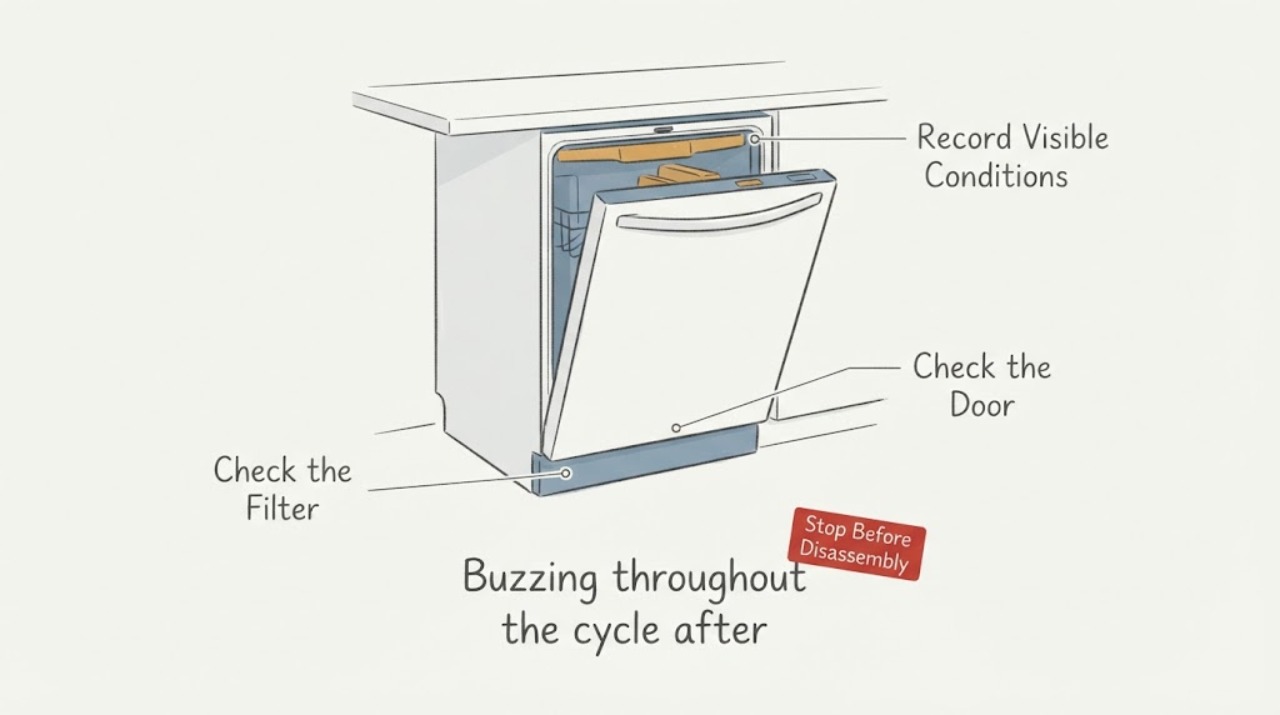
A new Maytag MDB4949SKZ can make different sounds at different stages: Maytag describes a gentle fill hum or whoosh, wash-phase swishing, and a soft drain-pump hum as normal possibilities. A buzz that is present throughout the cycle, changes the cabinet or toe-kick by vibration, or is accompanied by leaking, poor draining, grinding or a cycle that stops should be documented and sent back to the installer or Maytag service before any part is selected. First identify whether the sound follows fill, wash, drain or drying, then check only the visible load and installation conditions. Do not run repeated empty tests, remove the pump or base, or replace a pump based on sound alone.
Work through in order
Diagnostic checks
Use only checks that match the exact appliance or system and its official guide.
-
Check 1
During one normal, loaded cycle that is already needed, note the exact phase when the buzz is heard: initial fill, wash/spray, drain, heated dry or after completion. Record whether it is a steady electrical-sounding buzz, a water hum, a brief click, a gurgle, or a harsh grinding/scraping sound; do not create repeated empty cycles just to listen.
Expected result: The sound is brief and phase-linked, continues through every phase, occurs only after the clean light, or is harsh and accompanied by poor cleaning, standing water, leaking or a cycle stop.
Next step: Save the phase and symptom notes. Continue only if the sound is soft, phase-linked and the dishwasher completes without a leak or performance issue; otherwise stop the cycle and contact the installer or Maytag service.
Why this matters
Why: Maytag describes a gentle fill hum or whoosh, rhythmic wash swishing, a soft drain-pump hum and a brief gurgle as normal phase-related possibilities. A phase-independent or harsh buzz is not identified by that guidance as a specific failed part and needs a different service boundary.
-
Check 2
With the dishwasher off and cool, check only the visible rack loading: secure light cups, lids and utensils, keep large cookware from touching the tub or spray arms, and verify that no rack item is rubbing the door or toe kick. Do not reach under the filter or into the pump area to investigate a sound.
Expected result: The buzz or vibration changes after a lightweight item is secured or a rack is rearranged, or it remains with a stable load and clear spray-arm path.
Next step: Keep the load arranged so items cannot move or contact the spray arms. If the buzz remains with a stable load or the sound is harsh, do not keep testing it; arrange service.
Why this matters
Why: Maytag says load size and item type can create rattles, vibration and reflected spray noise. A load-related change makes a loose item more likely and does not support replacing a motor or pump; an unchanged buzz keeps installation and internal service possibilities open.
-
Check 3
Inspect the installation from the front and sides without pulling the dishwasher out: check whether the unit rocks, the door or toe kick touches surrounding cabinetry, the cabinet vibrates during operation, or the visible mounting/insulation and toe-kick pieces appear missing or displaced. Do not remove the toe kick, loosen mounting screws or work on wiring while powered.
Expected result: The dishwasher is not level or firmly supported, the door/tub/cabinet transmits vibration, the toe kick or insulation is not seated, or the installation appears stable while the full-cycle buzz continues.
Next step: Photograph the visible installation condition and ask the original installer to correct leveling, support, mounting or contact issues. If the installation looks stable but the buzz remains, request model-specific service rather than moving the appliance or opening it yourself.
Why this matters
Why: Maytag states that an unlevel or unsecured dishwasher can transmit vibration to the cabinetry and make normal sounds louder; it also calls out leveling legs, mounting brackets, insulation and the toe kick. Because this unit is newly installed, an installation issue is a higher-priority first check than selecting a pump from the sound.
-
Check 4
At the sink and floor, check for visible water at the dishwasher front, under-sink connections or drain area, and note whether the tub has standing water after the normal cycle. Look only at accessible hose routing for a sharp kink or obvious crush; do not disconnect a water or drain hose, remove the filter assembly, or open the base.
Expected result: The dishwasher completes with no water or leak and the buzz is phase-linked, or there is standing water, a leak, a drain problem, a new hose-routing issue or a buzz with no expected water movement.
Next step: If water is leaking, standing in the tub or near electrical parts, turn off the appliance and the accessible water supply if safe, protect the floor and arrange service. Do not run another cycle to see whether the pump clears it.
Why this matters
Why: A soft hum can be associated with a drain pump, but a hum with no expected draining, a leak or a stopped cycle is not safely identified from outside. Maytag's MDB4949SKZ product page also says its leak-identification system can stop filling, drain the tub and alert for service, while not detecting every inlet, hose or door leak.
-
Check 5
Prepare a concise installer/service handoff: exact model, installation date, cycle and option selected, sound phase and character, whether the load changed it, visible leveling or cabinet-contact findings, completion/drain result and any leak or error indication. Ask for a written finding before authorizing a pump, motor, valve or control replacement.
Expected result: The installer can reproduce or hear the buzz and confirms an installation issue, the sound is documented as a normal phase-linked hum, or the installer cannot explain a continuous or harsh buzz and the dishwasher has an operating symptom.
Next step: Use the installer or Maytag service route with the evidence packet. Keep the dishwasher out of service when the sound is harsh, continuous with poor operation or associated with water/electrical risk; do not diagnose by swapping parts.
Why this matters
Why: A new installation creates a clear responsibility and warranty trail. Maytag's official product and help pages provide model-specific literature/service routing, but neither says that a buzz alone identifies a particular replacement part.
Use your observations
Decision map
Find the observation that best matches what you see, then follow the next safe action.
-
PATH 01Next step
What you see
The buzz is a soft, phase-linked hum or water sound, the dishwasher completes, drains and does not leak, and the sound changes with normal loading or cabinet placement.
Do this next
Monitor for a change in sound or performance, keep the load secure and have the installer correct any visible vibration without opening the machine.
Why this path and its safety boundary
Why it matters: The observation is consistent with Maytag's documented operating sounds or installation-amplified normal sound; it does not justify a replacement part.
-
PATH 02Next step
What you see
The buzz is present from fill through wash and drain, does not change with a stable load, or sounds harsh, grinding, scraping or electrically abnormal.
Do this next
Stop using the dishwasher and ask the installer or qualified Maytag service to inspect it. Do not run repeated empty tests, remove the pump or replace a component by sound.
Why this path and its safety boundary
Why it matters: The phase-independent or harsh result is not explained by Maytag's normal soft-sound examples and cannot be mapped to a pump or motor from listening alone.
-
PATH 03Next step
What you see
The dishwasher rocks, vibrates against cabinetry, has a missing/displaced toe kick or insulation, or the door/tub is not square in the opening.
Do this next
Have the installer correct leveling, mounting, support and cabinet contact; do not pull the dishwasher out or loosen internal parts yourself.
Why this path and its safety boundary
Why it matters: Installation alignment or support can be amplifying normal operating noise, which is especially relevant on a newly installed machine.
-
PATH 04Next step
What you see
The buzz is accompanied by standing water, a visible leak, an error/alert, poor cleaning or a cycle that stops.
Do this next
Turn the dishwasher off, isolate water if safe, protect the floor and arrange service. Do not disconnect hoses, open the base or run another cycle to test the pump.
Why this path and its safety boundary
Why it matters: The sound is now part of an operating or water event, not an isolated acoustic question. Maytag's product page says the leak-identification system can stop filling, drain and alert for service, but it does not cover every hose or inlet leak.
-
PATH 05Next step
What you see
The noise is absent or acceptable after the installer corrects a visible installation issue, and the dishwasher completes normal cycles without leaks or poor performance.
Do this next
Keep the install documentation and monitor normal cycles. Request service if the original continuous buzz returns or a performance symptom appears.
Why this path and its safety boundary
Why it matters: The installation condition plausibly contributed to the perceived buzz; no part replacement is supported by this result.
-
PATH 06Next step
What you see
There is smoke, a burning smell, exposed or wet wiring, repeated breaker tripping, a hot electrical odor, or another immediate hazard.
Do this next
Stop using the dishwasher and isolate power only if it can be done without touching water or damaged wiring; keep clear and obtain qualified or emergency help.
Why this path and its safety boundary
Why it matters: This is an electrical or fire-safety stop condition beyond a normal-sound check.
Helpful context
Understand the symptom
This is a new-installation sound question, so the first service path is the installer and the model's warranty/support route. Confirm that the label reads MDB4949SKZ before using model literature. Maytag's product page identifies this model as a front-control dishwasher rated at 50 dBA; that rating is a design specification, not a promise that every kitchen will perceive the same loudness.
A soft hum is not automatically a failed pump. Maytag's cycle guidance describes fill and wash water sounds, a drain-pump hum and occasional gurgle, while also noting that cabinet placement and installation can make normal sounds more noticeable. The useful distinction is when the buzz occurs, whether it is tied to water movement, and whether the new installation adds cabinet vibration or an operating problem.
Do not run the dishwasher empty over and over to chase the noise. If there is a leak, burning odor, smoke, grinding, exposed wiring, a tripped breaker or a cycle that stops, switch it off and arrange service. Do not remove the pump, base, toe-kick wiring or other internal parts yourself.
When checks do not resolve it
Need a professional?
Use the installer or qualified Maytag service for a new MDB4949SKZ that buzzes continuously or harshly, remains noisy with a stable load and sound installation, leaks, leaves standing water, stops a cycle, cleans or drains poorly, or needs leveling, mounting, toe-kick, pump, wiring or internal inspection. Stop immediately for smoke, burning odor, exposed or wet wiring, repeated breaker trips or water near electrical parts. Do not run repeated empty tests, remove the pump or base, disconnect hoses, access wiring or replace a part based on sound alone.
Common questions
FAQ
Is a buzzing Maytag dishwasher always a bad pump?
No. Maytag describes a soft hum during operation when the drain pump runs, as well as other phase-related sounds. A continuous or harsh buzz, or a buzz with draining, leaking or cycle problems, needs service diagnosis rather than a pump purchase.
Why is a new dishwasher louder after installation?
Maytag says installation affects how much sound is heard and that an unlevel or unsecured unit can transmit vibration to the cabinetry. Ask the installer to check leveling, mounting, cabinet contact, insulation and the toe kick before considering an internal component.
Should I run the MDB4949SKZ empty several times to locate the buzz?
No. Use the sound and phase from one normal cycle if it can be observed safely. Repeated empty tests add wear without proving a part; stop for harsh noise, leaks, standing water, smoke, burning odor or a cycle that stops.
Read the exact guide
Official sources
- Humming - DishwasherMaytag Product Help · Opened Maytag's official humming article. It says a humming noise during operation can be the drain pump and that some models can hum after completion because a fan runs for drying.
- Squeaking - DishwasherMaytag Product Help · Opened Maytag's official noise article. It says the dishwasher should be level, supported by leveling legs and rear wheels, flat on the floor and square in the cabinet; installation fit can affect door and cabinet contact.
- VIDEO: Normal Dishwasher Noises - Newly Installed DishwashersMaytag Product Help · Opened Maytag's official newly installed dishwasher noise page. It points owners to common sounds on the first run and to model-specific manuals and literature.
- Normal Dishwasher Sounds and NoiseMaytag Product Help · Opened Maytag's official sound guide. It maps fill, wash, drain and drying sounds to common cycle phases, discusses load-related vibration and explains how leveling, mounting, insulation and the toe kick affect perceived sound.
- 24” Front Control Dishwasher with Dual Power Filtration and PowerBlast® Cycle - 50 dBA Fingerprint Resistant Stainless Steel MDB4949SKZMaytag · Opened the official Maytag product page for MDB4949SKZ. It identifies the exact model, 50 dBA rating, front-control design and leak-identification behavior, and routes owners to model literature and service.
Community feedback
Share a repair observation
Share a plain-text repair observation. Accepted observations are published automatically; this page may take a moment to update.