
On this page
Start here
Quick answer
A GE dishwasher can hum normally while the wash motor, cooling fan, food disposer, or drain pump is operating, and the sound can start and stop as the cycle changes. First note whether the buzz occurs during filling, washing, draining, or drying and whether the dishwasher otherwise fills, sprays, drains, and completes the cycle. Stop and inspect only after the cycle is over: secure dishes, check that the visible spray arms can rotate without striking the load, and compare the sound with an empty rack only if the manual permits a test cycle. A hum with no fill, a grinding sound with no water, a new or worsening sound, a sound that continues after the cycle, leaks, burning odor, or failure to complete the cycle needs the exact model manual and qualified service; the sound alone does not identify a failed pump or motor.
Before you begin
Safety first
- Stop use for leaks, burning odor, smoke, arcing, grinding without water, or incomplete operation. Do not open the pump or motor area, remove guards, test live wiring, bypass a safety device, or reach into a running dishwasher.
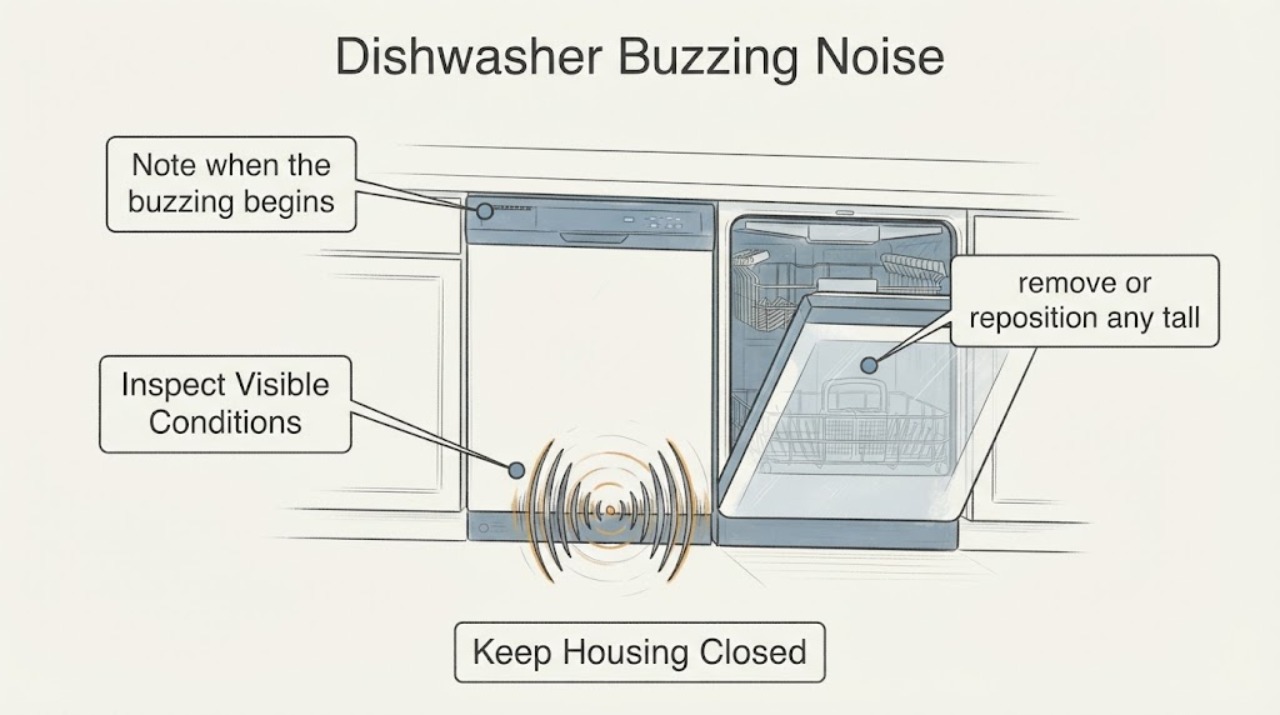
Work through in order
Diagnostic checks
Use only checks that match the exact appliance or system and its official guide.
-
Check 1
Note when the buzzing begins and stops: while filling, during wash or rinse spraying, during a drain, during drying, at a cycle transition, or after the cycle has ended. Also note whether it is on-and-off or continuous.
Expected result: The sound follows a wash/drain phase and stops with that phase, or it continues when no cycle phase should be operating.
Next step: If the sound follows the cycle and the dishwasher performs normally, compare it with the model manual's operating sounds. If it continues after the cycle or becomes louder, stop using the dishwasher and arrange service.
Why this matters
Why: GE Appliances lists humming from normal operating components and says the drain pump may start and stop during draining. A sound that continues outside the cycle cannot be classified as normal from the word buzzing alone.
-
Check 2
Without opening the cabinet or testing live parts, observe whether the dishwasher fills with water, sprays during wash, drains at the expected points, and completes the selected cycle. Stop the cycle if there is a leak, burning smell, smoke, or electrical arcing.
Expected result: The cycle completes normally, or the dishwasher hums while it does not fill, does not drain, stops, leaks, or produces a hazardous smell.
Next step: For no fill, no drain, a stopped cycle, leak, burning odor, smoke, or arcing, turn the dishwasher off, keep it out of service, and use the exact model manual or qualified service. Do not repeatedly restart it to listen for a change.
Why this matters
Why: A normal result makes an operating sound more likely; GE Appliances treats a hum with no fill and grinding with no water as a different troubleshooting pattern. The symptom does not prove a pump, motor, or valve failure.
-
Check 3
After the dishwasher is stopped and safe to open, remove or reposition any tall dish, utensil, or lightweight item that could touch a spray arm or rattle in a rack. Turn a visible spray arm by hand only as the owner manual permits, without forcing it or reaching into a guarded area.
Expected result: The sound disappears after the load is secured or clearance is restored, or it remains with the load clear.
Next step: If the sound changes with loading, follow the model's loading guidance. If it remains, grows louder, or is accompanied by poor washing or a stalled cycle, stop troubleshooting externally and arrange service.
Why this matters
Why: GE Appliances associates rattling or rhythmic knocking with loading and spray-arm contact. If a buzzing remains after the load is clear, loading is not enough evidence to identify the cause.
-
Check 4
If the dishwasher is new or has been unused for a long period, record that context and consult the exact installation instructions before adding anything to the tub. GE Appliances identifies a special first-use or extended-idle squeal/rattle pattern, but that does not convert every buzz into a dry-seal condition.
Expected result: The sound began on first use or after extended storage, or it is present on a regularly used dishwasher.
Next step: Follow only the model-specific installation instructions for the first-use/extended-idle condition. If the sound persists, the unit will not fill, or the instructions do not match, stop and schedule service rather than adding chemicals or opening the pump area.
Why this matters
Why: GE Appliances says some squealing or rattling pump noise can occur when a new dishwasher has no water or after extended non-use, while a valve hum may occur for a limited period during a cycle. The article cannot infer that the assigned buzzing has either cause.
-
Check 5
Collect the complete GE model number, cycle and option selected, when the sound occurs, whether the tub fills and drains, whether the noise changes with the load, and any leak, odor, grinding, or error indication. Use that record when contacting GE service.
Expected result: The buzzing is new, persistent, worsening, present with no fill or drain, or unresolved after the model-authorized load and observation checks.
Next step: Keep the dishwasher off if the sound is persistent or accompanied by a leak, burning odor, smoke, arcing, grinding without water, or incomplete operation. Do not disassemble the pump, motor, disposer, wiring, or safety devices.
Why this matters
Why: GE Appliances directs unresolved abnormal-noise concerns to service. A sound recording and cycle timing are more useful than guessing an internal part from an acoustic description.
Use your observations
Decision map
Find the observation that best matches what you see, then follow the next safe action.
-
PATH 01Next step
What you see
The hum is on and off during wash or drain, the dishwasher fills, sprays, drains, and completes the cycle, and there is no leak, odor, smoke, or grinding without water.
Do this next
Keep the unit in service while monitoring it and compare the timing with the exact model's Owner's Manual. Arrange service if the sound changes or a performance or safety symptom appears.
Why this path and its safety boundary
Why it matters: This pattern is consistent with the normal operating sounds GE Appliances lists for the fan, disposer, motor, or drain pump, although the sound alone does not identify which one is active.
-
PATH 02Next step
What you see
The buzz or rattle changes when a tall item, utensil, or lightweight dish is removed or when the spray-arm path is cleared.
Do this next
Rearrange the load according to the model manual and keep spray arms free to rotate. Stop and call service if the sound remains with the load clear or washing performance falls.
Why this path and its safety boundary
Why it matters: GE Appliances associates dishware rattling and rhythmic knocking with loading or spray-arm contact rather than automatically with an internal motor fault.
-
PATH 03Next step
What you see
The dishwasher hums but does not fill, grinds while there is no water, stops before draining, or fails to complete the cycle.
Do this next
Turn the dishwasher off, verify only the external/model-authorized conditions in the Owner's Manual, and arrange qualified service if the issue remains. Do not open the pump or run repeated test cycles.
Why this path and its safety boundary
Why it matters: GE Appliances treats a hum with no fill and grinding with no water as abnormal troubleshooting patterns. The observed result does not prove which internal component is responsible.
-
PATH 04Next step
What you see
The buzz continues after the cycle, is newly much louder, or is accompanied by a leak, burning odor, smoke, arcing, grinding without water, or a stalled dishwasher.
Do this next
Stop using the dishwasher and isolate power and water only from safe, accessible controls if needed. Do not reach into a running tub, remove panels, or diagnose a pump, motor, disposer, or wiring assembly yourself.
Why this path and its safety boundary
Why it matters: The sound is no longer safely explained by a normal operating phase. GE Appliances sends unresolved abnormal-noise concerns to service.
Helpful context
Understand the symptom
Why a hum may be normal
GE Appliances says a dishwasher may make on-and-off humming sounds while it operates. The sound can coincide with the cooling fan for the main pump motor, a soft food disposer, or the drain pump. Swishing during wash and rinse and a brief pause or restart during draining are also listed as normal. These are operating-sound descriptions, not a diagnosis of which component is defective.
Use timing and results to separate normal from concerning
Record whether the buzzing appears during fill, wash circulation, drain, or dry and whether water enters, spray arms move, the tub drains, and the cycle finishes. A hum that follows the cycle and leaves the dishwasher working normally is a different situation from a hum with no fill, grinding without water, or a sound that persists after the cycle. GE Appliances directs unresolved abnormal-noise concerns to service rather than assigning a component from sound alone.
Check the load before assuming an internal fault
GE Appliances says dishware can rattle and a spray arm can strike a dish or utensil. Once the cycle is stopped and the dishwasher is safe to open, look for items extending into the spray-arm path and secure loose pieces. Do not reach into a running dishwasher, remove internal guards, or use the sound to identify a pump or motor part.
When checks do not resolve it
Need a professional?
Schedule qualified service when the buzzing persists after the cycle, is worsening, appears with no fill or drain, grinding without water, a leak, burning odor, smoke, arcing, poor washing, or an incomplete cycle. Keep the dishwasher off for hazardous symptoms and do not diagnose an internal pump or motor from sound alone.
Safety scope: Stop use for leaks, burning odor, smoke, arcing, grinding without water, or incomplete operation. Do not open the pump or motor area, remove guards, test live wiring, bypass a safety device, or reach into a running dishwasher.
Have this ready
- Provide the complete model number, cycle and options, a recording if safe, when the sound starts and stops, whether the tub fills/sprays/drains, load arrangement, recent installation or extended idle period, and any leak, odor, grinding, error, or incomplete-cycle symptom.
Common questions
FAQ
Is a humming sound from a GE dishwasher always a failure?
No. GE Appliances says on-and-off humming can be normal during operation and may coincide with the cooling fan, soft food disposer, or drain pump. Judge it by timing and by whether the dishwasher fills, washes, drains, and completes the cycle.
What if the dishwasher hums but does not fill?
Treat that as a different symptom from a normal cycle hum. GE Appliances has separate guidance for a dishwasher that hums and will not fill, and unresolved cases require service. Do not assume the sound proves a failed pump or repeatedly restart the dishwasher to test it.
Can a dish or spray arm cause a buzzing or rattling sound?
Loading can create rattling or rhythmic knocking when dishes or utensils contact the spray arm. After the dishwasher stops, clear the spray-arm path and follow the model's loading guidance. A sound that remains with the load clear needs service rather than an assumed motor diagnosis.
Read the exact guide
Official sources
- Dishwasher - Rhythmic Knocking NoiseGE Appliances · Opened official GE Appliances support content. It associates rhythmic knocking with loading and spray-arm contact, directs users to rearrange dishes for clearance, and points to the model Owner's Manual for loading guidance. It is used as a safe external load check, not as a diagnosis of the assigned buzzing.
- Dishwasher - Hums And Will Not FillGE Appliances · Opened official GE Appliances support content. It separates a humming/no-fill condition from ordinary operating hum, notes that a water valve may hum for a limited period during a cycle, and directs unresolved cases to service. The article does not transfer a component diagnosis to the assigned unspecified model.
- Dishwasher - Humming Noise While RunningGE Appliances · Opened official GE Appliances support content. It says the motor may make normal humming sounds during operation and again lists the cooling fan, disposer, and drain pump as possible sources when the dishwasher is working properly.
- Dishwasher - Humming SoundGE Appliances · Opened official GE Appliances support page. It says humming is common during dishwasher operation and lists the cooling fan, soft food disposer, and drain pump as possible operating sources without diagnosing a failed component.
- Dishwasher - Normal and Abnormal NoisesGE Appliances · Opened official GE Appliances support content. It identifies normal humming, drain pauses, swishing and whining; distinguishes grinding without water, loading rattles and spray-arm contact; and directs unresolved abnormal-noise concerns to service.
Community feedback
Share a repair observation
Share a plain-text repair observation. Accepted observations are published automatically; this page may take a moment to update.