
On this page
Start here
Quick answer
A persistent odor in a GE dishwasher usually points to food residue, a dirty filter or pump-inlet area, blocked spray-arm jets, mildew on the tub or gasket, or dirty water returning between cycles; a new-appliance smell can be temporary. First note whether the odor is new-plastic, food, sour or mildew-like, sewage-like after sitting, or burning during a cycle. With the dishwasher off, cool, and safe to access, remove only visible debris and clean a removable fine or ultra-fine filter if the exact model has one and its manual permits it. GE says some older and current models use self-cleaning filtration, so do not force a filter or sump cover. Check the visible drain-hose route for the model-required high loop or air gap, and use only model-appropriate interior cleaning. Never mix chlorine bleach and ammonia, use harsh or abrasive cleaners, reach near a hot heating element, or continue operation for smoke, melting plastic, electrical odor, leaks, or sewage backup. Persistent odor after safe cleaning or a drainage issue needs qualified appliance or plumbing service.
Before you begin
Safety first
- This article supports cool, power-off ordinary-access inspection and only model-approved removable-part cleaning. Do not open panels, reach near a hot element, force a filter or sump cover, disconnect plumbing, mix chemicals, or operate a leaking, smoking, electrically damaged, or chemically contaminated dishwasher.
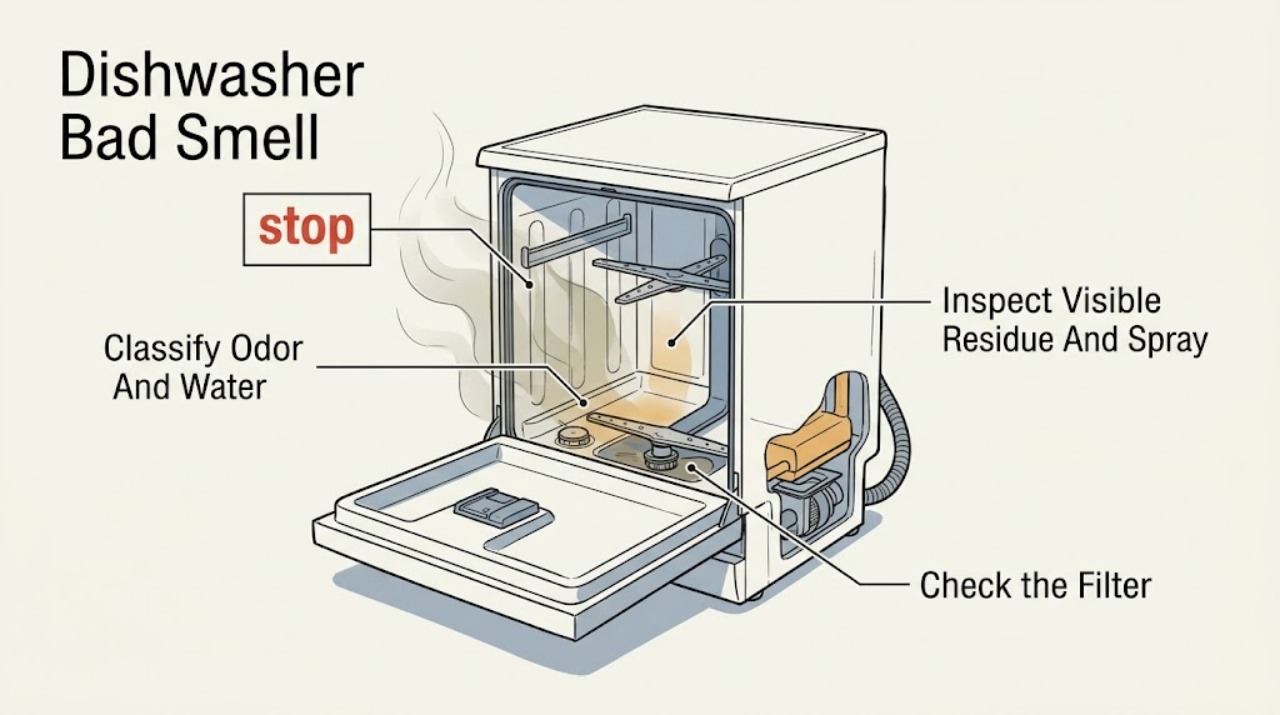
Work through in order
Diagnostic checks
Use only checks that match the exact appliance or system and its official guide.
-
Check 1
After the dishwasher is stopped and cool enough to inspect safely, open the door and record the odor type, when it appears, the presence of standing water, and whether the last load had food residue, gritty dishes, or poor spray coverage.
Expected result: Classify the smell as new-plastic or detergent-like, food-like, damp or mildew-like, sewage-like after sitting, chemical, burning, or melting plastic; note whether the tub is dry, has a small residual amount, or contains visibly dirty water.
Next step: Use the matching odor branch below and document the pattern before running another cycle; stop and seek service for a safety odor.
Stop if: Do not touch the heating element, wet electrical parts, melted plastic, or unknown chemical residue.
Why this matters
Why: New-appliance odor can fade with use, while food or mildew points toward cleanable areas. Dirty water between cycles points toward drainage or installation. Burning, chemical, or melting-plastic odor is not a routine cleaning branch.
-
Check 2
With power off and the tub cool, remove only loose visible food scraps from the tub bottom and inspect the accessible pump-inlet area and spray-arm openings without forcing parts or reaching into a covered sump.
Expected result: Record food or paper/plastic debris near the tub bottom or pump inlet, blocked spray jets, a clean accessible area, or an area that cannot be inspected without removing a cover or panel.
Next step: Remove only loose external debris and use the exact model's cleaning instructions for spray arms; if the debris is lodged under a cover or the odor remains, continue to the filter and drainage checks or call service.
Stop if: Do not insert sharp tools into jets, pry a pump cover, reach into the sump, or work near a hot element.
Why this matters
Why: GE links food odor and poor washing to residue around the pump inlet and blocked spray jets. A clean accessible area does not rule out a filter, drain, pump, or internal problem; inaccessible areas require the model manual or service.
-
Check 3
Use the exact GE dishwasher Owner's Manual to determine whether the model has removable fine and ultra-fine filters; only if it does and the manual permits access, remove, rinse, and reinstall them with power off and the tub cool.
Expected result: Record a removable filter with food or grease, a filter that is clean and correctly locked, self-cleaning filtration with no user-removable filter, or a filter that will not release or lock without force.
Next step: Rinse and reinstall only the specified filter, aligned and locked as the manual shows; run the model-approved empty cleaning or rinse step if appropriate, then reassess the odor.
Stop if: Do not pry a filter or sump cover, use scouring pads or harsh cleaners, operate with a loose filter, or continue if a seal or locking feature is damaged.
Why this matters
Why: A dirty removable filter can retain food residue and contribute to odor or gritty dishes. GE says some older and current models use self-cleaning filtration, so the absence of a removable filter is not itself a fault and forcing access can damage the sump.
-
Check 4
If dirty water or a sewage-like odor returns between cycles, inspect only the visible drain-hose route under the sink or beside the appliance against the exact installation instructions; do not disconnect plumbing or pull out a built-in dishwasher.
Expected result: Record a visible high drain loop or air gap, a hose route that appears to lack the required arrangement, standing dirty water, a blocked sink or disposer connection, or a route that cannot be verified without plumbing access.
Next step: Use the matching installation instructions or ask the installer or qualified plumber to correct the drain arrangement; request appliance service for internal drainage or pump diagnosis.
Stop if: Do not cut, disconnect, reroute, or clamp a drain hose by guesswork, and do not use the dishwasher if wastewater backs up or leaks onto electrical parts.
Why this matters
Why: GE identifies dirty water building up between uses as an installation problem when the drain hose lacks the required high loop or air gap. A sink or disposer blockage and an internal drain fault can produce similar symptoms, so the visible route alone does not prove the cause.
-
Check 5
When no safety hazard is present and the exact model permits it, choose one approved interior-cleaning method for buildup or mildew, keep dishes out, and follow the product and manual directions through the required rinse or empty cycle.
Expected result: Record whether the odor clears, becomes weaker but returns, remains unchanged, or is accompanied by residue, a leak, foam, abnormal heat, or a new chemical smell.
Next step: Stop after one compatible method if it does not resolve the smell and arrange appliance or plumbing diagnosis; keep the method and result for the technician.
Stop if: Never mix chlorine bleach with ammonia, use laundry or dish detergent as a substitute, use abrasive pads or harsh cleaners, or combine vinegar, bleach, ammonia, and commercial products.
Why this matters
Why: Improvement supports removable organic or mineral buildup as a contributor. A recurring or unchanged odor points toward drainage, hidden residue, filter or sump access, gasket moisture, or an internal condition rather than permission to use stronger chemicals.
-
Check 6
After safe cleaning and drainage observations, document any recurring odor, leak, smoke, melting plastic, electrical smell, abnormal heat, foam, or water near the dishwasher wiring and base without moving the appliance.
Expected result: Record a resolved odor, persistent odor with no visible cause, wastewater backup or leak, burning or melting-plastic odor, smoke or arcing, or a damaged cord, plug, outlet, or wiring area.
Next step: Stop operation and arrange qualified appliance service; use qualified plumbing service for drain or wastewater problems and electrical service for outlet or wiring hazards. Disconnect only from a dry, safely reachable point if doing so does not require moving the appliance.
Stop if: Do not run another cycle to mask the smell, open panels, touch wet electrical parts, scrape a hot element, or continue with smoke, arcing, melting, or wastewater leakage.
Why this matters
Why: GE says odors present for extended periods are abnormal. Persistent smell can require pump, drain, gasket, heater-area, or internal diagnosis; burning, smoke, electrical damage, and water near electricity are immediate safety conditions.
Use your observations
Decision map
Find the observation that best matches what you see, then follow the next safe action.
-
PATH 01Safety boundary
What you see
The dishwasher is new and has a temporary plastic, detergent, or rinse-aid smell without standing dirty water, smoke, or melting plastic.
Do this next
Run only the normal detergent cycles permitted by the manual and reassess; use service if the smell persists well beyond initial use or changes character.
Why this path and its safety boundary
Why it matters: GE says a newness odor can be normal and tend to dissipate after several normal cycles.
Safety stop: Stop for burning, chemical fumes, smoke, unusual heat, or melting plastic.
-
PATH 02Safety boundary
What you see
The odor is food-like and visible residue, blocked spray jets, gritty dishes, or poor wash performance is present.
Do this next
Remove only loose visible debris, clean the exact model's removable filter or spray parts as instructed, and run one compatible empty cleaning cycle.
Why this path and its safety boundary
Why it matters: Food is likely remaining in the tub, pump-inlet area, spray system, or filter rather than being fully flushed away.
Safety stop: Do not pry covers, force jets, or keep cleaning when the residue is hidden or the odor remains.
-
PATH 03Safety boundary
What you see
The model has removable fine or ultra-fine filters and they contain food or grease, or the model has self-cleaning filtration and no removable filter.
Do this next
Clean and lock only the filter named by the exact manual; for self-cleaning or inaccessible filtration, use model-specific service guidance.
Why this path and its safety boundary
Why it matters: A dirty removable filter can contribute to odor, but a self-cleaning design should not be forced open or treated as if it had the newer filter arrangement.
Safety stop: Do not operate with a missing, loose, or damaged filter or sump cover.
-
PATH 04Safety boundary
What you see
The odor is damp or mildew-like, with moisture or residue on the tub, door gasket, or other accessible interior surface and no burning smell.
Do this next
Wipe accessible surfaces with a compatible method and follow one exact-model-approved rinse or cleaning cycle; keep the appliance used and maintained according to its manual.
Why this path and its safety boundary
Why it matters: Mildew or retained moisture is plausible, especially when the dishwasher sits unused or food residue remains.
Safety stop: Never mix chlorine bleach and ammonia, use harsh cleaners, or continue if the odor becomes chemical or the gasket is damaged.
-
PATH 05Safety boundary
What you see
Dirty water or a sewage-like odor returns while the dishwasher is idle, and the visible drain route lacks the model-required high loop or air gap or cannot be verified.
Do this next
Use the exact installation instructions and have the installer or qualified plumber assess the drain route, sink, and disposer connection; call appliance service for internal pump or drain faults.
Why this path and its safety boundary
Why it matters: GE identifies this pattern as a possible drain-hose installation or plumbing issue, not simply an interior smell.
Safety stop: Do not disconnect plumbing or run the dishwasher when wastewater backs up or leaks near electricity.
-
PATH 06Safety boundary
What you see
The odor remains after safe, model-appropriate cleaning, or it is burning, electrical, chemical, or associated with melting plastic, smoke, abnormal heat, a leak, or arcing.
Do this next
Stop using the dishwasher and arrange qualified appliance, plumbing, or electrical service as indicated by the symptom; preserve the odor description and cleaning history.
Why this path and its safety boundary
Why it matters: Extended odor is abnormal; a heater-area, pump, drain, wiring, or other internal condition may be present, and the safety symptoms require immediate cessation.
Safety stop: Do not open panels, touch a hot element, mix chemicals, reset a tripping circuit, or run another cycle to test the smell.
Helpful context
Understand the symptom
Classify the odor before cleaning
A new GE dishwasher may have a temporary plastic, detergent, or rinse-aid smell that fades after several normal cycles. A food odor points toward residue or poor wash and drainage; a damp or mildew odor points toward moisture remaining on the tub, gasket, or filter area; an odor that returns after the dishwasher sits can indicate dirty water in the tub. A burning or melting-plastic odor is a safety stop, not a deodorizing problem. Note when the smell appears, whether standing water remains, and whether dishes are gritty or poorly washed.
Start with visible residue and the model's filter design
GE recommends checking the tub bottom, the pump-inlet area, and spray-arm jets for food or debris. Many newer GE dishwashers have fine and ultra-fine filters, but older and some current models use self-cleaning filtration and may not have a removable filter. The Owner's Manual for the exact model controls what can be removed. Do not pry a cover, force a filter, or assume that a different GE model's filter layout applies.
Treat drainage odor as an installation branch
If dirty water is collecting in the tub between uses, GE identifies an improperly routed drain hose as an installation issue. The drain route needs the arrangement specified by the installation instructions, such as a high drain loop or an air gap. This is not solved by adding fragrance or repeatedly running cleaner. Inspect only the visible hose route; corrections under the sink or at the disposer should be handled by an installer or qualified plumber when the model instructions or plumbing access are unclear.
Clean without creating chemical or heat hazards
GE's interior-cleaning guidance allows model-appropriate dishwasher cleaner, citric-acid cleaning, or a vinegar rinse for buildup, while cautioning against harsh cleaners and abrasive scouring pads. GE's odor guidance gives separate options for mildew and explicitly warns that chlorine bleach and ammonia create toxic fumes when mixed. Choose one method allowed by the exact manual, never combine products, keep hands away from a hot element, and stop if the odor is electrical, chemical, or associated with melting plastic.
Safety boundary
Stop conditions
- Stop for burning or electrical odor, smoke, sparks, arcing, melting plastic, abnormal heat, or a damaged cord, plug, outlet, or wiring area.
- Do not mix chlorine bleach and ammonia; never combine vinegar, bleach, ammonia, or commercial cleaners, and avoid harsh or abrasive products.
- Do not reach near a hot heating element, remove a sump cover or filter by force, insert sharp tools into spray jets, or open panels.
- Do not disconnect or reroute the drain hose by guesswork, pull out a built-in dishwasher, or operate while wastewater backs up or reaches electrical parts.
- Do not continue using the dishwasher for an extended or unexplained odor after safe model-appropriate cleaning; arrange qualified service.
When checks do not resolve it
Need a professional?
Arrange qualified appliance service when a GE dishwasher odor persists after model-appropriate residue, filter, gasket, and interior cleaning; when a filter or sump cannot be safely accessed; when the odor accompanies poor washing, standing water, a leak, or a suspected pump, drain, or heater-area problem; or whenever panels or internal parts would be needed. Use qualified plumbing service for a missing or unclear high drain loop or air-gap arrangement and wastewater backup. Stop immediately for smoke, arcing, burning odor, melting plastic, abnormal heat, or water near electricity.
Safety scope: This article supports cool, power-off ordinary-access inspection and only model-approved removable-part cleaning. Do not open panels, reach near a hot element, force a filter or sump cover, disconnect plumbing, mix chemicals, or operate a leaking, smoking, electrically damaged, or chemically contaminated dishwasher.
Common questions
FAQ
Why does my GE dishwasher smell like food?
Food can remain on the tub bottom, around the pump inlet, in a removable filter, or in blocked spray-arm jets. With the unit cool and off, inspect only accessible areas and follow the exact model's filter and spray-part instructions.
Is a plastic smell from a new GE dishwasher normal?
GE says a newness smell from tub material, detergent, or rinse aid can fade after several normal cycles. A smell that persists, changes to burning or melting plastic, or appears with abnormal heat needs service.
Does every GE dishwasher have a removable filter?
No. GE says many newer models have fine and ultra-fine filters, while older and some current models use self-cleaning filtration. Check the exact Owner's Manual and never force a filter or sump cover.
Why does the smell return after the dishwasher sits?
Dirty water remaining between cycles can point to drain-hose installation, such as a missing required high loop or air gap, or to a sink, disposer, pump, or drain problem. Inspect only the visible route and use qualified plumbing or appliance service when unclear.
Can I use bleach and ammonia to remove mildew odor?
Never mix them. GE explicitly warns that chlorine bleach and ammonia together create toxic fumes. Follow the exact model's cleaning guidance and use only one compatible method; do not mix chemicals.
When is a dishwasher smell serious?
Stop and seek service for burning or electrical odor, smoke, sparks, melting plastic, abnormal heat, leaks, wastewater backup, water near electricity, or an odor that persists after safe model-appropriate cleaning.
Read the exact guide
Official sources
- Dishwasher - Cleaning the InteriorGE Appliances · GE Appliances general interior-cleaning guidance; product labels, exact cycle procedures, and sump-cover access are model-dependent.
- How to Clean Your DishwasherGE Appliances · GE Appliances general cleaning article; filter availability and cleaning steps must be confirmed in the exact dishwasher Owner's Manual.
- Dishwasher - How to Clean Fine and Ultra Fine FiltersGE Appliances · GE Appliances filter guidance; only models equipped with removable fine and ultra-fine filters use these steps, and the exact Owner's Manual controls access.
- Dishwasher - OdorsGE Appliances · GE Appliances general dishwasher odor guidance; the exact filter, sump, spray-arm, drain, and installation arrangement remains model-specific.
- Dishwasher - Food or Mildew OdorGE Appliances · GE Appliances general dishwasher odor guidance; model-specific installation instructions and Owner's Manual control access and cleaning.
Community feedback
Share a repair observation
Share a plain-text repair observation. Accepted observations are published automatically; this page may take a moment to update.