
On this page
Start here
Quick answer
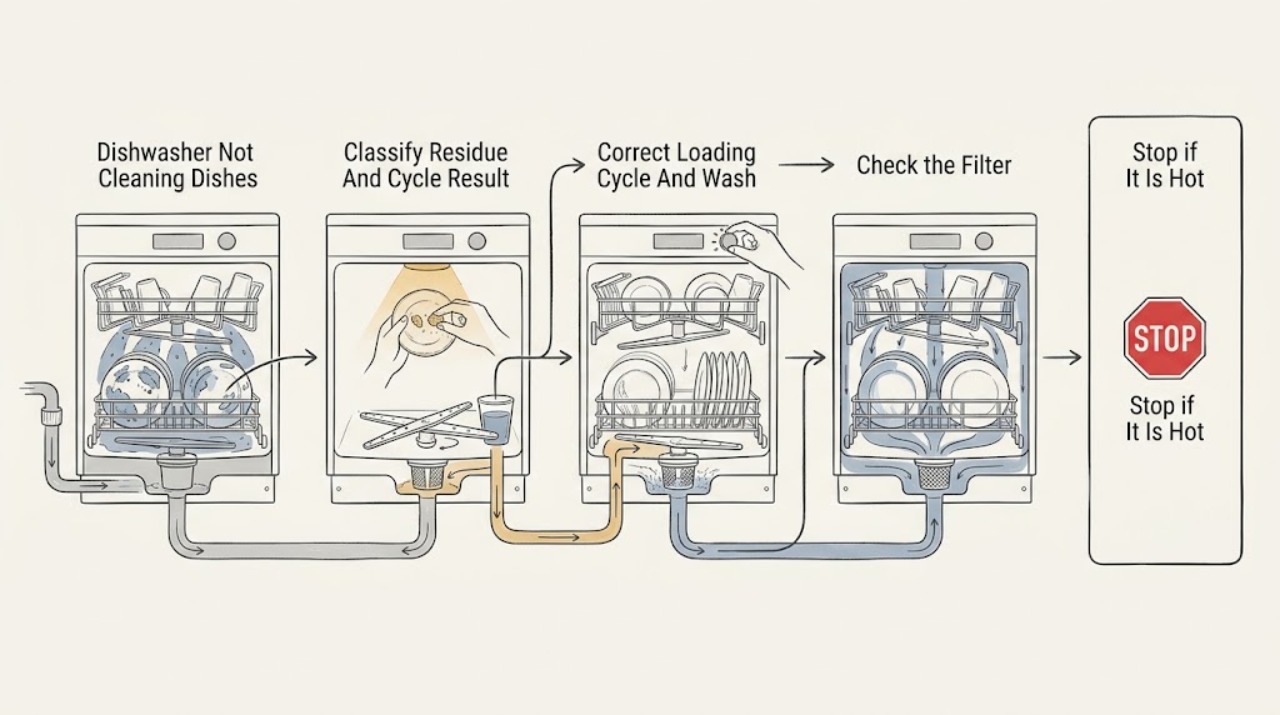
When a GE dishwasher leaves food, detergent, grit, or film on dishes, first separate a loading or detergent problem from a low-water, filtration, spray-arm, or drain problem. Empty the racks and note whether the residue is food, undissolved detergent, or a white film. Check that the selected cycle fits the load, the spray arms can turn and are not blocked, the correct automatic-dishwasher detergent is fresh, and the model's removable fine and ultra-fine filters are clean and locked in place. Also look for standing water, a blocked detergent cup, or a visible drain or sink-connection problem. GE says hot incoming water and adequate fill are important for cleaning, but do not open electrical panels or dismantle water connections to test them. If these safe checks do not improve wash performance, or the dishwasher is leaking, repeatedly stops, has damaged wiring, or needs an internal pump, valve, heater, or control diagnosis, stop and arrange qualified service.
Work through in order
Diagnostic checks
Use only checks that match the exact appliance or system and its official guide.
-
Check 1
Empty the GE dishwasher and inspect several problem dishes and the detergent cup after a completed cycle. Record whether the result is loose food, greasy soil, undissolved detergent, gritty particles, white film or spots, or dishes that are merely wet. Note the selected cycle, whether a wash-zone option was active, whether the cup opened, and whether water or leaks remain in the tub.
Expected result: Food remains across surfaces, detergent is still in the cup, grit or white film is present, only one rack is dirty, or water remains after the cycle.
Next step: Use the matching checks below rather than replacing a pump or control based on residue alone. If there is an active leak, burning odor, smoke, damaged wiring, or repeated breaker trip, stop using the dishwasher and arrange qualified service.
Stop if: Do not restart the appliance to investigate smoke, electrical damage, an active leak, or a strong burning odor.
Why this matters
Why: The pattern narrows the next check: food across the load favors spray coverage, loading, filters, water, or cycle choice; detergent in the cup favors a cup obstruction or wash-water issue; film or grit favors detergent, hardness, temperature, or rinse-aid conditions; rack-specific soil favors a blocked arm or selected wash zone; standing water favors drainage.
-
Check 2
Reload the dishwasher according to the GE model manual. Keep tall items, pan handles, and utensils from touching the detergent cup or blocking either wash arm; leave the soiled faces exposed to the spray. Select a cycle appropriate for the load and turn off a single-rack or wash-zone selection unless that limited coverage is intentional. Scrape large food particles before loading, but do not prewash every dish unless the manual says to do so.
Expected result: A dish or utensil was blocking the detergent cup or wash arm, only one rack was selected, the load was crowded, or the load was already correctly arranged.
Next step: Run an appropriate full-load cycle after correcting the arrangement and compare both racks. If the same food pattern returns with unobstructed loading, continue with the spray-arm, filter, detergent, and water checks.
Stop if: Do not force a rack, wash arm, or detergent cup past an obstruction, and do not use a cycle that the model manual excludes for the load or dishware.
Why this matters
Why: A blocked cup or wash arm prevents detergent or water from reaching the load, and a restricted wash zone can leave the other rack dirty. If the load is correct but both racks remain poorly cleaned, filtration, water supply, detergent, or circulation becomes more likely.
-
Check 3
With the dishwasher off and the racks unloaded, turn each wash arm only as the model manual permits and inspect its visible jets for food or mineral debris. If the GE model has removable fine and ultra-fine filters, remove and clean them according to the manual using warm soapy water and a soft sponge; do not use scouring pads. Inspect the accessible filter area for loose soil, then reinstall every filter and retaining post so it is correctly locked.
Expected result: A wash arm is blocked or cannot move freely, the filters contain food or calcium soil, a filter is damaged or will not lock, or the arms and filters are clear and secure.
Next step: Clear only loose, accessible residue without damaging jets, clean model-approved removable filters, and run a suitable cycle. If a filter is damaged, absent, or cannot be locked, leave the dishwasher unused until the exact model-specific repair is confirmed.
Stop if: Do not poke deeply into the sump, use a sharp or abrasive tool, run the dishwasher without required filters, or remove a non-removable filter system.
Why this matters
Why: Blocked arms reduce spray coverage and a dirty filter can reduce wash performance or allow soil to recirculate. GE notes that some older or current models use self-cleaning filtration with no removable filter, so forcing a filter that the model does not have can cause damage. A clear, correctly installed system shifts attention to water, detergent, drain, or internal circulation.
-
Check 4
Inspect the GE detergent cup before the next load. Remove old residue from the opening with a damp cloth, keep tall dishes from touching the cover, and use only fresh detergent made for automatic dishwashers. Keep powdered detergent dry and loose, use the amount directed for the water hardness and model, and use rinse agent only in its designated dispenser if the model supports it. Do not put detergent into the cup until you are ready to run the cycle.
Expected result: The cup was blocked or stayed closed, powder is damp or lumpy, the wrong soap was used, detergent residue or suds are present, the rinse-agent dispenser is empty, or the cup and detergent are normal.
Next step: Correct the detergent and cup condition, then run an appropriate cycle and compare the residue. If the cup repeatedly fails to open, the arms do not circulate, or suds or leaks continue, stop experimenting and arrange service.
Stop if: Do not use hand dish soap or another non-automatic detergent, add multiple detergents together, or continue cycling when suds are escaping onto the floor.
Why this matters
Why: A blocked cup, stale powder, incorrect soap, excess suds, or a mismatch between detergent amount and water hardness can leave food, detergent, spots, or film. Rinse agent can improve drying and reduce film but cannot correct blocked spray coverage, low fill, or a failing circulation system.
-
Check 5
Before starting a normal load, run the kitchen hot-water faucet briefly so the dishwasher can receive hot water, as GE recommends, and avoid starting it while another large fixture is using hot water. Observe the completed cycle for a normal fill and drain, broad standing water, a visibly kinked drain hose, sink or air-gap backflow, or an error indication. Check only visible hose and sink connections; do not disconnect plumbing or open the dishwasher cabinet.
Expected result: The incoming water is not hot, other fixtures reduce flow, the dishwasher appears underfilled, water remains across the tub, the sink or air gap backs up, the hose is visibly kinked, or the visible supply and drain symptoms are normal.
Next step: If the household water supply or visible drain path is abnormal, correct that household condition or arrange qualified plumbing help before judging the dishwasher. If fill or drain remains abnormal with normal visible connections, arrange appliance service for internal diagnosis.
Stop if: Do not adjust or dismantle gas, electrical, or plumbing components, remove panels, probe terminals, or bypass a fill or drain control as a test.
Why this matters
Why: GE states that hot incoming water and adequate water pressure are needed to activate detergent and provide effective wash action. Poor draining can leave soil in the tub and reduce the next cycle's performance. Normal visible plumbing does not rule out an inlet valve, circulation pump, heater, sensor, or control fault.
-
Check 6
After correcting loading, wash-zone selection, filters, detergent, and any clearly visible household water or drain issue, run one appropriate cycle with a representative load. Compare both racks, the detergent-cup result, the amount of food left behind, the presence of film or grit, and the water left in the tub. Record the GE model number and the checks already completed if service is needed.
Expected result: Cleaning improves, only film or spots remain, one rack is still dirty, the detergent cup still does not open, the dishwasher does not circulate or drain normally, or the same poor wash result returns.
Next step: Continue the GE model's maintenance instructions when performance is restored. If the same result returns after these checks, stop repeated test cycles and arrange qualified GE appliance service with the model and observations.
Stop if: Do not continue operating a leaking or electrically abnormal dishwasher, and do not open the appliance to test a pump, heater, valve, or control.
Why this matters
Why: Improvement supports a loading, detergent, filter, water, or drain condition rather than proving a replacement part is needed. Persistent rack-specific soil suggests spray-arm or circulation coverage; persistent cup, fill, drain, leak, or control symptoms point toward a component or installation diagnosis.
Use your observations
Decision map
Find the observation that best matches what you see, then follow the next safe action.
-
PATH 01Next step
What you see
Food remains on many dishes, the load was crowded, the selected cycle was light for the soil, or filters and wash-arm jets have visible residue.
Do this next
Correct the loading and cycle, clean the model-specific removable filters, clear accessible wash-arm residue, and compare a full-load cycle. If food remains with clear arms, clean filters, and correct loading, check water and arrange service if fill or circulation is abnormal.
Why this path and its safety boundary
Why it matters: The combined pattern favors inadequate spray coverage, loading, filtration, or cycle choice before an internal component failure.
-
PATH 02Next step
What you see
One rack is consistently dirty while the other cleans, a wash-zone option is selected, or a dish or utensil blocks a wash arm.
Do this next
Remove the obstruction, load according to the GE manual, and select full coverage unless a wash-zone cycle is intentional. If one rack remains dirty with unobstructed arms and full coverage, have circulation and wash-arm operation diagnosed.
Why this path and its safety boundary
Why it matters: The asymmetry makes a restricted spray path or intentional single-rack coverage more likely than a detergent problem affecting the whole tub.
-
PATH 03Next step
What you see
Detergent remains in the cup, the cup did not open, powder is damp or lumpy, suds are present, or dishes have gritty or white film residue.
Do this next
Clear the cup area, use fresh automatic-dishwasher detergent in the model-directed amount, correct loading, and confirm the incoming water and rinse-agent guidance. If the cup still fails to open or the result persists, arrange service.
Why this path and its safety boundary
Why it matters: The result favors cup obstruction, detergent condition or type, water temperature, hardness-related dosing, or rinse-agent conditions. These symptoms do not by themselves identify a failed pump.
-
PATH 04Next step
What you see
The dishwasher appears underfilled, leaves broad standing water, backs up at the sink or air gap, has a visibly kinked drain hose, or cleaning degrades along with drainage.
Do this next
Correct only a clearly household-level condition that is safe to address, such as avoiding simultaneous hot-water use or arranging plumbing help for a downstream blockage. For persistent fill, drain, hose, leak, or pump symptoms, stop and arrange qualified appliance service.
Why this path and its safety boundary
Why it matters: Low fill, restricted drainage, or returning dirty water can reduce spray action and carry soil into the next cycle. A normal small amount of water in a filter area is not the same as broad tub standing water, but GE's exact model guidance controls the interpretation.
-
PATH 05Next step
What you see
Loading, cycle choice, detergent, filters, spray-arm access, and visible water or drain checks are correct, but both racks still clean poorly or the symptom returns.
Do this next
Stop repeated trial cycles and arrange qualified GE appliance service. Provide the model number, residue type, cycle used, filter condition, detergent result, water pattern, and any display or leak symptom.
Why this path and its safety boundary
Why it matters: An internal circulation pump, inlet valve, heater, sensor, wash-arm feed, control, or hidden installation issue becomes more likely; the residue pattern alone cannot select the failed part.
-
PATH 06Next step
What you see
There is an active leak, smoke, burning odor, damaged wiring, repeated breaker trip, or water and electricity are entering an unsafe area.
Do this next
Stop using the dishwasher and keep people away from the hazard. Use local emergency guidance for smoke, fire, or immediate electrical danger, and arrange qualified appliance or electrical or plumbing help as appropriate. Do not restore power or restart the cycle as a test.
Why this path and its safety boundary
Why it matters: This is a safety or installation boundary, not an ordinary cleaning-performance problem.
Helpful context
Understand the symptom
Read the residue before changing parts
Food particles usually point toward spray coverage, loading, filtration, or a cycle that was too light for the soil. A detergent cup that stayed closed or contains wet powder points toward an obstruction, detergent condition, water temperature, or a dispensing problem. White film or spots can involve water hardness, detergent amount, temperature, or rinse aid and should not be treated as proof that the wash pump has failed. The exact GE model manual controls which filters, wash zones, and cleaning steps apply.
Do not turn a wash-performance check into a hazardous repair
The safe checks are external and model-guided: loading, detergent, visible spray-arm movement or obstruction, removable filter care, accessible water and drain symptoms, and cycle selection. Do not remove panels, probe wiring, bypass a control, force a wash arm, or disconnect a water line merely to find out why dishes are dirty. An active leak, burning odor, smoke, damaged wiring, or repeated breaker trip changes the decision to service immediately.
Only after diagnosis
Potential parts
- GE dishwasher fine and ultra-fine filter assembly
Consider this only when the exact GE model has removable filters and inspection confirms a cracked, missing, warped, or non-locking filter after cleaning.
Some GE dishwashers use self-cleaning filtration while others use removable fine and ultra-fine filters. Confirm the model manual and diagnosis before selecting a replacement. - GE dishwasher wash arm
Consider this only if a qualified diagnosis finds a damaged, warped, or persistently blocked wash arm after loading and accessible jet checks are complete.
Wash-arm design and mounting vary by GE model and rack position. Confirm exact model fit and the cause of poor spray coverage before ordering or installing. - GE dishwasher detergent cup or circulation component
Consider this only after service diagnosis confirms a cup mechanism, circulation pump, inlet valve, heater, sensor, or control fault rather than loading, detergent, filter, or water-supply conditions.
These parts are model-specific and may require water or electrical access. Have a qualified technician identify the failed component and confirm compatibility.
When checks do not resolve it
Need a professional?
Arrange qualified GE appliance service when the dishwasher still leaves food or detergent after correct loading, cycle selection, detergent, filter, spray-arm, and visible water checks; when the detergent cup repeatedly fails to open; or when fill, circulation, heating, drainage, control, or wash-zone operation remains abnormal. Arrange plumbing help when a sink connection, air gap, or downstream drain is implicated. Stop immediately for an active leak, smoke, burning odor, damaged wiring, repeated breaker trip, or any immediate electrical danger, and use local emergency guidance when appropriate. Do not open panels, probe wiring, bypass controls, disconnect water lines as a first test, use hand dish soap, or keep restarting an unsafe appliance.
Common questions
FAQ
Why is my GE dishwasher leaving food on the dishes?
Start with loading, cycle choice, blocked wash arms, and the model's filter system. Food particles can clog filters or wash-arm jets, and a short or limited-rack cycle may not provide enough coverage for the load. If both racks remain dirty after those checks, investigate water fill, circulation, drainage, or service rather than guessing at a part.
How do I clean the filters in a GE dishwasher?
Only remove filters that your GE model manual identifies as removable. GE's fine and ultra-fine filter guidance uses warm soapy water and a soft sponge, warns against abrasive pads or brushes, and requires the filters to be reinstalled and locked. Some GE models use self-cleaning filtration and do not have a removable filter to clean.
What if the GE dishwasher detergent cup does not open?
Check whether a tall dish, pan handle, or utensil is touching the cup, and wipe old detergent from the opening. Use fresh detergent made for automatic dishwashers. If the cup repeatedly stays closed after the loading and detergent checks, service may be needed.
Can low hot water cause a GE dishwasher not to clean?
Yes. GE says hot incoming water helps dissolve and activate detergent, and that adequate incoming water and pressure support effective wash action. Run the kitchen hot-water faucet before a cycle and avoid competing hot-water use, but do not open plumbing or electrical components to test the dishwasher. Persistent fill or heating symptoms need service.
When should I call for GE dishwasher service?
Arrange service when correct loading, cycle selection, detergent, filter, wash-arm, and visible water checks do not restore cleaning, or when the cup fails repeatedly, water remains, the dishwasher leaks, or an internal pump, valve, heater, sensor, or control issue is suspected. Stop immediately for smoke, burning odor, damaged wiring, or an active leak.
Read the exact guide
Official sources
- Dishwasher - How to Clean Fine and Ultra Fine FiltersGE Appliances · GE dishwasher fine and ultra-fine filter types, model-dependent filter cleaning, soft cleaning tools, and locking filters
- Dishwasher - Poor Wash PerformanceGE Appliances · GE dishwasher poor wash performance, incoming water, cycle selection, detergent, food debris, filters, wash arms, loading, and service guidance
- Dishwasher - Detergent Cup Not OpeningGE Appliances · GE dishwasher detergent-cup obstruction, detergent residue, rack loading, and service guidance
- Dishwasher "Blocked Wash Arm" DisplayGE Appliances · GE dishwasher blocked wash-arm indication, rack or food obstruction, insufficient water, and service boundary
- Dishwasher - Detergent and Rinse Agent TipsGE Appliances · GE dishwasher automatic detergent type and storage, detergent-cup timing, rinse-agent use, and film or drying guidance
Community feedback
Share a repair observation
Share a plain-text repair observation. Accepted observations are published automatically; this page may take a moment to update.