
On this page
Start here
Quick answer
A GE dishwasher that leaves more than its model's normal small amount of water usually has a restriction in the filter or sump, drain hose, air gap, sink or disposer connection, or pump path. First keep hands out of the disposer and any pump opening, note whether the water is clean or dirty, and check the exact model guidance for the filter style. Inspect visible hose routing, sink drainage, and an accessible air gap; clean the model-approved filter or sump area and reinstall it securely. Do not pour drain cleaner into the dishwasher. If water remains after those safe checks, a portable unit is connected with its unicouple, the drain path is inaccessible, or the dishwasher leaks, overflows, smells of burning, or repeatedly stops, leave it off and arrange qualified appliance or plumbing service.
Before you begin
Safety first
- This article supports water-level observation, model-approved filter or sump cleaning, visible hose and sink-path checks, suds identification, and one documented drain test only. Pump, float, control, cabinet, wiring, disposer, and inaccessible plumbing work belong to qualified service.
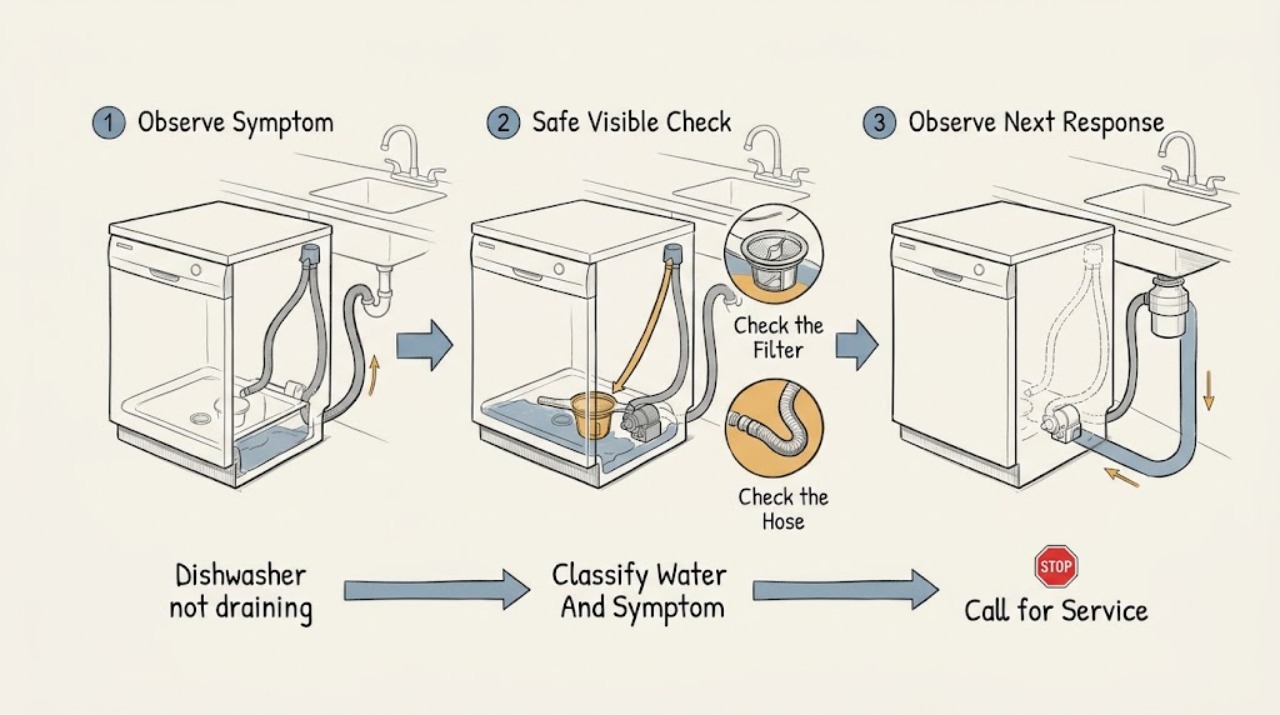
Work through in order
Diagnostic checks
Use only checks that match the exact appliance or system and its official guide.
-
Check 1
Stop the dishwasher and note whether the remaining water is only a small clean amount near the filter area or covers the tub floor, whether it is dirty or foamy, whether the cycle stopped, and whether there is a leak, overflow, or unusual smell.
Expected result: Only a small clean amount remains, dirty water builds up between cycles, water covers the bottom, suds are present, the dishwasher stopped, or the smell is burning or electrical.
Next step: Continue only with safe visual checks if there is no hazard. Leave the dishwasher off for overflow, a leak near electrical parts, smoke, sparking, burning odor, or water that cannot be contained.
Stop if: Do not put hands into a disposer, reach into the pump or sump opening, or restart an appliance with an active leak, overflow, smoke, or electrical odor.
Why this matters
Why: GE identifies a small amount of clean water as normal on applicable designs, while excess or dirty water supports a drain restriction or backflow check. Suds can obstruct draining; burning or electrical symptoms are not routine drain conditions.
-
Check 2
With the dishwasher off and safe, use the exact GE model instructions to inspect the fine and ultra-fine filters if fitted and the visible sump area at the tub bottom; remove only loose food or paper that is safely reachable, and do not force a filter or pump cover.
Expected result: Food, paper, plastic, or other debris covers the sump or filter, the applicable filters are dirty, the filter area is clear, the model has no removable filter, or the obstruction is below the safe access point.
Next step: Clean or reinstall only the filter parts named by the manual and confirm they are seated before testing. If the model has no removable filter, the cover is stuck, or the obstruction is inaccessible, stop and arrange appliance service.
Stop if: Do not reach into the pump, use tools to pry a cover, operate without required filters, or handle broken glass or sharp debris without a safe service boundary.
Why this matters
Why: GE links filter or sump debris with excess water and a blocked pump inlet. A clear, correctly installed filter makes the hose, air gap, sink or disposer, pump, or other internal path more likely; a deep or sharp obstruction needs service.
-
Check 3
Inspect the visible drain hose below the sink for a kink or blockage, confirm the kitchen sink drains freely, and if an air gap is installed check it for accessible debris; if a disposer was recently installed or replaced, confirm its installation instructions addressed the dishwasher drain connection.
Expected result: The hose is kinked or blocked, the sink or disposer backs up, the air gap contains buildup, the disposer connection followed a recent installation, or the visible discharge path appears open.
Next step: Correct only a plainly visible, model-approved routing issue and clean an accessible air gap as its instructions allow. Do not put hands in the disposer; arrange plumbing or appliance service for a blocked, damaged, or inaccessible connection.
Stop if: Do not pull out a built-in dishwasher, disconnect a wet hose without containment, use drain cleaner in the dishwasher, or put hands into a disposer.
Why this matters
Why: GE identifies hose restrictions, a clogged sink or air gap, and a disposer installation issue as external causes of no drain. An open visible path shifts attention to the filter, pump, or internal drain system.
-
Check 4
Look for foam or bubbles in the tub and review the detergent used and amount against the exact GE manual; if suds are present, stop the appliance and let them dissipate using only the model's documented cleanup procedure.
Expected result: Suds are present, rinse aid has spilled, the wrong detergent was used, detergent quantity is excessive, or there are no suds and the water remains.
Next step: Use only automatic-dishwasher detergent in the correct model-approved amount on the next test. If suds persist, water leaks, or the dishwasher still will not drain after they clear, leave it off and arrange service.
Stop if: Do not add hand dish soap, drain cleaner, bleach, or other chemicals to force drainage, and do not continue with an overflowing or leaking tub.
Why this matters
Why: GE states that wrong or excessive detergent can cause oversudsing that prevents proper draining and can contribute to leaks. With no suds, the restriction or pump path remains the primary branch.
-
Check 5
After the filter, sump, hose, air-gap, sink, disposer connection, and suds checks are normal, run one model-approved drain or cancel-cycle test while watching from a safe position; observe whether water discharges steadily and the tub reaches its normal end state.
Expected result: Water drains steadily, drains only partly, the pump is silent or makes an unusual sound, the tub remains full, the cycle stops again, or water leaks underneath.
Next step: Use the dishwasher only if it completes normally and remains dry. If flow is absent or partial, the cycle stops, or a leak appears, leave it off and provide the technician the water level, filter and hose findings, pump sound, and test result.
Stop if: Do not repeat tests with standing water, open panels, probe the pump, or continue operation after a leak, overflow, smoke, sparking, or burning odor.
Why this matters
Why: Steady discharge supports a corrected external restriction or temporary condition. Partial or absent flow after a clear visible path makes the pump, internal blockage, float, or control path more likely; a leak below the unit needs service rather than repeated testing.
Use your observations
Decision map
Find the observation that best matches what you see, then follow the next safe action.
-
PATH 01Safety boundary
What you see
Only a small amount of clean water remains in the model's normal filter or sump area, the tub floor is not covered, and the dishwasher completes cycles without odor or backup.
Do this next
Do not force the water out. Continue normal use and model-approved maintenance, but investigate if the amount increases, becomes dirty, or accompanies poor draining.
Why this path and its safety boundary
Why it matters: GE identifies limited clean water as normal on applicable designs because it helps keep a pump seal lubricated.
Safety stop: Stop if water covers the tub floor, dirty water returns between cycles, the sink backs up, or a leak appears.
-
PATH 02Safety boundary
What you see
Excess water is present and food, paper, plastic, or other debris is found at the filter or visible sump, with improved drainage after the model-approved cleaning.
Do this next
Reinstall the filter securely and run one supervised drain test. If excess water returns or the obstruction is below safe access, arrange appliance service.
Why this path and its safety boundary
Why it matters: A filter or pump-inlet blockage is more likely than a failed pump for that episode.
Safety stop: Do not operate with a loose filter, pry into the pump, or handle sharp debris unsafely.
-
PATH 03Safety boundary
What you see
The hose is kinked, the sink or air gap backs up, or a disposer connection has a recent installation issue, and drainage improves after the safe external condition is corrected.
Do this next
Keep the hose routed according to the exact installation instructions and have plumbing service clear a recurring sink, air-gap, or disposer restriction. Do not put hands into a disposer.
Why this path and its safety boundary
Why it matters: The household discharge path or installation is more likely than an internal dishwasher part.
Safety stop: Do not pull out the appliance, disconnect wet plumbing without containment, or use drain cleaner in the dishwasher.
-
PATH 04Safety boundary
What you see
Foam is present after the cycle, the wrong or excessive detergent or spilled rinse aid is suspected, and drainage returns after the suds are safely cleared.
Do this next
Use only the model-approved automatic-dishwasher detergent and amount. If suds or leaks return, stop using the unit and arrange service.
Why this path and its safety boundary
Why it matters: Oversudsing is more likely than a blocked pump for that event, although recurring no-drain symptoms still need investigation.
Safety stop: Do not add hand soap, drain cleaner, or other chemicals, and do not operate a leaking or overflowing tub.
-
PATH 05Safety boundary
What you see
The filters and visible discharge path are clear, there are no suds, but the pump is silent or abnormal, flow is partial, or the tub stays full after one documented drain test.
Do this next
Leave the dishwasher off and arrange qualified appliance service. Report the model, water level, filter result, hose and air-gap condition, pump sound, and whether any code appeared.
Why this path and its safety boundary
Why it matters: An internal pump, impeller, sump, float, or control fault is possible; a sound or symptom alone does not identify the failed part.
Safety stop: Do not remove the pump cover, probe the impeller, open panels, or keep restarting a stalled drain motor.
-
PATH 06Safety boundary
What you see
Water leaks from underneath, the dishwasher overflows, smoke or burning odor appears, or a portable dishwasher connected through its unicouple does not drain.
Do this next
Stop the dishwasher, keep people away from the hazard, and arrange qualified appliance or plumbing service. Follow local emergency guidance for smoke or fire.
Why this path and its safety boundary
Why it matters: This is a water, fire, electrical, or model-specific service hazard rather than a routine hose or filter check.
Safety stop: Do not restart the unit, touch wet electrical parts, put hands into a disposer, or continue a portable-unit test with the unicouple when it will not drain.
Helpful context
Understand the symptom
Separate normal residual water from a blocked drain
GE notes that some models can retain a small amount of clean water at the bottom to keep the pump seal lubricated. That is different from water covering the tub floor, dirty water building up between cycles, or water that rises after a cycle. Use the exact model's guidance and the change over time as the comparison rather than assuming every visible drop means a failed pump.
Start at the discharge path
A GE dishwasher drains through a path that can include the filter or sump, pump, drain hose, air gap, sink drain, or disposer connection. A kink, blockage, high-loop or air-gap installation issue, or a disposer plug left after installation can prevent discharge. Inspect only visible, safely reachable connections and do not put hands into a disposer.
Suds change the diagnosis
Wrong detergent or too much detergent can create suds that interfere with draining and can push water out of the tub. If suds are present, stop the dishwasher and follow the exact model guidance for clearing them. Do not add drain cleaner or another chemical to force a drain; a persistent leak or overflow needs service.
Safety boundary
Stop conditions
- Leave the dishwasher off for overflow, a leak near electrical components, smoke, sparking, burning odor, melting, or exposed wiring.
- Do not put hands into a garbage disposer, reach into the pump or sump, remove panels, or pull out a built-in dishwasher as an ordinary drain check.
- Do not pour drain cleaner, hand dish soap, bleach, or unapproved chemicals into the dishwasher, and do not operate without required filters correctly installed.
- Stop after one model-approved drain test if there is no or partial flow, unusual pump noise, a repeated stop, or water remains above the model's normal level.
- Do not replace a pump, hose, filter, float, or control based only on standing water; confirm the exact model-specific diagnosis first.
Only after diagnosis
Potential parts
- GE dishwasher drain hose
Consider this part class only when the visible hose is split, crushed, or confirmed by diagnosis to be internally restricted after safe routing and external plumbing checks.
Confirm the exact GE model, connection ends, routing requirements, and manufacturer fit information before ordering. - GE dishwasher filter or sump screen
Consider this part class only when the exact model uses it and the filter or screen is damaged, missing, or unable to seat after debris is removed and qualified diagnosis confirms its role.
Confirm the exact GE model and filtration design; do not assume fine, ultra-fine, and other filter styles interchange. - GE dishwasher drain pump or impeller assembly
Consider this part class only after qualified diagnosis finds a failed or obstructed pump when the filter, sump, hose, sink, air gap, disposer, and suds checks are clear.
Confirm the exact GE model and diagnostic result; partial flow or a pump sound alone is not proof of pump failure. - GE dishwasher flood float or control component
Consider this part class only when qualified diagnosis confirms a water-level or control fault that prevents draining after the visible drain path is clear.
Confirm the exact model, component location, wiring, diagnostic result, and manufacturer fit information before replacement.
When checks do not resolve it
Need a professional?
Arrange qualified GE dishwasher or plumbing service when excess water remains after the model-approved filter and sump check and visible hose, air-gap, sink, disposer, and suds checks; when a portable unit will not drain through its connection; or when the pump is silent or abnormal, flow is partial, or the cycle stops again. Seek prompt help for overflow, a leak near electrical parts, smoke, sparking, burning odor, melting, exposed wiring, or water that cannot be safely contained.
Safety scope: This article supports water-level observation, model-approved filter or sump cleaning, visible hose and sink-path checks, suds identification, and one documented drain test only. Pump, float, control, cabinet, wiring, disposer, and inaccessible plumbing work belong to qualified service.
Common questions
FAQ
Is a small amount of water in the bottom of a GE dishwasher normal?
On applicable GE designs, a small amount of clean water around the filter or sump can keep the pump seal lubricated. Water covering the tub floor, dirty water building up between cycles, or water that does not drain is a different condition.
What should I check first when my GE dishwasher will not drain?
Start with the model-approved filter or sump area, then inspect the visible drain hose, sink, air gap, and disposer connection. GE also identifies suds and recent disposer installation as possible drain causes. Keep hands out of the disposer and do not use drain cleaner in the dishwasher.
Can a clogged air gap keep a GE dishwasher from draining?
Yes, when the installation uses an air gap, GE identifies debris buildup there as a possible restriction. Clean only the accessible air-gap parts as their instructions allow. If the connection is blocked, damaged, or inaccessible, arrange plumbing or appliance service.
Can too much detergent cause a GE dishwasher not to drain?
Yes. GE states that wrong or excessive detergent can create suds that interfere with draining and may contribute to leaks. Stop the dishwasher, follow the exact model guidance for clearing suds, and use only the correct automatic-dishwasher detergent amount afterward.
When should I stop troubleshooting a GE dishwasher that will not drain?
Stop for overflow, a leak near electrical components, smoke, sparking, burning odor, exposed wiring, a portable unit that will not drain through its connection, or a pump or sump obstruction you cannot safely reach. Also stop after the model-approved filter, hose, air-gap, sink, disposer, suds, and one drain-test checks fail.
Read the exact guide
Official sources
- Dishwasher - Not DrainingGE Appliances · Official GE Appliances support article; exact filter design and installation requirements vary by model, so the owner's manual controls.
- Support for GE DishwashersGE Appliances · Official GE Appliances dishwasher support page used to confirm the manufacturer service boundary and no-drain topic scope.
- Dishwasher - Food or Mildew OdorGE Appliances · Official GE Appliances odor support article used for related drain-path symptoms; exact model cleaning instructions and safety boundaries take precedence.
- Dishwasher - Water in the Bottom of the TubGE Appliances · Official GE Appliances support article; the normal amount and installation details must be compared with the exact dishwasher model.
Community feedback
Share a repair observation
Share a plain-text repair observation. Accepted observations are published automatically; this page may take a moment to update.