
On this page
Start here
Quick answer
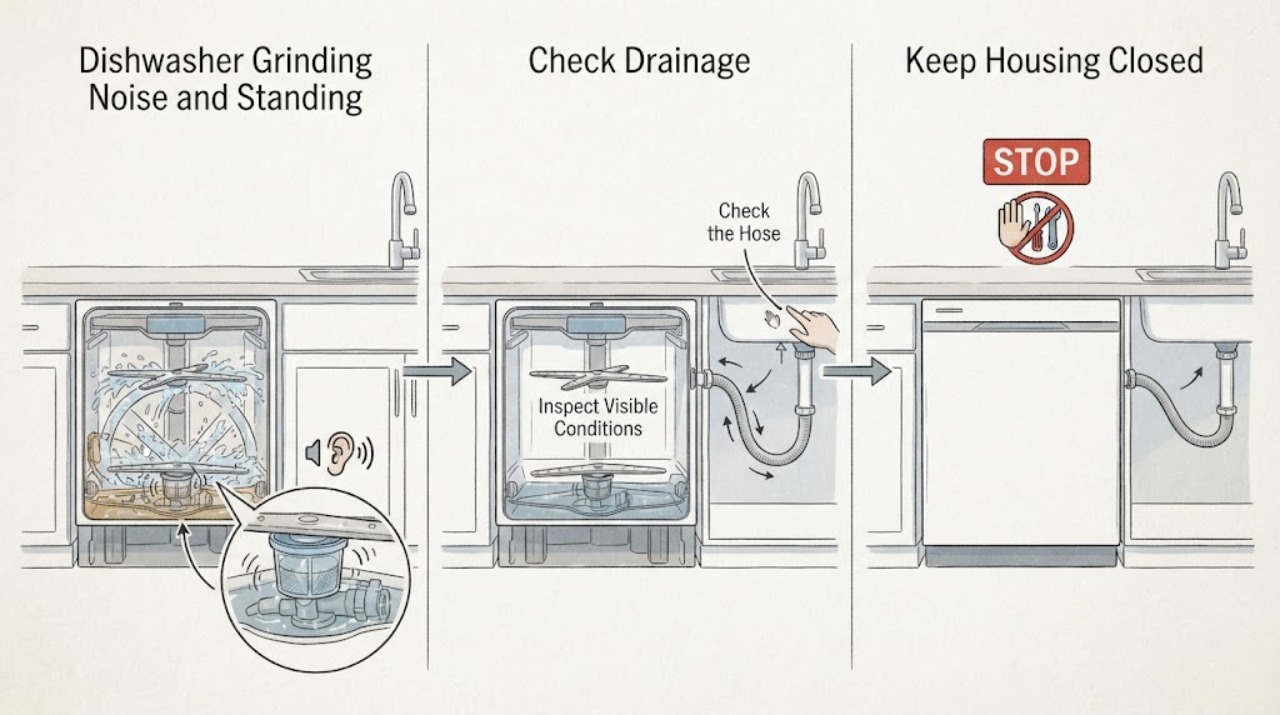
A Maytag dishwasher can leave a small amount of water in the filter area, but water covering the tub bottom after a completed cycle together with grinding needs a drain-path check. First cut power at the breaker, remove standing water safely, and inspect the model-appropriate filter or foreign-object cup and visible sump for debris. Then check the accessible hose, high loop, air gap, and garbage-disposal connection. Maytag says hard debris in the pump area can cause grinding, but that symptom alone does not prove a failed pump or identify a replacement part. Stop if there is a leak, burning smell, repeated breaker trip, or a check that requires opening internal components.
Work through in order
Diagnostic checks
Use only checks that match the exact appliance or system and its official guide.
-
Check 1
Stop the cycle and turn the dishwasher off at the circuit breaker before reaching into the tub or inspecting the drain path. Put on gloves, place towels at the door, and remove standing water with a cup, bucket, or hand pump.
Expected result: The control and lights are off and the water can be removed without touching wiring, or there is a burning smell, damaged wiring, a leak near electrical parts, or a breaker that trips again.
Next step: If the area is safe and dry, continue with the filter and drain-path checks. If any electrical warning or uncontrolled leak is present, leave the dishwasher off and arrange qualified service.
Why this matters
Why: Maytag says the control panel alone is not enough isolation for this work and recommends breaker shutoff. Its guidance treats burning, damaged wiring, repeated trips, and electrical concerns as service conditions.
-
Check 2
With power off, inspect and clean only the filter system or foreign-object cup shown for the exact Maytag model. Look at the visible sump for food, labels, seeds, toothpicks, or glass; rinse removable filters with warm water and a soft brush, then seat and lock every filter exactly as the manual shows.
Expected result: Debris is present in the filter, cup, or visible sump, the filter is damaged or incorrectly seated, or the area is clear and correctly assembled.
Next step: Remove only loose, reachable debris, reinstall the filter or cup without forcing it, and proceed to the external hose check. If glass is present, use gloves and stop if it is below a cover or cannot be removed safely.
Why this matters
Why: Maytag says objects in the filter can cause grinding, and that debris in the filter or sump can restrict drainage or reach the pump. A clear, correctly seated filter makes that user-level cause less likely but does not diagnose the pump.
-
Check 3
Inspect the accessible drain hose under the sink for kinks, crushing, sagging, or a recently changed disposal connection. Confirm the hose has the required high loop or that the air gap is clear, and check that a new garbage disposal does not still have its dishwasher knockout plug.
Expected result: The hose is kinked or low, the air gap or sink tailpiece is blocked, the disposal knockout plug remains, or the external drain route is clear.
Next step: Correct only an obvious external routing or connection issue. If disconnecting the hose is necessary, keep power off, place a pan under the connection, and use the model instructions; if the blockage is in household plumbing or the route is inaccessible, use a plumber or appliance technician.
Why this matters
Why: Maytag says incorrect hose routing, a blocked air gap or sink connection, and a retained disposal knockout plug can return wastewater to the tub or prevent drainage. This finding does not identify an internal pump failure.
-
Check 4
After the filter and external drain path are restored, run a short rinse or drain-capable cycle while observing from outside. Listen for when the grinding occurs and watch whether water exits through the sink connection or air gap without opening the cabinet or pump housing.
Expected result: The dishwasher drains normally, water backs up or spills at the sink connection, the pump hums with no water movement, or grinding returns while standing water remains.
Next step: If it drains, monitor the next complete cycle. If water backs up, stop and clear the downstream plumbing or arrange service. If the pump only hums, grinding persists, or water remains, stop user troubleshooting and request a model-specific diagnosis.
Why this matters
Why: Normal drainage after cleaning supports a filter or external restriction. Maytag associates water backup with the downstream hose or sink path and says a steady hum with no movement can indicate an obstruction in the pump area; recurring grinding can also mean hard debris near the pump, but neither observation proves a specific part failure.
-
Check 5
Use Maytag's manual lookup with the full model number before removing any lower access panel or discussing a pump, motor, valve, wiring, or control replacement. Record the cycle stage, water level, filter style, hose findings, and any error display for the service request.
Expected result: The exact manual gives a matching user-level drain procedure, or the grinding and standing water remain after the external checks and no model-specific procedure is available.
Next step: Follow only the matching manual's user-level steps. If the problem remains, arrange Maytag service and provide the recorded observations; do not order or install a guessed pump or motor.
Why this matters
Why: Maytag says manuals and literature are model-number specific, and its drain guidance reserves unresolved pump, valve, wiring, and control issues for professional diagnosis. A symptom alone cannot establish which internal component, if any, failed.
Use your observations
Decision map
Find the observation that best matches what you see, then follow the next safe action.
-
PATH 01Next step
What you see
Only a small amount of water remains around the filter area, the filter or foreign-object cup is clean and seated, and no water covers the tub bottom.
Do this next
Run a complete cycle while listening for a new or worsening sound. If draining becomes slow or water rises above the filter area, return to the drain-path checks.
Why this path and its safety boundary
Why it matters: Maytag says a small amount of filter-area water can be normal; a grinding sound may also be produced by a built-in chopper on some models.
-
PATH 02Next step
What you see
Water covers the tub bottom after the cycle and the filter, sump, hose, air gap, or disposal connection contains visible debris or a routing restriction.
Do this next
Power off, correct the safe external restriction, reassemble the exact filter style, and run a short observation cycle. Escalate if water remains.
Why this path and its safety boundary
Why it matters: The findings support a drain-path restriction or backflow condition before an internal part diagnosis.
-
PATH 03Next step
What you see
The hose and sink connection are clear, the exact filter is clean and seated, but grinding returns with a hum, no water movement, or standing water.
Do this next
Stop opening the appliance, do not bypass a safety device, and request model-specific service diagnosis rather than buying a guessed replacement part.
Why this path and its safety boundary
Why it matters: Maytag's diagnostic clues support an obstruction or internal drain-system issue, but they do not prove whether the pump, impeller, motor, valve, wiring, or control is at fault.
-
PATH 04Next step
What you see
There is a burning smell, damaged wiring, a leak near electrical parts, or repeated breaker tripping.
Do this next
Leave the breaker off, keep the area dry, and contact a qualified service technician. Do not run another cycle to test it.
Why this path and its safety boundary
Why it matters: Maytag identifies these as electrical or safety concerns outside the supported cleaning and hose checks.
Helpful context
Understand the symptom
Treat the timing and water level as separate clues
The supplied report describes a grinding sound during the cycle and water left in the tub. Maytag says some models can make a grinding sound because a built-in chopper is operating, but it also says objects caught in the filter can cause grinding. Standing water that remains only in the filter area can be normal; water covering the bottom after a completed cycle points toward a restriction or an interrupted drain that needs checking.
Use the exact Maytag manual for the filter style
Maytag documents more than one dishwasher filter arrangement. Some models have removable upper and lower filters; others use a foreign-object cup. The model number is required to choose the correct removal method, so do not force a filter, cup, cover, or pump access panel based on a different Maytag design.
When checks do not resolve it
Need a professional?
Contact Maytag service if the filter and external drain path are clear but the dishwasher still grinds and leaves water, if the pump only hums without moving water, or if any electrical, leak, or repeated-breaker symptom appears.
Common questions
FAQ
Is a small amount of water in a Maytag dishwasher normal?
Maytag says a small amount can remain in the filter area to keep seals from drying, but water filling the bottom after a completed cycle is more consistent with a clog, backflow, or interrupted drain and should be checked.
Can a Maytag dishwasher's normal chopper sound like grinding?
Yes, Maytag says some models have a built-in chopper that can make a grinding sound at different points in the cycle. Debris in the filter can also cause grinding, so compare the sound with the water level and inspect only the model-appropriate filter or foreign-object cup.
What should I check before blaming the drain pump?
Cut power, remove standing water, inspect the exact filter style and visible sump, then check the accessible hose, high loop, air gap, sink tailpiece, and disposal connection. Maytag says a restriction in those areas is common and that a grinding or humming symptom does not identify a replacement pump by itself.
Should I replace the pump if grinding continues?
Do not choose a pump from the symptom alone. Maytag recommends professional diagnosis when drainage does not improve after filter and hose checks; the actual cause could be debris, pump-area obstruction, valve, wiring, control, or another model-specific issue.
Read the exact guide
Official sources
- Dishwasher Troubleshooting: Tips for 6 IssuesMaytag · Used for small filter-area water, model-specific filter removal, soft filter cleaning, and drain-path decision boundaries; no internal pump compatibility claim is taken from this page.
- Maytag Manuals & LiteratureMaytag · Used only to direct readers to the exact model-number manual before using a model-specific filter, cup, pump-access, or service procedure.
- Grinding — DishwasherMaytag Product Help · Used for the Maytag-specific distinction between debris in the filter or foreign-object cup and a built-in chopper that can make a normal grinding sound; filter design varies by model.
- Dishwasher Not Draining — Product HelpMaytag Product Help · Used for model-independent Maytag drain-path checks, standing-water removal, safety preparation, visible filter/sump inspection, hose/high-loop/air-gap/disposal checks, diagnostic clues, and the boundary for professional service. Exact filter style and any internal repair remain model-specific.
- How to Unclog a Dishwasher That Won't DrainMaytag · Used for the distinction between normal filter-area water and excessive standing water, safe water removal, filter cleaning, air-gap checks, and the boundary that drain motor, valve and hose faults should be left to professionals.
Community feedback
Share a repair observation
Share a plain-text repair observation. Accepted observations are published automatically; this page may take a moment to update.