
On this page
Start here
Quick answer
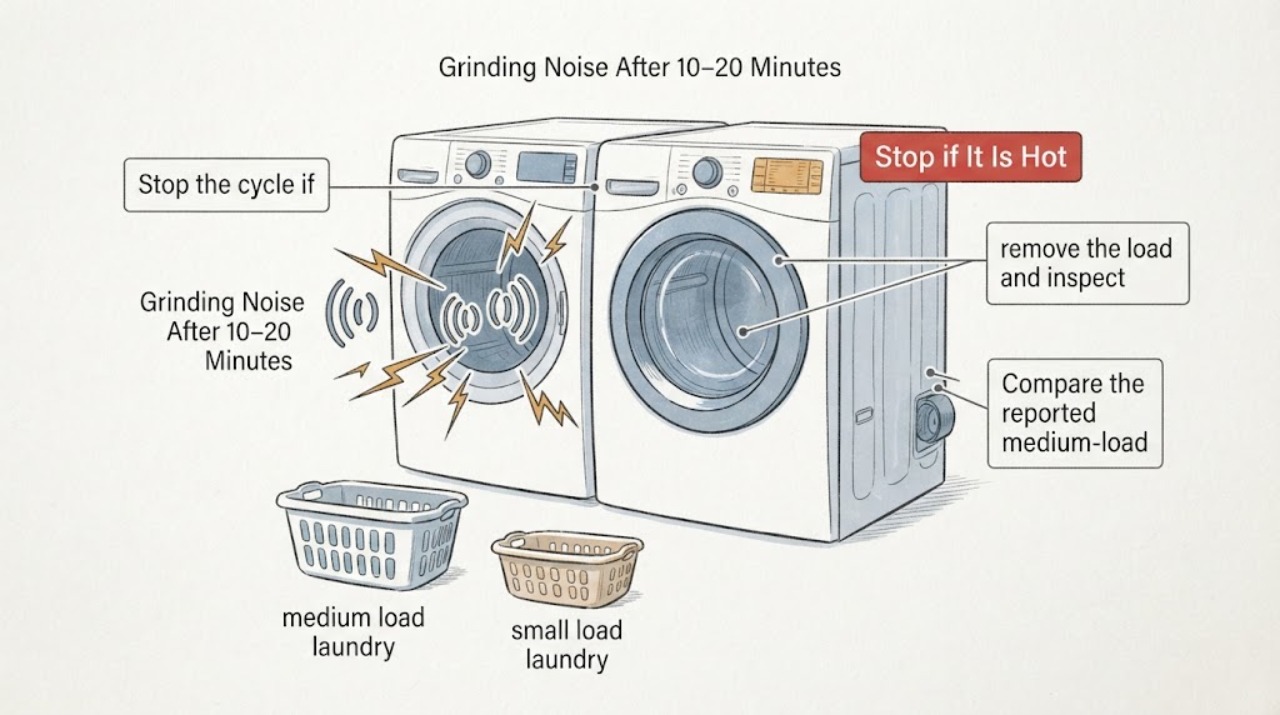
A brand-new Maytag MED5630HC may make a light roller sound during its first cycles, and a knotted or unbalanced load can vibrate, but a terrible grinding or rubbing noise that appears after 10–20 minutes should not be treated as a normal load sound. Stop the cycle if the noise is severe or is accompanied by scraping, burning odor, smoke, or loss of drum movement. With the dryer off and cool, check only the load, pockets, visible drum edges, nearby objects, and whether all four feet keep the dryer level. If the grinding remains with an ordinary or empty load, use Maytag support or the seller’s applicable warranty/service route; do not open the cabinet or guess at a bearing, belt, pulley, motor, or blower repair.
Before you begin
Safety first
- Do not remove the cabinet, reach the belt, motor, blower, rollers, bearings, or glides, bypass a safety control, or replace an internal part based only on the sound. Keep the dryer off if there is smoke, burning odor, hot electrical smell, repeated stopping, or loss of drum movement.
Work through in order
Diagnostic checks
Use only checks that match the exact appliance or system and its official guide.
-
Check 1
Stop the cycle if the grinding is severe, the drum stops or struggles, or there is smoke, a burning odor, or hot electrical smell. Leave the dryer off; only use a safely accessible normal disconnect or breaker if needed, and do not touch the cabinet, plug, or wiring while hot or energized.
Expected result: The sound is accompanied by a safety symptom, or it is only a noise with the drum still turning normally.
Next step: For smoke, burning odor, or an electrical concern, stay clear and arrange qualified appliance/electrical service. For noise only, wait until the dryer is stopped and cool before continuing with the external checks.
Why this matters
Why: A safety symptom raises the priority above a routine load or leveling check. A noise without those symptoms still needs external observation, but it does not identify an internal component.
-
Check 2
After the dryer is off and cool, remove the load and inspect the accessible drum opening and front/rear drum seams for a coin, clip, screw, zipper part, or other loose object. Clear only an object that is plainly accessible without removing a panel or reaching into the machine.
Expected result: A loose object is visible at the drum edge or the noise changes when a particular garment or hard item is removed, or nothing visible is found.
Next step: Remove the plainly accessible object and keep the dryer out of service if the sound persists. Do not reach into the blower, belt, motor, or cabinet interior.
Why this matters
Why: Maytag says small objects can catch at the drum seam and cause scraping, while pocket items can cause rattling or tapping. Finding nothing visible leaves mechanical causes unresolved; it does not prove a bearing or pulley failure.
-
Check 3
Compare the reported medium-load and small-load behavior without repeated full-cycle testing: note whether the sound follows a knotted/bulky load, occurs with ordinary items, or would also occur with the drum empty. Do not run the dryer merely to reproduce a severe grinding sound.
Expected result: The noise is limited to a balled or bulky load, or it occurs across ordinary loads and begins after the same warm-up interval.
Next step: Redistribute a load only when the sound is clearly load-related. If the noise returns with ordinary laundry or after the dryer warms, stop using the dryer and request service for the new MED5630HC.
Why this matters
Why: Maytag associates knotted or balled large items with thumping/vibration. A repeatable grinding interval across loads is less consistent with a simple load balance and remains an unresolved service issue.
-
Check 4
With the dryer stationary and cool, check that all four feet are installed and touch the floor, the cabinet is level front-to-back and side-to-side, and the dryer is not touching a wall, washer, pedestal item, or object resting on top. Make only the external leveling adjustment described for the installation.
Expected result: The dryer rocks, a foot is missing or loose, or a nearby object is contacting it; or the cabinet is stable and clear.
Next step: Correct the external contact or leveling issue and monitor only if the noise was mild and no safety symptom occurred. If the grinding remains, use Maytag/seller service rather than removing panels.
Why this matters
Why: Maytag says missing or uneven feet can cause rocking and noise, and nearby objects or the washer can transmit vibration. A stable, clear installation makes those external causes less likely but does not confirm an internal failure.
Use your observations
Decision map
Find the observation that best matches what you see, then follow the next safe action.
-
PATH 01Next step
What you see
The sound appears only with a tightly balled, bulky, or hard-item load and disappears after the load is safely redistributed or the item is removed.
Do this next
Use balanced loads and check pockets. If grinding returns with ordinary laundry, stop and request service.
Why this path and its safety boundary
Why it matters: A load or loose-item explanation is plausible, but the observation does not prove the dryer has no mechanical issue.
-
PATH 02Next step
What you see
The sound is a light roller noise on the first cycles after installation or a light thump after a long period of non-use, and it decreases as the dryer runs normally.
Do this next
Do not continue testing a severe noise. If the sound is loud, returns, or begins after the dryer warms, contact Maytag or the seller for service.
Why this path and its safety boundary
Why it matters: This matches Maytag's limited description of rollers conforming or recovering; it does not match a terrible persistent grinding sound.
-
PATH 03Next step
What you see
Grinding or rubbing persists with ordinary laundry, returns after a safe external check, occurs when the drum is empty, or begins at a repeatable point after 10–20 minutes.
Do this next
Keep the new MED5630HC out of use and arrange Maytag/seller warranty or authorized service. Do not open the cabinet or buy a guessed part.
Why this path and its safety boundary
Why it matters: Maytag says loud grinding can involve worn drum bearings or glides and may require a licensed technician, but the sound does not identify which component is affected.
-
PATH 04Next step
What you see
Smoke, burning odor, hot electrical smell, repeated stopping, or a drum that will not turn accompanies the noise.
Do this next
Leave the dryer off, keep clear of hot or energized parts, and contact qualified appliance/electrical service; use emergency or fire services if there is an active fire or immediate danger.
Why this path and its safety boundary
Why it matters: The situation needs a safety response rather than further sound diagnosis or repeated operation.
Helpful context
Understand the symptom
Separate a light startup roller sound from a grinding fault
Maytag says a roller sound during the first cycles after installation can decrease as the rubber rollers conform to the drum. It also describes a light thump after a period of non-use that should stop as flattened rollers recover. Those descriptions do not establish that a terrible grinding or vibrating sound beginning after 10–20 minutes is normal. A persistent grinding sound needs service evaluation rather than a guessed parts list.
Use the load and installation as the first decision points
With the dryer stopped and cool, check whether clothing is knotted or balled, whether a hard item is in a pocket, and whether anything is leaning against the cabinet or sitting on top of it. Maytag also says all four legs should be present and in contact with the floor, with the dryer level front-to-back and side-to-side. These checks can explain vibration or scraping without proving a failed bearing, pulley, belt, motor, or blower.
A new MED5630HC should be routed through support
The Maytag product record identifies MED5630HC and provides its model-specific support and service route. If the noise continues with a normal load, appears when the drum is empty, or returns after the dryer warms up, record when it starts and whether the drum keeps turning, then contact Maytag or the seller about the applicable warranty/service process. Do not open a new appliance or order an internal part from a sound guess.
When checks do not resolve it
Need a professional?
Contact Maytag or the seller for warranty or authorized service when grinding persists with ordinary or empty loads, returns after leveling and visible-object checks, starts after the dryer warms, or is present on a new MED5630HC. Seek qualified appliance/electrical help immediately for smoke, burning odor, hot electrical smell, repeated stopping, or loss of drum movement.
Safety scope: Do not remove the cabinet, reach the belt, motor, blower, rollers, bearings, or glides, bypass a safety control, or replace an internal part based only on the sound. Keep the dryer off if there is smoke, burning odor, hot electrical smell, repeated stopping, or loss of drum movement.
Have this ready
- Provide model MED5630HC, purchase/installation date, region, whether the sound occurs with an empty drum or ordinary load, when it begins, whether the drum keeps turning, and any smoke or odor. A short recording can help the service provider, but do not keep running the dryer to obtain one if the noise is severe.
Common questions
FAQ
Is a grinding or vibrating sound normal on a brand-new Maytag MED5630HC?
Maytag says a light roller sound during initial cycles can decrease, and a light thump after non-use can stop as rollers recover. A terrible grinding sound that persists, returns after warming, or occurs across loads is outside that limited description; stop and use Maytag or seller service rather than opening the dryer.
What can I safely check before calling for service?
With the dryer off and cool, check for loose pocket items at the visible drum seams, a knotted or bulky load, objects touching the cabinet, and all four feet contacting a level floor. Do not remove panels or reach the belt, motor, blower or drum supports.
Should I replace the rollers, belt, pulley, or bearings myself?
No component is confirmed by the sound alone. Maytag says loud grinding may involve drum bearings or glides and may require a licensed technician. For a new MED5630HC, preserve the warranty/service path and ask Maytag or the seller to evaluate it before any cabinet disassembly or parts purchase.
Read the exact guide
Official sources
- Sounds or Noises in a Dryer - Product HelpMaytag Product Help · The opened page states that missing or uneven legs can cause rocking, objects can catch at the drum seam, and nearby objects or the washer can transmit vibration. It directs owners to model-specific literature and service routes.
- Thumping Sound - Dryer - Product HelpMaytag Product Help · The opened page describes knotted/balled loads, first-use and non-use roller sounds, all-four-legs leveling, and contacting Maytag or scheduling service when help is still needed.
- Possible Fixes for a Dryer That’s Making Loud NoisesMaytag · The opened Maytag article distinguishes loose or unlevel legs, loose items, unbalanced loads, and internal wear possibilities. Its grinding section says loud grinding may involve worn drum bearings or glides and may need licensed service.
- Dryer Sounds and Noises - Product HelpMaytag Product Help · The opened Maytag Product Help page says initial roller sound can decrease as rollers conform, light thumping after non-use can stop as rollers recover, and pocket items can cause noise.
- MED5630HC | MaytagMaytag · The opened Maytag product page identifies MED5630HC as a Front Load Electric Dryer with Extra Power and Quick Dry cycle, 7.3 cu. ft., and exposes its support and schedule-service links.
Community feedback
Share a repair observation
Share a plain-text repair observation. Accepted observations are published automatically; this page may take a moment to update.