
On this page
Start here
Quick answer
If a Maytag dryer drum is not tumbling, stop using the dryer until you know why: the drum needs to rotate to circulate air, and continued operation can worsen a fault. First note whether the dryer has power, the door latches, and the motor is silent, humming, or running while the drum stays still. With the dryer unplugged, check for an obstruction and gently turn the empty drum by hand; unusual resistance can point to a seized drum, roller, bearing, or another mechanical problem. A motor sound with a stationary drum makes the drive belt or idler path more likely, while loud rumbling, squealing, or a drum that stops mid-cycle can involve rollers, bearings, motor, or control. Check only the exterior power and door conditions yourself; internal belt, pulley, motor, electrical, and gas-related work belongs to qualified service.
Before you begin
Safety first
- Homeowner-safe checks are observing the start behavior, visually checking the plug and breaker, confirming door and control-lock status, and gently rotating an empty drum only when the dryer is unplugged and cool. Cabinet access, internal drive or support diagnosis, electrical testing, gas work, safety-switch bypass, and damaged-component replacement belong to qualified professionals.
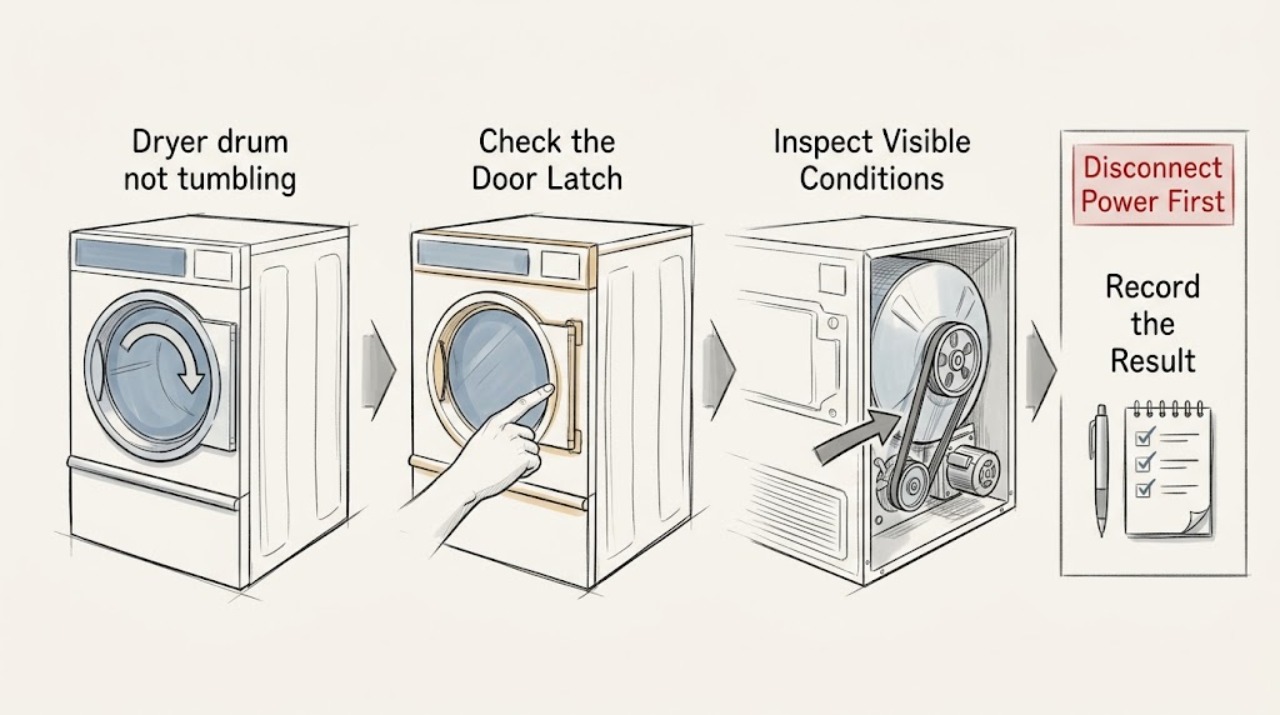
Work through in order
Diagnostic checks
Use only checks that match the exact appliance or system and its official guide.
-
Check 1
Remove the clothes and attempt one normal start from a dry, safe position while observing the display, interior light, motor sound, drum movement, and whether the door latch engages; stop immediately if there is smoke, burning, sparking, or unusual heat.
Expected result: The dryer is silent, the display is off, the door does not latch, the motor hums or runs, the drum remains still, or the drum starts and then stops.
Next step: Record the model and exact behavior, then stop using the dryer until the external checks below are complete. Do not hold the door switch closed or repeatedly start the cycle.
Why this matters
Why: Silence or no display keeps power, controls, and the door interlock in consideration. A running or humming motor with a stationary drum points more toward the belt or drive path, while mid-cycle stopping can involve the motor or another internal fault.
-
Check 2
Check the plug and outlet visually for a loose connection, scorching, damage, or signs of overheating, and look at the dryer circuit breaker or fuse panel for an obvious tripped condition; leave electrical measurements and outlet-cover work to a qualified professional.
Expected result: The plug is loose or damaged, the breaker appears tripped, the outlet shows heat damage, or the exterior power setup looks normal.
Next step: If there is no visible damage and you are comfortable doing so, follow the home panel instructions for one reset, then stop if it trips again. Do not continue operating with a damaged cord, outlet, or breaker; arrange a qualified electrician or appliance technician.
Why this matters
Why: An unplugged dryer or power interruption can prevent the motor from starting. Heat damage, repeated trips, or an uncertain supply requires electrical help rather than an appliance restart.
-
Check 3
Confirm the dryer door closes squarely and the latch engages, and check that no garment, foreign object, or active control-lock setting is preventing a normal start; do not bypass the door switch or force the latch.
Expected result: The door will not latch, a control-lock indicator is active, an object blocks closure, the door latches normally, or the dryer still does not tumble after the external check.
Next step: Remove only an obvious obstruction and use the model manual to change a control-lock setting. Service a worn latch, switch, or persistent no-start condition rather than defeating the interlock.
Why this matters
Why: A door latch, door switch, or control-lock condition can keep the dryer from starting the motor. A normal latch shifts attention to power delivery, drum resistance, belt, motor, or control.
-
Check 4
Unplug the dryer, wait for the drum and cabinet to cool, remove all clothing, and gently rotate the empty drum by hand from the opening; do not use tools or put hands near wiring or a hot gas appliance.
Expected result: The drum turns smoothly, is unusually hard to turn, feels loose or uneven, or has a scraping or grinding point.
Next step: Leave the dryer unplugged for hard, rough, or uneven movement and arrange service. Do not spray lubricant, force the drum, remove panels, or attempt to free a mechanical obstruction by running the motor.
Why this matters
Why: A normally movable drum makes a completely seized support system less likely. Strong resistance or rough movement can indicate a seized drum, roller, bearing, slide, or an obstruction that should be diagnosed before power is restored.
-
Check 5
Use the earlier sound observation to classify the drive path: compare a motor that runs or hums with a motionless drum against a silent motor, loud rumbling, squealing, or a drum that stops during a cycle; do not open the cabinet to inspect the belt or pulley unless qualified and the model procedure permits it.
Expected result: The motor runs while the drum stays still, the motor is silent, the dryer rumbles or squeals, or the drum stops mid-cycle.
Next step: Use these observations to give a technician a focused starting point, not to choose a part by symptom alone. Keep the dryer off and arrange service for any internal drive or support diagnosis.
Why this matters
Why: A motor-heard/no-drum pattern makes a broken or slipped drive belt more likely. Silence can involve power, door, control, motor, or wiring; rumbling or squealing makes rollers, idler, slides, or bearings possible; mid-cycle stopping can involve the motor or control.
-
Check 6
Check the selected cycle, start control, and control-lock indicator against the exact Maytag manual, then avoid repeated resets or test cycles if the drum remains still; do not bypass a safety switch to make the dryer run.
Expected result: The control-lock setting was active, the start command was not accepted, the cycle controls look normal, or the dryer still will not tumble after one normal start.
Next step: Correct only a clearly identified user setting from the manual. If the dryer still will not tumble, leave it off and arrange qualified service rather than opening the control console.
Why this matters
Why: A setting or start-input issue can prevent a motor command without a mechanical failure. A normal control state with persistent no-tumble behavior makes a drive, motor, wiring, or control fault more likely.
-
Check 7
Document the model number, dryer type, whether the drum turns by hand, motor sound, door-latch behavior, power-panel result, noise, odor, and whether the problem began suddenly or mid-cycle; do not diagnose a belt, motor, roller, bearing, or control board from one symptom.
Expected result: External checks are normal but the drum remains stationary, the dryer has a mechanical noise, the breaker trips, a burning odor appears, or cabinet access is required.
Next step: Keep the dryer unplugged and arrange qualified appliance service. For damaged electrical supply or repeated breaker trips, involve a qualified electrician; for gas odor, close the gas supply only if safe and leave the area for immediate danger.
Why this matters
Why: A persistent stationary drum after safe external checks is an internal repair decision. The recorded pattern helps separate belt, motor, support, control, and electrical paths without unsafe disassembly.
Use your observations
Decision map
Find the observation that best matches what you see, then follow the next safe action.
-
PATH 01Next step
What you see
The dryer has no display or response, the door does not latch, or the motor is silent, while the drum turns normally by hand when unplugged.
Do this next
Check only the visible plug, breaker, door closure, and manual-listed control-lock setting. Leave the dryer off for a damaged supply, repeated breaker trip, or persistent no-start condition.
Why this path and its safety boundary
Why it matters: Power delivery, a door switch or latch, control lock, start input, motor command, or control issue is more likely than a seized drum.
-
PATH 02Next step
What you see
The motor can be heard running or humming but the empty drum does not rotate.
Do this next
Do not keep running the dryer or open the cabinet as an improvised check. Arrange qualified service to inspect the belt, idler, drum supports, motor, and related wiring for the exact model.
Why this path and its safety boundary
Why it matters: The drive belt or another part of the drum-drive path is more likely than a simple control setting.
-
PATH 03Next step
What you see
The drum is difficult to turn by hand, feels rough or loose, or produces scraping, grinding, rumbling, or squealing noises.
Do this next
Keep power disconnected and arrange service. Do not force the drum, lubricate unknown parts, or run another load to see whether the noise improves.
Why this path and its safety boundary
Why it matters: A seized drum, roller, slide, bearing, idler, or another mechanical support problem is more likely.
-
PATH 04Next step
What you see
The drum starts and then stops mid-cycle, or the dryer stops after a loud noise or warm-up.
Do this next
Stop using the dryer and give the technician the timing, sounds, odor, and whether the drum turns freely when cool. Do not repeatedly reset or restart it.
Why this path and its safety boundary
Why it matters: The drive motor, belt or support load, thermal or control protection, or another internal fault may be involved; the symptom does not identify one part.
-
PATH 05Next step
What you see
There is a burning smell, smoke, sparking, a hot or damaged cord or outlet, repeated breaker trips, gas odor, exposed wiring, or any need to remove the cabinet while energized.
Do this next
Stop use and leave for smoke, fire, gas odor, or immediate danger. Disconnect power and close the gas supply only if safe and without contact with hot, energized, or leaking equipment; arrange qualified appliance and electrical help.
Why this path and its safety boundary
Why it matters: An electrical, fire, gas, or mechanical hazard is present and ordinary no-spin checks should stop.
Helpful context
Understand the symptom
Separate a no-start problem from a drive problem
A dryer that is completely silent has a different first branch from one whose motor runs but the drum does not move. Start with the power, door latch, control-lock, and cycle state. If the motor runs or hums while the drum remains stationary, the belt or drive path becomes more likely. If the drum is difficult to turn by hand when unplugged, treat that as mechanical resistance rather than a reason to keep trying cycles.
A stationary drum is a stop-use symptom
Maytag says continued use is not recommended when the dryer does not spin because tumbling circulates air through the load and a malfunction can cause further damage. Remove the load, let the dryer cool, and do not bypass the door switch, hold a latch closed, or open the cabinet while energized.
Use sound and hand movement as clues, not a parts diagnosis
A motor sound without drum movement can fit a broken or slipped belt, while rumbling, squealing, or a drum that becomes hard to move can fit rollers, an idler, bearings, or a seized drum. Those clues narrow the inspection, but only model-specific testing can establish which component failed.
Safety boundary
Stop conditions
- Do not continue using a Maytag dryer whose drum is not tumbling. Tumbling circulates air through the load, and continued operation can worsen the fault.
- Do not bypass the door switch, latch, thermal protection, or control lock, and do not hold a safety switch closed to make the drum run.
- Do not open the cabinet, test live voltage, work on wiring, or attempt belt, pulley, motor, roller, bearing, or gas-component replacement unless qualified and following the exact model procedure.
- Stop for a burning smell, smoke, sparking, damaged cord or outlet, repeated breaker trips, exposed wiring, severe mechanical resistance, or gas odor. Isolate power or gas only when safe.
- For smoke, fire, gas odor, or immediate danger, leave the area and use emergency assistance from a safe location.
Only after diagnosis
Potential parts
- dryer drive belt
Consider this only when a qualified diagnosis confirms that the motor runs or attempts to run while the drum remains stationary and the belt is broken, slipped, or damaged; no-tumble alone does not prove belt failure.
Belt length, rib pattern, routing, and tension vary by Maytag model. Confirm the complete model number and manufacturer fit information before ordering or installing. - dryer drive motor
Consider this only when model-specific testing separates a motor fault from power, door switch, belt, idler, drum support, wiring, and control issues, especially for a no-start or mid-cycle-stop pattern.
Motor shaft, rotation, wiring, thermal protection, and model compatibility vary. Confirm the exact model and manufacturer information before ordering or installing. - dryer drum roller or support kit
Consider this only when rough hand movement or rumbling noise and an internal inspection confirm worn, seized, or damaged drum supports rather than a belt or motor fault.
Roller size, shaft, support geometry, and whether a set is required vary by model. Confirm fitment from the exact manufacturer information. - dryer idler pulley or drum slide
Consider this only after a qualified inspection identifies a squeal, rattle, belt-tension problem, or worn drum support at the idler or slide path.
Pulley, bearing, slide, and mounting details vary by model. Confirm the complete model number and manufacturer fit information before ordering or installing.
When checks do not resolve it
Need a professional?
Safety scope: Homeowner-safe checks are observing the start behavior, visually checking the plug and breaker, confirming door and control-lock status, and gently rotating an empty drum only when the dryer is unplugged and cool. Cabinet access, internal drive or support diagnosis, electrical testing, gas work, safety-switch bypass, and damaged-component replacement belong to qualified professionals.
Common questions
FAQ
Why is my Maytag dryer running but the drum is not tumbling?
If you can hear the motor but the drum stays still, a broken, slipped, or damaged drive belt is one possibility. An idler, drum support, seized drum, or motor problem can produce a similar symptom, so stop using the dryer and have the internal drive path diagnosed rather than ordering a belt from the symptom alone.
Can I keep using a Maytag dryer if the drum does not spin?
No. Maytag does not recommend continuing to use a dryer that does not spin because tumbling circulates air through the load and a malfunction can cause further damage. Leave it off until the cause is identified.
What does it mean if the dryer drum is hard to turn by hand?
With the dryer unplugged and cool, strong resistance or rough movement can indicate a seized drum, roller, bearing, slide, obstruction, or another mechanical support problem. Do not force the drum or run the motor to free it; arrange qualified service.
Could a tripped breaker stop a Maytag dryer drum from tumbling?
Yes. Maytag lists the circuit breaker and power setup among no-spin possibilities. Visually inspect the plug, outlet, and breaker only; do not remove covers or test live voltage, and stop if the breaker trips again or there is heat damage.
Why does my Maytag dryer make noise and stop tumbling?
Rumbling, squealing, or rattling can involve drum rollers, an idler pulley, slides, bearings, belt tension, or the motor. A drum that stops mid-cycle can also involve the motor or control. Note the sound and timing, then arrange service rather than opening the cabinet as a guess.
When should a Maytag dryer with a stationary drum be serviced?
Arrange service when the drum remains still after safe power, door, control, and hand-movement checks, when the motor runs without drum movement, or when a belt, motor, roller, idler, bearing, control, wiring, or gas-related issue is possible. Stop immediately for smoke, burning, sparking, damaged electrical parts, repeated breaker trips, or gas odor.
Read the exact guide
Official sources
- How to Fix a Dryer That Won’t SpinMaytag · Maytag dryer guidance; exact controls, power configuration, and internal parts vary by model.
- What Are the Parts of a Dryer?Maytag · Maytag parts overview; locations, support designs, and replacement procedures vary by model.
- How Long Does a Dryer Take to Dry Clothes?Maytag · Maytag dryer performance guidance; model-specific troubleshooting and electrical requirements take precedence.
Community feedback
Share a repair observation
Share a plain-text repair observation. Accepted observations are published automatically; this page may take a moment to update.