
On this page
Start here
Quick answer
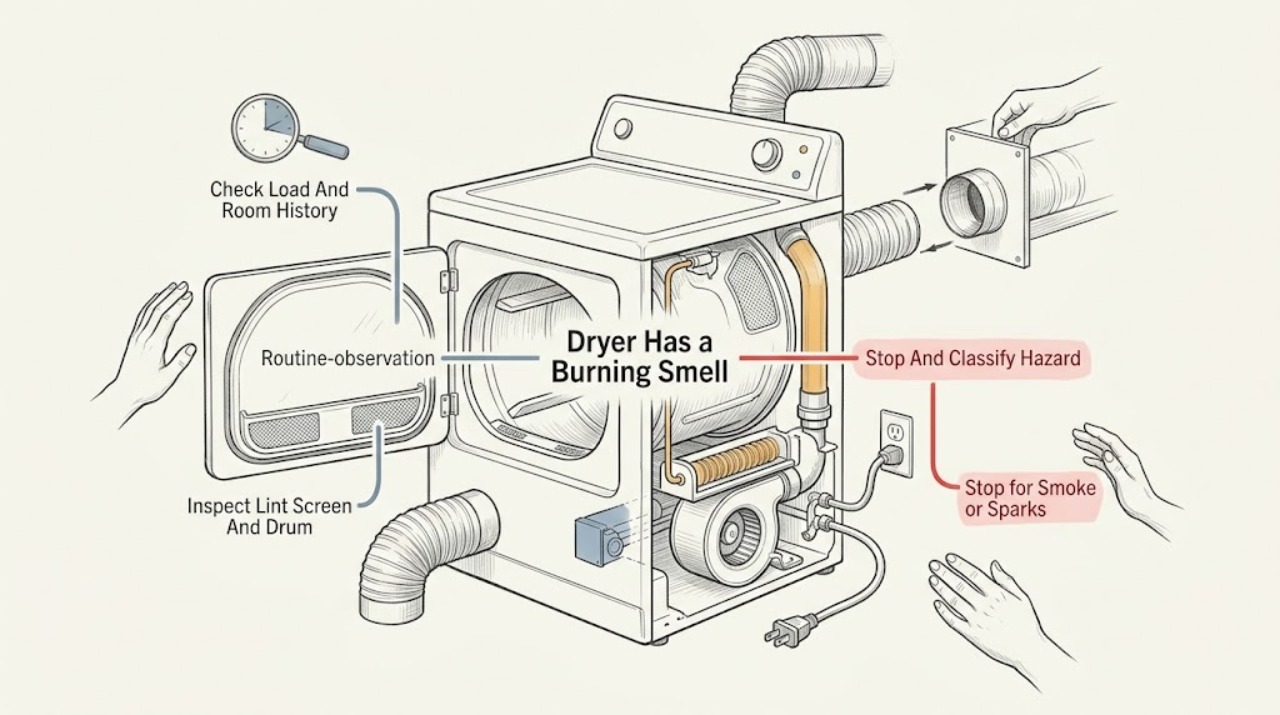
Stop using a Maytag dryer as soon as a burning smell appears and keep people away if there is smoke, a flame, intense heat, sparking, a hot cord, or a gas odor. Do not restart it to see whether the smell clears. From a safe position, note whether the odor came from the load, the drum, the exhaust, or the power or gas connection, and whether the dryer is new or was used near paint, stain, varnish, oil, solvents, or other chemicals. After the dryer is off and cool, inspect only the lint screen, visible lint around the door and vent area, the exterior exhaust hood, and the load; Maytag warns that lint or an obstructed vent can cause overheating and fire risk. A new dryer can have a temporary semi-burning or oily smell, but an unexplained, recurring, electrical, gas, or smoke-related odor still needs qualified service before further use.
Before you begin
Safety first
- This article supports stopping the dryer, clearing the area when hazardous, and ordinary-access visual observations of the load, lint screen, and visible vent only. It does not authorize cabinet or control access, gas or electrical work, heating or drive-part testing, duct disconnection, chemical cleaning, or operation after a safety sign.
Work through in order
Diagnostic checks
Use only checks that match the exact appliance or system and its official guide.
-
Check 1
Stop the dryer, keep the door closed if smoke or flames are present, and from a safe position note whether there is visible smoke, a flame, intense heat, sparking, a hot cord, or a gas-like odor. Do not touch the cabinet, cord, plug, or gas connection if hot, damaged, or wet.
Expected result: There is smoke, flame, gas odor, sparking, a hot or damaged cord, intense cabinet heat, or only an odor with no visible hazard.
Next step: Clear people and pets from the area for smoke, flame, or gas odor and contact the appropriate emergency or qualified service response; otherwise let the dryer cool and continue only with safe visual observations.
Stop if: Do not restart the dryer, use a switch or electrical equipment in a suspected gas leak, or handle hot or damaged equipment.
Why this matters
Why: Smoke, flame, gas odor, electrical signs, or intense heat are urgent safety conditions, not ordinary troubleshooting. An odor without a visible hazard still requires the dryer to stay off until its source is understood.
-
Check 2
After the dryer is off and cool, record what was in the load and whether it had contact with cooking or other oil, hair products, solvents, flammable fluids, industrial chemicals, or rubber-backed or foam materials. Note whether paint, stain, varnish, or refinishing occurred near the dryer.
Expected result: The dryer is new, the room had recent paint or finishing fumes, the load contains an oil or chemical history, or none of these conditions is present.
Next step: Do not dry a contaminated load or operate near active finishing fumes; ventilate the room only if safe, isolate the load, and follow the product and model instructions or qualified guidance before any reuse.
Stop if: Do not wash or dry solvent-, fuel-, or oil-contaminated items as an improvised odor fix, and do not run the dryer to test a questionable load.
Why this matters
Why: Maytag identifies a temporary odor in a new dryer and room fumes as possible non-fault sources, but oil- or chemical-contaminated loads can ignite or produce harmful fumes. No such history makes an airflow, heating, electrical, or mechanical source more important to rule out.
-
Check 3
With the dryer unplugged or otherwise safely isolated and cool, inspect the lint screen, lint-screen housing, visible drum surface, door seal area, and accessible vent opening for heavy lint, residue, melted material, scorch marks, or a foreign object. Clean only according to the exact model instructions; do not remove panels.
Expected result: Lint or residue is heavy, a foreign object or scorch mark is visible, the accessible areas look clean, or inspection would require cabinet access.
Next step: Keep all lint-screen parts correctly installed, photograph any residue or damage, and arrange service for scorch marks, melted material, a concealed source, or an odor that remains after safe cleaning.
Stop if: Do not scrape heating parts, vacuum into an unknown opening, use flammable cleaners, or operate without the lint screen.
Why this matters
Why: Lint buildup or a load residue can support an overheating or odor source, but scorch marks, melted material, or a hidden area cannot be safely diagnosed from outside. Clean accessible lint only when no damage or active hazard is present.
-
Check 4
From outside the appliance, inspect the visible vent run for crushing, kinks, lint, or a section pressed against the dryer, and inspect the exterior exhaust hood for lint, debris, nests, or a blocked opening. Do not pull the dryer out or disconnect the duct.
Expected result: The lint screen is dirty, the visible duct is crushed or kinked, the outside hood is restricted, exhaust airflow is weak when a safe model-approved check is available, or the vent path looks clear.
Next step: Leave the dryer off and arrange professional vent cleaning or inspection for a restricted, damaged, inaccessible, or uncertain vent path; do not compensate with a hotter or longer cycle.
Stop if: Do not move a connected dryer, insert tools into the duct, burn out lint, or run the appliance when the vent is crushed or blocked.
Why this matters
Why: Maytag identifies lint, crushed or kinked venting, exterior blockage, and restricted airflow as overheating and fire-risk concerns. A clear visible run does not rule out an inaccessible restriction inside the home vent.
-
Check 5
Without restarting the dryer, record whether the odor was strongest near the drum, rear exhaust, control area, power cord, or gas connection and whether it followed a scraping, squealing, humming, or stopped-drum symptom. Do not open the cabinet or test wiring.
Expected result: The odor is strongest at the cord or control area, near the rear vent, inside the drum, or with a distinct mechanical sound or drum problem.
Next step: Leave the appliance off and give the pattern to a qualified appliance technician or electrician; include whether the dryer is electric or gas and whether a breaker, fuse, or gas-control symptom occurred.
Stop if: Do not remove panels, tighten terminals, inspect a gas valve, or use live electrical tests as a consumer check.
Why this matters
Why: A cord or control-area odor can indicate an electrical fault, a rear-vent odor can accompany airflow or lint overheating, and an odor with a mechanical sound can point toward a drive or support issue. Location alone cannot safely identify a component.
-
Check 6
After the dryer has cooled, compare the documented pattern with the model manual and Maytag support guidance. Do not perform a test cycle unless a qualified professional or the exact model instructions explicitly establish that the observed odor was a non-hazardous new-appliance or room-fume condition and no safety sign remains.
Expected result: The odor was clearly tied to a documented non-fault condition and is gone, the source is unexplained or recurring, or any smoke, heat, gas, electrical, lint, or mechanical sign remains.
Next step: Keep the dryer off and arrange qualified service for any unresolved, recurring, or damage-related odor; provide the model, load history, vent observations, and exact odor timing.
Stop if: Do not run a no-load cycle to mask an unexplained smell or use the dryer after smoke, intense heat, gas odor, sparking, or visible damage.
Why this matters
Why: A clearly resolved new-appliance or room-fume odor may follow the model's instructions, but an unexplained or recurring burning smell is not a normal-use condition. Any remaining safety or damage sign requires service before reuse.
Use your observations
Decision map
Find the observation that best matches what you see, then follow the next safe action.
-
PATH 01Safety boundary
What you see
The odor is gas-like or there is smoke, flame, sparking, a hot or damaged cord, or intense cabinet heat.
Do this next
Clear the area and contact the appropriate emergency or qualified service response; do not use the dryer or nearby electrical equipment in a suspected gas leak.
Why this path and its safety boundary
Why it matters: This is an immediate gas, fire, electrical, or thermal hazard rather than a routine odor to diagnose by restarting.
Safety stop: Do not operate switches, restart the dryer, handle damaged equipment, or attempt internal repair.
-
PATH 02Safety boundary
What you see
The dryer is newly installed, there is no smoke, gas odor, unusual heat, damage, or electrical sign, and Maytag's described temporary semi-burning or oily smell matches the observation.
Do this next
Follow the model manual and Maytag guidance, document whether the odor disappears, and stop and request service if it persists, intensifies, or changes character.
Why this path and its safety boundary
Why it matters: A new-appliance odor is possible, but the safety signs must remain absent and the exact model instructions still govern any first-use procedure.
Safety stop: Do not treat a new-dryer explanation as permission to continue when smoke, intense heat, gas odor, damage, or a recurring burning smell appears.
-
PATH 03Safety boundary
What you see
The odor follows recent paint, stain, varnish, or refinishing, or the load has an oil, solvent, flammable-fluid, or industrial-chemical history.
Do this next
Keep the dryer off, ventilate only from a safe position, isolate the load, and follow the chemical or garment-care instructions or qualified guidance before reuse.
Why this path and its safety boundary
Why it matters: The dryer may be pulling in room fumes or heating a hazardous load, not producing a simple internal odor.
Safety stop: Do not dry contaminated items, use the dryer to remove fumes, or operate near active finishing work.
-
PATH 04Safety boundary
What you see
The lint screen or vent has buildup, the duct is crushed or kinked, exhaust is weak, dry times increased, or the cabinet is unusually warm.
Do this next
Leave the dryer off, clean only the accessible lint screen as instructed, and arrange professional vent cleaning or inspection for the duct, hood, or inaccessible run.
Why this path and its safety boundary
Why it matters: Restricted airflow can retain heat and lint and creates an overheating and fire-risk concern.
Safety stop: Do not run hotter or longer cycles, operate with a blocked vent, or move the dryer to reach a duct.
-
PATH 05Safety boundary
What you see
The visible lint and vent path are clear, but the burning odor returns with a scraping, squealing, humming, stopped drum, unusual heat, or odor concentrated inside or behind the cabinet.
Do this next
Keep the dryer off and arrange qualified appliance service; provide the sound, drum behavior, odor location, and whether the dryer is electric or gas.
Why this path and its safety boundary
Why it matters: A heating component, blower, belt, support, motor, wiring, or another internal fault is more likely than a removable lint issue.
Safety stop: Do not open the cabinet, lubricate a drive part, inspect live wiring, or replace a heating or drive component by guesswork.
-
PATH 06Safety boundary
What you see
The smell is not explained by a new appliance, room fumes, load contamination, lint, or visible vent condition, or it returns after a previous service or cleaning.
Do this next
Leave the dryer off and arrange qualified service or vent inspection, carrying the model, timing, odor location, and all safe observations.
Why this path and its safety boundary
Why it matters: An unresolved appliance or installation fault remains possible and cannot be cleared safely by repeated use.
Safety stop: Do not mask the odor with cleaners, run empty cycles, or continue use because the dryer still heats or tumbles.
Helpful context
Understand the symptom
Treat a burning odor as a stop signal first
A warm exhaust is expected during normal drying, but Maytag says the dryer should not give off a burning smell or intense heat. Turn the dryer off and let it cool without restarting it. If the smell is gas, smoke is visible, the cabinet or cord is very hot, or there are sparks or flames, clear the area and use only a safe emergency shutoff or qualified response; do not operate nearby electrical equipment in a suspected gas leak.
Separate a load or room odor from a dryer fault
Maytag notes that a new gas or electric dryer may give off a temporary semi-burning or oily smell, and that paint, stain, or varnish fumes in the room can be pulled into the dryer. Oil-affected or solvent-contaminated items create a separate fire hazard and should not be treated as an ordinary load. Record the load and room history before deciding that the odor comes from an internal dryer part.
Check lint and airflow only from ordinary access
Lint is combustible, and Maytag explains that buildup in the drum or vent can obstruct airflow, cause overheating, and create a fire hazard. When the appliance is off and cool, clean the lint screen as directed and look at the visible vent run and outside hood without moving the dryer. A crushed duct, weak exhaust, long dry times, or a very warm cabinet calls for vent service rather than more heated cycles.
Do not guess at a heating or drive part
A burning smell can come from lint, a contaminated load, a vent problem, a shifted heating component, a blower, a belt or support, wiring, or another model-specific fault. A visible smell location cannot identify the failed part. Maytag's support guidance directs owners to manuals and professional service for unknown appliance issues; keep the dryer off until the cause is assessed.
Safety boundary
Stop conditions
- Stop immediately and clear the area for a gas-like odor, smoke, flame, sparks, intense heat, a hot or damaged cord, or visible fire damage.
- Do not use the dryer or nearby electrical equipment in a suspected gas leak and do not restart the appliance to see whether the odor clears.
- Do not dry oil-, solvent-, fuel-, industrial-chemical-, rubber-, or foam-contaminated items as an odor test.
- Do not open panels, inspect live wiring or gas components, move the appliance to reach the vent, or use flammable cleaners.
- Stop normal-use troubleshooting and arrange qualified appliance or vent service for any unexplained, recurring, or damage-related burning smell.
Only after diagnosis
Potential parts
- dryer heating element or heat-control assembly
Consider this category only when qualified diagnosis identifies a shifted, damaged, or electrically faulty heating assembly after lint, venting, load, and room-fume causes are ruled out.
Confirm the complete Maytag model and exact heat-system design; heating and electrical work should be performed by a qualified technician. - dryer blower wheel or airflow assembly
Consider this category only when a technician isolates the odor, overheating, or abnormal sound to the blower or airflow assembly rather than the vent run or lint screen.
Verify exact model and airflow assembly before ordering; do not open the cabinet or operate with restricted exhaust. - dryer drive belt, idler, or drum-support assembly
Consider this category only when qualified diagnosis links the burning odor to a drive or support fault accompanied by scraping, squealing, binding, or abnormal drum movement.
Confirm exact Maytag model and drive design and use qualified installation; do not lubricate or replace moving parts from odor alone.
When checks do not resolve it
Need a professional?
Arrange qualified appliance service before reuse for any unexplained or recurring burning smell, an odor with scraping, squealing, humming, stopped-drum, or unusual-heat symptoms, visible scorch or melted material, a suspected heating or drive fault, or an electrical or gas connection concern. Arrange professional vent inspection for lint buildup, weak exhaust, crushed or kinked ducting, a blocked hood, or an inaccessible vent run. For gas odor, smoke, flames, sparks, intense heat, or a hot or damaged cord, clear the area and use the appropriate emergency or qualified response.
Safety scope: This article supports stopping the dryer, clearing the area when hazardous, and ordinary-access visual observations of the load, lint screen, and visible vent only. It does not authorize cabinet or control access, gas or electrical work, heating or drive-part testing, duct disconnection, chemical cleaning, or operation after a safety sign.
Common questions
FAQ
What should I do first if my Maytag dryer smells like it is burning?
Stop the dryer and do not restart it. Check from a safe position for smoke, flame, gas odor, intense heat, sparks, a hot cord, or a damaged cabinet. If any appears, clear the area and use the appropriate emergency or qualified response; otherwise let the appliance cool before safe visual checks.
Can a new Maytag dryer have a burning smell?
Maytag says a new gas or electric dryer can emit a temporary semi-burning or oily smell. That explanation applies only when there is no smoke, gas odor, intense heat, electrical sign, damage, or recurrence. Follow the exact model instructions and arrange service if the odor persists or worsens.
Can a clogged vent cause a burning smell?
A blocked or crushed vent can restrict airflow, retain heat, and create a fire-risk condition. Leave the dryer off, inspect the lint screen and visible vent or exterior hood without moving the appliance, and arrange professional vent cleaning or inspection for a restricted or inaccessible run.
Can clothes cause a burning smell in the dryer?
Yes. Oil-, solvent-, fuel-, industrial-chemical-, rubber-, or foam-contaminated items can create fire or harmful-fume hazards. Do not run a questionable load to test the smell; isolate it and follow the garment-care and safety instructions or qualified guidance.
Is it safe to clean the dryer drum after a burning smell?
Only after the dryer is off, cool, safely isolated, and no hazard or damage is present. Maytag supports ordinary cleaning with appropriate nonflammable materials, but cleaning does not authorize panel access or erase an unexplained odor, scorch mark, melted material, or airflow problem.
When should I call for Maytag dryer service?
Arrange service before reuse for an unexplained or recurring burning smell, intense heat, a hot or damaged cord, scorch marks, smoke, sparks, a mechanical symptom, or a restricted vent that ordinary access cannot correct. A gas odor, flame, or active fire requires clearing the area and the appropriate emergency response.
Read the exact guide
Official sources
- USER INSTRUCTIONSMaytag · Official Maytag user-instruction PDF for a Maytag electric washer/dryer model family; the safety principles are used here for odor triage, while the reader's exact manual controls model-specific operation.
- Removing Odors or Smells - DryerMaytag Product Help · Official Maytag Product Help article for dryer odors; its new-appliance and room-fume guidance does not clear an unexplained burning smell or safety sign.
- Dryer Vent may be Blocked or RestrictedMaytag Product Help · Official Maytag Product Help article for blocked or restricted dryer vents; it supports symptom recognition and ordinary-access observation, not concealed duct repair.
- How Hot Does a Dryer Get?Maytag · Official Maytag manufacturer article for dryer heat and overheating symptoms; exact model instructions and qualified service control repairs.
- How to Check VentingMaytag Product Help · Official Maytag Product Help article for dryer venting and airflow; ordinary-access checks must not involve moving a connected appliance or entering an inaccessible duct.
Community feedback
Share a repair observation
Share a plain-text repair observation. Accepted observations are published automatically; this page may take a moment to update.