
On this page
Start here
Quick answer
Stop using the Maytag MEDC200XW1 immediately if its heating element comes on when no cycle is running, stays hot after the drum stops, or a cycle becomes dangerously hot. If it is safe to reach, turn it off and unplug it; otherwise have the circuit disconnected by a qualified person. Keep lint and flammable materials away, and use emergency help for smoke or fire. Do not run another test cycle, bypass a thermal fuse, open the cabinet, measure live voltage, or replace the element based on a guess. Maytag says restricted airflow can contribute to overheating, while damaged heating elements, thermal fuses and electrical issues require professional service; rural parts availability is not a reason to keep using a dryer that may overheat.
Before you begin
Safety first
- Do not reconnect the dryer to test it, remove the cabinet, measure live voltage, bypass a thermal fuse or thermostat, bridge wiring, substitute a part, or continue using it because replacement parts are delayed.
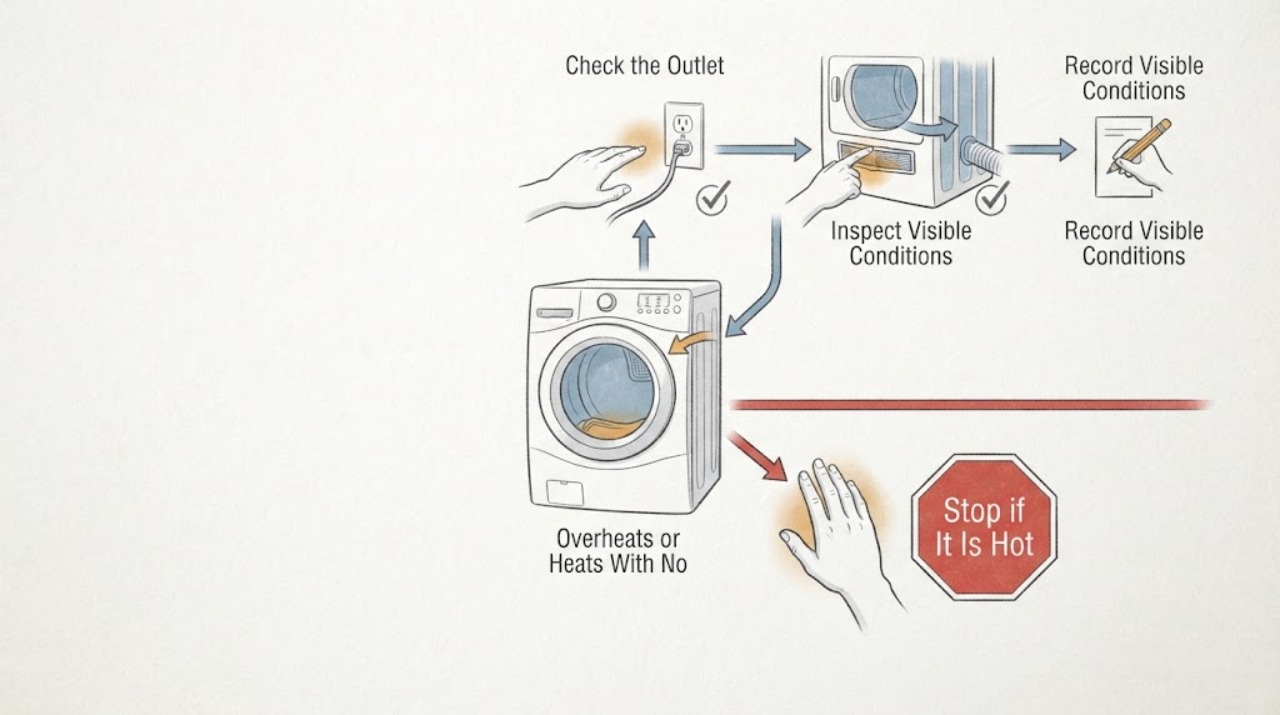
Work through in order
Diagnostic checks
Use only checks that match the exact appliance or system and its official guide.
-
Check 1
Stop the dryer and remove power if the plug and disconnect are safe to reach. If there is smoke, flame, an electrical odor, a hot plug or outlet, or visible arcing, move away and use emergency or qualified electrical help instead of approaching the appliance.
Expected result: The dryer is safely disconnected and cool, or an active fire/electrical hazard prevents a safe approach.
Next step: Keep the dryer disconnected and keep combustibles away. Use emergency help for smoke or fire and qualified appliance/electrical service for diagnosis.
Why this matters
Why: A heater that can energize unexpectedly or create excessive heat is a potential fire hazard. The immediate decision is to remove the dryer from service, not to identify a component while powered.
-
Check 2
With power disconnected and the dryer fully cool, inspect only the lint screen, the visible vent hose and the outside vent hood. Look for lint accumulation, a crushed or obstructed hose, or a hood that is visibly blocked; do not operate the dryer to check airflow.
Expected result: A visible lint or airflow restriction is present, or the visible path is clear but the heater previously ran unexpectedly or overheated.
Next step: Arrange qualified cleaning or service, especially if lint is inside the cabinet or the heater energized outside a cycle. Do not run a confirmation cycle until the cause is cleared by service.
Why this matters
Why: Restricted airflow can increase heat stress and fire risk, but clearing an external obstruction does not prove that an idle heater or control fault is fixed.
-
Check 3
Record the exact model and serial label, the selected cycle, whether the heater was active while the dryer was idle, whether the drum had stopped, any smoke or odor, and whether a thermal protection device or breaker operated. Do not remove a panel to reach a label or component.
Expected result: The label confirms MEDC200XW1 and the event history shows idle heating, excessive heat, a stopped drum, an odor, or a protective trip.
Next step: Give the complete model/serial and event history to Maytag or a qualified dryer technician. Request the exact service and parts determination before ordering anything, especially where shipping takes time.
Why this matters
Why: These observations help a technician scope the service call, but they do not distinguish an element, thermostat, timer, wiring or airflow cause remotely.
-
Check 4
Check the room around the disconnected dryer for lint, clothing, boxes or other materials that could burn, and keep the exhaust area clear while waiting for service. Do not reconnect the dryer just because the exterior appears normal.
Expected result: Combustible material or lint is present near the dryer, or the area is clear but the unexplained overheating event remains.
Next step: Remove only loose, accessible combustibles from the area and leave the dryer disconnected. Have qualified service inspect the heating and protection system before use.
Why this matters
Why: Combustibles increase the consequence of another overheating event. A clear room does not establish that the heating circuit is safe.
Use your observations
Decision map
Find the observation that best matches what you see, then follow the next safe action.
-
PATH 01Next step
What you see
The heating element glows or heats when no cycle is running, remains hot after the drum stops, or the dryer becomes dangerously hot.
Do this next
Keep the dryer disconnected and arrange qualified appliance/electrical diagnosis. Do not run another cycle, bypass thermal protection or perform a live test.
Why this path and its safety boundary
Why it matters: This is an abnormal heating/control event with fire risk. The symptom does not identify whether the element, timer, thermostat, wiring, airflow or another part is responsible.
-
PATH 02Next step
What you see
The lint screen or visible exhaust path is blocked, crushed or obstructed, but no electrical warning sign was observed.
Do this next
Leave the dryer off while the airflow path is professionally cleaned or verified, then have the unexpected heating history evaluated before restoring use.
Why this path and its safety boundary
Why it matters: Restricted airflow can stress the heating system and raise fire risk, but it does not prove that clearing the path repaired unexpected heater operation.
-
PATH 03Next step
What you see
Smoke, flame, burning odor, melted wiring, a hot plug/outlet or repeated breaker/thermal protection operation occurred.
Do this next
Move away and use emergency help for fire or smoke. Keep power disconnected and have qualified appliance and electrical professionals inspect the dryer and supply before any use.
Why this path and its safety boundary
Why it matters: This is a fire or electrical safety event, not a routine heating-element replacement decision.
Helpful context
Understand the symptom
Unexpected heat is a stop-use symptom
A dryer that energizes its heater while idle or becomes far hotter than its selected cycle has a safety problem that cannot be cleared by another test run. The symptom does not prove that the heating element itself is the failed part: Maytag's guidance discusses airflow, heating elements and thermal protection as separate possibilities, and its professional-service guidance covers heating, thermal-fuse and electrical issues.
Only make safe external checks after power is off
After the dryer is disconnected and cool, look at the lint screen and the visible exhaust path for obvious blockage, crushing or a closed outside hood. Do not remove the cabinet, reach toward the heater, bypass a fuse, or take electrical measurements. A clean visible vent does not prove the internal heater-control circuit is safe.
Parts availability does not change the boundary
The task notes that parts are difficult to obtain in rural Alaska. That affects scheduling, not the safe decision: leave the dryer disconnected while obtaining the exact model-specific service or part determination. Do not substitute an element, thermostat, timer or fuse by appearance, resistance reading or another dryer's listing.
When checks do not resolve it
Need a professional?
Call qualified appliance service before using the dryer again for idle heating, excessive heat, heat after the drum stops, repeated thermal protection or breaker operation, smoke, burning odor, damaged wiring, or any suspected heating/control fault. Use emergency help for active smoke or fire.
Safety scope: Do not reconnect the dryer to test it, remove the cabinet, measure live voltage, bypass a thermal fuse or thermostat, bridge wiring, substitute a part, or continue using it because replacement parts are delayed.
Have this ready
- Provide the exact Maytag MEDC200XW1 model and serial, the cycle and timing, whether the heater ran while idle, whether the drum stopped, visible vent/lint findings, and any odor, smoke, heat or protective-trip event. Explain that parts may need remote shipping but do not request a guessed part.
Common questions
FAQ
Why would the Maytag MEDC200XW1 heater turn on when the dryer is not running?
The symptom does not prove one cause. It can involve the heating/control circuit, thermal protection, wiring or airflow, and it is unsafe to distinguish those remotely. Keep the dryer disconnected and have qualified service diagnose it.
Can I run one short cycle to see if it overheats again?
No. Unexpected heater operation and dangerous heat are stop-use symptoms. Do not restore power or bypass protection for a test; arrange professional diagnosis first.
Can I order a heating element while I wait for service in rural Alaska?
Do not order by symptom or appearance. Maytag identifies several possible heating, airflow and protection issues, and heating-element or thermal-fuse work requires disassembly. Give the exact model and event history to qualified service before selecting a part.
Read the exact guide
Official sources
- Appliance and Electrical Fire SafetyU.S. Fire Administration · Opened the official USFA appliance-fire page. It supports keeping major appliances directly connected, avoiding damaged cords and recognizing lint-related dryer fire risk; it does not prescribe internal dryer repair.
- Service & Support Owners CenterMaytag · Opened Maytag's official Owner's Center. It confirms that support inquiries need model and serial numbers and shows dryer model-number locations; it does not provide a repair procedure.
- Overheated Clothes Dryers Can Cause FiresU.S. Consumer Product Safety Commission · Opened the official CPSC safety-guide page. It establishes the fire-risk context for overheating and links the official safety alert; it is not used to diagnose the Maytag element or control circuit.
- Dryer Too HotMaytag Product Help · Opened Maytag's official dryer-overheating support page. It supports family-level external airflow checks and service escalation for the assigned Maytag dryer; it does not diagnose MEDC200XW1 internal components or authorize a powered test after unexpected heating.
- Troubleshooting Why a Dryer Isn’t HeatingMaytag · Opened Maytag's official guidance. It is used for general safety and service boundaries rather than an exact MEDC200XW1 wiring or part diagnosis; Maytag explicitly says heating-element and thermal-fuse work requires disassembly and recommends professional service.
- Appliance Manuals and LiteratureMaytag · Opened Maytag's official manuals portal. It requires entering the appliance model to obtain the matching manual and is used only to direct model-specific service lookup, not as evidence of MEDC200XW1 internal procedures.
Community feedback
Share a repair observation
Share a plain-text repair observation. Accepted observations are published automatically; this page may take a moment to update.