
On this page
Start here
Quick answer
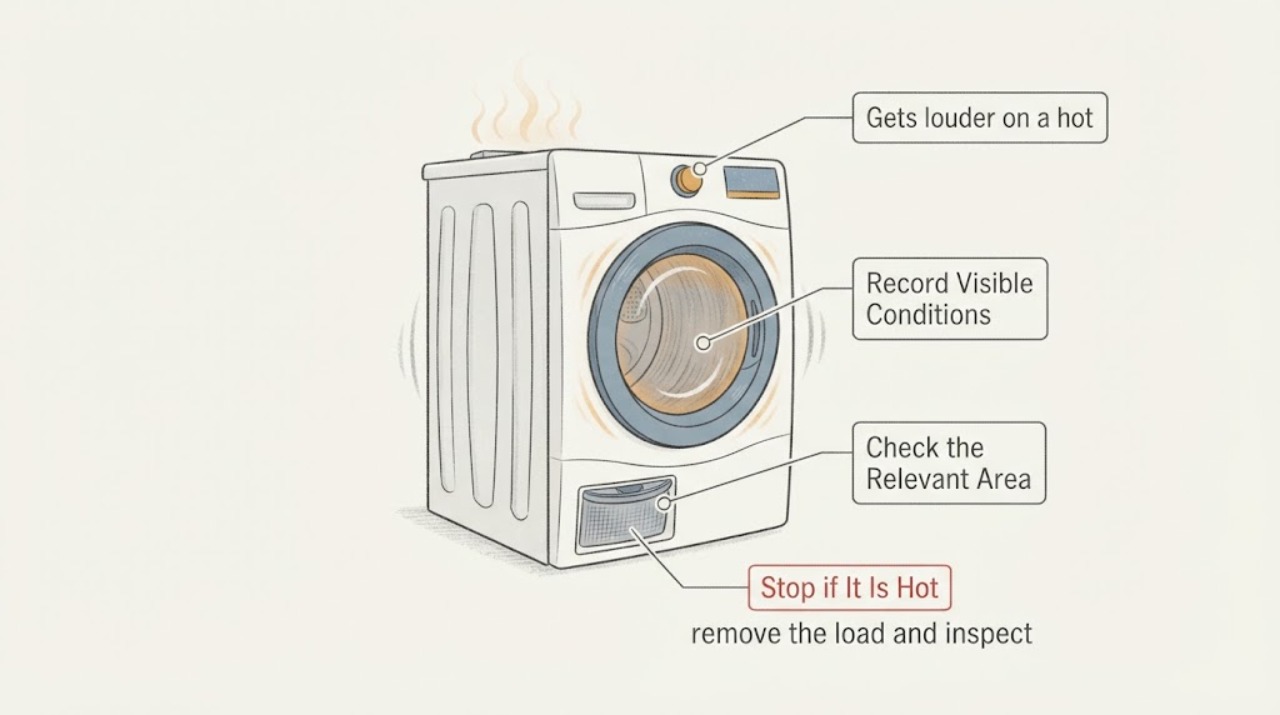
If the Maytag MDE2400AZW becomes progressively louder on a hot setting, stop it immediately for smoke, a burning or electrical smell, sparks, scorching, unusual heat, violent movement, or a breaker that opens again. Otherwise, stop the cycle, let the drum cool, and record whether the sound follows drum rotation, starts only as the heater and airflow come on, changes with the load, or continues after stopping. The model's MD-24 guide describes normal heater cycling and a hum from fast-moving air, but a new or worsening scrape, grind, rumble, rubbing sound, weak exhaust, or overheating is not identified by the setting alone. Clean and reseat the lint filter, check the accessible outside vent and clearance, and remove only plainly visible load or seam objects. If the noise returns with a light load or empty drum, follows rotation, persists after cooling, or is accompanied by weak airflow or excess heat, leave the dryer off and arrange qualified service; do not open the cabinet or guess at a roller, belt, blower, or motor.
Work through in order
Diagnostic checks
Use only checks that match the exact appliance or system and its official guide.
-
Check 1
Press Stop or Power Off, wait for the drum to stop, and let the dryer cool. From outside the appliance, record smoke, a burning or electrical smell, sparks, scorching, unusual cabinet heat, violent movement, or a breaker that opened.
Expected result: The dryer is cool and intact with none of those warnings, or a fire, electrical, thermal, or mechanical warning is present.
Next step: If any warning is present, keep the dryer off, isolate power only when safe and permitted, and arrange qualified appliance or electrical help. If there is no warning, continue with the sound-timing record.
Stop if: Do not restart to reproduce smoke, burning odor, sparks, scorching, excessive heat, violent movement, or a repeated breaker trip.
Why this matters
Why: A warning sign makes another hot-setting test unsafe. The absence of a warning permits only low-risk external observations; it does not prove that the noise is harmless.
-
Check 2
With the dryer off, write down when the noise begins and ends: as the hot cycle starts, only while the drum rotates, during a louder airflow period, with a particular load, or after the drum stops. If a recording helps, make it from outside the closed dryer during one brief supervised observation only when no warning sign is present.
Expected result: The sound is a soft hum or heater-cycle change, follows rotation, changes with a garment or load, is strongest near the lint or exhaust path, or continues after shutdown.
Next step: Use the result to choose the load and drum check, the accessible air-path check, or the stop-and-service branch. Preserve the exact timing for the technician instead of running unattended cycles.
Why this matters
Why: The MD-24 guide documents heater cycling and high-velocity air hum as normal operating sounds. A rotation-linked scrape or rumble, a sound tied to one load, an air-path sound with weak exhaust, or a sound that continues after stopping leads to different checks and is not resolved by selecting another heat setting.
-
Check 3
With the dryer stopped and cool, remove the load and inspect pockets, zippers, buckles, buttons, coins, and other hard objects. Separate a tightly balled or unusually heavy load and note whether the noise was present only with that load; do not reach into a moving drum.
Expected result: A loose object, hard fastener, balled load, or unusual item is found, or the noise also occurs with a balanced light load or an empty drum.
Next step: Remove the identified object and use one brief supervised check with a balanced soft load. If the same sound returns, stop using the dryer and continue only with the visible seam and external vent checks.
Why this matters
Why: Maytag identifies clothing hardware, loose objects, and balled or uneven loads as causes of rattling, tapping, thumping, or vibration. A repeatable noise with a light load or empty drum makes a load explanation less likely and keeps the drum, drive, or blower path in consideration without naming a failed part.
-
Check 4
With the appliance disconnected only as permitted by its instructions and the drum fully stopped, look along the visible front and rear drum edges for a coin, screw, or other small object caught in a seam. Remove it only if it is plainly accessible without tools, panel removal, or contact with sharp or moving parts.
Expected result: An object is safely accessible at a seam, the seam is clear, or the sound remains a scrape or grind.
Next step: If safely removed, check the load for another object and make one short supervised check. If the object is trapped, the seam is clear, or the scrape returns, leave the dryer off and provide the location and timing to service.
Why this matters
Why: Maytag's scraping guidance specifically identifies small hardware at the front or rear drum seam as a possible source. A clear seam or a returning scrape does not establish a roller, glide, belt, bearing, or motor fault, but it does remove the simplest visible explanation.
-
Check 5
After the dryer is cool, clean and firmly reseat the lint filter as the MD-24 guide directs. From outside, inspect the exhaust termination for an obvious lint blockage, confirm the vent is not visibly crushed or touching the cabinet, and note whether airflow appears weak or drying has become slower. Do not insert tools or remove a guard or panel.
Expected result: The filter or accessible exhaust is blocked, the exhaust is weak or restricted, the vent is contacting the cabinet, or the accessible path is clear and the sound is unchanged.
Next step: Clear only the filter or obvious outside obstruction, restore safe clearance without pulling the appliance, and monitor one brief supervised cycle only if no warning sign exists. If airflow remains weak, the cabinet becomes unusually hot, or the noise persists, stop and arrange vent and appliance service.
Why this matters
Why: The guide links lint-filter and exhaust care to drying performance and identifies a secure filter and free exhaust as necessary conditions. A restriction can make airflow or blower noise more noticeable and can increase heat stress; clearing an accessible obstruction does not prove an internal blower or motor fault.
-
Check 6
Compare the cooled dryer with the recorded pattern rather than choosing a replacement part: note whether the noise is louder only as heat builds, repeats at the same drum position or rotation, comes from the front or rear, or is accompanied by rubbing, grinding, burning odor, weak airflow, or unusual heat.
Expected result: The noise is a repeatable rotation-linked scrape or rumble, persists with a light load or empty drum, returns after accessible cleaning, or is paired with friction, odor, weak airflow, or excess heat.
Next step: Leave the dryer off, document the model, cycle, heat setting, load, sound timing, warning signs, and safe checks, and request qualified service. Do not lubricate, bypass a safety device, run with the filter removed, or perform a live electrical test.
Why this matters
Why: Maytag's service guidance treats persistent grinding, squeaking, rumbling, or internal-access problems as service issues. The progressive hot-setting pattern narrows the information to when the problem appears; it cannot distinguish a roller, belt, glide, blower, bearing, motor, or heating component without model-specific professional inspection.
Use your observations
Decision map
Find the observation that best matches what you see, then follow the next safe action.
-
PATH 01Next step
What you see
The sound is a soft hum or a brief heater-cycle change, with normal airflow, no odor or excess heat, and no worsening rubbing or grinding.
Do this next
Use the dryer only while present, keep the filter installed, and stop if the sound changes to scraping, grinding, burning, weak airflow, or unusual heat.
Why this path and its safety boundary
Why it matters: That pattern is compatible with the MD-24 guide's description of high-velocity air hum and heater-element cycling, but it is not a blanket approval of a newly worsening noise.
-
PATH 02Next step
What you see
The sound changes with one garment, a hard fastener, a balled load, or an object that is visible at a drum seam.
Do this next
Remove or rearrange the item only after the drum is stopped and cool, then perform one brief supervised check with a balanced soft load. Escalate if the sound returns without that item.
Why this path and its safety boundary
Why it matters: The observed pattern makes a load or accessible-object cause more likely than a heat-setting-specific component conclusion.
-
PATH 03Next step
What you see
The noise is strongest near the lint or exhaust path and is accompanied by weak airflow, longer drying, a blocked filter or vent, or a vent touching the cabinet.
Do this next
Clean and reseat the filter and correct only an obvious external obstruction or contact without pulling the appliance. Arrange vent cleaning or appliance service if airflow or noise does not normalize.
Why this path and its safety boundary
Why it matters: An accessible air-path restriction or external contact is more plausible than a confirmed motor or blower diagnosis; heat-related worsening raises the reason to stop if airflow stays weak or the cabinet is unusually hot.
-
PATH 04Next step
What you see
The sound is a repeatable rotation-linked scrape, grind, rumble, or rubbing noise; returns with a light load or empty drum; persists after cooling; or comes with burning odor, scorching, unusual heat, violent movement, or a repeated breaker trip.
Do this next
Keep the dryer off and request qualified appliance service, with electrical help when the symptom involves supply, scorching, or repeated breaker operation. Do not open the cabinet, reach into moving parts, or guess a roller, belt, blower, motor, or heater replacement.
Why this path and its safety boundary
Why it matters: The simple load, level, seam, and accessible air-path explanations are not sufficient, and the warning signs make further hot-setting reproduction unsafe. A component cannot be selected from the sound or setting alone.
Helpful context
Understand the symptom
This symptom is about a change that tracks heating, not proof that one named part has failed. A sound that becomes more noticeable as the drum and exhaust warm can reflect normal heater or airflow sounds, a load or object that shifts as the drum turns, or a heat-sensitive rubbing or air-path problem. Use the timing and the result of each safe check to decide whether to stop or call for service.
Do not approach moving parts, reach into the drum, remove a guard, pull the dryer out, or open the cabinet to listen more closely. The Maytag guide says not to reach into a moving drum and limits servicing to work covered by instructions that the user understands and can safely perform.
The useful decision is whether the noise is a normal-sounding heater or air change, a load or accessible-object result, an external vent or contact problem, or a repeatable rotation-linked or heat-related fault that needs a technician. A single hot cycle should not be used to reproduce a warning sign.
When checks do not resolve it
Need a professional?
Arrange qualified Maytag or appliance service when the progressive noise returns with a light load or empty drum, follows drum rotation, persists after the dryer cools, requires a panel or guard to investigate, or remains after the safe load, seam, filter, clearance, and accessible exhaust checks. Stop immediately for smoke, burning or electrical odor, sparks, scorching, unusual heat, violent movement, weak airflow with overheating, or a repeated breaker trip; isolate power only when safe and permitted and seek electrical or emergency help as appropriate. Do not run unattended cycles, remove the lint filter during operation, open the cabinet, perform live tests, lubricate an unknown part, or bypass a safety control.
Common questions
FAQ
Can a louder sound on the hot setting identify a bad roller, belt, or motor?
No. Heat-linked timing is useful evidence, but it does not identify a part. A roller, belt, glide, bearing, blower, motor, or heater path may require internal inspection; first separate a load, seam, clearance, or accessible exhaust result and stop for warning signs.
Is a hum while the Maytag MDE2400AZW heats always a failure?
Not necessarily. The MD-24 guide describes normal heater-element cycling and a hum from high-velocity air. A new progressively louder hum, weak airflow, unusual heat, rubbing, grinding, or odor should not be dismissed; stop and arrange service when it persists or is paired with a warning.
What can I safely check before calling for service?
After the dryer is stopped and cool, check the load and pockets, look for a plainly visible object at the front or rear drum seam, clean and reseat the lint filter, and inspect the outside exhaust termination and cabinet clearance. Do not open the cabinet, insert tools into the air path, pull the dryer out, or perform a live test.
Read the exact guide
Official sources
- Why Is My Dryer Squeaking? 8 Possible CausesMaytag · Official Maytag troubleshooting overview used for symptom-to-service boundaries; it lists possible internal causes without proving which component failed on MDE2400AZW.
- Sounds or Noises in a DryerMaytag Product Help · Official Maytag guidance for dryer noise patterns, including level, load, non-use, pocket items, and drum-seam observations; it does not identify a part for MDE2400AZW from sound alone.
- Use & Care GuideMaytag · The opened Maytag PDF is the MD-24 use and care guide associated with the MDE2400AZW task identity; model-specific service parts and internal tests are not inferred.
- Scraping Sound - DryerMaytag Product Help · Official Maytag external check for a small object caught at the front or rear drum seam; it directs service when help is still needed.
Community feedback
Share a repair observation
Share a plain-text repair observation. Accepted observations are published automatically; this page may take a moment to update.