
On this page
Start here
Quick answer
If a Maytag MEDE300VW1 electric dryer stopped operating after its first belt replacement, do not assume the belt is the only failed part or keep restarting it to prove the repair. First identify whether the controls and drum light have power, whether the door latches, whether Start is being held as the model requires, and whether the dryer has any hot cord, burning odor, smoke, sparking, or repeated breaker behavior. With power disconnected and the dryer cool, a gentle empty-drum movement check can document binding or abnormal drag, but it cannot prove belt or motor fit. Because the symptom followed a repair, the safer next step is a qualified re-check of the belt path, drum support, motor, door switch, wiring, and power connection before another part is ordered.
Before you begin
Safety first
- Do not operate a dryer with smoke, sparking, a hot or damaged cord, burning odor, repeated breaker trips, a loose vent, abnormal drum drag, or a door that will not latch. Do not open the terminal, motor, heater, control, or drive areas; probe live wiring; bypass the door switch or thermal protection; or run the dryer with panels or guards removed.
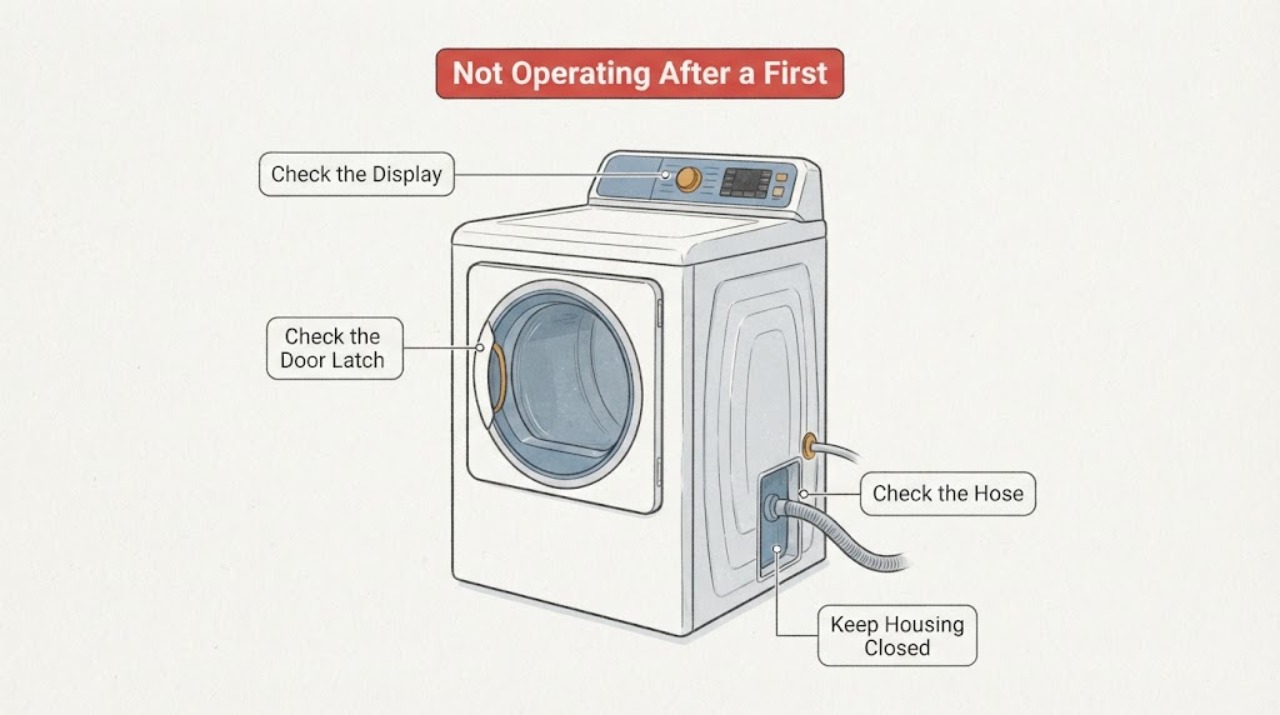
Work through in order
Diagnostic checks
Use only checks that match the exact appliance or system and its official guide.
-
Check 1
From a safe position, note whether the drum light and control panel illuminate, whether the dryer becomes completely blank after pressing Start, and whether the household breaker or fuse has changed state. Do not open the terminal area or make electrical measurements.
Expected result: The controls and drum light are dead, the display is powered but the motor does not start, or the breaker trips again or the cord or outlet is hot or damaged.
Next step: Stop use for a hot connection, odor, smoke, sparking, damaged cord, or repeated trip and arrange qualified appliance or electrical service. If the panel is stable, continue only with the external door and start checks.
Why this matters
Why: A dead panel or repeated electrical symptom points first to supply or wiring safety, not to a belt diagnosis. A powered panel with no drum movement leaves the door switch, start circuit, belt path, motor, control, and post-repair connections open.
-
Check 2
Close the dryer door normally and confirm that the latch engages without forcing it. Check for clothing, packing material, or visible debris in the latch area, and hold Start, Push to Start, or Hold to Start for the interval stated in the MEDE300VW1 manual rather than tapping once.
Expected result: The door does not latch, something blocks the latch, Controls Locked is illuminated, the controls respond only when Start is held, or the door and controls appear normal but the motor still does not begin.
Next step: Remove only accessible lint or clothing and follow the exact manual for Control Lock. If the latch remains abnormal or the dryer still will not start, leave it out of service and arrange service rather than bypassing the interlock.
Why this matters
Why: Maytag says an unlatched door or active Control Lock can prevent operation, and that some Start controls require a firm two-to-five-second press. A normal latch and correct start input do not clear an internal switch or post-repair connection.
-
Check 3
With the dryer cool, inspect only the visible exterior for a shifted unit, damaged cord, new scraping marks, or a vent hose pulled loose during the repair. Do not pull the dryer out, remove a panel, or reach into the motor or heater area as a user test.
Expected result: A cord, outlet, or vent connection is damaged or displaced, there are new scrape marks or lint around the front, or the visible installation is unchanged and safe.
Next step: Keep the dryer off and arrange qualified correction for damage, a loose vent, or any sign of heat. If the outside is safe, proceed to the unplugged drum observation without opening the cabinet.
Why this matters
Why: A repair can disturb surrounding connections or create drum and airflow symptoms, but an external inspection cannot prove the belt route or internal wiring. A loose vent is a separate heat and fire-risk concern even if the dryer also will not start.
-
Check 4
If the plug is reachable, cool, and undamaged, disconnect power before checking the empty drum by hand through the door. Turn it gently and note binding, scraping, unusual resistance, rocking, or a smooth movement; recall whether the failed start followed a squeal or motor hum.
Expected result: The drum binds, scrapes, rocks, or has unusual resistance, or it turns smoothly but the dryer still refuses to run.
Next step: Keep the dryer unplugged when movement or sound is abnormal and request model-specific service. Do not remove panels, lubricate parts, or reinstall the belt yourself from a generic diagram.
Why this matters
Why: Abnormal movement supports a mechanical reassembly or drive review involving the belt, idler, rollers, drum support, or motor, but smooth hand movement does not prove the belt is correctly routed or the switch and control circuit are sound.
-
Check 5
Record whether the symptom is a completely dead dryer, a powered dryer with no motor sound, a motor hum without drum movement, or a brief start followed by stopping. Include the exact repair date, what was removed or disturbed, and whether the dryer ran at all after the belt was installed.
Expected result: The dryer never ran after the belt work, ran briefly and then stopped, hums without turning, or has no sound despite a powered panel.
Next step: Give the complete model and this timeline to the technician and request a post-repair inspection of belt routing and tension, idler and drum supports, motor seating, door switch, harnesses, and the electric supply connection before parts are selected.
Why this matters
Why: These observations separate supply or start symptoms from a mechanical drive or motor symptom for service triage, but none alone selects a belt, motor, door switch, control, or thermal part.
-
Check 6
If there is no safety hazard and the exact manual permits a control reset, follow that manual once after documenting the symptom; do not repeatedly reset breakers or keep starting the dryer to see whether it catches.
Expected result: The dryer starts after the documented reset, remains unresponsive, or starts briefly and stops again.
Next step: Stop after one abnormal retest and arrange qualified Maytag service. Keep the dryer disconnected if there is heat, odor, noise, binding, exposed damage, or repeated breaker behavior.
Why this matters
Why: A one-time recovery can indicate a transient control state, but it does not validate a belt installation or clear a mechanical or electrical fault that followed service. A repeat failure needs diagnosis, not repeated cycling.
Use your observations
Decision map
Find the observation that best matches what you see, then follow the next safe action.
-
PATH 01Next step
What you see
The panel and drum light are dead, the breaker trips again, or a cord or outlet is hot, damaged, smoking, sparking, or producing a burning odor.
Do this next
Stop use and isolate power only when safe; arrange qualified appliance or electrical service. Do not re-energize the dryer, reset the breaker repeatedly, or open the terminal or control area.
Why this path and its safety boundary
Why it matters: This is an electrical safety branch. The belt replacement may be coincidental or may have disturbed a connection, but the hazard cannot be narrowed safely from the symptom alone.
-
PATH 02Next step
What you see
The control panel is powered, but the door does not latch, Controls Locked is active, or Start is only tapped rather than held as the manual requires.
Do this next
Clear only the documented lock or latch obstruction and use the model-specified Start input. If the latch or controls remain abnormal, leave the dryer out of service and request service; never bypass the door switch.
Why this path and its safety boundary
Why it matters: An external start or interlock condition can make the dryer appear not to operate without proving that the belt or motor is faulty.
-
PATH 03Next step
What you see
The drum binds, scrapes, rocks, or the motor hums without turning after the first belt replacement.
Do this next
Keep the dryer unplugged and ask a qualified technician to inspect the drive assembly and guards using the exact MEDE300VW1 literature. Do not run it with a panel removed or attempt a generic belt reinstallation.
Why this path and its safety boundary
Why it matters: A post-repair drive or reassembly problem becomes more likely, including belt routing or tension, idler, roller, drum support, motor seating, or an obstruction. The observation does not identify one part.
-
PATH 04Next step
What you see
The drum turns smoothly by hand, the panel is powered, the door latches, and the dryer still does not start or stops immediately after a Start attempt.
Do this next
Stop testing and request a post-repair electrical and control diagnosis. Provide the exact model, repair timeline, and whether the motor made any sound; do not probe live terminals or replace a control by guesswork.
Why this path and its safety boundary
Why it matters: Smooth hand movement rules out only an obvious seized-drum symptom. A door switch, start circuit, harness, motor, control, or power connection remains possible, so the belt should not be blamed solely from timing.
-
PATH 05Next step
What you see
The dryer starts only briefly, becomes unusually hot, emits a burning smell, shows scorch or lint damage, or stops after a long run.
Do this next
Keep the dryer out of service and arrange qualified inspection of the vent, thermal protection, heater, motor, drive assembly, and wiring. Do not bypass a safety device or operate with a restricted or displaced vent.
Why this path and its safety boundary
Why it matters: Heat, airflow, electrical, thermal, or drive protection may be involved. This is not a normal belt break-in behavior and should not be tested with repeated cycles.
Helpful context
Understand the symptom
What the first belt replacement changes
A dryer that fails immediately after a first belt repair needs a repair-context check, not an automatic second belt order. The belt may be misrouted, not seated in the idler or motor path, or affected by drum support, motor, door-switch, wiring, or power work that was disturbed during access. The repair date is useful evidence for a technician, but it does not prove which part caused the no-run symptom.
Why MEDE300VW1 needs exact literature
Maytag's opened owner page is for the MEDE300VW family and identifies it as a front-load electric dryer; the exact suffix MEDE300VW1 still needs to be entered in Maytag's model-number manual lookup. Do not transfer a belt route, service-test sequence, or component location from a different Maytag dryer. The public no-start guidance supports external checks, while belt-path and internal electrical verification belong to the model-specific service procedure.
Only after diagnosis
Potential parts
- Maytag MEDE300VW1 dryer belt, idler, roller, or drum-support assembly
Consider these only after a qualified technician confirms the exact model, belt routing and tension, drum support, idler, and motor seating. A first repair followed by a no-run symptom is not enough to select another belt or drive part.
Use the complete MEDE300VW1 model and matching Maytag literature or parts record; do not infer fit from the MEDE300VW family name or another Maytag dryer. - Maytag dryer door switch, motor, harness, or control
These remain conditional possibilities if the panel is powered, the door latches, the drum moves smoothly, and service testing identifies a start-circuit, motor, wiring, or control fault. They should not be ordered because the belt was recently replaced.
Internal electrical and drive diagnosis belongs to qualified service with power isolated; confirm the exact suffix before any part decision.
When checks do not resolve it
Need a professional?
Arrange qualified Maytag appliance service when the dryer did not run after the belt repair, starts and stops, hums without turning, has abnormal drum movement, remains unresponsive after the safe external checks, or shows any electrical, heat, airflow, or burning symptom.
Safety scope: Do not operate a dryer with smoke, sparking, a hot or damaged cord, burning odor, repeated breaker trips, a loose vent, abnormal drum drag, or a door that will not latch. Do not open the terminal, motor, heater, control, or drive areas; probe live wiring; bypass the door switch or thermal protection; or run the dryer with panels or guards removed.
Have this ready
- Provide the complete model MEDE300VW1, the model-plate photo, the belt replacement date, the work performed and parts used if known, whether the dryer ran afterward, panel and drum-light behavior, door-latch status, Start behavior, drum movement, breaker or cord symptoms, and any odor, heat, noise, or vent change.
Common questions
FAQ
Does the new belt have to be the cause because the Maytag dryer stopped after it was replaced?
No. The timing should trigger a post-repair inspection, but it does not distinguish belt routing, idler or drum support, motor seating, door switch, wiring, control, or power problems. Do not order another belt from timing alone.
What should I check first on a Maytag MEDE300VW1 that will not run?
Check whether the panel and drum light have power, whether the door latches, whether Controls Locked is active, and whether Start must be held. Stop immediately for a hot cord, odor, smoke, sparking, or repeated breaker trips.
Can I open the dryer to see whether the belt is on correctly?
Do not open the cabinet as a homeowner test. Disconnecting power and gently observing an empty drum can document binding, but belt routing, motor, wiring, and guard checks should follow the exact MEDE300VW1 service procedure and qualified repair boundary.
What if the drum turns smoothly by hand but the dryer still does not start?
Smooth hand movement does not clear the door switch, start circuit, harness, motor, control, or power connection. Record whether the motor hums and have service perform the model-specific diagnosis without live testing by the owner.
Read the exact guide
Official sources
- No Power - Electric DryerMaytag Product Help · Official Maytag electric-dryer guidance used for the external supply branch; it does not authorize owner live testing or establish a belt cause.
- MEDE300VW | MaytagMaytag · Opened Maytag owner page identifies the MEDE300VW family as a Performance Series Front Load Electric Dryer. The assigned MEDE300VW1 suffix is not exposed on this page, so the page is used to enforce exact-model lookup rather than to claim suffix-specific belt fit.
- Not Starting or Not Operating - DryerMaytag Product Help · Official Maytag dryer operating guidance for the assigned MEDE300VW1 topic; it supports external power, Control Lock, Start, door-latch, and cycle checks but does not diagnose a belt replacement.
- Loc - Error Code - DryerMaytag Product Help · Official Maytag dryer guidance used only for the Control Lock branch; the exact MEDE300VW1 manual controls take priority.
- Appliance Manuals and Literature | MaytagMaytag · Official Maytag manual portal opened to establish that installation, use, and service literature must be selected by the complete model number MEDE300VW1.
- Not Tumbling or Spinning - DryerMaytag Product Help · Official Maytag dryer guidance used to distinguish a powered no-tumble symptom from an obvious no-power state; it does not identify a specific belt or motor without model-specific diagnosis.
Community feedback
Share a repair observation
Share a plain-text repair observation. Accepted observations are published automatically; this page may take a moment to update.