
On this page
Start here
Quick answer
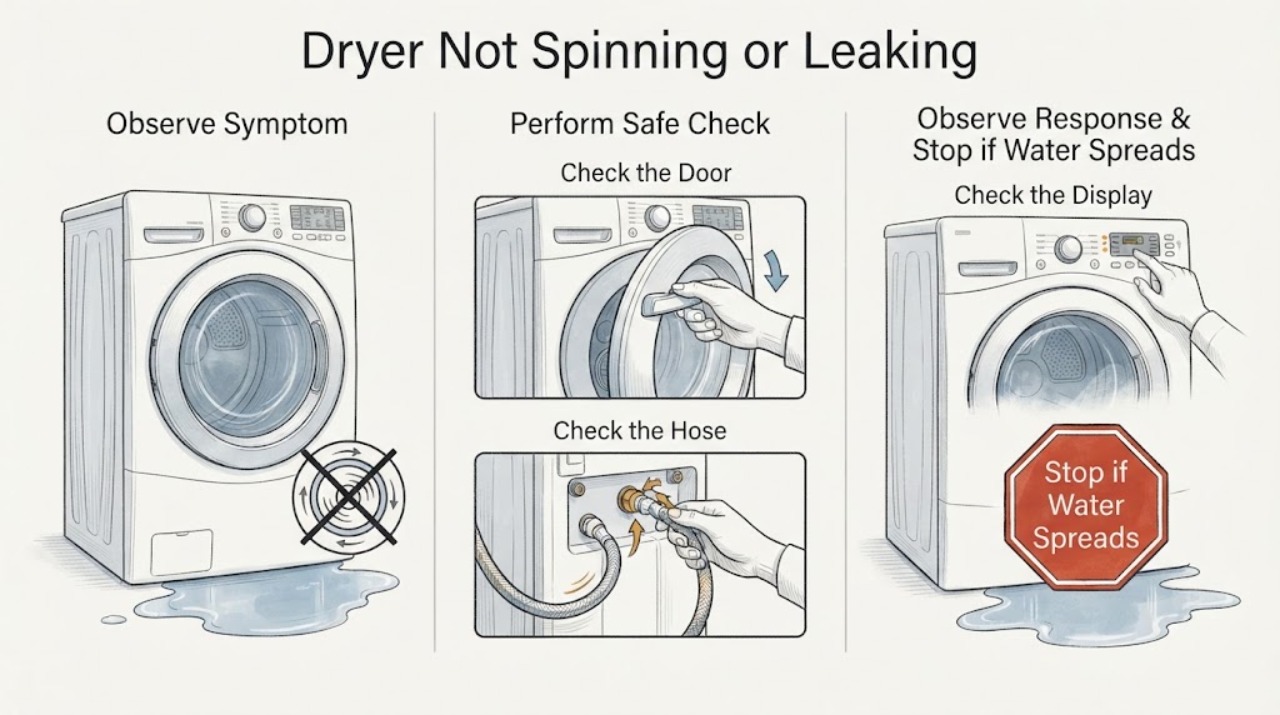
First separate the two symptoms. On a Maytag dryer with a Steam Cycle, a small load can leave wet spots or condensation on the door or drum; that is different from water leaking at the rear inlet or onto the floor. If water is at the inlet, stop using the dryer and check only that the accessible connections are secure. For a drum that does not turn, confirm the controls have power, press Start/Push to Start/Hold to Start for the model-required two to five seconds, close the door fully, and check the selected cycle or Control Lock. If the dryer still will not tumble, or if the leak recurs, do not assume both symptoms share one cause or open the cabinet; arrange Maytag or qualified service.
Work through in order
Diagnostic checks
Use only checks that match the exact appliance or system and its official guide.
-
Check 1
With the dryer stopped, dry the outside and identify where the water appears: on the door or inside drum after Steam, at the rear water inlet, beneath the cabinet, or nowhere except condensation on a small load.
Expected result: The load used Steam and was small; water is only on the door/drum; water is at the rear inlet; or water reaches the floor or appears without Steam.
Next step: Treat door/drum moisture after a small Steam load as a condensation path to verify with the correct load size. If water is at the inlet or floor, stop the dryer and continue only with a safe external connection check; do not run another cycle to test a recurring leak.
Why this matters
Why: Maytag says small Steam loads can leave wet spots or condensation, while a rear-inlet leak points to a connection issue. A recurring floor puddle or water without Steam is not explained by ordinary condensation from the cited guidance.
-
Check 2
If the dryer has a Steam connection, inspect the accessible water hose and connection points at the back without pulling the dryer or opening a panel; keep the area dry and do not disturb hidden plumbing.
Expected result: A fitting is visibly loose or wet, all accessible connection points are dry and secure, or water is coming from a location that cannot be seen safely.
Next step: If a connection is wet or loose, stop water flow at the accessible shutoff if safe and arrange service. If the source is hidden, the floor is wet, or water is near electrical parts, stop using the dryer and have a qualified technician inspect it.
Why this matters
Why: Maytag directs owners to check that rear water connections are secure when water is leaking from the inlet. A dry visible connection does not clear an internal valve, hose, or cabinet leak.
-
Check 3
For the no-tumble symptom, confirm that the display or drum light has power, close the door firmly, select a model-supported timed or automatic cycle, and press Start/Push to Start/Hold to Start for the model-required two to five seconds.
Expected result: The dryer starts turning, the controls remain dark, the door does not latch, the touch panel was wet, or the controls light but the drum still does not move.
Next step: Dry hands and the accessible control surface, correct the door/cycle/lock condition described by the exact manual, and retry only a normal start check. If the drum still does not move, stop troubleshooting at the controls and schedule service.
Why this matters
Why: Maytag lists power, the Start-button hold, moisture on electronic controls, door latching, cycle selection, and Control Lock as model-dependent no-operation checks. A control panel that lights while the drum stays still does not identify the internal failed part.
-
Check 4
If the dryer is electric and the controls are dark or the motor will not run, check the household breaker or fuse condition once from the normal electrical panel; do not remove the dryer terminal cover or test live wiring.
Expected result: A breaker or fuse is tripped/blown, power returns but the drum still will not turn, or the breaker trips again.
Next step: If a normal reset restores operation without water or odor, monitor the appliance and record the event. If the breaker trips again, power is absent, or the supply/cord installation is uncertain, leave the dryer off and call a qualified electrician or appliance technician.
Why this matters
Why: Maytag says electric dryers use two household fuses or breakers and that power-cord installation or supply problems can prevent operation. A repeated trip is an electrical fault boundary, not a reason to keep resetting or open the dryer.
-
Check 5
Record whether the no-tumble condition occurs with the water symptom, and note the cycle, load size, Steam setting, water location, display state, and any unusual sound or smell before arranging service.
Expected result: The drum never turns even when there is no water, water appears only during Steam, or both symptoms recur together.
Next step: Give service the full sequence and exact model number. Do not order a valve, belt, motor, or control board from this symptom combination and do not run repeated cycles to reproduce it.
Why this matters
Why: The timing can help a technician separate a Steam water path from a start/tumble fault, but timing alone does not prove a shared valve, motor, belt, or control cause.
Use your observations
Decision map
Find the observation that best matches what you see, then follow the next safe action.
-
PATH 01Next step
What you see
Water appears only on the door or interior drum after a small Steam load, with no floor puddle or rear-inlet wetness.
Do this next
Use the Steam instructions and load-size guidance in the exact manual. Keep the water and no-tumble assessments separate and continue only with normal operation if the drum turns and no leak recurs.
Why this path and its safety boundary
Why it matters: Maytag identifies condensation or wet spots as possible when a Steam Cycle is used with a smaller load; this does not establish a leak or a no-tumble cause.
-
PATH 02Next step
What you see
Water is visible at the rear inlet, below the dryer, or near an electrical connection, or it appears again without a Steam Cycle.
Do this next
Stop using the dryer, shut off the accessible water supply if safe, keep away from wet electrical areas, and arrange qualified service. Do not pull the machine out or open panels in a wet area.
Why this path and its safety boundary
Why it matters: The symptom is outside the cited condensation explanation and may involve the water connection or an unseen leak. It is not safe to infer the no-tumble cause from the leak.
-
PATH 03Next step
What you see
The controls are dark, a breaker/fuse is abnormal, or a breaker trips again after a normal reset.
Do this next
Leave the dryer off and contact a qualified electrician or appliance technician. Do not keep resetting the breaker or inspect live terminals.
Why this path and its safety boundary
Why it matters: Maytag's power guidance points to a household supply, two-breaker electric-dryer circuit, or power-cord issue; repeated trips require an electrical service boundary.
-
PATH 04Next step
What you see
The controls light, the door is latched, the Start control was held as required, and the drum still does not turn, whether or not the water symptom is present.
Do this next
Stop using the dryer and arrange model-specific service. Provide the model number and the separate water and no-tumble observations; do not bypass the door or motor protection or replace an internal part by guesswork.
Why this path and its safety boundary
Why it matters: The public checks do not identify the failed internal part, and the two symptoms cannot be assumed to share one cause.
Helpful context
Understand the symptom
Classify the water before calling it a leak
Maytag distinguishes condensation from a water-inlet leak. Steam cycles are intended for larger loads; a small steam load can leave wet spots or condensation on the door or drum. Water at the rear connection, a puddle on the floor, or water when no steam cycle was used needs a different response. The article keeps those paths separate because the same symptom word—“leaking”—does not identify the source.
A dryer that does not tumble needs a separate start and power check
A Maytag dryer can fail to start because the Start control was not held long enough, moisture is affecting a touch panel, the door is not latched, a cycle or Control Lock is wrong, or the household supply is not correct. These are user-level checks. They do not prove a belt, motor, switch, or control-board failure, and they do not prove that a water symptom caused the no-tumble condition.
Do not open the dryer to combine the diagnoses
If the drum remains still after the model-supported external checks, or if water continues to appear, stop and provide the model number, cycle used, load size, water location, and whether the controls light up to service. Do not pull apart the dryer, work on a 240-volt connection, bypass a door or motor protection, or keep running it to see whether the two symptoms eventually line up.
When checks do not resolve it
Need a professional?
Arrange Maytag or qualified service for a recurring water leak, water near electrical parts, a hidden inlet or cabinet leak, or a drum that remains stationary after the external power, door, control and Start checks. The symptom combination does not identify a valve, belt, motor, or control-board part.
Common questions
FAQ
Can a Maytag Steam dryer leave water on the door without leaking?
Yes. Maytag says Steam Cycles used with smaller loads can produce wet spots or condensation on the door or interior drum. Water at the rear inlet, on the floor, or recurring without Steam is a different condition that needs an external connection check and possibly service.
Why is my Maytag dryer not spinning?
Maytag's user-level checks include power, holding Start/Push to Start/Hold to Start for two to five seconds, a fully latched door, a supported cycle, moisture on touch controls, and Control Lock on some models. If the drum remains still after those checks, service is safer than guessing a belt or motor.
Does a water leak cause a Maytag dryer to stop spinning?
The cited Maytag guidance does not establish a shared cause. Steam condensation, a rear water connection, a household power problem, a door/control condition, and an internal fault are separate possibilities. Record whether the symptoms occur together and have service scope them by model.
Should I open the dryer to check the belt or water valve?
No. A no-tumble symptom and water symptom do not identify a belt, motor, valve, or control-board failure, and electric dryers can involve a 240-volt supply. Stop at the documented external checks and arrange qualified service when the problem persists.
Read the exact guide
Official sources
- Dryer is not Drying or Experiencing Long Dry TimesMaytag Product Help · Maytag dryer service boundary, model-number documentation, and safe external airflow/power context
- Water on the Door - DryerMaytag Product Help · Maytag dryer Steam Cycle condensation, load-size scope, rear water-inlet connection checks, and service boundary
- Not Tumbling or Spinning - DryerMaytag Product Help · Maytag dryer no-tumble external power, Start-control, moisture-on-controls, power-cord and qualified-service checks
- Dryer Not Starting or No OperationMaytag Product Help · Maytag dryer start, door-latch, cycle-selection, Control Lock and household fuse/breaker checks by model
Community feedback
Share a repair observation
Share a plain-text repair observation. Accepted observations are published automatically; this page may take a moment to update.