
On this page
Start here
Quick answer
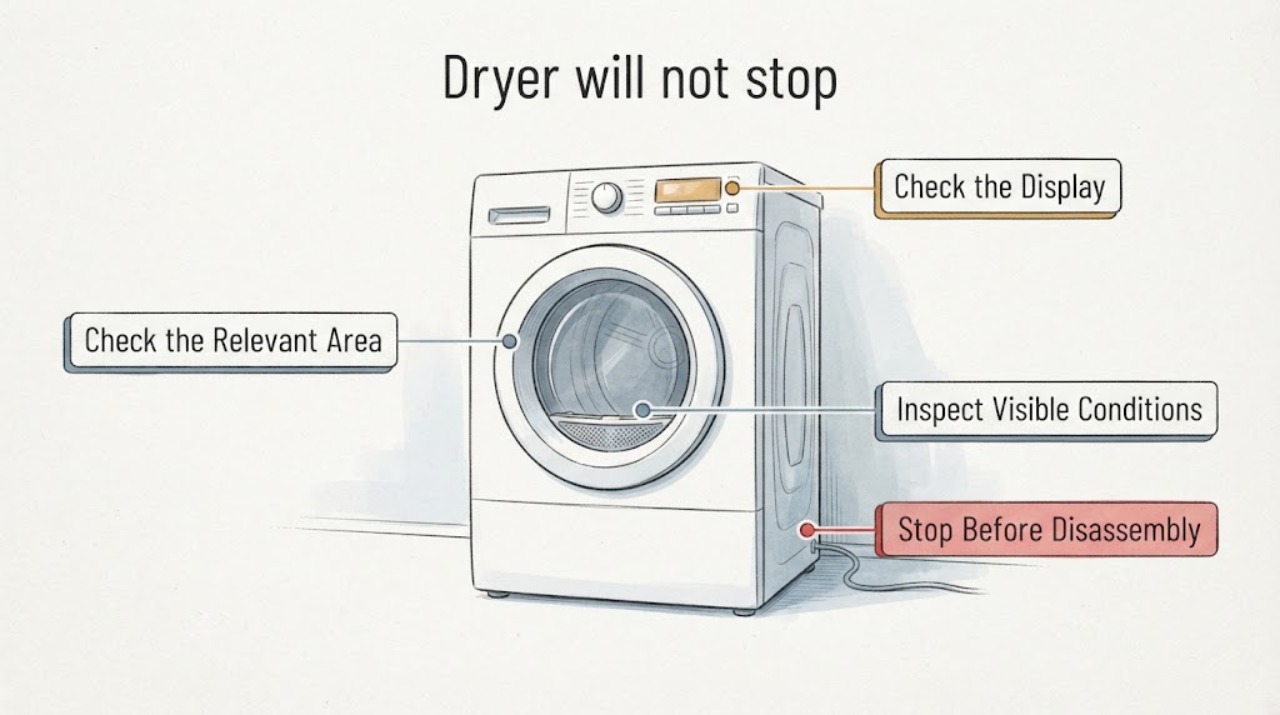
Treat a Maytag LDG8200AAW that appears to run forever as a safety and control-state question, not as proof that one part needs replacing. First note whether the drum is still tumbling, whether heat is present, whether the dial is at Off, and whether the load is dry or damp. Maytag's legacy dryer guide describes separate Auto Dry, Time Dry, Air Fluff, and cool-down behavior; an exact-model Reddit report also describes this older model as a thermostatic auto-dry machine, but that community description is only a lead. If the load is dry and the drum only tumbles intermittently without heat, confirm whether this is cool-down or wrinkle prevention. If the dryer keeps heating, the dial does not terminate the cycle, the drum stops while heat remains, the door will not latch, or there is smoke, a burning or gas smell, unusual heat, or electrical damage, stop using it and arrange qualified service. Decide repair versus replacement only after a technician confirms the fault, safe venting, and parts/service support; do not diagnose a timer or thermostat from age or a symptom alone.
Work through in order
Diagnostic checks
Use only checks that match the exact appliance or system and its official guide.
-
Check 1
From a dry position, do not restart the dryer. Note whether the drum is completely stopped, still turns intermittently, or turns continuously; whether the dial is at Off or remains in a cycle; whether the load is dry, damp, or unusually hot; and whether the display or end-of-cycle signal, if present, is active.
Expected result: The load is dry and the drum tumbles intermittently without heat, the dryer is fully off with damp clothes, the dial remains in a cycle, or heat, smoke, odor, or unusual temperature is present.
Next step: If a hazard is present, leave the dryer off and arrange the appropriate qualified appliance, electrical, gas, or emergency help from a safe location. Otherwise photograph the dial and record the state before continuing with the cool, external checks.
Why this matters
Why: Intermittent unheated movement can be a documented cool-down or wrinkle phase, while a wet load, continued heat, or unexpected full-power behavior is not established as normal completion. Any smoke, gas smell, burning smell, sparking, or unusual heat is a safety stop.
-
Check 2
Identify the selected control position without forcing the knob. Compare it with the exact model information and the legacy Maytag descriptions for Auto Dry, Time Dry, Air Fluff, and cool-down. In Auto Dry, note whether the control advances as the load dries; in a timed or no-heat position, note only the normal end state and do not use repeated cycles as a repair test.
Expected result: The control is in Auto Dry or a documented cool-down area, it is in Time Dry or Air Fluff, the knob never reaches Off, or the machine continues to heat after the expected end state.
Next step: Use the exact model manual or a technician to confirm the control layout. If the dryer keeps heating or cannot be stopped with the normal control, disconnect it only if this can be done safely without approaching hot or damaged equipment, and leave it out of service.
Why this matters
Why: A cycle or cool-down explanation remains possible when the clothes are dry and no heat is present. A knob that never terminates, or heat that continues after the cycle should be complete, needs model-specific diagnosis; the observation does not identify a timer, thermostat, or relay by itself.
-
Check 3
With the dryer off and cool, clean the lint screen as the manual directs and inspect only the visible exhaust hose, wall connection, and outside hood. Look for a crushed or disconnected duct, heavy lint, a blocked hood, or weak visible airflow; do not remove the cabinet or reach toward the blower or burner.
Expected result: The lint screen or visible duct is restricted, the hood does not open freely, the laundry area is unusually hot or humid, or the visible path is clear and the stop still repeats.
Next step: Do not operate with a blocked, crushed, disconnected, or unverified exhaust path. Correct only an accessible, safe external issue; if the no-stop or heat symptom remains, arrange qualified inspection of the complete vent, burner, thermal protection, and control system.
Why this matters
Why: Maytag identifies restricted exhaust as a cause of poor drying and elevated heat, and its legacy guide warns against clogged or crushed ducts and nonmetal ducting. A clear visible path does not rule out internal lint, thermal protection, or a control fault.
-
Check 4
After the dryer is cool, inspect the door opening, latch, strike, and visible seal for lint, clothing caught in the opening, distortion, or looseness. Close the door normally and observe whether it stays latched without tape, a wedge, or force. Do not remove the door or front panel.
Expected result: The door will not remain latched, an item is trapped at the opening, the latch is visibly damaged, or the door and visible latch appear intact while the cycle still will not terminate.
Next step: Remove only loose lint or clothing that is accessible without tools. If the latch is damaged, the door opens during operation, or the symptom repeats with a secure door, leave the dryer out of service and request model-specific service.
Why this matters
Why: A door latch or switch can interrupt a cycle or prevent normal operation, but an intact visible latch does not clear the hidden switch or control circuit. A door that opens during tumbling is not a harmless explanation for continued running.
-
Check 5
If there is no gas smell, smoke, unusual heat, or visible damage, record the safe cycle context for a technician: load size and fabric mix, whether it was dry when the dryer seemed to stop, whether the drum was still moving, whether heat was felt before shutdown, and whether the issue occurs in more than one control position. Do not repeatedly run the dryer to compare results.
Expected result: The no-stop behavior occurs only after dry clothes and unheated tumbling, occurs with damp clothes, occurs on every control position, or occurs after a long heated run.
Next step: Give the technician the exact LDG8200AAW, full model suffix and serial information, control position, load condition, heat observation, and vent observations. Do not select a replacement timer or thermostat from a symptom or online parts listing.
Why this matters
Why: A dry load with unheated intermittent movement supports a normal end-phase possibility. A repeatable problem with damp clothes, every control position, or continued heat is more consistent with a control, thermal, airflow, door, or drive issue requiring service diagnosis.
-
Check 6
For the repair-versus-replace discussion, ask for a written diagnosis that states the failed function, whether the vent and gas installation are safe, whether the required part is actually supported for LDG8200AAW, and what other age-related safety findings were observed. Separately record any history of repeated overheating, smoke, damaged wiring, gas odor, drum drag, or previous repairs.
Expected result: The technician identifies one bounded, serviceable fault with safe installation and supported parts, or finds multiple safety, venting, structural, control, or parts-availability concerns.
Next step: Use the written findings, safety condition, service/parts support, reliability history, and your need for dependable operation to make the repair-or-replace decision. Do not keep operating a hazardous dryer while deciding.
Why this matters
Why: A single confirmed repairable fault is a different decision from an unsafe vent or gas installation, multiple unrelated faults, or an appliance that cannot be safely supported. Age alone neither proves that repair is worthwhile nor proves that replacement is required.
Use your observations
Decision map
Find the observation that best matches what you see, then follow the next safe action.
-
PATH 01Next step
What you see
The load is dry and the drum only tumbles intermittently in unheated air after the apparent end of the cycle, with no odor, smoke, abnormal heat, or electrical symptom.
Do this next
Confirm the control position and end-phase behavior in the exact model documentation. If the drum later stops normally and the same safe pattern repeats, do not order a part from the original wording alone; service is needed only if the behavior differs from the documented end phase.
Why this path and its safety boundary
Why it matters: This can fit the legacy Maytag guide's cool-down or wrinkle-prevention behavior rather than a dryer that is still heating indefinitely.
-
PATH 02Next step
What you see
The dryer continues heating, the load is unusually hot, the knob does not terminate, or a long heated run is followed by a no-stop complaint.
Do this next
Stop using the dryer and keep it disconnected if safe. Arrange qualified appliance service to inspect the complete exhaust, heating, thermal, and control paths; do not bypass a safety device or keep restarting it.
Why this path and its safety boundary
Why it matters: A thermal, airflow, control, or heating fault is more concerning than normal cool-down. A stuck thermostat, timer, or other part cannot be confirmed from this observation alone.
-
PATH 03Next step
What you see
The drum stops or the cycle interrupts with a damp load, a door that will not stay latched, a motor hum, scraping, drum drag, or another mechanical symptom.
Do this next
Leave the dryer out of service, provide the technician the timing and sound/door observations, and do not open the cabinet or run it with a defeated interlock.
Why this path and its safety boundary
Why it matters: Door or drive interruption can explain an early or abnormal end, but the visible symptom does not prove a particular belt, motor, roller, switch, or timer failure.
-
PATH 04Next step
What you see
There is smoke, a gas or burning smell, sparking, a hot or damaged cord or outlet, exposed wiring, repeated breaker trips, or an exhaust path that cannot be verified as safe.
Do this next
Stop use, leave the area and contact the appropriate emergency, gas, electrical, or qualified appliance service from a safe location. Do not touch switches in a gas-filled area, reset a tripping breaker repeatedly, or open the dryer.
Why this path and its safety boundary
Why it matters: This is a fire, gas, electrical, or airflow safety condition, not a repair-versus-replace experiment.
Helpful context
Understand the symptom
The phrase “will not stop” can describe several different observations: the drum may be in an unheated cool-down or wrinkle phase, the timer may not be reaching Off, the dryer may be restarting because the door or control is not behaving normally, or the appliance may still be heating after it should have stopped. On an old gas dryer, do not keep running it to find out which one it is. Observe from a safe position, let it cool, and record what happened.
Maytag's legacy guide says Auto Dry movement can be slow at first and quicker as the load dries, and it documents separate Time Dry/Air Fluff and cool-down sections. The exact LDG8200AAW discussion found on Reddit is useful for identifying the model and the reported symptom, but community comments are not a substitute for the model's service diagnosis.
Keep hands away from the drum, burner area, exhaust, and wiring. Never bypass the door switch, open the control console, test live terminals, relight or adjust gas components, or use a setting change to conceal a dryer that overheats, smokes, sparks, smells of gas, or keeps heating when it should be cooling.
When checks do not resolve it
Need a professional?
Arrange qualified Maytag or appliance service when LDG8200AAW will not terminate with the normal control, continues heating, stops with damp clothes, has a door or drum problem, or repeats the symptom after safe external lint and vent checks. Stop immediately for smoke, fire, gas or burning odor, sparking, a hot or damaged cord or outlet, exposed wiring, unusual heat, repeated breaker trips, or an exhaust path that cannot be verified as safe; use emergency, gas, or electrical help from a safe location as appropriate. Do not open the control console or cabinet, bypass the door switch, test live terminals, adjust gas parts, or continue running the dryer while deciding whether to repair or replace it.
Common questions
FAQ
Is it normal for an old Maytag dryer to keep tumbling after the clothes are dry?
It can be normal when the selected control is in a documented cool-down or wrinkle-prevention phase and the drum is moving without heat. Confirm the exact control position and stop immediately if the load is unusually hot, the dryer keeps heating, or smoke, odor, or electrical symptoms appear.
Does the LDG8200AAW report prove that the timer or thermostat is bad?
No. An exact-model Reddit discussion reports a similar symptom and community commenters suggest a thermostatic auto-dry or timer path, but that is not a verified diagnosis. The cycle position, heat state, termination behavior, vent condition, and professional inspection are needed before naming a part.
Should I repair or replace a Maytag LDG8200AAW that is more than 20 years old?
Do not decide from age alone. Get a diagnosis that covers the actual failed function, safe gas and exhaust installation, parts and service support, and any additional safety or structural findings. One bounded repair with safe support is a different decision from repeated overheating, unsafe venting, multiple faults, or unavailable support.
Read the exact guide
Official sources
- Checking the Gas Supply and the Shutoff ValveMaytag Product Help · General Maytag gas-dryer guidance; it supports identifying the user-visible supply shutoff only when there is no gas emergency and does not authorize burner or valve service.
- Repair or replace 20+ year old dryer?Reddit r/Appliances · The original poster identifies LDG8200AAW and reports that it came with a house, dries but does not stop as expected, and has no clear manual; comments offer unverified control hypotheses and must not be treated as a diagnosis.
- Appliance Manuals and LiteratureMaytag · Maytag's official manual page requires the exact model number to locate model-specific literature; use it to confirm the control layout and procedures before service.
- Why Does My Dryer Keep Stopping Mid-Cycle?Maytag · General Maytag guidance used to distinguish load, door, drive, moisture, and thermal observations; it is not an exact LDG8200AAW service manual.
- Dryer is not Drying or Experiencing Long Dry TimesMaytag Product Help · General Maytag dryer guidance used for safe external lint and exhaust checks and for the professional-service boundary; it does not identify an LDG8200AAW part.
- Maytag Legacy Dryer Use & Care GuideMaytag · This is a legacy Maytag guide, not proof that every control option appears on LDG8200AAW. It documents the relevant Auto Dry, Time Dry/Air Fluff, cool-down, end-phase, lint, exhaust, and gas-safety distinctions; confirm exact model options before operating.
Community feedback
Share a repair observation
Share a plain-text repair observation. Accepted observations are published automatically; this page may take a moment to update.