
On this page
Start here
Quick answer
On an AEG TR8G83CW, a display that reaches 0 minutes while the drum makes a few turns every few minutes is consistent with the anti-crease phase, not automatically a failed control. AEG says this phase can continue for about an hour after the drying cycle and can be stopped manually by turning the cycle selector to Off. Check whether the drum is moving intermittently, whether the anti-crease indicator is shown, and whether the load is cool and dry. Do not wait indefinitely or keep restarting the appliance: if it runs continuously, remains hot, takes much longer than the normal cycle, shows an error, smells of burning, trips power, or cannot be stopped with the documented control, stop using it and arrange qualified AEG service. Confirm the full model and PNC because AEG lists several TR8G83CW PNC versions and exact controls can vary.
Before you begin
Safety first
- Do not force the door, reach into a moving or hot drum, open panels, test live circuits, alter grounding or power wiring, bypass a thermal or door safety, or replace a sensor, control, motor, heater, or other part solely because the display reached 0. Stop immediately for smoke, sparking, burning odor, excessive heat, a hot or damaged cord/outlet, or repeated power trips.
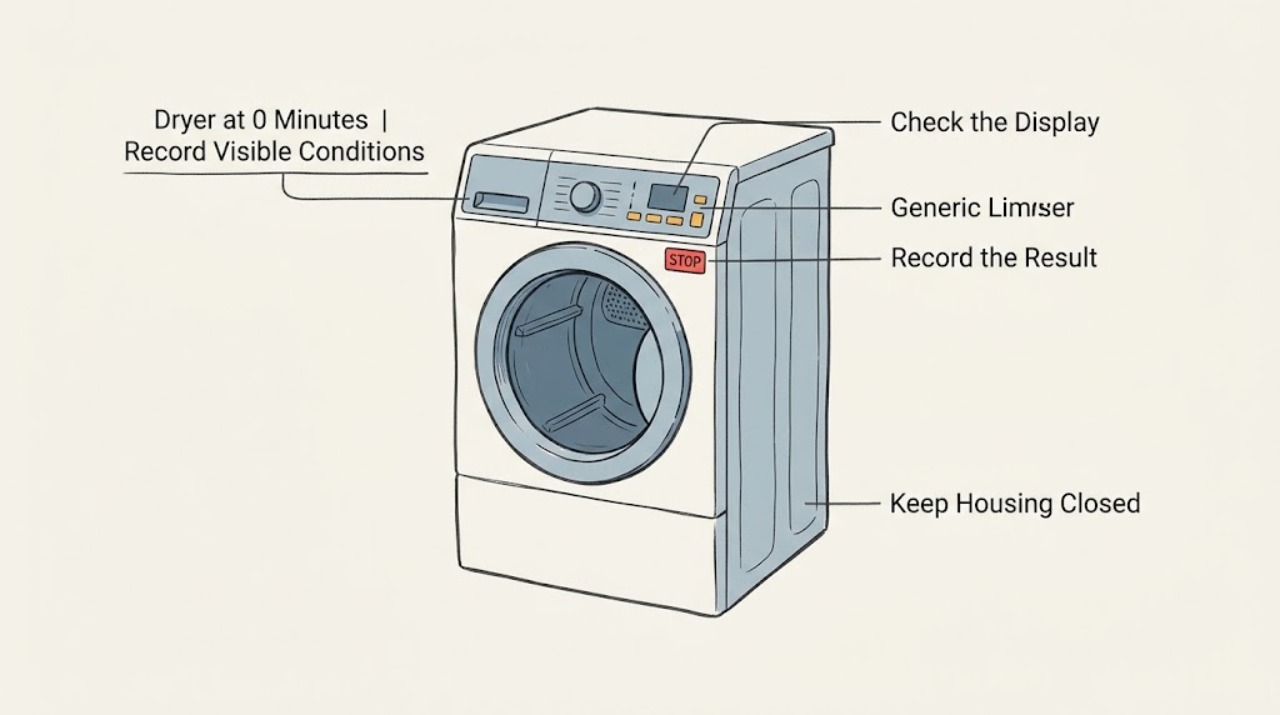
Work through in order
Diagnostic checks
Use only checks that match the exact appliance or system and its official guide.
-
Check 1
Read the rating plate without moving the dryer and record the complete TR8G83CW model and 11-digit PNC. Compare the panel and anti-crease control with the matching AEG manual; do not use a button combination from another AEG series.
Expected result: The complete model and PNC are known, the model is known but the PNC is missing, or the label does not match TR8G83CW.
Next step: Use the matching manual or provide the complete label to AEG service. If the identity is uncertain, treat the movement as unresolved and do not keep testing it to discover a control sequence.
Stop if: Do not move a stacked or inaccessible dryer, remove panels, or enter a service mode to identify the PNC or force an end state.
Why this matters
Why: AEG lists multiple PNC versions under TR8G83CW. The family name alone cannot establish the exact manual wording, indicator, or control behavior.
-
Check 2
Watch the display and drum only from outside for one safe observation period. Note whether the display is at 0, the drum turns for a few seconds and pauses, an anti-crease indicator is visible, or the drum runs continuously. Do not open the door while the drum is moving or reach inside.
Expected result: Movement is intermittent with pauses, movement is continuous, or the drum is stopped but the display or controls remain active.
Next step: For intermittent anti-crease movement, use the documented Off control when you are ready to end the phase. For continuous or unresponsive behavior, stop the appliance using only a safe normal control if it responds and arrange service; do not force the door.
Stop if: Do not repeatedly restart cycles, wedge the door, or reach into a moving drum.
Why this matters
Why: Intermittent short tumbling after the cycle matches AEG's anti-crease description. Continuous movement or an unresponsive control does not match that narrow pattern and needs the exact manual or service assessment.
-
Check 3
Check whether the load is dry and the cabinet is merely warm rather than excessively hot. Record the selected programme, approximate load size, whether the clothes entered very wet, and whether the lint filter and condenser areas are accessible and visibly obstructed when the appliance is off and cool.
Expected result: The load is dry and the appliance is only moderately warm, the load is large or very wet, a filter or condenser area is visibly obstructed, or the appliance is excessively hot or has an odor.
Next step: When cool, clean only the user-accessible filter or condenser area specified by the exact manual. If the load is dry and the pattern is only intermittent anti-crease, use Off; if heat or odor is abnormal, stop use and arrange service.
Stop if: Do not dismantle the condenser, touch hot parts, bypass a thermal device, or keep running the dryer to see whether it eventually cools.
Why this matters
Why: AEG says drying time is estimated and can be prolonged by a large or wet load; it also lists dirty filters or condenser areas among possible causes of a cycle that does not end. Excessive heat or odor is a stop condition, not a reason to run another test.
-
Check 4
Check the room conditions and installation from a safe, stationary position. Note whether the room is within the exact manual's ambient range, whether an extension cord or unusual power connection is being used, and whether airflow around the appliance is obstructed. Do not move a stacked or heavy appliance.
Expected result: The room is outside the manual range, the power connection is not the specified arrangement, airflow is blocked, or the installation appears normal.
Next step: Correct only an obvious external installation issue if the manual allows it and the area is dry. If the connection, access, or clearance is uncertain, stop and have a qualified installer or service engineer assess it.
Stop if: Do not rewire the outlet, use a longer extension cord, move the dryer, or open the cabinet to inspect grounding or wiring.
Why this matters
Why: AEG's cycle guidance says low or high ambient temperature can prevent correct operation and lists inappropriate grounding or an extension cord among possible causes of an abnormal cycle. These observations do not identify a specific internal component.
-
Check 5
Use the normal cycle selector or On/Off control once according to the TR8G83CW manual and note the result. Preserve any error code, blinking light, unusual sound, or time at which the dryer stops responding; do not repeat the sequence to make another code appear.
Expected result: The documented Off control ends the anti-crease movement, the appliance remains active or keeps tumbling, or an error, burning odor, smoke, sparking, hot cord, or power trip occurs.
Next step: If it will not stop or any hazard appears, stop using it, isolate power only from a dry accessible position if safe, and arrange qualified AEG service. Provide the full model/PNC, programme, display state, movement pattern, and safety observations.
Stop if: Do not force the selector, open panels, test live circuits, bypass a door or thermal safety, or replace a board, sensor, motor, or heater by symptom alone.
Why this matters
Why: A documented Off response supports normal anti-crease behavior. Failure to stop, a much longer cycle, or any electrical/heat warning falls outside a simple end-of-cycle explanation and requires professional assessment.
Use your observations
Decision map
Find the observation that best matches what you see, then follow the next safe action.
-
PATH 01Next step
What you see
The display reaches 0 and the drum makes only brief turns separated by pauses, with no excessive heat, odor, error, or electrical symptom.
Do this next
Turn the cycle selector to Off using the exact TR8G83CW control instruction when ready, and remove laundry only through the normal safe door operation after movement has stopped. No part diagnosis is justified.
Why this path and its safety boundary
Why it matters: This pattern is consistent with AEG's anti-crease phase, which is designed to move the load periodically after drying rather than indicate that the main drying cycle is still heating.
-
PATH 02Next step
What you see
The dryer runs continuously beyond the anti-crease period, takes much longer than the expected programme, leaves clothes wet, or the timer never resolves.
Do this next
Stop repeated testing. When cool, perform only the exact manual's accessible filter/condenser care and document programme, load, room conditions, and display behavior; if unresolved, arrange an Authorized Service Center visit.
Why this path and its safety boundary
Why it matters: AEG treats a much longer cycle as a possible moisture-measurement, load, filter, condenser, ambient-temperature, or installation issue. The pattern does not identify a control board or sensor by itself.
-
PATH 03Safety boundary
What you see
The drum is excessively hot, there is a burning smell, smoke, sparking, a hot or damaged cord/outlet, repeated power tripping, or the door/control will not respond normally.
Do this next
Stop using the dryer. If safe from a dry accessible position, isolate power and keep clear; use local emergency procedures for smoke or fire. Arrange qualified appliance/electrical service and do not resume operation until assessed.
Why this path and its safety boundary
Why it matters: This is a heat, fire, electrical, or safety-interlock boundary and overrides anti-crease troubleshooting.
Safety stop: No forced door opening, restart, panel removal, live test, bypass, or internal part replacement.
-
PATH 04Next step
What you see
The model or PNC cannot be confirmed, the panel differs from the available manual, or the installation uses an inaccessible stack or nonstandard power arrangement.
Do this next
Preserve the label, display, programme, and movement pattern and request exact AEG support or qualified service. Do not use another series' anti-crease or reset sequence.
Why this path and its safety boundary
Why it matters: AEG's TR8G83CW model page lists multiple PNC versions, so a family-level anti-crease explanation cannot safely establish every control sequence or service procedure.
Helpful context
Understand the symptom
0 minutes is not always the end of drum movement
AEG describes an anti-crease phase that starts after drying if the appliance has not been turned off. During that phase the dryer may make occasional drum movements to reduce creasing, and AEG says the phase lasts about an hour and can be stopped manually with the cycle selector. That explains a pattern of a few turns followed by a pause. It does not explain continuous running, persistent heat, a burning smell, or a machine that ignores the documented Off control.
Use the exact TR8G83CW identity and PNC
AEG's model page identifies TR8G83CW and lists more than one PNC version. Keep the full rating-plate information, including the PNC, because the panel, manual revision, and compatible service information are not safely inferred from the model family alone. The first-time-user question can be answered at the anti-crease level, but any unusual behavior needs the exact documentation.
When the timer or movement becomes a service symptom
AEG says the displayed time is estimated and that a load can take longer when it is too large or too wet. It also points to filters, condenser cleanliness, ambient temperature, and moisture measurement when a drying cycle does not end. These are external, model-guided checks; they do not identify a control board, sensor, motor, or heater from the display alone. Stop rather than experimenting if the dryer is abnormally hot, smells of burning, trips a protective device, or cannot be stopped safely.
When checks do not resolve it
Need a professional?
Arrange qualified AEG appliance service when the dryer runs continuously beyond the documented anti-crease phase, a cycle is much longer than expected or leaves clothes wet, the Off control does not work, an error recurs, the exact PNC/manual cannot be confirmed, or any heat, odor, electrical, or door-safety concern appears.
Safety scope: Do not force the door, reach into a moving or hot drum, open panels, test live circuits, alter grounding or power wiring, bypass a thermal or door safety, or replace a sensor, control, motor, heater, or other part solely because the display reached 0. Stop immediately for smoke, sparking, burning odor, excessive heat, a hot or damaged cord/outlet, or repeated power trips.
Have this ready
- Provide the complete TR8G83CW rating label and PNC, region, programme and options, displayed time, anti-crease indicator state, intermittent versus continuous movement, load condition, filter/condenser observations, ambient and power arrangement, and all abnormal heat, odor, sound, or error details.
Common questions
FAQ
Why does my AEG dryer show 0 minutes but keep turning?
AEG says the anti-crease phase can continue after the drying cycle and move the drum periodically for about an hour. A few turns followed by pauses at 0 minutes fit that explanation. Continuous running, excessive heat, odor, an error, or failure to respond to the documented Off control does not; stop and arrange service.
Should I wait for the AEG TR8G83CW to stop by itself?
If the movement is the documented intermittent anti-crease phase, AEG says it can be stopped manually by turning the cycle selector to Off. Use the exact TR8G83CW manual and do not wait indefinitely if the machine runs continuously or shows a safety symptom.
Does 0 minutes mean the dryer is still heating?
Not necessarily. Anti-crease movement is separate from the main drying explanation, but the display alone cannot prove the heating state. Observe whether movement is intermittent and whether the drum is merely warm or excessively hot; stop for abnormal heat, burning odor, smoke, or an electrical warning.
Why does AEG list a PNC for TR8G83CW?
AEG's official model page lists several PNC versions under TR8G83CW. The PNC helps match the correct manual, controls, and service information, so record it from the rating plate before requesting help or applying a model-specific instruction.
Read the exact guide
Official sources
- Heat Pump Tumble DryersAEG UK · Opened official AEG UK heat-pump dryer information page. It explains that heat-pump dryers recirculate warm air and dry at lower temperatures; it does not establish TR8G83CW-specific controls or authorize internal testing.
- Tumble dryer's drying cycle does not end / Does not sense when clothes are dryAEG · Opened official AEG UK support article for tumble dryers. It supports load, filter/condenser, ambient-temperature, heat-observation, and stop-use branches, while warning that exact controls and content can vary by model.
- Model TR8G83CW - Spares & Accessories - AEG UKAEG UK · Opened official AEG UK model page for TR8G83CW. It identifies the model and lists multiple PNC versions; the page is used only for identity matching and not for a part recommendation or pricing claim.
- Tumble dryer does not stop when the cycle is finishedAEG · Opened official AEG support article for tumble dryers. It explains the anti-crease phase, its approximate duration, the normal Off action, long-cycle warning signs, and service escalation; exact TR8G83CW controls remain PNC/manual-dependent.
Community feedback
Share a repair observation
Share a plain-text repair observation. Accepted observations are published automatically; this page may take a moment to update.