
On this page
Start here
Quick answer
An AEG dryer that does not complete its cycle may be shortening a sensor program because the load is too small or already too dry, or it may be stopping because of blocked filters, a full water container, a kinked outlet hose, poor airflow, an abnormal room condition, or a heating or sensor fault. First record whether it ends immediately, stops after a few minutes, runs unusually long, or tumbles without heat. Use a normal load and the exact model manual for program choices, clean only the user-accessible filter or condenser areas as directed, and check the water container and hose when fitted. Stop using the dryer for burning odor, smoke, repeated power trips, abnormal heat, or a persistent fault; do not open panels, bypass a safety device, test live wiring, or replace a sensor from the symptom alone.
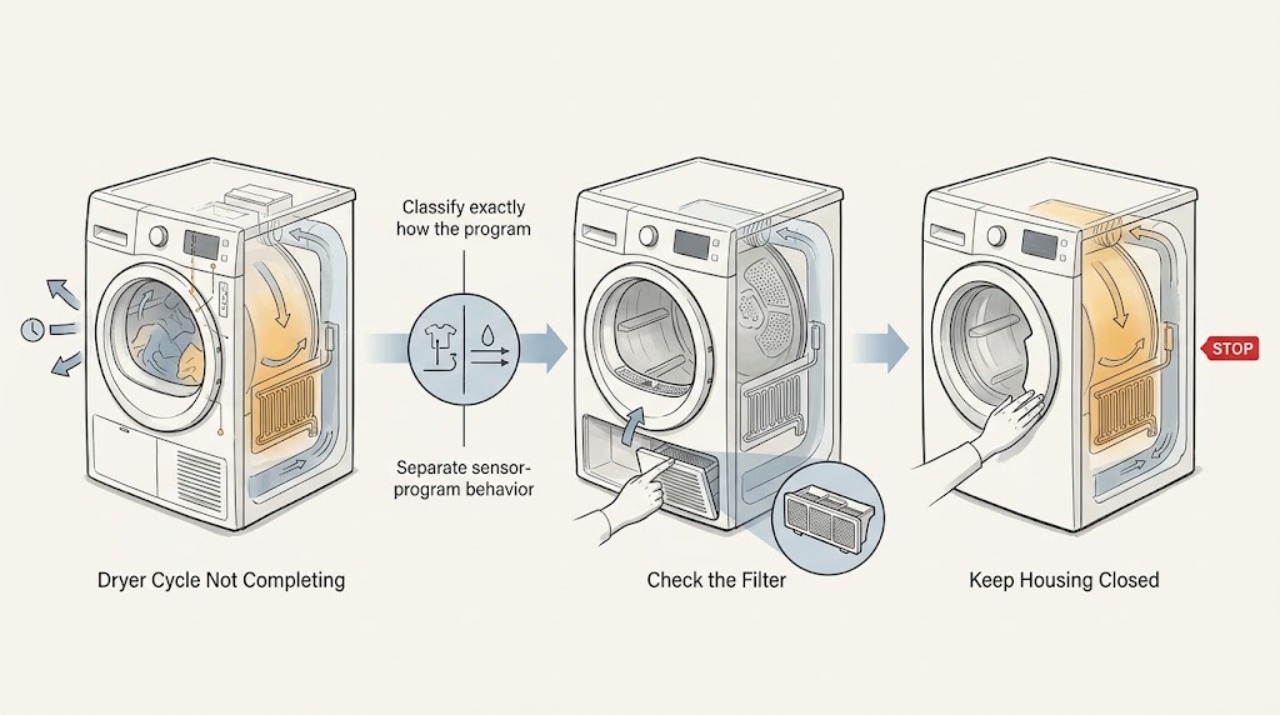
Work through in order
Diagnostic checks
Use only checks that match the exact appliance or system and its official guide.
-
Classify exactly how the program fails to complete
Using a normal, model-appropriate load and the program you usually use, record the starting load condition, displayed time, whether the drum turns and heats, and when the dryer stops or appears to finish. Note any indicator, beep, or error message; do not repeatedly restart an abnormal cycle.
Expected result: The program jumps to the end immediately; stops after a few minutes; runs for the expected period but leaves clothes damp; runs much longer than expected; or the display time changes while the load continues to tumble.
Next step: Use the matching branch below and record the model, program, load size, and result for service if the behavior repeats.
Stop if: Stop for smoke, burning odor, abnormal heat, scraping, water near electrical parts, repeated power trips, or a drum that does not turn normally.
Why this matters
Why: An immediate end can occur when a humidity-controlled program cannot detect enough moisture, while a long or damp cycle points toward load moisture, airflow, water handling, or heating. A changing time display can be normal sensor calculation rather than a failed timer. AEG distinguishes these patterns in its cycle and drying-result guidance.
-
Separate sensor-program behavior from a load problem
Check the exact manual's description of the selected sensor or automatic program. Confirm the load is not nearly dry, empty, or unusually small, and that it matches the selected fabric and dryness setting. If you need to finish a small or partly air-dried load, use a time-controlled option only when the model manual says it is suitable and choose a conservative duration.
Expected result: The load is very small or already mostly dry; the selected program is humidity-controlled; the load is normal for that program; or the program ends early even with a suitable, damp load.
Next step: Run one suitable load with the documented program and note whether the cycle completes. Do not add wet items merely to defeat a sensor decision or select a long time that could overdry unsuitable fabrics.
Stop if: Stop if the dryer overheats, the load scorches, the program cancels repeatedly with suitable loads, or the exact program guidance is unavailable.
Why this matters
Why: AEG explains that humidity-controlled programs use the moisture in the load and may cancel when there is too little laundry or too little moisture to measure. Early completion with an appropriate damp load is not explained by normal sensor behavior alone and needs the filter, water, heat, and service branches.
-
Check the accessible filter, condenser, and water container
Turn the dryer off and let it cool. Following the exact model manual, inspect and clean only the user-accessible fluff filter and condenser area, and check whether a water-container-full indicator is lit. Empty the container only as the manual directs; do not remove sealed panels, scrape fins aggressively, or reach into the fan, pump, heater, or wiring.
Expected result: The filter or condenser is visibly loaded; the water container indicator is on; the accessible areas are clean and the container is clear; or access would require removing a cover.
Next step: Restore the filter and container exactly as directed and run one ordinary test load. If the indicator returns or the cycle still stops, record it and request service; do not improvise a filter, bypass a float or door switch, or dismantle the condenser system.
Stop if: Stop for water near electrical connections, a damaged filter housing, a sharp or hot condenser surface, a blocked internal passage, or any need to open the appliance cabinet.
Why this matters
Why: AEG says restricted filters or condenser airflow can affect drying and that a full water container can stop a cycle. A clean accessible area with a continuing fault moves the diagnosis toward hose, pump, sensor, heat, or control faults rather than just more cleaning.
-
Observe room conditions and any accessible outlet hose
From outside the appliance, note whether the room is unusually cold, hot, damp, or poorly ventilated and whether an outlet hose fitted to the dryer is visibly kinked or crushed. Keep the dryer in its installed position and do not pull it out or change ventilation, ducting, or connections without the exact manual.
Expected result: The room is outside the model's documented operating conditions; an outlet hose is kinked; the room and hose look normal; or the hose and rear connections cannot be inspected safely.
Next step: Correct only an obvious, safe placement issue permitted by the manual, then make one normal test. If the hose or room cannot be assessed without moving the dryer, leave it in place and request service.
Stop if: Stop for condensation near power connections, a hot or damaged outlet, gas or combustion equipment nearby, a crushed connection, or any need to move a heavy or hard-wired appliance.
Why this matters
Why: AEG states that unsuitable ambient conditions can affect operation and that a kinked outlet hose can contribute to early stops on models equipped with one. Normal room and hose observations do not rule out an internal airflow, pump, sensor, or heat fault.
-
Record heat, indicators, and model details for service
Record the full model number, dryer type if known, program and load, start and stop behavior, whether the drum turns, whether the load becomes warm during a normal cycle, filter and water-container observations, hose condition, ambient clues, and every displayed code or light pattern. Do not open the cabinet or run a long empty heating test unless the exact manual explicitly directs it and the appliance has no safety warning.
Expected result: The drum never warms; it warms but stops early; it completes only on a time-controlled program; an error or indicator repeats; or the symptom remains unexplained after the user-level checks.
Next step: Stop using the dryer if the abnormal behavior repeats or heat is absent, and request an authorized appliance service visit with the recorded evidence. Keep the dryer unplugged only when safe and as directed by the manual.
Stop if: Do not measure live voltage, open panels, bypass a thermal or door safety device, reset hidden diagnostics, or replace a heater, sensor, fuse, pump, or control board from this symptom alone.
Why this matters
Why: No heat after a normal cycle can indicate an internal fault, while a sensor-only or program-specific pattern may require a different inspection. AEG recommends service when its accessible checks do not resolve a persistent early stop or heating concern; the model details prevent guessing at a sensor or heater part.
Use your observations
Decision map
Find the observation that best matches what you see, then follow the next safe action.
-
PATH 01Safety boundary
What you see
The load is very small or already dry, and a humidity-controlled program ends quickly without a safety warning.
Do this next
Use a suitable load and the exact manual's documented program or time-controlled option for small or partly air-dried loads. Monitor one cycle and stop if it ends early with a suitable damp load.
Why this path and its safety boundary
Safety stop: Do not add wet items solely to defeat the sensor or choose an unnecessarily long time for unsuitable fabrics.
-
PATH 02Safety boundary
What you see
The filter or condenser is loaded, the water-container indicator is on, or an outlet hose is kinked on a model that has one.
Do this next
Power down and perform only the accessible cleaning, container-emptying, or hose check described by the exact model manual, then run one normal test. Request service if the condition returns.
Why this path and its safety boundary
Safety stop: Do not open the cabinet, scrape internal parts, bypass a level or door switch, or continue operation when water reaches electrical areas.
-
PATH 03Safety boundary
What you see
The dryer does not warm during a normal cycle, shows a repeated fault, trips power, smells hot or burnt, or stops with an abnormal noise.
Do this next
Stop using the appliance and request authorized appliance service with the model number and observations. Disconnect power only by the safe method in the manual and only when there is no immediate electrical hazard.
Why this path and its safety boundary
Safety stop: Do not open panels, test live wiring, bypass thermal protection, or repeatedly restart the dryer to see whether the fault clears.
-
PATH 04Safety boundary
What you see
The dryer works on one program but repeatedly fails on another, or it ends early with a suitable load after the accessible checks are normal.
Do this next
Record the exact program, load, timing, warmth, and indicator pattern and request model-specific service; a program-specific sensor or control issue cannot be identified from the symptom alone.
Why this path and its safety boundary
Safety stop: Do not substitute a long timed cycle as a permanent workaround or order a sensor, heater, or control part without a model-specific diagnosis.
-
PATH 05Safety boundary
What you see
The cycle still does not complete and no safe user-level cause is visible, or the relevant manual is unavailable.
Do this next
Keep the dryer out of service and arrange appliance-repair assessment. Provide the full model number, the result pattern, photos of accessible indicators, and the checks already completed.
Why this path and its safety boundary
Safety stop: Do not run repeated cycles, open the cabinet, or use an improvised bypass for the door, water, airflow, or thermal controls.
Helpful context
Understand the symptom
Cycle not completing is not one diagnosis. A humidity-controlled program can decide that a small or already-dry load has reached its target and end early, while a blocked airflow path or full water container can interrupt drying. A cycle that runs for a long time with damp clothes is a different branch from a cycle that jumps to the end immediately.
AEG's support articles apply to its tumble-dryer families, but the available control names, filter locations, condenser access, and error meanings vary by model. Record the complete model number from the rating plate and use the matching manual before changing a program or attempting maintenance. Do not infer a failed heating element, sensor, compressor, or control board from the end-of-cycle symptom alone.
Keep the dryer safe while you narrow the cause
Do not run the appliance unattended while it is behaving abnormally. Stop immediately for smoke, a burning smell, a hot plug or socket, repeated breaker trips, unusual scraping, water near electrical parts, or a drum that will not turn normally. Keep the door closed and the appliance disconnected only in the safe manner described by its manual; never remove a cover or probe wiring.
The first useful comparison is the program result: sensor programs may legitimately change their displayed time, whereas a prompt cancellation with damp laundry, a repeated stop after a few minutes, or no heat after a normal run needs a different next step.
Only after diagnosis
Potential parts
- dryer moisture or conductivity sensor
Consider this category only when suitable loads repeatedly end early on sensor programs and a qualified diagnosis rules out load size, filter, water handling, program selection, and heating problems.
Match the exact AEG model, sensor arrangement, and approved service method. Do not replace a sensor from an early-stop symptom alone. - dryer temperature sensor or thermistor
Consider this category only when a model-specific service diagnosis identifies an incorrect temperature reading or a related fault after airflow and heating checks.
Confirm the exact model and sensor specification before ordering; do not open the cabinet or test the sensor from this guide. - dryer heating system component
Consider this category only when the dryer does not warm during a normal cycle and a qualified technician identifies the failed heating component.
The heating path differs by vented, condenser, and heat-pump design. Match the exact model and leave electrical diagnosis to a qualified technician. - dryer water pump or drain component
Consider this category only when the water container repeatedly fills or a drainage fault is confirmed after the container, filter, and accessible hose checks.
Confirm whether the model uses a pump and the exact approved component. Do not open the appliance or infer pump failure from an early stop alone.
When checks do not resolve it
Need a professional?
Request appliance service when a suitable load repeatedly ends early, the dryer has no heat, an indicator or fault repeats, the accessible filter and water checks do not resolve the issue, or the model's manual is unavailable. Stop using it promptly for smoke, burning odor, abnormal heat, repeated power trips, water near electrical parts, or a damaged cord or socket.
Common questions
FAQ
Why does my AEG dryer stop soon after it starts?
A sensor program may end when the load is too small or already too dry to measure reliably. A blocked filter or condenser, full water container, kinked outlet hose, or internal fault can produce a similar stop. Test only with a suitable load and follow the exact model manual.
Is it normal for an AEG dryer's remaining time to change?
It can be normal on automatic programs because the dryer recalculates duration from the load and moisture. A changing display is different from a repeated cancellation with a suitable load, damp laundry, no heat, an error, or a safety warning.
Can a small load make the dryer end the cycle early?
Yes. AEG says humidity-controlled programs may be unable to determine moisture when there is too little laundry or too little moisture. Use the documented time-controlled option for small loads only when suitable for that model and fabric.
What should I check before calling for AEG dryer service?
Record the exact stop pattern and model number, then check the user-accessible fluff filter, condenser area, water container, and outlet hose when fitted, following the manual. Also note the load, program, warmth, indicators, and any unusual sound. Do not open panels.
Could a moisture sensor be causing the cycle not to complete?
It is one conditional possibility when suitable loads repeatedly end early on sensor programs, but the symptom does not prove the sensor is faulty. First rule out load size, filter and water handling, program selection, and heat; have the model-specific sensor path diagnosed before ordering a part.
When should I stop using the AEG dryer and call a professional?
Stop for burning odor, smoke, abnormal heat, repeated power trips, water near electrical parts, no heat, repeated fault indicators, or a cycle that still stops after the documented accessible checks. Keep the appliance out of service until it has been assessed.
Read the exact guide
Official sources
- Aeg dryer doesn't dryReddit, r/appliancerepair · Anecdotal AEG dryer discussion involving intermittent early stops, poor drying, airflow or heat observations, and an unverified sensor-repair report.
- Tumble dryer ends the programme immediately after the startAEG · Supports the small, dry, or low-moisture load branch and the distinction between sensor and time-controlled programs.
- Tumble dryer's drying cycle does not end / Does not sense when clothes are dryAEG · Direct AEG support for tumble dryers; exact model controls, filter access, and program behavior may differ.
- Clothes are still wet at the end of the drying cycleAEG · Supports separating sensor and timed programs and checking water-container and fluff-filter indicators when clothes remain damp.
- Start - Pause LED flashes on tumble dryerAEG · Supports checking repeated early stops, filter and water-container condition, a fitted outlet hose, load sufficiency, and requesting service.
Community feedback
Share a repair observation
Share a plain-text repair observation. Accepted observations are published automatically; this page may take a moment to update.