
On this page
Start here
Quick answer
A Beko dryer cycle that does not complete should first be separated into a mid-cycle stop, an early end with damp laundry, a cycle that never starts, or a drum that stops turning. For a non-plumbed dryer, empty the water tank; clean the lint filter after each cycle and the filter drawer or condenser when the model indicates; and use the program and load size suited to the laundry. Check that the door closes and that child lock or a delayed setting is not preventing the expected operation. If the drum turns with no resistance, the dryer repeatedly stops, a breaker trips, there is a burning smell, overheating, water leakage, or the cause remains after a single safe power reset, stop using it and arrange an authorized service assessment.
Before you begin
Safety first
- This article covers cool, ordinary-access observation, filter and tank maintenance, and one safe power reset only. Do not open the cabinet, test live circuits, alter a drain, replace internal parts, or bypass a door or lock.
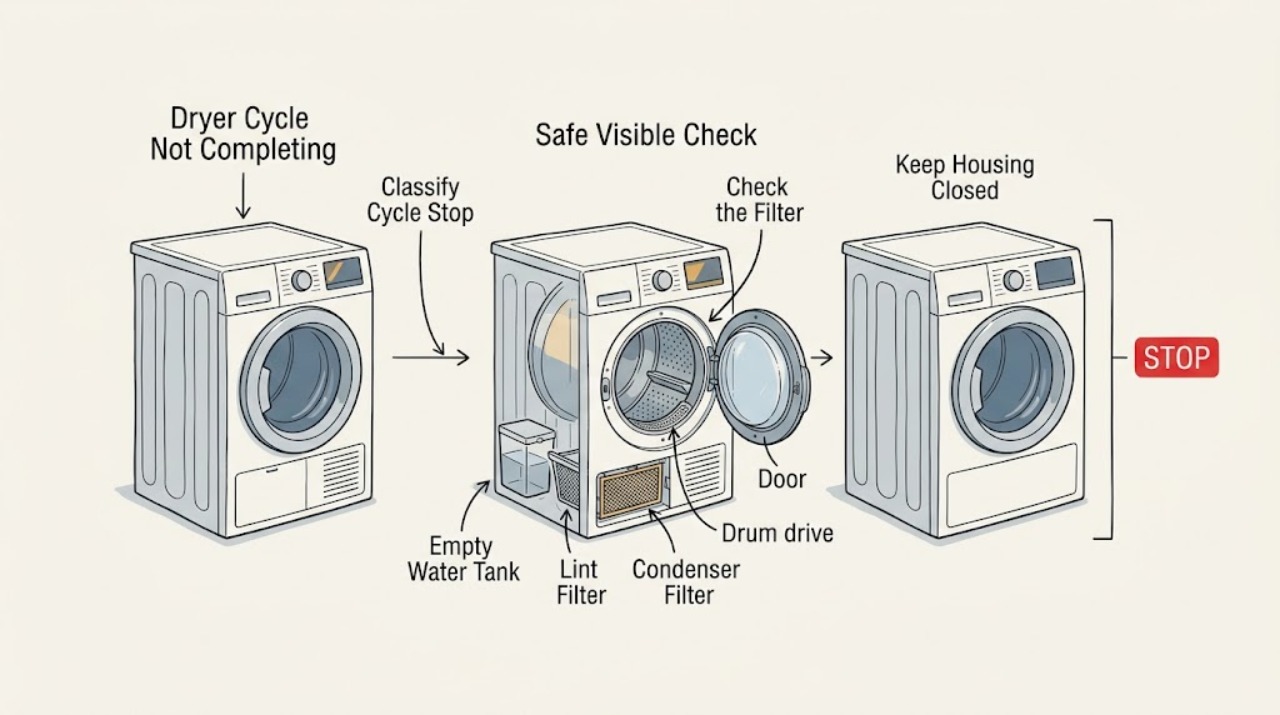
Work through in order
Diagnostic checks
Use only checks that match the exact appliance or system and its official guide.
-
Check 1
From a cool, stable position, note the selected program, whether the display is still on, whether the drum stopped with laundry inside, whether the cycle ended early with damp items, and whether the dryer starts again after the door is closed; do not reach into a moving or hot drum.
Expected result: The dryer stops mid-cycle, ends early but remains powered, never starts, or the drum no longer turns while the controls remain active.
Next step: Write down the program, load type, approximate point of stopping, display indicators, laundry dampness, and any sound or smell, then follow the matching checks below.
Stop if: Stop immediately for smoke, burning smell, visible overheating, sparking, water around electrical parts, or a drum that moves abnormally.
Why this matters
Why: A full tank, restricted filters, unsuitable load or program, door or lock state, drive problem, power interruption, or technical fault can produce different versions of this symptom. A clear symptom timeline is more useful than assuming the timer alone identifies the failed component.
-
Check 2
If the dryer is not plumbed in, switch it off, wait until the appliance is safe to handle, and inspect the removable water tank; empty it and rinse away visible lint only as the model instructions allow.
Expected result: The tank is full, partly full, empty, or cannot be removed without force; the dryer resumes after emptying; or it stops again with a tank that appears empty.
Next step: Reinstall the tank securely and observe one suitable cycle. If the tank fills unusually quickly, the dryer is plumbed in, water leaks, or the stop repeats, arrange authorized service.
Stop if: Do not operate with the tank loose, reach into a wet electrical area, force the tank, or alter a plumbed drain connection.
Why this matters
Why: Beko says a full tank can stop a later drying cycle until the tank is emptied. A repeat stop with an apparently empty tank can indicate a drainage, sensor, installation, or technical issue rather than permission to dismantle the tank housing.
-
Check 3
With the dryer off and cool, remove the lint filter at the door and inspect the visible filter drawer or condenser filter if the model has one; remove lint by hand or with the model-approved gentle method, and dry any washed filter completely before refitting.
Expected result: The lint filter is clogged, the secondary filter or condenser warning is lit, filters are clean, or a filter cannot be removed or latched normally.
Next step: Refit each filter and close the kick plate or filter cover securely, then run one appropriate lighter load. If the warning returns immediately, airflow remains poor, or the filter housing is damaged, stop and request service.
Stop if: Do not run the dryer without its filters, use sharp tools on a screen, leave wet filter pieces installed, or open sealed airflow components.
Why this matters
Why: Beko says a clogged lint filter can prevent complete drying and that a blocked filter drawer or condenser can lengthen drying time. A clean, correctly seated filter makes a load, program, tank, door, or technical cause more plausible; a broken latch or housing needs service.
-
Check 4
Check the laundry care labels and exact model manual, then compare the selected program and load amount with the fabric type and dryer capacity; if the load may be too heavy, run a smaller suitable load without adding items during a running cycle.
Expected result: The program is unsuitable, the load is overloaded or unusually wet, the load is light and appropriate, or the dryer completes only with a lighter or different program.
Next step: Use the model-recommended program and capacity, and compare a complete cycle result after the filters and tank are addressed. If it still stops or ends early, document the comparison for service.
Stop if: Do not exceed the stated capacity, dry items prohibited by their care labels, or continue if the drum, cabinet, or load becomes abnormally hot.
Why this matters
Why: Beko says an unsuitable program or overloaded appliance can leave laundry incompletely dried. Improvement with a suitable lighter load supports a cycle or loading issue, while repeated mid-cycle stops with an appropriate load point back to tank, power, door, drive, or technical checks.
-
Check 5
Confirm that no fabric is caught in the door seal, the door closes firmly, the child-lock indicator is not preventing control changes, and no delayed start or end-time setting is waiting; use only the model manual for the button sequence.
Expected result: The door was ajar, a seal obstruction is present, child lock is active, a delay is set, or none of these conditions explains the incomplete cycle.
Next step: Remove only a loose obstruction, close the door normally, cancel the documented lock or delay, and run one test cycle. Arrange service if the lock, door, or control does not behave normally.
Stop if: Do not force the door, defeat the lock, tape the latch, or open the control panel.
Why this matters
Why: Beko says an open door prevents a dryer from starting, child lock prevents program changes, and delayed programs can postpone operation. A door that will not close or a lock that remains active after the documented procedure points to a mechanical or control fault.
-
Check 6
With the dryer unplugged or otherwise safely isolated and the drum cool, turn the empty drum gently by hand only as Beko describes; if the machine stopped after an electrical interruption, perform one manufacturer-compatible power reset before retrying.
Expected result: The drum turns with normal resistance, turns with no resistance at all, is jammed, or the dryer stops again after the reset.
Next step: If the drum has no resistance, is jammed, or the cycle stops again, leave the dryer out of service and provide the symptom record to an authorized technician. If the reset restores one complete cycle, continue monitoring rather than repeatedly resetting.
Stop if: Do not remove covers, test live voltage, replace a belt, bypass a door switch, or keep operating after a burning smell, trip, or abnormal drum movement.
Why this matters
Why: Beko says a drum that turns with no resistance can indicate a damaged or broken drive belt and calls for an authorized service agent. A jam, repeated stop, or unchanged symptom after a power reset indicates a mechanical or technical fault rather than a reason to remove panels.
Use your observations
Decision map
Find the observation that best matches what you see, then follow the next safe action.
-
PATH 01Safety boundary
What you see
The non-plumbed dryer's water tank is full and the dryer stopped during or before a later cycle.
Do this next
Empty and securely refit the tank, then observe one appropriate cycle; arrange service if the condition repeats or water leaks.
Why this path and its safety boundary
Why it matters: The tank can prevent the dryer from continuing until its collected water is emptied.
Safety stop: Do not force the tank or work near wet electrical parts.
-
PATH 02Safety boundary
What you see
The lint filter or model-specific filter drawer or condenser is visibly clogged or its cleaning indicator is active.
Do this next
Clean and fully dry the accessible filter pieces, refit them correctly, and test a suitable lighter load.
Why this path and its safety boundary
Why it matters: Restricted lint or condenser airflow can lengthen drying or leave laundry wet at an apparent early end.
Safety stop: Do not run without filters or open sealed airflow components.
-
PATH 03Safety boundary
What you see
The program does not suit the load, the load exceeds the model capacity, or the dryer completes only with a smaller or different load.
Do this next
Follow care labels and the model manual, choose the appropriate program, and compare one lighter load.
Why this path and its safety boundary
Why it matters: The incomplete result may be a loading or program mismatch rather than a failed dryer component.
Safety stop: Stop for abnormal heat, damaged fabric, or repeated stopping with an appropriate load.
-
PATH 04Safety boundary
What you see
The door is not firmly closed, child lock is active, or delayed start or end-time is set.
Do this next
Clear only a loose door obstruction and use the exact model instructions to cancel the lock or delay before one test cycle.
Why this path and its safety boundary
Why it matters: The dryer may be preventing input or waiting by design instead of failing to complete a running cycle.
Safety stop: Do not force or bypass the door lock.
-
PATH 05Safety boundary
What you see
The empty drum turns with no resistance, is jammed, or the dryer stops with abnormal drum movement.
Do this next
Stop using the dryer and arrange authorized service for drive and drum diagnosis.
Why this path and its safety boundary
Why it matters: Beko identifies a drum with no resistance as a possible damaged or broken drive belt; a jam or abnormal movement also needs mechanical assessment.
Safety stop: Do not open covers, replace a belt, or operate with a jammed or freely spinning drum.
-
PATH 06Safety boundary
What you see
The tank, filters, program, load, door, lock, and one safe power reset do not explain a repeated stop or incomplete cycle.
Do this next
Leave the dryer out of service and arrange an authorized service assessment with the cycle history and observations.
Why this path and its safety boundary
Why it matters: A technical, electrical, sensor, motor, heating, or control fault remains possible, but the symptom does not identify a safe user-replaceable part.
Safety stop: Do not continue repeated resets, live-test, open the cabinet, or defeat a safety device.
Helpful context
Understand the symptom
Define what ‘not completing’ looks like
Record whether the drum stops while clothes are still wet, the display reaches End unusually early, the dryer never starts, or the drum is no longer turning but the controls remain lit. A mid-cycle stop points toward the water tank, power, drive, or a technical fault. Damp clothes at the end can instead reflect program choice, a clogged filter, or an overloaded drum. These observations narrow the safe checks without proving a failed part.
Drainage and airflow affect cycle progress
A Beko dryer that is not plumbed in stores extracted water in a tank; Beko says a full tank can stop the next cycle until it is emptied. Lint and, on heat-pump or condenser models, a filter drawer or condenser filter can extend drying time or prevent laundry from becoming dry. Clean only the accessible filters described for the exact model, and let washed filter pieces dry fully before reinstalling them.
Program controls can postpone or interrupt the expected end
The chosen program must suit the load and the dryer capacity. Beko also documents child lock and delayed-program features that can disable changes or postpone operation. If the panel beeps without accepting input or the cycle seems to be waiting for a later time, check the model's manual before treating that behavior as a mechanical stop.
Safety boundary
Stop conditions
- Stop for smoke, burning smell, visible overheating, sparking, water near electrical parts, a tripping breaker, or a damaged cord or plug.
- Do not run the dryer without its lint or model-specific secondary filters, with a loose door, or with the water tank improperly fitted.
- Do not open the cabinet, test live voltage, replace a belt or internal component, or bypass a door or child-lock safety function.
- Do not keep resetting power after the dryer stops again or after an abnormal sound, odor, or electrical symptom.
- Stop and arrange plumbing or appliance service when a plumbed drain, leaking tank area, hidden airflow path, or installation connection needs alteration.
Only after diagnosis
Potential parts
- dryer lint filter or filter drawer
Consider this category only when the exact model's filter is damaged, cannot latch, or remains restricted after the documented cleaning method.
Match the exact Beko model and filter design; do not run without the filter or substitute a part by appearance. - dryer water tank or drain component
Consider this category only if the exact model's tank or drain component is cracked, leaking, or not detected after a qualified assessment.
Confirm the model's plumbed or tank configuration and fit; do not alter a drain connection as a user test. - dryer drive belt
Consider this category only when the drum turns with no resistance and an authorized technician confirms a belt fault.
Confirm exact model, drum-drive design, and repair procedure; do not open the cabinet or replace it from the symptom alone. - dryer door latch or switch
Consider this category only when the door will not close or be recognized after loose obstructions are cleared and a qualified diagnosis identifies the latch path.
Match the exact model and preserve the door safety function; do not tape, jumper, or bypass it.
When checks do not resolve it
Need a professional?
Arrange authorized appliance service when a Beko dryer repeatedly stops mid-cycle, the drum turns with no resistance, the tank appears empty but the stop repeats, filters and a suitable load do not resolve an early end, the door or lock will not behave normally, or a technical fault is suspected. Seek prompt service for overheating, smoke, burning smell, sparking, water leakage near electrical parts, a damaged cord, or a tripping breaker. Do not open the cabinet or perform live electrical tests.
Safety scope: This article covers cool, ordinary-access observation, filter and tank maintenance, and one safe power reset only. Do not open the cabinet, test live circuits, alter a drain, replace internal parts, or bypass a door or lock.
Common questions
FAQ
Why does my Beko dryer stop before the cycle is finished?
Check the water tank if the dryer is not plumbed in, clean the lint and model-specific secondary filters, and verify the program and load. Also check the door, child lock, and delayed setting. A repeated stop after these checks needs authorized service.
Can a full water tank stop a Beko dryer?
Yes. Beko says a non-plumbed dryer can stop when its water tank is full. Empty and refit the tank as the model instructions describe; if it fills unusually quickly, leaks, or the dryer stops again, arrange service.
Can a clogged filter make a Beko dryer end early?
A clogged lint filter or secondary filter can prevent complete drying or lengthen the cycle. Clean the accessible filters, dry washed pieces completely, refit them, and compare a suitable lighter load. Do not run without filters.
What does it mean if the Beko dryer drum turns freely by hand?
Beko says a drum that turns with no resistance may indicate a damaged or broken drive belt. Stop using the dryer and arrange an authorized service assessment; do not remove the cabinet or replace the belt by guesswork.
Why will my Beko dryer not continue after I press a button?
The door may not be recognized as closed, child lock may be active, or a delayed program may be waiting. Clear only a loose door obstruction and use the exact model manual for lock or delay controls. If the controls or latch remain abnormal, request service.
Read the exact guide
Official sources
- How to fix a tumble dryer that stops mid-cycleBeko · Supports the full-tank branch, no-resistance drum observation, one power-reset check, and authorized-service escalation for a mid-cycle stop.
- Tumble Dryer Help CenterBeko · Supports the control-state and maintenance branches where child lock or delayed operation affects expected cycle behavior and filters need periodic cleaning.
- How to fix a tumble dryer that’s not dryingBeko · Supports early-end or damp-laundry branches involving program choice, clogged filters, filter-drawer or condenser condition, and overload.
- How to fix a tumble dryer that won’t startBeko · Supports the no-start or interrupted-control branch where a door is open, child lock is active, or power or technical failure is suspected.
Community feedback
Share a repair observation
Share a plain-text repair observation. Accepted observations are published automatically; this page may take a moment to update.