
On this page
Start here
Quick answer
Do not decide whether a Maytag Neptune dryer's motor is worth repairing from an overheating shutdown alone. Neptune is a series, not a complete model number, and the same symptom can come from restricted exhaust, a blocked lint screen, an unsuitable load or cycle, gas or electrical supply, a protective shutdown, or an internal heat or drive fault. Press Stop or Power, let the dryer and clothes cool, and do not run another heated load if there is a burning smell, smoke, scorching, gas odor, sparks, a damaged cord, or repeated breaker action. After the dryer is cool, identify the full model and fuel type, clean the lint screen, inspect the visible hose and outside hood, and record whether the problem occurs on an automatic or timed cycle. If airflow is clear but the dryer still overheats or shuts down, arrange qualified service; ask for a diagnosis and repair-versus-replace estimate rather than approving a motor on the symptom alone.
Before you begin
Safety first
- Do not run repeated heated tests, bypass a thermal cutoff, open the cabinet, probe live voltage, work on gas fittings, or treat the motor as confirmed from an overheating shutdown. Do not continue using a dryer with smoke, scorching, gas odor, abnormal heat, damaged wiring/cord, water near electricity, or repeated breaker action.
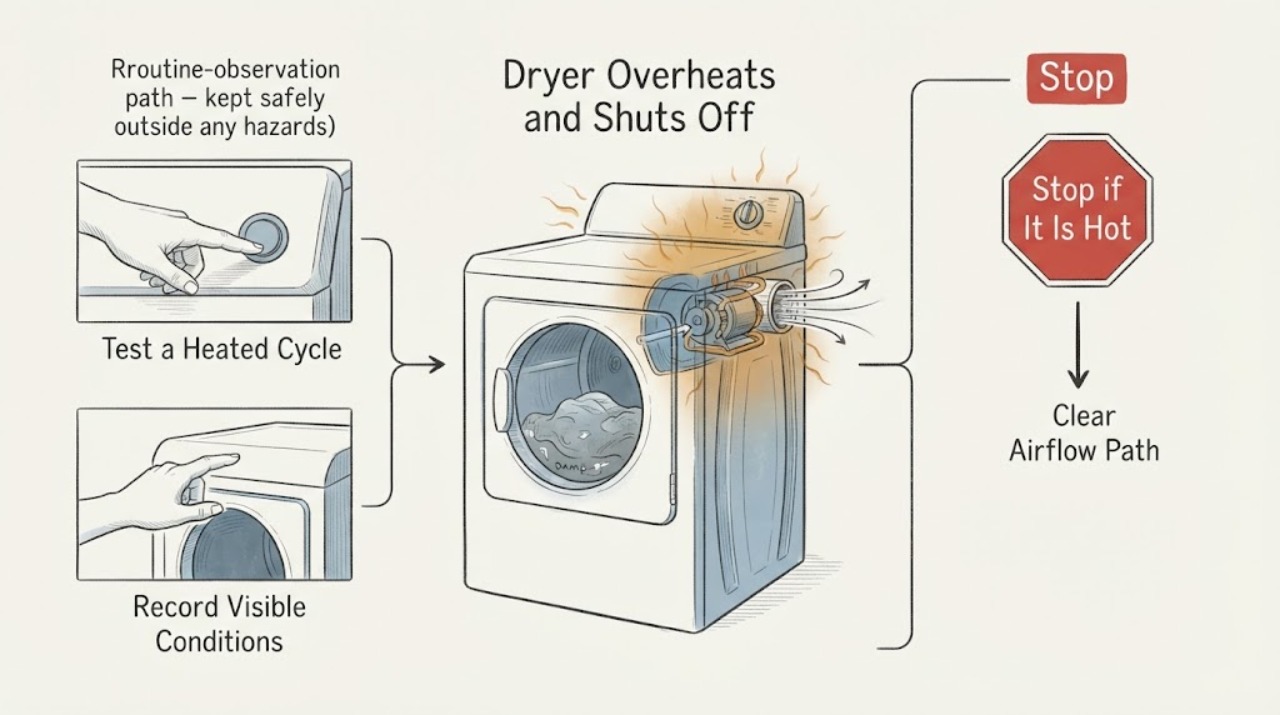
Work through in order
Diagnostic checks
Use only checks that match the exact appliance or system and its official guide.
-
Check 1
Press Stop or Power and leave the dryer off until the cabinet, drum, and clothes are cool. From outside, record any smoke, burning smell, scorching, melted fabric, sparks, gas odor, water near electrical parts, damaged cord, or breaker that opened. Do not open the cabinet or restart a heated cycle to reproduce the shutdown.
Expected result: The dryer cools with no warning sign, or a fire, gas, electrical, water, or severe-heat warning is present.
Next step: If no warning sign is present, write down the cycle, load, fuel type, and time to shutdown. If one is present, leave the dryer off, isolate power or gas only from a safe accessible point, and obtain qualified appliance, electrical, or gas help.
Stop if: Stop immediately for smoke, fire, gas odor, exposed wiring, a wet outlet or cord, severe cabinet heat, or damaged clothing.
Why this matters
Why: A cool dryer without a warning sign permits only low-risk external checks. Smoke, odor, scorching, gas, sparks, wet electrical areas, or a repeated breaker trip changes the problem to an immediate safety stop and does not support a motor diagnosis.
-
Check 2
Find the complete model number and serial label without moving an unsafe dryer; record whether the Neptune dryer is electric or gas. Note whether it overheated on Timed Dry, an Automatic Cycle, a high-temperature setting, or every cycle, and whether it was a small, tightly packed, mixed, or bulky load.
Expected result: The full model and fuel type are known, the symptom is limited to one cycle or load pattern, or it occurs across cycles and loads.
Next step: Use the full model number when consulting Maytag or scheduling service. Do not approve a motor based on a load-limited symptom; keep the dryer off if the cabinet or clothes became abnormally hot.
Stop if: Stop if the label cannot be read without moving the dryer, opening a panel, touching a hot surface, or approaching a gas/electrical hazard.
Why this matters
Why: Neptune is only a series boundary, so the full model is needed before selecting a service procedure or part. A cycle- or load-limited symptom can reflect normal sensing, over-drying, or load behavior; overheating on every cycle is more concerning but still does not identify the motor.
-
Check 3
With the dryer unplugged or otherwise safely isolated and fully cool, clean the lint screen and check for a fabric-softener film or poor airflow through the mesh. Reinstall it fully. Do not operate the dryer without its lint screen and do not use a vacuum, tool, or cleaning method that the series instructions do not permit near internal parts.
Expected result: The screen is packed with lint, has an invisible-feeling residue, is not seated, or is clean and correctly installed.
Next step: After the screen is fully dry and seated, continue only to the visible hose and outside hood checks. If the screen was clear or the dryer still overheats, do not infer a motor failure.
Stop if: Stop if the screen housing is damaged, lint is packed inside an inaccessible opening, or cleaning would require removing panels or contacting wiring.
Why this matters
Why: Maytag identifies lint-screen blockage and residue as airflow restrictions that can increase drying time and contribute to excess heat. A clean screen does not rule out a restricted house vent or internal heat-control fault.
-
Check 4
Inspect the visible exhaust path without moving the dryer into an unsafe position: look for a crushed or sharply kinked hose, lint at the wall connection, and an outside hood blocked by lint, debris, nests, landscaping, or snow. Do not reach deep into the duct, use sheet-metal screws, or dismantle the dryer. If the house run is long or inaccessible, arrange professional vent cleaning or testing.
Expected result: The hose is crushed or kinked, outside airflow is weak, the hood is blocked, an AF or Check Vent indication appears, or the visible path is clear with strong exhaust.
Next step: Clear only an obvious external hood obstruction when safe and arrange a qualified vent clean/test for a restricted run. Do not run heated cycles until a severe restriction is corrected; if airflow is strong but overheating persists, request appliance service.
Stop if: Stop if the hood or duct is inaccessible, the dryer must be pulled through a gas/electrical connection, there is lint buildup with scorching, or the exhaust area is dangerously hot.
Why this matters
Why: Maytag links restricted airflow with overheating, longer drying, and fire risk; a clear visible section does not prove the full house vent is clear. A weak hood flow points first to vent service rather than a motor replacement.
-
Check 5
Compare the use pattern with the manual: do not overload, keep one washer load to one dryer load, separate heavy and lightweight items, and avoid treating a small or bulky load as proof of a motor problem. If there was no hazard and airflow has been verified, record whether an automatic cycle ends normally or the dryer shuts off early on every cycle; do not run repeated heated tests.
Expected result: Only a small/bulky load or Timed Dry causes the complaint, an Automatic Cycle ends at the selected dryness, or every cycle overheats or shuts down.
Next step: Correct only the load or cycle selection when no warning sign occurred. For recurring heat or shutdown, keep the dryer off and schedule service with the full model, fuel type, load, cycle, and vent observations.
Stop if: Stop all heated testing if clothes are damaged, the cabinet is abnormally hot, the shutdown repeats, or any odor, smoke, gas, or electrical sign appears.
Why this matters
Why: Maytag says Timed Dry runs for the selected duration while Automatic Cycles sense load conditions and stop at selected dryness. Load size and type can change results, but recurring overheating in different loads and cycles needs service and cannot be assigned to the motor from symptoms alone.
-
Check 6
For the repair-versus-replace question, ask the technician to document the actual cause, affected safety device or drive/heat system, full model-specific part numbers, labor and parts estimate, vent condition, and post-repair safety test. Do not accept a motor diagnosis merely because the dryer stopped after overheating, and do not use a universal age or cost rule.
Expected result: The estimate identifies a confirmed cause with a clear safety test, or it names a motor/control/heating part without explaining the overheating and exhaust findings.
Next step: Proceed only after the cause, model fit, safety checks, and estimate are documented. If the cause remains unproven or the dryer still overheats after a proposed repair, keep it out of heated service and obtain a second qualified diagnosis.
Stop if: Stop approval of parts or continued operation if the provider cannot explain the safety cause, model applicability, and post-repair verification.
Why this matters
Why: A confirmed cause and complete estimate allow an informed repair decision; a motor-only explanation without checking airflow and the thermal symptom leaves the primary risk unresolved. Official Maytag guidance supports service when excess heat or unusual operation persists but does not set a universal repair-price threshold.
Use your observations
Decision map
Find the observation that best matches what you see, then follow the next safe action.
-
PATH 01Next step
What you see
Smoke, fire, burning odor, scorching, gas odor, sparks, water near electrical parts, a damaged cord, abnormal cabinet heat, or repeated breaker action occurred.
Do this next
Leave the dryer off, isolate gas or power only from a safe accessible location, and arrange qualified appliance, electrical, or gas service. Do not restart to reproduce it.
Why this path and its safety boundary
Why it matters: This is a fire, gas, shock, or thermal safety stop. It is not a routine motor-repair decision.
-
PATH 02Next step
What you see
The lint screen is blocked or coated, the hose is crushed or kinked, the hood is obstructed, outside airflow is weak, or AF/Check Vent is displayed.
Do this next
Clean or correct only the visible, safe obstruction and arrange professional house-vent cleaning or testing for the inaccessible run. Do not continue heated cycles with a severe restriction.
Why this path and its safety boundary
Why it matters: Restricted airflow is the leading user-level branch supported by Maytag's guidance and can trap heat; it does not establish a failed motor.
-
PATH 03Next step
What you see
The complaint occurs only on Timed Dry, a high setting, or a very small/bulky load, while an Automatic Cycle ends normally and there is no safety warning.
Do this next
Use the full model's normal cycle guidance and an appropriate load, monitor only when safe, and arrange service if heat becomes excessive or the shutdown returns.
Why this path and its safety boundary
Why it matters: Cycle selection, load sensing, or load distribution may explain the event more closely than a motor failure, although this does not prove the dryer is healthy.
-
PATH 04Next step
What you see
The screen and visible vent path are clear, but the dryer overheats or shuts down across different loads and cycles, or the symptom returns after one safe external correction.
Do this next
Keep the dryer off and request qualified Maytag-compatible service using the complete model and fuel type. Ask for cause, vent findings, model-specific parts, and a written repair estimate before deciding whether repair is worthwhile.
Why this path and its safety boundary
Why it matters: The issue is beyond the owner-level airflow and load checks. An internal thermal, heating, drive, control, or power condition is possible, but the symptom still cannot identify the motor.
-
PATH 05Next step
What you see
The provider proposes a motor or other part without a documented cause, full model fit, airflow result, or post-repair safety verification.
Do this next
Ask for a diagnostic explanation and estimate that addresses exhaust, heat control, drive operation, and the observed shutdown. Obtain another qualified opinion if the provider cannot establish the cause.
Why this path and its safety boundary
Why it matters: The repair decision is not yet evidence-based; overheating and shutdown may remain unresolved.
Helpful context
Understand the symptom
“Maytag Neptune” identifies a product series, not a complete dryer model. That matters because fuel type, controls, service instructions, and parts vary. Overheating followed by a shutdown is a safety symptom; it is not a motor diagnosis. Start with the fuel/model and exhaust path, then let a qualified technician identify any internal fault.
A motor can run while the dryer overheats, and a protective shutdown can leave the motor as an unproven suspect. Do not keep restarting the dryer to see whether it fails again. The safest repair decision is based on the cause, the full model number, the dryer’s condition, and a documented estimate—not a guessed part or a fixed lifetime rule.
When checks do not resolve it
Need a professional?
Use a qualified Maytag-compatible appliance technician for recurring overheating or shutdown, unclear fuel/model identity, internal heat or drive diagnosis, or any safety symptom. Use a qualified vent-cleaning specialist for an inaccessible or restricted house exhaust run; use a qualified electrician or gas professional when the supply itself is unsafe.
Safety scope: Do not run repeated heated tests, bypass a thermal cutoff, open the cabinet, probe live voltage, work on gas fittings, or treat the motor as confirmed from an overheating shutdown. Do not continue using a dryer with smoke, scorching, gas odor, abnormal heat, damaged wiring/cord, water near electricity, or repeated breaker action.
Have this ready
- Provide the complete model and serial number, Neptune series label, electric or gas fuel type, cycle and temperature, load description, time to shutdown, photos of any scorching or lint, lint-screen result, visible hose/hood findings, AF/Check Vent indication, and any odor, smoke, breaker, or gas observations.
Common questions
FAQ
Does a Maytag Neptune dryer shutting off when hot prove the motor is bad?
No. Restricted exhaust, lint, cycle/load conditions, fuel or power issues, protective shutdowns, and internal heat or drive faults can overlap. Neptune is a series, so the full model and a technician's diagnosis are needed before naming the motor.
What should I check first when the dryer overheats?
Stop and cool the dryer first. If there is no safety warning, clean and seat the lint screen, inspect the visible hose and outside hood, and record the cycle, load, fuel type, and full model. Maytag identifies airflow restrictions as a key overheating check.
Can a small load or Timed Dry make the dryer seem too hot?
It can change drying behavior. Maytag says Timed Dry runs for its selected duration, while Automatic Cycles sense the load and stop at selected dryness; its Neptune manual also warns about very small, bulky, or overloaded loads. Excessive heat, damaged clothing, or repeat shutdown still needs service.
Should I buy a motor before the service call?
No. Do not select a motor, heating part, or thermal device from the symptom alone. Ask the provider to document the cause, full model fit, airflow result, estimate, and post-repair safety verification.
When should I stop using the dryer completely?
Stop immediately for smoke, fire, burning odor, scorching, gas odor, sparks, abnormal cabinet heat, water near electrical parts, damaged wiring or cord, or repeated breaker action. Isolate power or gas only from a safe accessible point and obtain qualified help.
Read the exact guide
Official sources
- Dryer Too Hot - Product HelpMaytag Product Help · Maytag dryer symptom guidance used for cycle/load and lint, vent, hood, and service branches; it does not identify a motor on a Neptune series symptom.
- Ordering a Dryer Vent Testing KitMaytag Product Help · Maytag general dryer safety guidance used for the overheating and professional vent-testing boundary; not used to claim a component failure.
- Owner's ManualMaytag · Opened Maytag Neptune owner manual used for series-level fuel, lint/exhaust, load, cool-down, odor, power, and service boundaries; a complete model number remains necessary for model-specific instructions.
- Check Vent Light on DryerMaytag Product Help · Maytag general dryer guidance used to distinguish a weak/blocked exhaust path from an unproven motor fault.
- Long Dry Times - Dryer - Product HelpMaytag Product Help · Maytag general dryer guidance used for the repair-diagnosis boundary and recurring symptoms, not a cost or lifespan rule.
- NEPTUNE DRYER INSTALLATION INSTRUCTIONSMaytag · Opened Neptune installation guidance used for fuel/electrical and exhaust safety boundaries, not for diagnosing a motor.
Community feedback
Share a repair observation
Share a plain-text repair observation. Accepted observations are published automatically; this page may take a moment to update.