
On this page
Start here
Quick answer
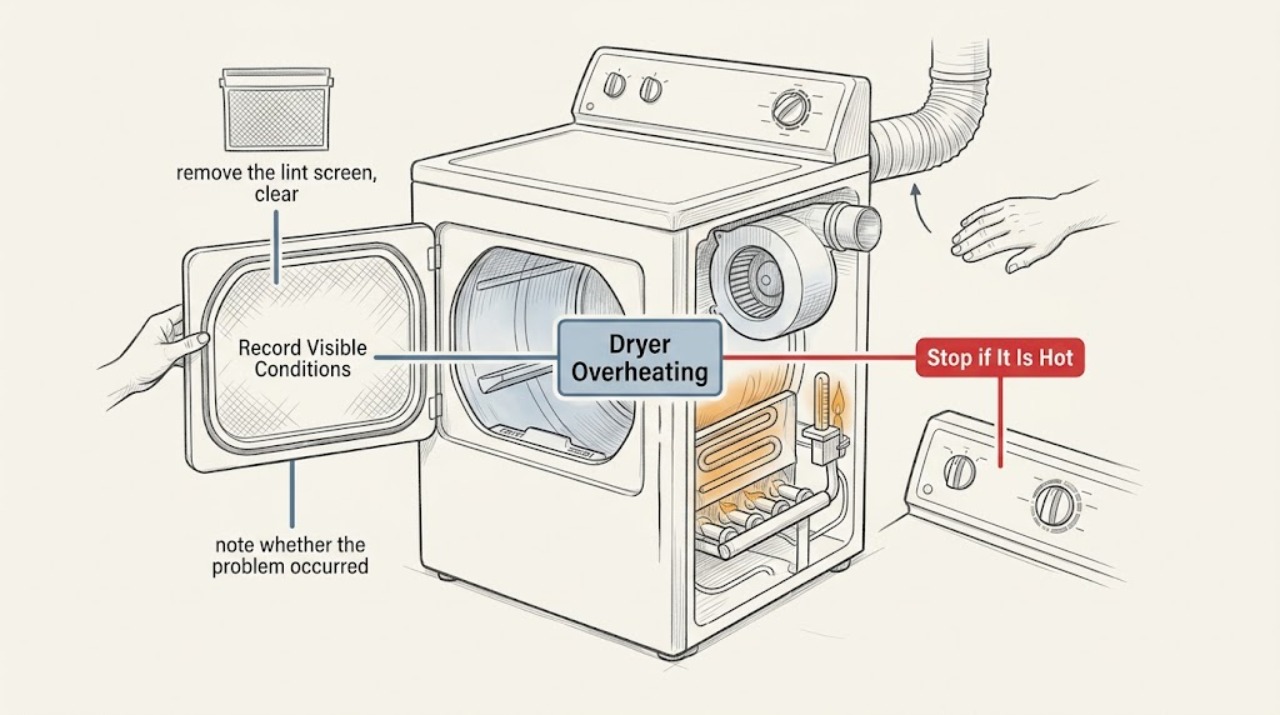
Stop the Maytag dryer immediately for a burning smell, smoke, sparks, scorching, clothing that is dangerously hot, an unusually hot cabinet, a gas odor, or a breaker that opens again. A dryer should be warm during use, but intense heat or heat that stays trapped is not normal. With the dryer off and cool, clean the lint screen, check the accessible vent hose for crushing or kinks, confirm the outside hood is open and clear, and note any AF or Check Vent indication. Review the selected cycle: Timed Dry can continue for the chosen duration, while an Automatic Cycle senses the load and ends at the selected dryness. If airflow is clear but the dryer still overheats, heat does not cycle down, clothing scorches, or the fault returns after one safe check, leave it off and arrange qualified appliance service. Do not open the cabinet, bypass thermal protection, adjust a gas burner, or test live wiring.
Work through in order
Diagnostic checks
Use only checks that match the exact appliance or system and its official guide.
-
Check 1
Press Power or Stop, keep the dryer off, and allow it to cool before opening the door or handling clothing. From outside the appliance, record burning smell, smoke, sparks, scorching, melted fabric, dangerously hot clothing, abnormal cabinet heat, gas odor, water near electrical parts, or a breaker that opened.
Expected result: The dryer cools normally with no warning sign, or a fire, gas, electrical, water, or severe-heat warning is present.
Next step: If no warning sign is present, record the cycle, load, display, and when the heat became abnormal. If one is present, leave the dryer off, isolate power only when safe and permitted, and obtain qualified appliance, electrical, or gas help.
Stop if: Stop immediately for smoke, fire, burning odor, sparks, scorching, gas odor, dangerously hot clothing, abnormal cabinet heat, water near electrical parts, or repeated breaker operation.
Why this matters
Why: A cool dryer without a warning sign permits low-risk airflow and cycle checks. A warning sign can indicate fire, shock, gas, or thermal danger and must not be reproduced with another load.
-
Check 2
With the dryer cool, note whether the problem occurred on Timed Dry, an Automatic Cycle, a high-temperature setting, a low-temperature setting, or a special option. Check whether the load was very small, tightly packed, mixed with heavy items, or left running after the clothes were already dry; do not use a cycle with clothing that shows scorching or melting.
Expected result: Overheating occurs only on Timed Dry or a high setting, the Automatic Cycle ends normally, the load is tightly packed or very small, or every cycle produces excessive heat.
Next step: Use the model manual to select a suitable cycle and load only after the lint and vent checks are clear and no hazard occurred. If every cycle overheats, the dryer does not stop at the selected dryness, or a load is damaged, keep it off and arrange service.
Stop if: Stop for damaged clothing, smoke, burning odor, gas odor, sparks, abnormal exterior heat, or a dryer that continues heating after a stop command.
Why this matters
Why: Maytag says Timed Dry runs for the chosen duration, while Automatic Cycles sense the load and stop at the selected dryness. Load size and cycle choice can change drying behavior, but heat in every cycle points beyond a simple setting issue.
-
Check 3
With the dryer off and cool, remove the lint screen, clear visible lint, and inspect it for a film from detergent or fabric softener. If residue is present, deep-clean and dry the screen exactly as Maytag's care instructions describe, then reinstall it fully. Do not operate the dryer without its lint screen.
Expected result: The screen is packed with lint, has invisible-feeling residue or poor airflow through the mesh, is incorrectly seated, or is clean and correctly installed.
Next step: After the screen is fully dry and seated, continue to the hose and outside hood inspection. If overheating or a warning returns, stop rather than relying on repeated screen cleaning.
Stop if: Stop for a damaged screen, lint falling into a hot appliance, smoke, scorching, burning odor, or any need to reach into the blower or cabinet.
Why this matters
Why: Maytag says a blocked screen obstructs airflow and makes the dryer work harder, while residue can remain even when lint is not obvious. A clean, seated screen with continued overheating shifts attention to the exhaust path or internal heat control.
-
Check 4
Without moving an unsafe dryer, look behind it for a crushed or sharply kinked exhaust hose and check the accessible wall connection. From outside, inspect the hood for lint, debris, nests, snow, or a flap that cannot open. If the appliance is safe and the model instructions permit a brief supervised airflow check, observe the outside exhaust without placing hands near moving or hot parts.
Expected result: The hose is crushed or kinked, the hood is blocked, airflow is weak, an AF or Check Vent indication appears, or the accessible path is clear with strong exhaust.
Next step: Clear only an obvious outside obstruction and arrange professional vent cleaning or testing for a restricted home run. If airflow is clear but the dryer remains too hot, leave it off and request appliance service.
Stop if: Stop for a hot or damaged hose, lint ignition, smoke, burning odor, a blocked hood that cannot be cleared safely, or any need to move the dryer through a hazardous space.
Why this matters
Why: Maytag links restricted airflow with lint or vent blockage, crushed or kinked hose, too many turns, and a blocked outside hood. Weak exhaust can trap heat and moisture even when the drum still tumbles. A clear accessible path does not rule out a restriction deeper in the home vent or an internal fault.
-
Check 5
With the dryer cool, compare the current installation with the model's instructions: the hose should not be crushed behind the cabinet, the exhaust should reach outdoors, the hood should have clearance, and the dryer should not be packed tightly against the wall. Note long dry times, humidity or heat in the laundry room, steam, water behind the dryer, or little lint collected on the screen.
Expected result: The dryer was recently moved or installed, the hose is too tight or sharply bent, the room is hot or humid, water appears behind the dryer, or installation and airflow signs are normal.
Next step: Correct only safe external clearance or an obvious hose position issue according to the installation instructions, then have the complete home vent run checked if symptoms remain. Do not disassemble the exhaust system or operate a damaged hose.
Stop if: Stop for water near electrical parts, a collapsed or damaged exhaust hose, lint buildup that may ignite, smoke, abnormal heat, or unsafe clearance.
Why this matters
Why: Maytag lists heat retained in the dryer, steam, water behind the unit, weak lint capture, and little air movement as signs of restricted venting. A recent installation or tight clearance can create a restriction without an internal component failure.
-
Check 6
After the lint and vent path are confirmed safe, note whether the dryer ends an Automatic Cycle at the selected dryness, keeps heating when clothes are dry, shuts down and later restarts, or shows a Check Vent or other fault. Do not bypass a thermal device or open the cabinet to test the temperature sensor, heater, gas burner, blower, or control.
Expected result: The Automatic Cycle ends normally, the dryer keeps heating, the dryer shuts down from heat, a warning returns, or the symptom appears only with poor airflow.
Next step: If the dryer keeps heating, shuts down repeatedly, or a fault returns after the safe external checks, leave it off and arrange qualified Maytag appliance service. Do not continue heated tests to force a code.
Stop if: Stop for continuous heating, repeated thermal shutdown, smoke, burning odor, scorching, sparks, gas odor, abnormal cabinet heat, or a recurring warning.
Why this matters
Why: Normal sensing and shutdown make a cycle or airflow issue more plausible. Continued heat, repeated thermal shutdown, a returning warning, or a fault with clear airflow can involve temperature sensing, heat regulation, blower operation, or another internal component.
-
Check 7
Arrange qualified Maytag or appliance service when overheating persists after one safe airflow check, occurs with a clear vent, damages clothing, returns after a reset or cool-down, or would require access to a heater, gas burner, blower, sensor, thermal protection, motor, control, or wiring. Keep the dryer off until the cause is diagnosed.
Expected result: The symptom is repeatable, intermittent but worsening, limited to one cycle, present on every cycle, or accompanied by heat, gas, fire, water, or electrical warnings.
Next step: Give service the model, fuel type, cycle and temperature setting, load, lint-screen state, vent and hood findings, display indication, shutdown pattern, and any odor, smoke, spark, clothing, cabinet, gas, water, or breaker observation. Do not bypass safety controls or run an unattended cycle.
Stop if: Stop all operation for smoke, fire, burning odor, sparks, scorching, gas odor, dangerously hot clothing, abnormal cabinet heat, water near electrical parts, or repeated breaker operation.
Why this matters
Why: Possible internal causes include a heating element or gas burner, blower, temperature sensor, cycling control, thermal protection, motor, or installation fault. Similar symptoms can have different causes, so heat alone does not identify a safe part.
Use your observations
Decision map
Find the observation that best matches what you see, then follow the next safe action.
-
PATH 01Next step
What you see
Smoke, fire, burning smell, sparks, scorching, gas odor, dangerously hot clothing, abnormal cabinet heat, water near electrical parts, or a repeated breaker trip occurs.
Do this next
Arrange qualified service and follow the exact model guidance.
Why this path and its safety boundary
Why it matters: Stop the dryer, move away from the hazard, isolate power or gas only when safe, and obtain qualified emergency, gas, electrical, or appliance help. Do not restart it to reproduce the event.
-
PATH 02Next step
What you see
The lint screen is blocked, has residue, is not seated, or lint is collecting around the screen or door instead of moving through the filter.
Do this next
Arrange qualified service and follow the exact model guidance.
Why this path and its safety boundary
Why it matters: Clean and dry the screen according to Maytag's instructions, reinstall it, and inspect the exhaust path before another heated cycle. Persistent heat or a warning needs service or vent cleaning.
-
PATH 03Next step
What you see
The hose is crushed or kinked, the hood is blocked, outside airflow is weak, or AF or Check Vent remains displayed.
Do this next
Arrange qualified service and follow the exact model guidance.
Why this path and its safety boundary
Why it matters: Stop heated operation until the accessible obstruction is cleared and the complete home vent run is cleaned or professionally checked. Do not operate with a damaged hose.
-
PATH 04Next step
What you see
Heat is limited to Timed Dry, a high setting, a very small load, or a tightly packed load, with no safety warning.
Do this next
Arrange qualified service and follow the exact model guidance.
Why this path and its safety boundary
Why it matters: Review the model's cycle and temperature guidance, use a suitable load, and monitor one supervised cycle only after airflow is confirmed. Repeated overheating is not a setting issue.
-
PATH 05Next step
What you see
The lint screen, accessible hose, outside hood, installation clearance, and home vent are clear, but heat remains excessive or the dryer does not cycle down.
Do this next
Arrange qualified service and follow the exact model guidance.
Why this path and its safety boundary
Why it matters: Keep the dryer off and arrange qualified diagnosis of the heater or burner, blower, temperature sensing, cycling control, thermal protection, or wiring. Do not open the cabinet.
-
PATH 06Next step
What you see
An Automatic Cycle ends normally at the selected dryness and no warning sign occurs after airflow maintenance.
Do this next
Arrange qualified service and follow the exact model guidance.
Why this path and its safety boundary
Why it matters: Monitor one normal supervised load and use the documented cycle and temperature for the fabric. If clothing becomes too hot or the behavior returns, stop and request service.
-
PATH 07Next step
What you see
Diagnosis would require cabinet removal, a live electrical test, gas-burner adjustment, thermal-device bypass, or internal sensor or control access.
Do this next
Arrange qualified service and follow the exact model guidance.
Why this path and its safety boundary
Why it matters: Stop the DIY diagnosis and use qualified Maytag appliance, electrical, or gas service with the recorded symptom and model details.
Helpful context
Understand the symptom
Warm is expected; trapped or intense heat is not
A Maytag dryer can feel warm while it runs, but the outside should not give off intense heat, clothing should not be dangerously hot, and a burning smell is a warning. Restricted exhaust is a high-value first check because lint and debris can keep hot, damp air inside the appliance. Smoke, scorching, sparks, gas odor, or a repeated electrical trip ends troubleshooting immediately.
Cycle choice changes how the dryer ends
Timed Dry continues for the selected duration and can over-dry a load if used as a default. Automatic Cycles sense the load and stop at the selected dryness. A load that is too hot after a timed cycle may reflect duration or restricted airflow; a load that overheats in an Automatic Cycle, or a dryer that keeps heating after the load is dry, needs closer service assessment.
Check the whole exhaust path
The lint screen, hose behind the dryer, wall connection, internal home vent, and outside hood all affect airflow. Check only what is accessible without moving an unsafe appliance. A crushed hose, blocked hood, lint buildup, nests, snow, or too many bends can reduce exhaust even when the dryer still tumbles and heats.
Temperature sensing and heating parts are not guessable from heat alone
A heating element or gas burner, temperature sensor, blower, cycling control, or thermal protection can produce similar symptoms. Do not bypass a cutoff, adjust a burner, or open the cabinet to test a sensor or live circuit. Give service the cycle, airflow, load, heat, odor, display, and shutdown observations so the correct model-specific path can be tested safely.
Only after diagnosis
Potential parts
- heating element or gas burner
Consider this category only after qualified diagnosis confirms that heat production or burner cycling remains abnormal with a clear lint and exhaust path.
Confirm the exact Maytag model and fuel type; do not adjust a gas burner or access a heating circuit as an ordinary-user test. - temperature sensor or cycling control
Consider this category only when the dryer keeps heating, fails to end an Automatic Cycle, or repeatedly shuts down after airflow is verified and a technician confirms a sensing or control fault.
Use exact model documentation and qualified diagnosis; do not bypass a thermal safeguard or test live wiring. - blower wheel or motor
Consider this category only when qualified service confirms weak airflow or blower behavior after the accessible lint and home vent path are clear.
Confirm model-specific fitment and keep the cabinet closed until service has isolated the fault. - thermal cutoff or protective device
Consider this category only after repeated thermal shutdown or an open protective device is confirmed by qualified service; a shutdown alone does not identify the cause.
Never bypass or substitute a protective device without model-specific qualified service.
When checks do not resolve it
Need a professional?
The dryer remains too hot after the lint screen and accessible exhaust checks, or the complete vent run needs cleaning or testing., The dryer keeps heating, fails to end an Automatic Cycle, or repeatedly shuts down from heat., Clothing is scorched, dangerously hot, melted, or otherwise heat-damaged., The cabinet, control area, hose, or laundry room becomes abnormally hot or humid, or water appears behind the dryer., Smoke, fire, burning odor, sparks, gas odor, water near electrical parts, or a repeated breaker trip occurs., Diagnosis would require opening the cabinet, bypassing thermal protection, adjusting gas components, or testing live wiring.
Common questions
FAQ
How hot should a Maytag dryer feel?
A dryer can feel warm while operating, but intense exterior heat, clothing that is too hot to handle, or a burning smell can indicate overheating or restricted airflow. Stop for any smoke, scorching, odor, sparks, or abnormal heat and arrange service.
Can a clogged vent make a Maytag dryer overheat?
Yes. Lint, a crushed or kinked hose, a blocked outside hood, nests, debris, or too many bends can restrict exhaust and keep heat inside. Clean the lint screen and inspect only accessible areas; have the complete home vent run cleaned or tested when airflow is weak.
Can Timed Dry cause a Maytag dryer to get too hot?
Timed Dry runs for the selected duration, while an Automatic Cycle senses the load and stops at the selected dryness. Review the cycle and load after airflow is verified, but repeated overheating, damaged clothing, or heat that does not cycle down needs service.
Why does my Maytag dryer shut off when it gets hot?
A dryer may shut down when it detects overheating, and restricted airflow is a common cause. Check the lint screen and accessible exhaust path after the appliance cools. If shutdown repeats or the airflow is clear, leave the dryer off and arrange qualified diagnosis.
When should I stop using a Maytag dryer?
Stop for smoke, fire, burning smell, sparks, scorching, gas odor, dangerously hot clothing, abnormal cabinet heat, water near electrical parts, a repeated breaker trip, or heat that continues after the dryer should stop. Do not bypass thermal protection or open the cabinet.
Read the exact guide
Official sources
- Cleaning the Lint Screen on a DryerMaytag Product Help · Supports cleaning visible lint after every load, deep-cleaning residue with a nylon brush, drying the screen fully, and recognizing airflow-related signs.
- Cleaning the Dryer DrumMaytag Product Help · Supports the link between lint accumulation, restricted airflow, overheating risk, drum and vent care, and keeping the dryer and vent area clear.
- AF or "Check Vent" - DryerMaytag Product Help · Supports interpreting AF or Check Vent, checking the screen and vent for lint, crushing, kinks, turns, and outside-hood restriction, and escalating persistent weak airflow.
- How Hot Does a Dryer Get?Maytag · Supports the distinction between normal warmth and intense heat, burning smell, overheating, restricted vent, automatic shutdown, blower symptoms, and qualified component diagnosis.
- Not DryingMaytag Product Help · Supports accessible lint and vent checks, outside airflow observation, home vent cleaning, cycle selection, and the link between heating and restricted airflow.
- Dryer Too HotMaytag Product Help · Supports the distinction between Timed Dry and Automatic Cycles, available temperature selections, lint-screen care, crushed or obstructed vent checks, outside hood checks, and service escalation.
- Dryer Vent may be Blocked or RestrictedMaytag Product Help · Supports the observable signs of restricted venting, including long dry times, warm exterior, steam, water behind the dryer, weak lint collection, and little air movement.
Community feedback
Share a repair observation
Share a plain-text repair observation. Accepted observations are published automatically; this page may take a moment to update.