
On this page
Start here
Quick answer
A Maytag MED5630 that starts rattling only after it has been running and heating needs a timing-and-source check, not an immediate parts diagnosis. Let the dryer cool, then check the empty drum edges and lint-chute area for a loose object, verify that the dryer is level and not touching nearby items, and inspect the accessible lint screen and exhaust path. Maytag's official guidance connects rattling to loose items, objects leaning on the cabinet, leveling, and lint-chute objects; its product guide separately says increased noise during a cycle can accompany a tightly packed load or blocked exhaust. If the rattle persists after these safe external checks, becomes harsh, or appears with unusual heat, a burning odor, smoke, or electrical symptoms, stop using the dryer and arrange qualified service.
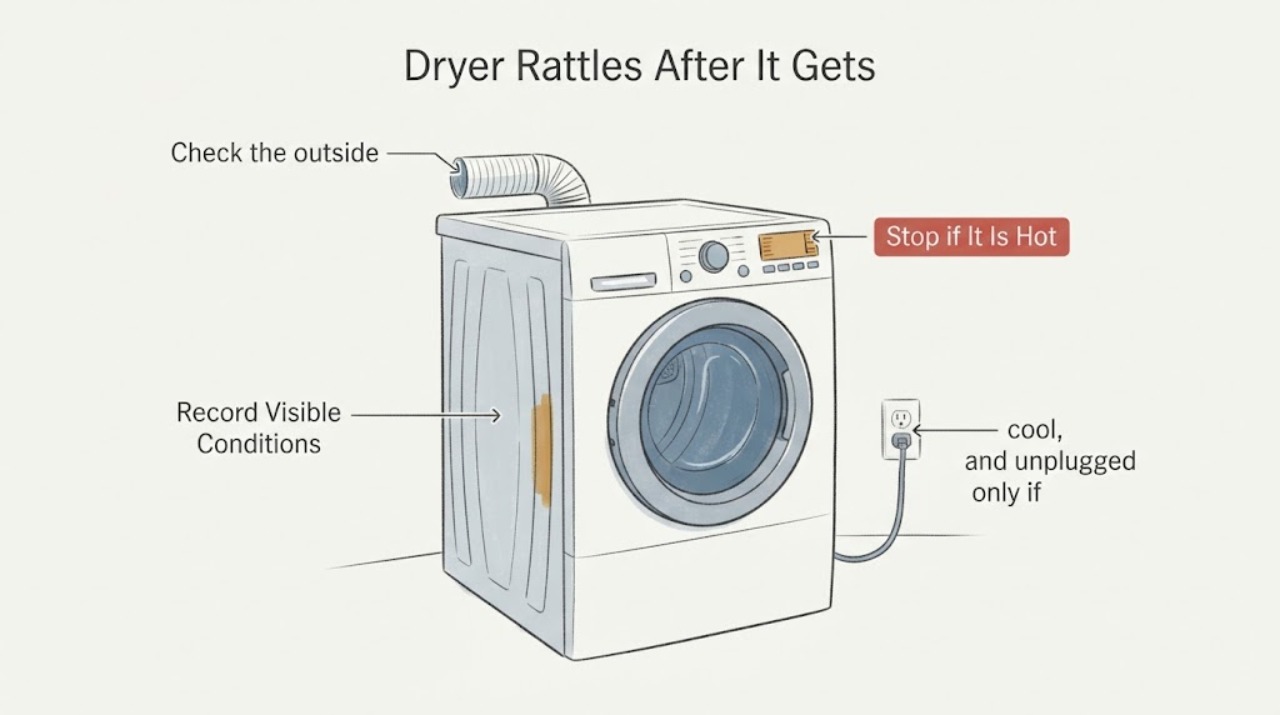
Work through in order
Diagnostic checks
Use only checks that match the exact appliance or system and its official guide.
-
Check 1
Record the full Maytag model number, the load and cycle, how long the dryer runs before the rattle begins, whether the sound is from the drum/front/back/vent area, and whether the drum still turns and heats. Note any hot laundry, display code, breaker trip, burning odor, smoke, or visible damage.
Expected result: The rattle is brief and load-linked, starts only after a long heated run, is continuous or harsh, the drum stops, or a heat/electrical safety symptom is present.
Next step: Continue only after the dryer is cool and there is no safety symptom. Use the exact model literature for the confirmed suffix; for smoke, burning odor, unusual heat, or electrical damage, stop use and arrange qualified service.
Stop if: Do not restart a dryer that is smoking, sparking, producing a burning or electrical odor, unusually hot, tripping protection, or showing visible damage.
Why this matters
Why: Maytag's model lookup requires the complete model number for the correct literature, while the product guide distinguishes ordinary noise checks from safety and operating faults. Timing alone cannot identify a part.
-
Check 2
With the dryer off, cool, and unplugged only if the plug is cool, reachable, and undamaged, inspect the front and rear edges of the empty drum for coins, buttons, clips, screws, or other small objects. Remove the lint screen and look only into the accessible lint-chute opening for a visible object; keep the lint screen installed for any later operation.
Expected result: A foreign object is caught at the drum edge or visible in the lint chute, or both areas are clear.
Next step: Remove only a loose object that is accessible without tools and record whether the rattle is gone when the dryer remains cool. If the object is lodged, deep, or requires cabinet access, leave the dryer unplugged and arrange service.
Stop if: Do not reach into the blower, insert tools into the chute, remove panels, or run the dryer with the lint screen missing.
Why this matters
Why: Maytag says small objects in the drum seam can scrape or rattle and that objects in the lint-chute housing can strike the blower wheel. A clear opening does not rule out an internal blower or drive problem.
-
Check 3
Check the outside of the dryer without moving it: confirm all visible feet are present and the machine is not rocking, remove objects resting on top, clear items leaning against the cabinet, leave space from a washer, and check any pedestal drawer for loose contents.
Expected result: The dryer rocks or is not level, a nearby/top/pedestal object vibrates, the washer contacts the dryer during spin, or all accessible external contacts are stable.
Next step: Remove only loose external items and have the dryer leveled according to the exact installation instructions if a foot or floor issue is found. If the cabinet must be moved or a structural adjustment is needed, use qualified installation/service help.
Stop if: Do not tilt or drag the dryer, remove feet or panels, wedge the cabinet, or continue operating if it rocks, scrapes, or has damaged supports.
Why this matters
Why: Maytag identifies missing or uneven feet and nearby objects, washer vibration, and pedestal contents as causes of knocking or rattling. Correcting an external contact can remove the noise without proving that internal components are good.
-
Check 4
If the rattle is tied to a long heated run, inspect the lint screen, visible vent hose, wall connection, and outside exhaust hood for lint, crushing, kinks, or little/no airflow. Do this only when the dryer is cool and the accessible path can be checked without disconnecting a hot duct or opening the cabinet.
Expected result: The vent path is restricted, the outside hood has little airflow, the load was tightly packed, the path is clear with normal airflow, or the noise is unchanged by load and airflow conditions.
Next step: Keep the dryer off until a visible crushed or blocked vent path is correctly restored and the home exhaust is cleaned as needed. If airflow is normal but the rattle persists, arrange qualified diagnosis rather than repeating heated cycles.
Stop if: Do not operate with a crushed, disconnected, blocked, or unverified exhaust path, and do not clean inside the cabinet or test the blower/heater electrically.
Why this matters
Why: Maytag's product guide links increased noise during a cycle with a packed load or blocked exhaust and says restricted exhaust can also lengthen drying. This is a conditional airflow branch, not proof that a vent caused every hot-time rattle.
-
Check 5
After the safe checks, compare the sound recording and timing with the empty-drum, external-contact, and airflow results. Do not run repeated cycles just to make the dryer hot again; do not open the cabinet or touch a belt, motor, roller, blower, heater, thermostat, or wiring.
Expected result: The rattle stopped after an accessible correction, returns only when hot, remains with a clear drum and vent, or is accompanied by drum drag, scraping, smoke, odor, overheating, or electrical symptoms.
Next step: If the rattle remains or any safety/drive symptom appears, leave the dryer out of service and give qualified Maytag service the full model, recording, cycle, run time, temperature/airflow observations, and checks already completed.
Stop if: Do not bypass a safety device, make live measurements, lubricate or replace a part from the sound alone, or run the dryer with a panel or guard removed.
Why this matters
Why: A corrected object, contact, or vent issue supports an external cause. A persistent heat-dependent rattle with normal external checks leaves an internal drive, blower, support, or thermal issue unresolved and the sound cannot select the part.
Use your observations
Decision map
Find the observation that best matches what you see, then follow the next safe action.
-
PATH 01Next step
What you see
The rattle disappears after a coin/button is removed, a loose garment is corrected, or an accessible top/side/pedestal object is moved away.
Do this next
Keep pockets clear, leave the cabinet unobstructed, and run only a normal load if the dryer is cool and has no safety symptom. Escalate if the rattle returns or becomes harsher.
Why this path and its safety boundary
Why it matters: The observed pattern fits Maytag's documented external-object or load explanation more closely than a selected internal part failure.
-
PATH 02Next step
What you see
The rattle grows during a long heated run and the lint screen, vent, or outside hood shows restricted airflow or a tightly packed load.
Do this next
Keep the dryer off until the accessible vent path and load practice are corrected. Arrange qualified vent or appliance service if airflow remains weak or the noise persists.
Why this path and its safety boundary
Why it matters: An airflow/load condition is more likely than a generic rattle diagnosis, and continuing to run a restricted dryer can increase heat and drying problems.
-
PATH 03Next step
What you see
The drum/object/leveling/airflow checks are normal, but the rattling returns only after the dryer warms or continues with the drum turning.
Do this next
Stop repeated heated tests and arrange model-specific Maytag service with the complete suffix and sound recording. Do not order a belt, roller, motor, blower, or thermal component from the symptom alone.
Why this path and its safety boundary
Why it matters: A heat-dependent internal drive, blower, support, or cabinet issue remains possible; Maytag's public symptom guidance does not identify a particular part for this exact MED5630 pattern.
-
PATH 04Next step
What you see
The rattle is accompanied by unusual heat, a burning/electrical odor, smoke, sparks, a hot plug or outlet, a repeated breaker trip, drum drag, or a door that will not stay closed.
Do this next
Stop using the dryer and isolate power only if it is safe to do so without touching damaged parts. Contact qualified appliance/electrical service, and use emergency assistance for an active fire.
Why this path and its safety boundary
Why it matters: This is a stop-use safety or mechanical branch rather than a routine noise adjustment.
Helpful context
Understand the symptom
The fact that the rattling starts after the MED5630 has been running is useful timing evidence, but it does not prove that a belt, roller, blower, or motor is failing. Heat and airflow can change the sound of a loose object, a cabinet contact, a load, or an exhaust restriction. Maytag's public guidance supports separating those safe observations before service selects a component.
Use the full model number, including any suffix on the rating label, when retrieving the manual. Keep the dryer cool before inspecting it, keep the lint screen installed, and do not open the cabinet or run the appliance with a guard removed.
When checks do not resolve it
Need a professional?
Arrange qualified Maytag appliance or vent service if the MED5630 rattle persists after the cool, external drum, leveling, object, and accessible airflow checks; if it returns only after heating; or if the sound is accompanied by drum drag, scraping, poor drying, or a warning. Stop immediately for smoke, burning/electrical odor, sparks, unusual heat, a hot plug/outlet, visible damage, or repeated breaker trips. Do not remove the cabinet, bypass a safety device, test live wiring, or choose a part from the sound alone.
Common questions
FAQ
Why does my Maytag MED5630 start rattling after it gets hot?
The timing can point to a load, loose object, cabinet contact, leveling, or airflow condition, but it does not identify a part. Let the dryer cool, inspect the drum edge and lint-chute opening, check external vibration and airflow, and arrange service if the rattle returns with those checks normal.
Can a blocked dryer vent cause rattling?
Maytag's product guide links a blocked exhaust or tightly packed load to increased noise during a cycle and gives an airflow check. That makes vent inspection a conditional branch when the sound increases during a hot run, not proof that every rattle is caused by the vent.
Should I replace the belt, roller, blower, or motor for a hot-time rattle?
Not from this symptom alone. Maytag's public guidance first checks objects, leveling, external vibration, the lint chute, and exhaust conditions. A persistent heat-dependent rattle after those checks needs model-specific service diagnosis.
Read the exact guide
Official sources
- Sounds or Noises in a DryerMaytag · Opened official Maytag dryer sound guide; used for sound-pattern and external checks while retaining exact-model uncertainty.
- Knocking or Rattling Sound - DryerMaytag · Opened official Maytag Product Help page for dryer knocking/rattling; used for generic Maytag dryer checks, not as proof of a specific internal MED5630 part.
- Maytag Dryer Product GuideMaytag · Opened official Maytag product guide used for a conditional increased-noise/blocked-exhaust branch; it is not treated as a model-specific MED5630 service manual.
- Product Lookup - Product HelpMaytag · Opened official Maytag model lookup page; used to require the complete MED5630 suffix before applying model-specific instructions.
Community feedback
Share a repair observation
Share a plain-text repair observation. Accepted observations are published automatically; this page may take a moment to update.