
On this page
Start here
Quick answer
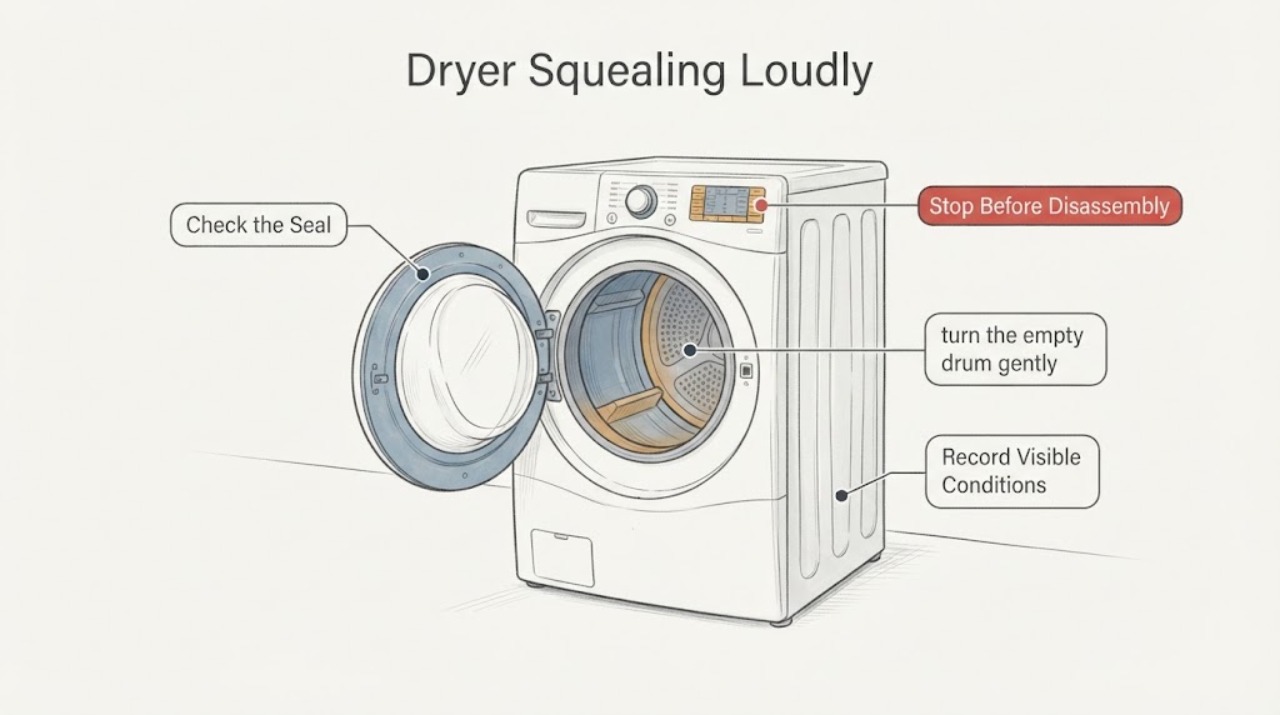
A very loud squeal from a used Maytag MED3500FW0 dryer should not be diagnosed as a particular roller, idler pulley, belt, or motor from sound alone. Maytag's official squealing guidance starts with the sound's location and also lists leveling, loose items, lint buildup, age-related belt or pulley wear, and service as different possibilities. First stop if there is a burning smell, smoke, sparks, unusual heat, a hot connection, or the dryer moves. With the dryer off and cool, confirm the full model suffix, note whether the squeal occurs at startup, only with a load, throughout tumbling, or during coast-down, and check only the accessible drum, floor, lint screen, and visible vent path. A brief thump after long non-use can be a roller flat spot that improves as the dryer runs, but a persistent sharp or very loud squeal is not established as normal; leave the dryer out of service and arrange qualified diagnosis rather than continuing to run it or ordering a guessed part.
Work through in order
Diagnostic checks
Use only checks that match the exact appliance or system and its official guide.
-
Check 1
Before restarting the dryer, read the rating label and record the complete model as MED3500FW0 if that is what it shows. Write down whether the squeal begins at startup, occurs only while the drum turns, changes with a load, continues after the motor stops, or was heard after a long period of non-use; estimate whether it comes from the front, back, bottom, or drum opening.
Expected result: The suffix is confirmed or uncertain, and the sound is a brief startup noise, a persistent squeal, a load-dependent noise, or a noise from a particular area.
Next step: If the full suffix cannot be confirmed, stop part selection and provide the label information to Maytag or qualified service. If the squeal is very loud, persistent, or accompanied by any safety symptom, leave the dryer off rather than repeating the run.
Why this matters
Why: Maytag's model page identifies the MED3500FW dryer family, while its squealing guidance uses location and timing to separate loose feet, loose items, lint, and possible drive-area service issues. A similar Maytag model or a sound description without timing is not enough to select a part.
-
Check 2
With the dryer off and cool, remove laundry and check pockets, zippers, buckles, buttons, rivets, and other loose items. Look around the drum opening and visible seal for an item or fabric edge caught where the drum meets the door; also check that the dryer is stable and not touching an object or wall.
Expected result: A loose item, trapped fabric, contact with the wall, an unstable or missing foot, or no accessible object is found.
Next step: Remove only a loose item that is accessible without tools and restore safe clearance or leveling without opening the cabinet. If the squeal remains or the door seal/drum edge is damaged, stop using the dryer and arrange service.
Why this matters
Why: Maytag says loose items can create noise and that an unlevel dryer or loose leg can contribute to noise. A clear opening and stable exterior do not clear internal belt, pulley, roller, glide, bearing, or motor wear.
-
Check 3
With the dryer unplugged or otherwise safely isolated and the drum cool, turn the empty drum gently by hand from the opening. Note smooth movement, binding, scraping, rocking, or an obvious rough spot; do not reach past guards, remove the front or rear panel, or lubricate a hidden component.
Expected result: The empty drum turns smoothly, binds or scrapes, rocks, or the hand movement is normal but the prior run produced a sharp squeal.
Next step: Keep the dryer isolated if movement is abnormal or the squeal was very loud. Even with smooth movement, do not use that result to name a part; give the timing, location, and load relationship to a qualified technician.
Why this matters
Why: Binding or scraping supports a mechanical service concern, while smooth hand movement does not rule out an idler pulley, belt, roller, glide, bearing, motor, or sound that occurs only under power or load. Maytag describes cabinet access for several of these components as professional work.
-
Check 4
With the dryer off and cool, clean the lint screen as the model instructions allow and inspect only the visible lint-screen housing, exhaust hose, wall connection, and outside hood for heavy lint, a crushed duct, a loose connection, or a flap that cannot open. Do not open the cabinet or reach into the blower or belt area.
Expected result: The screen or visible exhaust is restricted, a foreign object is visible in the accessible lint path, the duct is damaged, or the visible airflow path appears normal.
Next step: Correct only an obvious external vent or screen condition without disassembling the dryer, and do not operate with a crushed, disconnected, or blocked exhaust. If the path is clear but the loud squeal remains, leave the dryer off for service inspection.
Why this matters
Why: Maytag says lint buildup can contribute to squealing or squeaking at the belt and pulleys, and objects can fall into the lint-chute area and contact the blower. A clear visible path does not exclude internal lint or a drive-area fault.
-
Check 5
Review the last safe load and the sound pattern without deliberately running another noisy cycle. Note whether the squeal occurred with an empty drum as well as with clothes, only when heating, only while the drum was accelerating or stopping, or together with slow tumbling, scraping, a hot exterior, a hot plug, a burning smell, smoke, or movement of the cabinet.
Expected result: The squeal is load-independent, load-dependent, tied to a particular phase, or accompanied by heat, odor, smoke, poor tumbling, or cabinet movement.
Next step: For any safety symptom or abnormal tumbling, keep the dryer out of service and arrange qualified appliance or electrical inspection. Otherwise provide the phase, load, location, and empty-drum result to service rather than guessing rollers, an idler pulley, a belt, or a motor.
Why this matters
Why: A load-dependent sound can fit an item or seal contact, while a persistent sound with an empty drum is more concerning for a drive or support system. Heat, odor, smoke, poor tumbling, or movement overrides ordinary sound troubleshooting and cannot be safely sorted by listening longer.
Use your observations
Decision map
Find the observation that best matches what you see, then follow the next safe action.
-
PATH 01Next step
What you see
The sound was a light thump for only the first few minutes after the used dryer had been idle for a while, then it stopped and there was no heat, odor, smoke, scraping, or poor tumbling.
Do this next
Do not force the dryer to continue if the sound is loud or returns. If the limited thump does not improve as described, stop using the dryer and request service.
Why this path and its safety boundary
Why it matters: Maytag documents this narrower pattern as possible temporary thumping while support rollers regain shape after non-use. It does not explain a persistent, sharp, or very loud squeal.
-
PATH 02Next step
What you see
A sharp squeal is loudest at the front, back, bottom, or drum opening, and the location is repeatable without a safety symptom.
Do this next
Record the location for the technician, complete only the safe external checks, and leave the dryer off if the squeal is very loud or persistent. Do not open the cabinet to confirm a suspected component.
Why this path and its safety boundary
Why it matters: Maytag's squealing guidance uses location to prioritize different observation areas: feet or leveling at the bottom, an idler-pulley area toward the front, belt/bearing/roller/glide areas toward the back, or seal/contact and loose-item checks at the opening. Location narrows the branch but does not prove a part.
-
PATH 03Next step
What you see
The squeal occurs only with clothes or changes when pockets, zippers, bulky items, or the door seal are involved, while the empty drum turns normally.
Do this next
Remove only accessible loose items and stop if the seal or drum edge is damaged. If the sound returns, leave the dryer out of service and provide the load relationship to qualified service.
Why this path and its safety boundary
Why it matters: A loose item or contact at the drum opening can explain a load-dependent noise more directly than a guaranteed roller or motor failure. The result does not clear a worn drive part if the sound returns with an empty drum.
-
PATH 04Next step
What you see
The drum binds, scrapes, rocks, tumbles slowly, or the squeal persists with an empty drum and a clear visible vent path.
Do this next
Keep the dryer disconnected from power and arrange qualified Maytag appliance service. Do not lubricate, replace, or bypass a belt, roller, pulley, motor, guard, or safety device as a sound test.
Why this path and its safety boundary
Why it matters: The external checks have not found a simple load, foot, or visible lint explanation. Maytag's guidance places several drive, support, and belt-related causes behind professional inspection, so the sound still does not select one component.
-
PATH 05Next step
What you see
The squeal is accompanied by a burning or electrical smell, smoke, sparks, unusual heat, a hot plug or outlet, poor tumbling, a tripped breaker, or movement of the dryer.
Do this next
Stop using the dryer immediately. From a safe position, disconnect it only if doing so does not expose anyone to heat, smoke, water, or damaged equipment; leave the area and seek emergency help for smoke or fire. Do not reset repeatedly, remove panels, or retest.
Why this path and its safety boundary
Why it matters: This is a fire, electrical, airflow, or mechanical safety boundary, not a normal used-dryer noise branch.
Helpful context
Understand the symptom
What a loud squeal can and cannot tell you
The opened Maytag guidance separates a squealing sound by where it seems to come from: the bottom can point toward leveling or loose feet, the front can involve an idler-pulley area, and the back can involve belt, bearing, roller-shaft, or glide areas. Those are observation branches, not a remote parts diagnosis. A sound that changes with a load or a trapped item can follow a different path from a sound that is present with an empty drum. Do not keep running a very loud dryer just to make the source easier to hear.
Used does not automatically mean normal
Maytag says a dryer that has been unused for a while may make a light thumping sound for the first few minutes because support rollers can flatten where they contact the drum. That description is narrower than a persistent, sharp, or very loud squeal. If the noise does not improve, returns on an empty drum, or is accompanied by heat, odor, smoke, scraping, or poor tumbling, treat it as a service condition rather than a harmless break-in sound.
When checks do not resolve it
Need a professional?
Arrange qualified Maytag appliance service for a persistent or very loud squeal, a sound that returns with an empty drum, binding or scraping, poor tumbling, a damaged door seal, or a noise that remains after accessible load, leveling, lint-screen, and visible vent checks. Stop immediately for smoke, sparks, burning or electrical odor, unusual heat, a hot cord or outlet, repeated breaker trips, or cabinet movement; do not continue operating to identify the part by sound.
Common questions
FAQ
Does a very loud squeal prove the rollers or idler pulley are bad?
No. Maytag lists several possible causes and uses sound location, loose items, leveling, lint, and age as branches. A technician should confirm the component before a part is selected.
Can a used dryer make a normal noise after sitting unused?
Maytag documents a light thump for the first few minutes after non-use as possible roller flat-spot noise that can improve as the rollers regain shape. That is not a blanket explanation for a persistent, sharp, or very loud squeal.
Should I run the dryer empty to locate the squeal?
Do not deliberately keep running a very loud dryer just to identify the source. Record whether the prior sound was load-dependent, note its location and phase, and use the cool, unplugged drum check. Stop entirely for heat, odor, smoke, sparks, poor tumbling, or movement.
Can I lubricate or replace a belt or roller based on the sound?
Not safely from the sound alone. Maytag says several noisy components require service access and recommends confirming what parts should be replaced. Keep the dryer assembled and provide the model and sound pattern to qualified service.
Read the exact guide
Official sources
- MED3500FW | MaytagMaytag · Maytag MED3500FW0 (MED3500FW family) dryer identity, model-specific literature, and service routing
- Dryer Sounds and NoisesMaytag Product Help · Maytag dryer sound behavior after installation or a period of non-use
- Squealing or Squeaking Sound - DryerMaytag Product Help · Maytag dryer squealing checks, sound-source limits, lint/loose-item observations, and service boundary
- Why Is My Dryer Squeaking? 8 Possible CausesMaytag · Maytag dryer squeaking sound-location distinctions and conditional drive/support causes
Community feedback
Share a repair observation
Share a plain-text repair observation. Accepted observations are published automatically; this page may take a moment to update.