
On this page
Start here
Quick answer
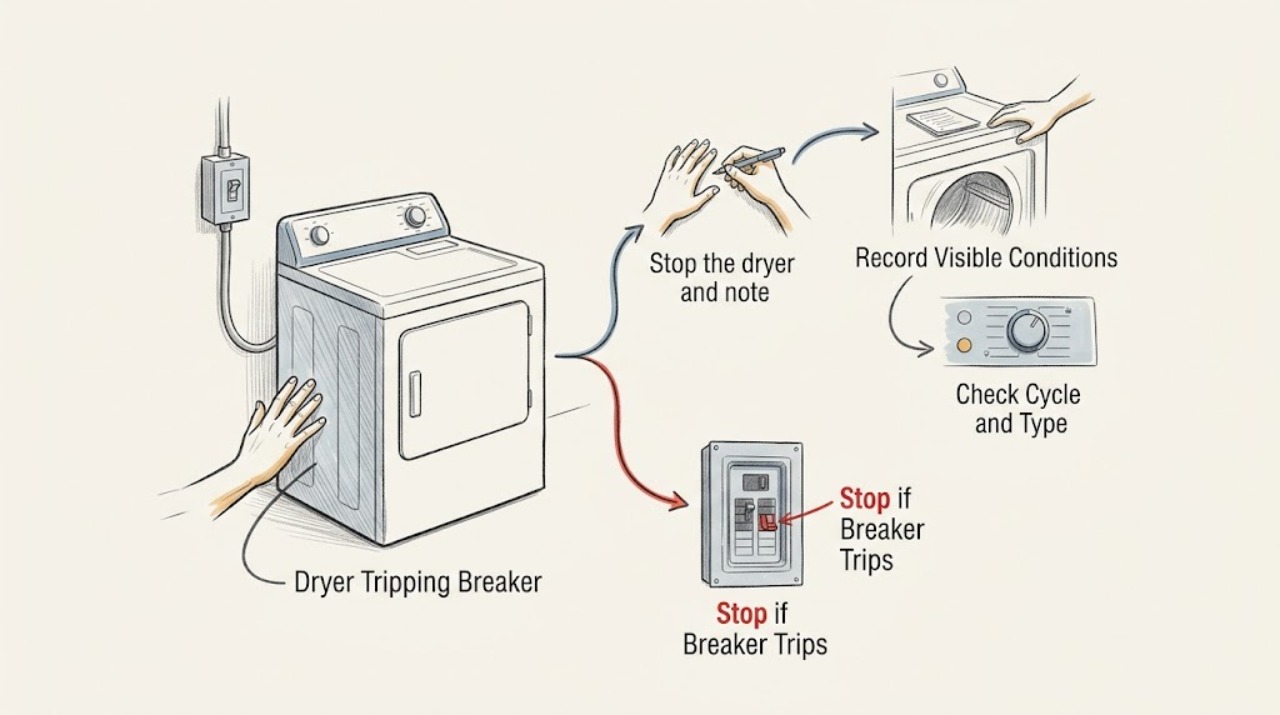
A Maytag dryer that trips a breaker is signaling an electrical overload, fault, or supply problem; repeated resets can turn a warning into a fire or shock hazard. Stop immediately for smoke, sparks, a burning smell, unusual heat, water near the appliance, a damaged cord or outlet, or a breaker that trips again. Otherwise record when the trip occurs, identify whether the dryer is electric or gas, and make only one safe visual check of the household breaker. If it trips again, shows an L2 or low-line-voltage message, or the installation looks damaged, leave the dryer off and arrange qualified electrical or appliance service.
Work through in order
Diagnostic checks
Use only checks that match the exact appliance or system and its official guide.
-
Check 1
Stop the dryer and note any smoke, sparks, burning or gas odor, unusually hot plug or cabinet, water near the cord, damaged insulation, or a trip that happened again after a reset.
Expected result: Any of those hazards is present, or the breaker will not remain on with the dryer off.
Next step: Leave the dryer off. Do not touch a hot or damaged connection and do not keep resetting the breaker; move people away from immediate danger and use emergency, utility, or qualified service help as appropriate.
Why this matters
Why: The event may involve fire, shock, gas, moisture, or a supply fault rather than a routine interruption.
-
Check 2
Write down exactly when the breaker trips: as Start is pressed, when the drum begins turning, when heat begins, after several minutes, or only on one cycle or option.
Expected result: The trip is immediate, occurs with drum motion, begins with heat, appears after warm operation, or follows one repeatable cycle choice.
Next step: Use the matching branch below and give the timing to the technician. Do not repeat a hazardous cycle merely to reproduce the trip.
Why this matters
Why: Immediate trips point toward supply, cord, control, or motor-start faults; a heat-timed trip makes the heater, thermal protection, airflow, or heat wiring more relevant; a cycle-specific trip points to that option or its control path.
-
Check 3
Identify the dryer type from its rating label or installation paperwork, then look at the household panel without removing its cover: an electric dryer normally has two dryer breakers or fuses, while a gas dryer uses one electrical branch for its controls and motor.
Expected result: One dryer breaker is visibly out of position, a fuse is open, the panel label is unclear, or the dryer uses an unexpected shared circuit.
Next step: If there is no odor, heat, moisture, or visible damage, make one normal reset attempt exactly as the panel is designed. If it trips again, remains partly off, or the circuit arrangement is unclear, stop and call a qualified electrician.
Why this matters
Why: A partial supply can leave a dryer dead, unable to heat, or reporting low line voltage; an unclear or shared installation needs electrical review rather than repeated resets.
-
Check 4
With the dryer disconnected from power only when it is safe to do so, inspect the accessible plug, cord, receptacle, and the area behind the dryer for looseness, scorching, melting, pinching, moisture, an extension cord, or an adapter. Do not open the terminal area.
Expected result: The plug or receptacle is hot, discolored, loose, wet, damaged, or connected through an extension or adapter.
Next step: Keep the dryer disconnected and arrange a qualified electrician or appliance technician to inspect the supply and connection. Do not substitute an adapter, extension cord, altered grounding, or improvised repair.
Why this matters
Why: The connection or installation can be the fault source and should not be tested by running the dryer again.
-
Check 5
Only after the electrical safety checks are normal and the breaker has stayed on, inspect the lint screen and visible exhaust path for a blocked screen, crushed duct, blocked hood, or lint buildup; clear only loose lint that is plainly user-accessible and leave the dryer off if it trips again.
Expected result: Airflow is restricted, the screen is damaged or missing, the cabinet or laundry was unusually hot, or the breaker trips during or after a heated period.
Next step: Do not run a heated cycle with restricted airflow or any repeat trip. Have the vent system and dryer inspected by a qualified venting or appliance professional, and use only the lint-screen arrangement specified for the model.
Why this matters
Why: Poor airflow can raise operating temperature and can coexist with a heater, thermal-protection, wiring, or control fault; it does not prove that cleaning alone fixes a breaker trip.
-
Check 6
Check the display for an L2, PF, AF, F4E3, or F#E# message and record the complete code before switching anything off; consult the manual for the exact model rather than treating a code from another Maytag series as universal.
Expected result: L2 or another low-line message is shown, PF follows a power interruption, AF or F4E3 accompanies poor airflow, or an F#E# code returns.
Next step: Save the code, model information, and trip timing. If the code returns after one safe power restoration or the breaker trips again, leave the dryer off and request qualified service.
Why this matters
Why: Maytag associates these groups with low or missing line voltage, a power event, restricted airflow, or a service-required fault; the code narrows the handoff but does not authorize live testing.
-
Check 7
Separate motor and drum symptoms from heat symptoms by recording whether the drum was turning, humming, stalled, or making an unusual sound before the trip, without reaching into the moving drum or removing a panel.
Expected result: The trip occurs at motor start, after a stall or repeated restart, or only after the heater has been active.
Next step: Stop testing and give the pattern to the technician. Motor, heater, thermal, control, and internal wiring diagnosis requires de-energized access and model-specific procedures.
Why this matters
Why: A start or stall pattern makes the motor, drive load, controls, or supply more relevant; a heat-only pattern makes the heater circuit, thermal protection, airflow, or heat wiring more relevant.
Use your observations
Decision map
Find the observation that best matches what you see, then follow the next safe action.
-
PATH 01Next step
What you see
Smoke, sparks, a burning smell, gas odor, water near electrical parts, a damaged cord, extreme heat, or an immediate repeat trip is present.
Do this next
Stop using the dryer and do not reset the breaker again. Leave the area if gas is suspected and follow local emergency or gas-supplier instructions; otherwise arrange qualified electrical or appliance service.
-
PATH 02Next step
What you see
The breaker trips as Start is pressed or as the drum begins to move.
Do this next
Treat the supply, cord, controls, or motor-start path as the leading direction. Do not keep cycling the dryer; provide the exact timing to a qualified technician.
-
PATH 03Next step
What you see
The breaker trips when heat starts or after several minutes of heated operation.
Do this next
Keep the dryer off and have the heater, thermal protection, internal wiring, and airflow evaluated. Do not run an additional heated test.
-
PATH 04Next step
What you see
The trip occurs only on one cycle or option, with no visible damage.
Do this next
Record the cycle, load, time, and display message, then stop using that cycle until service identifies the control, load, or heating condition.
-
PATH 05Next step
What you see
An L2 or low-line message appears, or one of the two electric-dryer breakers will not stay on.
Do this next
Do not treat the dryer as having only a control problem. Leave it off and have the branch circuit, receptacle, cord, and dryer supply checked by a qualified electrician.
-
PATH 06Next step
What you see
A gas smell is present, even if the electrical breaker also tripped.
Do this next
Do not operate electrical switches or try to light the appliance. Clear the area and contact the gas supplier or fire department from a safe location according to the official gas-safety instructions.
-
PATH 07Next step
What you see
One visual panel check finds no hazard and one normal reset holds, but the cause is not clear.
Do this next
Do not use repeated resets as a test. If the dryer trips again, shows a code, or behaves abnormally, keep it off and arrange service.
Helpful context
Understand the symptom
A breaker trip is a symptom, not a reset procedure. An electric Maytag dryer can use separate protected paths for the motor and heater, while a gas model still needs an electrical supply for its controls and motor. The moment of the trip helps separate a supply or drive problem from a heat-related fault, but it does not make repeated testing safe.
The checks below stay at the user-accessible level. Do not remove panels, open the terminal area, measure live voltage, bypass a breaker, or alter gas connections. Those tasks belong to a qualified professional.
Only after diagnosis
Potential parts
- dryer power cord or receptacle connection
Consider only when inspection or electrical testing identifies a damaged cord, receptacle, or connection as the fault source.
A qualified electrician must confirm the installation type, grounding, and model requirements before any replacement. - heating element or thermal protection
Relevant only when the trip begins with heat or after warm operation and professional testing isolates the heating path.
Confirm the exact model and electrical configuration; do not choose a part from a generic symptom alone. - drive motor or blower assembly
Relevant only when the breaker trips at drum start, during a stall, or with a confirmed motor or blower fault.
Fit and electrical ratings are model-specific and require professional confirmation. - control or door-switch circuit
Consider only after supply, cord, motor, heating, and thermal causes have been tested and the control path is implicated.
Use the complete model identity and qualified fit verification; a breaker trip does not by itself prove a control part is faulty.
When checks do not resolve it
Need a professional?
Call a qualified electrician or appliance technician if the breaker trips again, will not remain on, an L2 or service code returns, the cord or receptacle is damaged, the dryer overheats, or the trip timing points to a motor, heater, thermal, control, or internal wiring fault. Stop immediately for smoke, sparks, a burning smell, gas odor, water near electrical parts, or a hot or melted connection. Never bypass protection, work inside the dryer while energized, or alter gas connections.
Common questions
FAQ
Why does my Maytag dryer trip the breaker as soon as I press Start?
An immediate trip can involve the branch supply, cord or receptacle, controls, or motor-start path. Do not keep pressing Start; record the timing and have the supply and dryer checked if the breaker trips again.
Why does the breaker trip only when the dryer heats?
A heat-timed trip makes the heater circuit, thermal protection, internal wiring, or restricted airflow more relevant. Keep the dryer off instead of running another heated test and arrange qualified diagnosis.
Does a Maytag electric dryer have more than one breaker?
Maytag support explains that electric dryers can use two household breakers or fuses, with separate protected paths for the motor and heater. A partial supply can cause no heat or an L2 message, so an electrician should review a breaker that will not stay on.
Can a blocked vent cause a dryer breaker to trip?
Restricted airflow can raise operating temperature and reduce performance, but it does not prove that vent cleaning is the only cause of a breaker trip. Do not run a heated cycle with restricted airflow or a repeat trip; have the vent and dryer assessed.
What should I do if I smell gas after the breaker trips?
Do not operate electrical switches or try to light the appliance. Clear the area and contact the gas supplier or fire department from a safe location, following the gas-safety directions in the Maytag manual.
Read the exact guide
Official sources
- Dryer is Not HeatingMaytag · Maytag dryer heating and supply diagnosis
- No Power - Electric DryerMaytag · Maytag electric dryer power supply and installation
- GAS DRYER OWNER’S MANUALMaytag · Maytag gas dryer installation, gas-safety, electrical-safety, lint, and vent guidance
- Dryer Not Starting or No OperationMaytag · Maytag dryer no-start and electrical supply checks
- Checking if a Household Fuse or Circuit Breaker has TrippedMaytag · Maytag dryers and household fuse or circuit breaker checks
- Error Codes in DryersMaytag · Maytag dryer display-code categories
- L2 - Error Code - DryerMaytag · Maytag dryer L2 low or missing line-voltage message
Community feedback
Share a repair observation
Share a plain-text repair observation. Accepted observations are published automatically; this page may take a moment to update.