
On this page
Start here
Quick answer
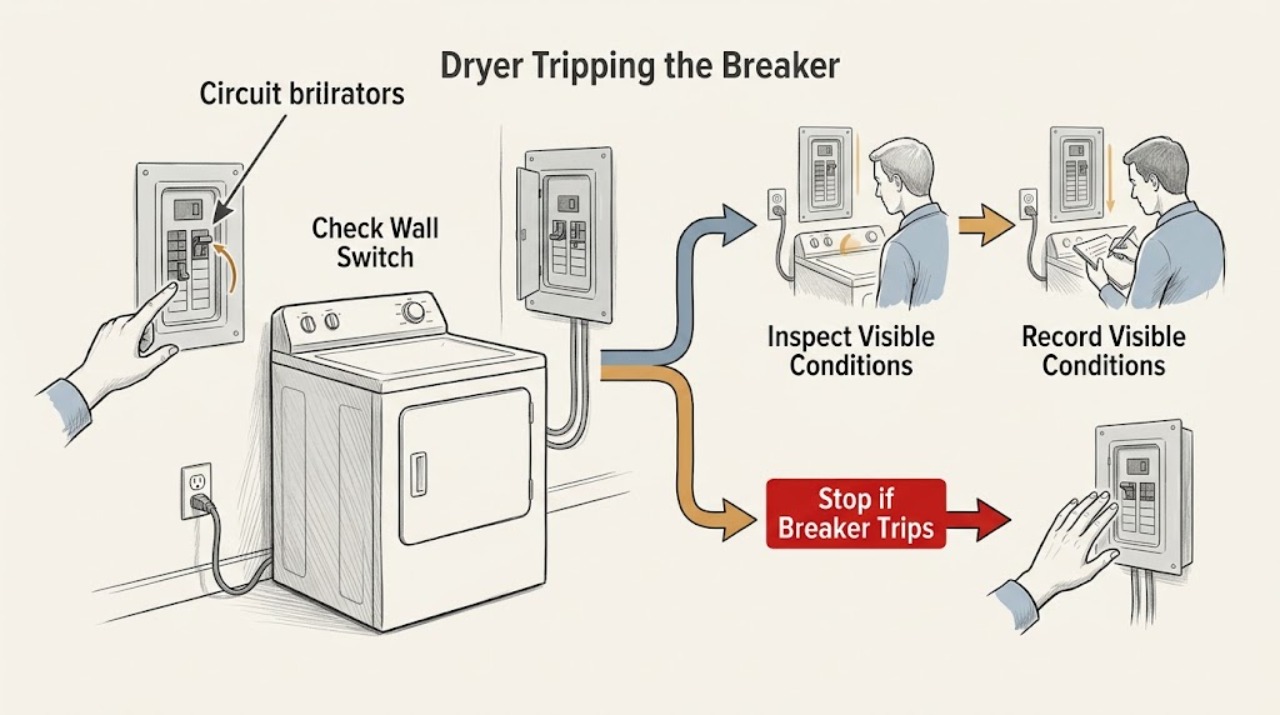
If a Kenmore dryer trips its breaker, stop using it and do not keep resetting the breaker or running test cycles. Unplug the dryer immediately when the plug and receptacle are cool, dry, undamaged, and safely reachable; otherwise switch off the dryer circuit without removing the panel cover. Look only for external cord, receptacle, lint-screen, and exhaust-path problems after the appliance is cool and de-energized. A burning smell, spark, hot or damaged plug, smoke, visible arcing, water, or another trip is an immediate stop condition for a qualified electrician or appliance technician. Use the model number and manual to distinguish a circuit overload from a dryer fault.
Work through in order
Diagnostic checks
Use only checks that match the exact appliance or system and its official guide.
-
Check 1
Stop the cycle and do not reset the breaker to run another test. Unplug the dryer only if the plug and receptacle are cool, dry, undamaged, and safely reachable without touching a hot cabinet; otherwise switch off the dryer circuit at the breaker and leave the panel cover closed.
Expected result: The breaker trips again immediately, or it will not remain on with the dryer disconnected.
Next step: Keep the circuit off and arrange qualified electrical inspection. Do not increase the breaker rating or reconnect the dryer to a different circuit as a test.
Why this matters
Why: The fault may be in the circuit, receptacle, or appliance supply rather than a recoverable dryer setting; repeated tripping is a safety signal.
-
Check 2
From outside the appliance, record when the trip occurs: as soon as Start is pressed, when the heater should begin, after several minutes of operation, or only with a particular load. Do not restart the dryer to reproduce the timing.
Expected result: The trip is immediate, heat-related, delayed, or associated with one heavy or damp load.
Next step: Write down the cycle, load, display behavior, and whether the breaker or any other room power changed; keep the dryer disconnected while awaiting service.
Why this matters
Why: Timing helps a technician separate a supply or control symptom from heat, airflow, or load conditions, but it does not identify a safe part to replace.
-
Check 3
With power removed and the dryer fully cool, inspect the visible power cord, plug, receptacle face, and nearby wall area without loosening anything. Look for a loose-fitting plug, melted or discolored plastic, scorch marks, damaged insulation, moisture, or a warm outlet.
Expected result: The plug or receptacle is loose, hot, discolored, wet, cracked, scorched, or damaged.
Next step: Leave the circuit off and call a licensed electrician; do not touch exposed conductors or replace the receptacle yourself as a shortcut.
Why this matters
Why: A damaged connection can create a shock or fire hazard and should not be tested by plugging the dryer back in.
-
Check 4
After power is removed and the dryer is cool, clean the lint screen and inspect only the accessible exhaust hose, wall connection, and outside vent hood for lint, crushing, kinks, or a flap that cannot open. Do not run the dryer to check airflow while a breaker-trip fault remains.
Expected result: The lint screen or visible duct is packed, the hose is crushed or kinked, or little or no air can leave the outside hood.
Next step: Correct only an obvious external obstruction with the dryer disconnected, reconnect ducting before any future use, and have a qualified person inspect the appliance if it has already tripped or overheated.
Why this matters
Why: Restricted exhaust can increase heat and fire risk; correcting a visible obstruction may improve airflow but does not prove that the electrical fault is fixed.
-
Check 5
Check whether other high-load appliances share the same circuit only from the household distribution information and labels; do not remove the panel cover or alter wiring. Do not use an extension cord or an unverified adapter for the dryer.
Expected result: The dryer circuit is overloaded by other equipment, the circuit labeling is unclear, or no obvious shared load is present.
Next step: Leave the dryer off and ask a qualified electrician to verify the circuit, receptacle, grounding, and required supply for the specific model; do not move the dryer to another outlet as a workaround.
Why this matters
Why: An overload can trip protective equipment, while an unclear or dedicated circuit with repeated trips keeps an appliance or wiring fault in consideration.
-
Check 6
Find the dryer's model number and use Kenmore's official manual search. Give the technician the model, electric or gas configuration, trip timing, cycle, cord and receptacle observations, lint or vent condition, and any heat or odor history.
Expected result: The manual provides model-specific supply or vent guidance, or the manual does not explain the repeated trip.
Next step: Keep the dryer de-energized and schedule appliance repair plus electrical inspection as needed; do not replace an internal fuse, heater, motor, or control board based only on the symptom.
Why this matters
Why: Kenmore designs differ, so the manual can identify required operating conditions but cannot make a repeated breaker trip safe to ignore.
Use your observations
Decision map
Find the observation that best matches what you see, then follow the next safe action.
-
PATH 01Next step
What you see
The breaker trips immediately when the dryer is connected or Start is selected.
Do this next
Keep the appliance and circuit off; have a qualified electrician or appliance technician isolate the fault without live cabinet work.
Why this path and its safety boundary
Why it matters: A supply, receptacle, cord, control, or short-circuit fault is possible.
-
PATH 02Next step
What you see
The breaker trips only when heat begins or after the dryer has run for a while.
Do this next
Do not run another cycle. Inspect only the cool, visible lint and exhaust path and arrange professional diagnosis.
Why this path and its safety boundary
Why it matters: A heat, airflow, heater, motor, or circuit problem may be involved, but the timing alone is not a diagnosis.
-
PATH 03Next step
What you see
The visible cord, plug, or receptacle is hot, loose, wet, scorched, or damaged.
Do this next
Leave power off and call a licensed electrician; do not plug the dryer into another outlet or repair the connection while energized.
Why this path and its safety boundary
Why it matters: The connection is a potential shock or fire hazard.
-
PATH 04Next step
What you see
The lint screen or visible exhaust path is obstructed, crushed, or not exhausting air.
Do this next
Correct the visible obstruction only while disconnected and cool, then keep the dryer off until the prior breaker trip is professionally assessed.
Why this path and its safety boundary
Why it matters: Restricted airflow can raise dryer heat and fire risk, but it may not be the only reason for a trip.
-
PATH 05Next step
What you see
The breaker trips again, or there is smoke, a spark, arcing, burning odor, abnormal heat, water, or a shock.
Do this next
Stop all checks, keep clear, disconnect power only if safe, and use emergency services for smoke or fire; otherwise call qualified electrical and appliance service.
Why this path and its safety boundary
Why it matters: The issue has crossed the immediate safety boundary.
Helpful context
Understand the symptom
A breaker trip is protective information, not a prompt to try the dryer again. The timing matters: a trip as soon as the dryer is selected, a trip only when heat begins, and a trip after several minutes can point to different parts of the supply, appliance, or exhaust system, but none can be safely confirmed by repeated resets. First remove the dryer from service and preserve the exact pattern for diagnosis.
Kenmore models and electrical arrangements vary. Kenmore's official manual search lets you locate the manual by model number, while its customer-care page provides support and repair routes. The owner checks below stay outside the cabinet: no panel removal, live measurements, heater or motor testing, or replacement of a breaker with a different rating.
When checks do not resolve it
Need a professional?
Arrange appliance repair and electrical inspection after any repeated breaker trip, especially when the trip happens immediately, heat begins, or the dryer has an unknown circuit. Stop immediately for smoke, sparks, arcing, burning odor, overheat, water, shock, or a damaged or hot plug, cord, or receptacle.
Common questions
FAQ
Should I reset the breaker to see whether my Kenmore dryer works?
Do not keep resetting it or running test cycles. Disconnect the dryer safely and leave the circuit off after a repeated trip; a breaker trip can indicate a defect or overload that requires qualified inspection.
Can a clogged dryer vent cause the breaker to trip?
Restricted airflow can build heat and create a fire risk, so inspect and clean only the cool, visible lint and exhaust path with power removed. Because a breaker trip can also be electrical, keep the dryer off and have the complete condition assessed before reuse.
What if the Kenmore dryer trips the breaker as soon as I press Start?
Leave it disconnected and do not reproduce the trip. Record the model and timing, then have a qualified electrician or appliance technician inspect the circuit, receptacle, cord, and dryer without opening live panels.
Read the exact guide
Official sources
- Find Your Manual | Kenmore Appliance Manuals & GuidesKenmore · Kenmore appliance manuals
- Customer Care & Support | Kenmore AppliancesKenmore · Kenmore product support and repair routes
- Appliance Safety TipsElectrical Safety Foundation International · appliance breaker and electrical safety
- Understand Your Breaker Box - Video ShortElectrical Safety Foundation International · breaker trip and electrical safety
- CPSC Publication 5022 - Overheated Clothes Dryers Safety AlertU.S. Consumer Product Safety Commission · clothes dryer lint and exhaust fire prevention
Community feedback
Share a repair observation
Share a plain-text repair observation. Accepted observations are published automatically; this page may take a moment to update.