
On this page
Start here
Quick answer
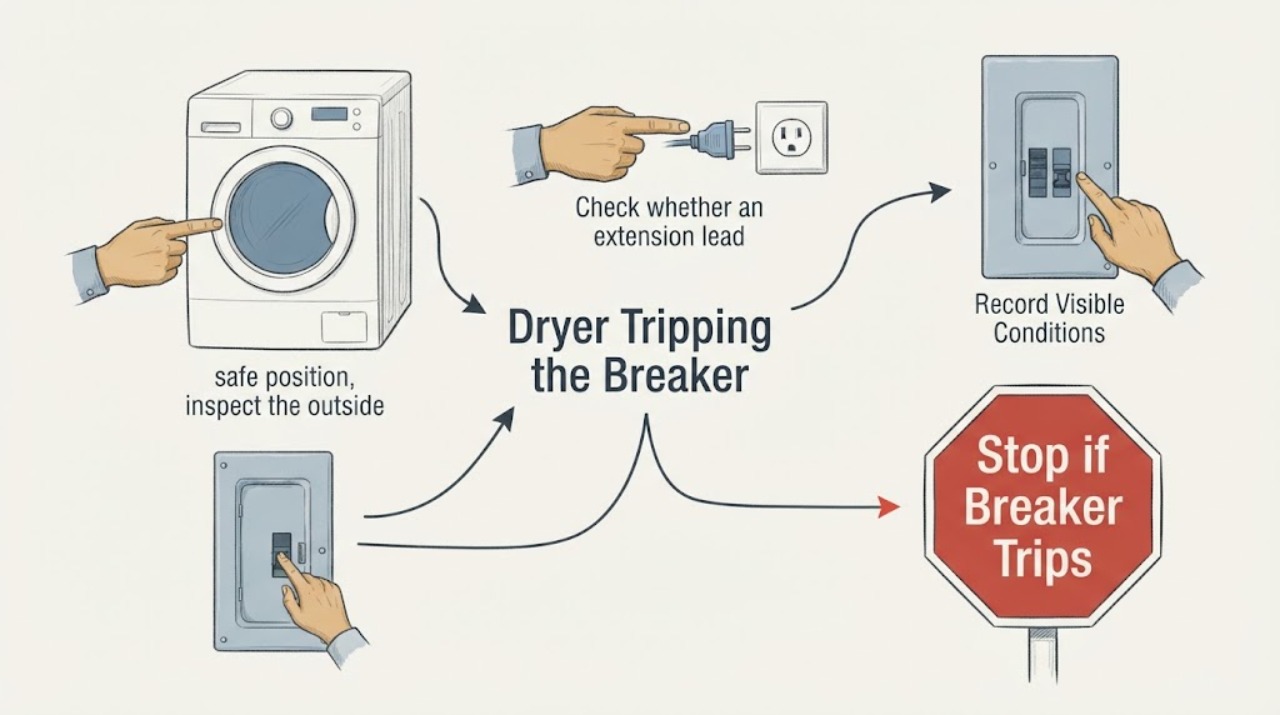
If a Siemens dryer trips a breaker, leave it switched off and do not keep resetting the breaker to test it. Note whether the trip happens when the plug is connected, when Start is pressed, or after the dryer heats; then inspect only the dry, accessible plug, socket, cord, extension lead, lint condition, and surrounding moisture. A hot or damaged socket, burning smell, smoke, crackling, arcing, water exposure, or a trip that returns requires the appliance to remain out of service and a qualified appliance technician or electrician to assess it.
Work through in order
Diagnostic checks
Use only checks that match the exact appliance or system and its official guide.
-
Check 1
Leave the Siemens dryer off and record exactly when the breaker trips: when the plug is connected, when power is selected, when Start is pressed, when the drum begins, when heat begins, or only after several minutes.
Expected result: The trip point is immediate, start-related, heat-related, delayed, or not reproducible without another attempt.
Next step: Keep the dryer out of service and give the timing, program, load, and any indicator to the technician. Do not reset the breaker again to obtain a cleaner test.
Stop if: If the breaker will not stay on, the appliance is hot, or there is smoke, smell, crackling, or visible damage, move away and use emergency help as appropriate.
Why this matters
Why: Different stages energize different loads, so timing narrows the service diagnosis without proving which part is at fault. A trip that is immediate or repeats should not be recreated.
-
Check 2
From a dry, safe position, inspect the outside of the plug, socket, and power cord without touching damaged areas or removing any cover.
Expected result: You see discoloration, melted plastic, scorching, a loose socket face, a crushed or cut cord, moisture, or no visible external damage.
Next step: If any damage or moisture is present, leave the dryer disconnected only if that can be done without contact with wet or damaged equipment and arrange an electrician or qualified appliance technician. Otherwise leave the dryer untouched and report the finding.
Stop if: Do not touch a wet socket, pull a cord by force, remove the plug cover, or use the outlet for another test appliance.
Why this matters
Why: Heat, arcing, moisture, or cord damage can create shock or fire risk and can explain a protection trip; no visible mark does not rule out an internal fault.
-
Check 3
Check whether an extension lead, multiple socket strip, travel adapter, or other shared connection is being used, and note whether other high-load appliances share the same supply.
Expected result: The dryer is on an extension or shared strip, or it is connected directly as specified but still trips the circuit.
Next step: Do not continue operation through an extension or strip. Have the installation and the dryer assessed rather than changing protection or trying another circuit as a test.
Stop if: Never substitute a larger breaker, defeat residual-current protection, or run the dryer from a makeshift connection.
Why this matters
Why: Dryers can draw substantial power, and an extension or shared connection can overload or heat. A direct connection does not make a repeatedly tripping appliance safe; it points the next check toward the appliance or fixed installation.
-
Check 4
With power isolated and the dryer cool, check only the visible lint filter, condenser or base-filter access, and surrounding ventilation for heavy lint, obstruction, or moisture, following the exact Siemens manual for the E-Nr.
Expected result: The filter or air path is visibly blocked, the area is wet, or the accessible areas are clean and dry.
Next step: Clean only the user-accessible filter or care area described by the manual after the dryer is cool and disconnected. If moisture reaches the appliance, stop and arrange inspection.
Stop if: Do not spray, hose, steam-clean, remove covers, or operate the dryer with wet filters, wet flooring, or visible internal moisture.
Why this matters
Why: Siemens documentation requires regular filter care and identifies moisture ingress as an electric-shock hazard; a blocked or wet dryer should not be run to see whether the breaker trips again.
-
Check 5
Compare the load and program with the Siemens manual and note whether the trip occurred during a normal load, a bulky or unusually damp load, or after a blocked-filter warning.
Expected result: The trip is associated with a heavy or unsuitable load, restricted care path, or it occurs with no load-related trigger.
Next step: Remove the load only when the drum is stopped and safe to reach. Keep the dryer off after any trip; record the program and filter indicators instead of restarting with a smaller load.
Stop if: Do not run a hotter, longer, or empty cycle as a stress test, especially after overheating, smoke, burning smell, or a previous trip.
Why this matters
Why: Load and airflow affect heat and runtime, but a breaker trip remains an electrical safety event and cannot be explained away as a normal overload without professional assessment.
-
Check 6
Use the Siemens E-Nr to read the installation section and confirm the dryer is installed exactly as specified, including accessible isolation, an undamaged supply cord, and any model-specific circuit requirement; do not open the consumer unit or appliance.
Expected result: The installation record is available and compliant, or the cord, outlet, circuit arrangement, ventilation, or installation history is uncertain.
Next step: Give the manual, E-Nr, installation details, and trip timing to a qualified electrician or Siemens appliance technician for a de-energized assessment.
Stop if: Do not change breaker size, wiring, grounding, plug type, or circuit configuration yourself.
Why this matters
Why: Siemens documentation differs by model and warns against damaged cords, unapproved adapters, extension cables, and incorrect installation. An uncertain installation needs a qualified person, not a guessed breaker change.
-
Check 7
If the external checks show no safe user-level cause, preserve the dryer in its tripped state and report whether the breaker, residual-current device, or fuse operated and whether any other appliance was affected.
Expected result: Only the dryer-related protection operated, the whole supply was affected, or the type of protection is unknown.
Next step: Arrange qualified appliance service and, when the circuit or socket is suspect, a qualified electrician. Provide photos only from a safe dry position and include all observed warnings.
Stop if: Do not reset and retry, substitute a fuse or breaker, move the dryer while plugged in, or continue using it after a trip.
Why this matters
Why: The distinction helps separate a dryer fault from a circuit, socket, moisture, or broader installation problem, but it cannot be diagnosed safely by repeated operation.
Use your observations
Decision map
Find the observation that best matches what you see, then follow the next safe action.
-
PATH 01Next step
What you see
The trip occurs as soon as the plug is connected or power is selected.
Do this next
Do not reconnect or reset to confirm it. Leave the dryer isolated and arrange a qualified electrical and appliance assessment.
Why this path and its safety boundary
Why it matters: A supply, cord, plug, socket, or appliance fault is possible before the drying load is active.
-
PATH 02Next step
What you see
The trip occurs when Start or the drum motor begins.
Do this next
Record the program and timing and stop using the dryer; do not make live measurements or open the cabinet.
Why this path and its safety boundary
Why it matters: The fault may appear when the motor or associated circuit is energized, but timing alone does not identify a component.
-
PATH 03Next step
What you see
The trip occurs when heat begins or after several minutes.
Do this next
Do not run another heat cycle. Check only the cool, visible filter and surroundings, then request qualified service.
Why this path and its safety boundary
Why it matters: A heat-stage load, airflow condition, moisture ingress, or supply fault may be involved.
-
PATH 04Next step
What you see
An extension lead, multiple socket strip, adapter, or shared high-load connection is present.
Do this next
Stop using that arrangement and have the installation checked; do not substitute a breaker or try a different circuit as an experiment.
Why this path and its safety boundary
Why it matters: The connection can overload or heat and is not a valid workaround for a tripping dryer.
-
PATH 05Next step
What you see
The plug, socket, cord, floor, or appliance is hot, wet, scorched, cracked, smoking, or making a crackling sound.
Do this next
Move away, avoid switches and wet equipment, and contact emergency services for smoke or fire. From a safe dry position, have power isolated by a qualified person.
Why this path and its safety boundary
Why it matters: There is an immediate shock or fire concern.
-
PATH 06Next step
What you see
The dryer trips repeatedly even though the visible installation and care areas are dry and unobstructed.
Do this next
Leave it out of service and provide the E-Nr, trip timing, program, load, protection device, and external observations to a qualified appliance technician or electrician.
Why this path and its safety boundary
Why it matters: An appliance or fixed-circuit fault remains possible and is outside safe user troubleshooting.
Helpful context
Understand the symptom
Why the timing matters
A breaker trip is a protection event, not a normal dryer setting. A trip as soon as the plug is connected points toward the supply, cord, or an appliance fault. A trip when Start is pressed or when heat begins can involve a load that is only energized later in the program. The timing does not identify a failed part by itself, but it gives a technician a useful boundary without requiring you to repeat the hazardous event.
What you can safely observe
The Siemens manual is model-specific: use the E-Nr on the rating plate to retrieve the correct documentation before interpreting an indicator or installation requirement. With the dryer disconnected and the area dry, look only at the outside of the plug, socket, cord, controls, vent or filter access, and floor. Do not remove panels, open the plug, alter the breaker, or make electrical measurements.
The safe stopping point
One breaker operation may be a household protection response, but a repeated trip is a fault signal. Do not use an extension lead or multiple socket strip to work around the trip, and do not move the dryer or reach behind it if doing so would expose you to wet surfaces, a hot appliance, or a damaged cable. Record the exact sequence and arrange qualified diagnosis.
Only after diagnosis
Potential parts
- Siemens dryer power cord or plug assembly
Consider this only if a qualified inspection identifies external cord or plug damage and confirms the exact replacement for the appliance.
Match the complete E-Nr and local installation requirements; do not fit an unapproved cord, adapter, or plug. - Siemens dryer filter or filter frame
Consider this only if the user-accessible filter or frame is damaged and the exact manual identifies it as replaceable; a filter does not explain away a repeated breaker trip.
Confirm the complete E-Nr and the correct manufacturer documentation before ordering or fitting. - Siemens dryer electrical control or heating component
Consider this only after qualified diagnosis links the trip to a specific component; do not order or replace an electrical part from timing alone.
Component fit and safe installation are model-specific and require trained service.
When checks do not resolve it
Need a professional?
Request qualified Siemens appliance service when the dryer trips repeatedly, trips at plug-in or Start, trips during heat, or remains unexplained after the dry external checks. Request a qualified electrician as well when the socket, cord, circuit, protection device, or installation is suspect. Supply the E-Nr, program, load, exact trip timing, protection device, and any visible heat or moisture damage.
Common questions
FAQ
Should I reset the breaker to see whether my Siemens dryer works?
No. Treat a repeated or unexplained trip as a fault signal and do not keep resetting it. Record when the trip occurred and arrange qualified appliance or electrical assessment.
Can an extension lead cause a dryer breaker trip?
It can overload or heat, and it is not a safe workaround. Siemens instructions and independent dryer-safety guidance say not to use extension cables or multiple socket strips for the appliance.
What if the dryer trips only when it starts heating?
That timing is useful to a technician but is not a safe diagnosis. Do not run another heat cycle; record the program and timing and leave the dryer out of service.
Can I inspect the lint filter after a trip?
Only after the dryer is cool and power is safely isolated, and only in the user-accessible way described by the exact Siemens manual. Do not spray water, open covers, or restart a dryer with moisture or damage present.
Who should diagnose a Siemens dryer that keeps tripping?
Use qualified Siemens appliance service for the dryer and a qualified electrician when the socket, cord, circuit, or protection device may be involved. Provide the E-Nr and exact trip timing so the right boundary can be tested safely.
Read the exact guide
Official sources
- Electrical Safety Advice for Tumble Dryers / Tumble Dryer SafetyElectrical Safety First · Independent electrical and fire-safety guidance for tumble dryers
- Instruction manual | Siemens HomeSiemens Home Appliances · Siemens appliance documentation and E-Nr lookup
- Tumble dryers | Siemens HomeSiemens Home Appliances · Siemens tumble dryer product range and dryer-type applicability
- User manual and installation instructions WT45RHC5DN | SiemensSiemens Home Appliances · Siemens tumble dryer installation, electrical safety, care, and troubleshooting guidance
Community feedback
Share a repair observation
Share a plain-text repair observation. Accepted observations are published automatically; this page may take a moment to update.