
On this page
Start here
Quick answer
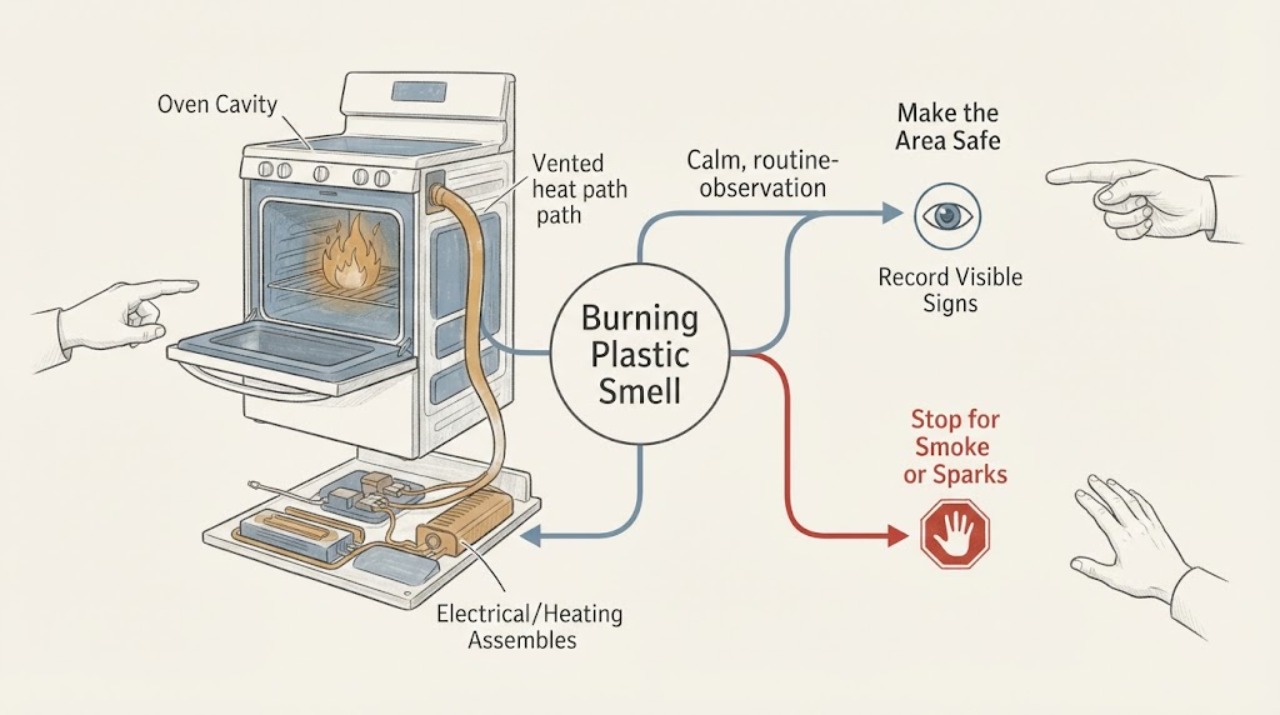
Treat a recurring burning-plastic smell from the Maytag MMW5530DAB as a stop-use symptom until its context is clear. Maytag identifies a small odor or smoke as potentially normal during the first uses of a new oven because of coatings, insulation or shipping materials, but that guidance does not make a recurring smell on an established oven normal. Turn the oven off and isolate power if there is smoke, a hot or melted part, visible arcing, sparking, or an odor that returns after first-use burn-in. When the oven is cold and power is off, inspect only the cavity and accessible exterior for forgotten packaging, plastic, foil, or a spill; do not remove the built-in microwave/oven combination, open covers, tighten terminals, or guess a part. Use the exact model's Maytag manual and qualified service for a persistent or unexplained smell.
Work through in order
Diagnostic checks
Use only checks that match the exact appliance or system and its official guide.
-
Check 1
Stop the oven immediately if the smell is recurring or accompanied by smoke, visible flame, sparking, a glowing or melted area, a hot control, or a hot electrical connection. Cancel the cooking function, keep clear of the built-in unit, and switch off its circuit at the breaker only if it is safe to do so; do not touch wet or damaged electrical parts. Do not run another cycle to reproduce the smell.
Expected result: There is only a mild first-use odor with no smoke or damage, or there is recurring odor, smoke, heat damage, sparking, glow or arcing.
Next step: Keep the appliance off for the second result and arrange qualified Maytag or appliance service; use emergency response for an active fire or immediate electrical danger. Never remove the built-in unit or open the microwave section as a smell check.
Why this matters
Why: The first result can fit Maytag's limited new-oven odor guidance. The second is an unresolved heat or electrical hazard and is not evidence of a specific terminal, wire, element or control-board failure.
-
Check 2
Determine whether MMW5530DAB is newly installed and within its first few uses. Once the cavity is fully cool and power is isolated, look only inside the oven cavity and around the visible door/rack area for shipping tape, plastic, ties, packing pieces, foil or a spill; do not remove panels, trim, the control console or microwave covers.
Expected result: Packaging remains or a visible spill/foil is present, or the cavity is clear and the odor occurred on an established appliance or after packaging was removed.
Next step: With power off and the oven cool, remove only plainly accessible packaging or clean a documented spill according to the owner's manual. If the smell is recurring, persists after first-use guidance, or came with smoke or damage, do not perform another burn-in; use service.
Why this matters
Why: Maytag attributes limited first-use odor to new parts, coatings and shipping materials, while foil or trapped spills can create odors. A clear cavity or an established appliance leaves the burning-plastic source unconfirmed.
-
Check 3
If the oven is genuinely new, all packaging is removed, there is no visible damage, and Maytag's exact manual permits first-use burn-in, use only the documented empty Bake procedure with ventilation and no food. Keep birds and other sensitive pets away from the fumes, and remain present rather than leaving the oven unattended.
Expected result: The odor diminishes over the first-use cycles, or it remains strong, returns after cooling, produces smoke, or appears to come from outside the cavity or the combination unit.
Next step: Stop the burn-in process for persistent or hazardous odor and keep the appliance off. Do not increase the temperature, start self-clean, or repeat cycles in an attempt to diagnose the source.
Why this matters
Why: Diminishing odor can fit Maytag's first-use explanation. Persistent, recurring or externally located odor is not established as normal by that guidance and may involve an installation or electrical/heating issue that requires service.
-
Check 4
Review whether the odor began during self-cleaning or after a spill, foil/liner use, or another recent oven event. With the appliance cool and isolated, remove only accessible debris or foil that the model instructions permit; do not use self-clean as a remedy for a suspected electrical or plastic-burning fault and do not disturb the door gasket or vent openings.
Expected result: The smell coincides with self-clean/heavy soil or a visible spill/foil, or it occurs during ordinary baking/preheating on a previously used oven.
Next step: Follow the exact MMW5530DAB manual for routine cool-down cleaning only when no safety symptom exists. For ordinary-use recurrence, smoke, melting or an electrical odor, keep the unit off and request service.
Why this matters
Why: Maytag says self-clean can create heat, smoke and odor, and that foil or liners can trap spills/debris. An ordinary-use recurrence on an established oven is not explained by the first-use guidance.
-
Check 5
Use Maytag's Owner's Center and manuals lookup with the full model and serial numbers, and give service the exact source location, operating mode, whether the unit was new, when the smell starts, whether smoke or visible damage occurred, and whether the odor returns after cooling. Do not order a terminal block, element, wire or other part from the smell alone.
Expected result: Maytag provides a model-specific manual or service route, or the documents are unavailable and the smell remains unexplained.
Next step: Keep the appliance off for a persistent or unexplained smell and arrange Maytag-authorized service. Provide the model, serial, source location and safety observations; do not open the cabinet or attempt live electrical testing.
Why this matters
Why: The official model page identifies MMW5530DAB as a built-in microwave/oven combination but does not establish a failed part. Exact documentation and a qualified inspection are needed for the oven and microwave sections.
Use your observations
Decision map
Find the observation that best matches what you see, then follow the next safe action.
-
PATH 01Next step
What you see
MMW5530DAB is newly installed, packaging has been removed, no damage or smoke is present, and the mild odor diminishes over the first few uses.
Do this next
Follow the exact manual's first-use procedure with ventilation and no food until the odor dissipates; do not carry that explanation over to a previously used oven.
Why this path and its safety boundary
Why it matters: This fits Maytag's limited first-use explanation involving new parts, coatings, insulation or shipping materials.
-
PATH 02Next step
What you see
The appliance is established or the smell returns after first-use burn-in, especially during ordinary baking or preheating.
Do this next
Stop using the combination unit and arrange Maytag or qualified appliance service. Do not repeat heating cycles, self-clean, open covers or buy a part from the smell.
Why this path and its safety boundary
Why it matters: The normal-first-use explanation no longer scopes the symptom. The odor source may be in the cavity, vent, heating path, controls or microwave/oven electrical system, but no component is confirmed.
-
PATH 03Next step
What you see
The smell followed self-cleaning or a visible spill/foil event, and there is no smoke, melting, arcing or electrical warning.
Do this next
Let the oven cool fully, follow the exact model cleaning guidance and remove only accessible residue or foil. Stop and seek service if the smell persists or any hazardous sign appears.
Why this path and its safety boundary
Why it matters: Maytag documents smoke/odor from high-temperature self-clean and from trapped spills or foil, which is a different context from recurring plastic-burning odor during ordinary use.
-
PATH 04Next step
What you see
There is smoke, visible flame, glowing or arcing, melted plastic, a hot electrical connection, or an odor from the built-in cabinet or microwave section.
Do this next
Leave the appliance off, isolate the circuit only when safe, keep people and pets away from fumes and arrange qualified service or emergency help. Do not remove the built-in unit or defeat any microwave safety interlock.
Why this path and its safety boundary
Why it matters: This is an immediate fire or electrical safety concern, not a confirmed oven element, terminal or wiring diagnosis.
Helpful context
Understand the symptom
Do not treat an established oven like a first-use oven
Maytag's new-oven odor guidance is conditional: a small amount of odor or smoke can occur during the first uses while new parts, insulation, protective oil or shipping tape heat, and it should dissipate. The assigned MMW5530DAB report concerns a burning-plastic smell, so the first question is whether the oven is genuinely new and still within that first-use context. A recurring smell on an established unit, visible smoke, melting, glow or arcing is outside that limited explanation and should not be tested repeatedly.
The MMW5530DAB is a built-in combination appliance
Maytag identifies MMW5530DAB as a 30-inch built-in microwave/oven combination. That matters for safe scope: a smell from the lower oven cavity, vent, controls or microwave section cannot be assigned to one component from the odor alone, and built-in access or electrical checks are not a homeowner troubleshooting step. Use Maytag's model lookup and service path rather than opening the cabinet or the microwave section.
When checks do not resolve it
Need a professional?
Call Maytag-authorized or qualified appliance service for a recurring burning-plastic smell on an established MMW5530DAB, any odor that persists after the limited first-use procedure, smoke, melting, arcing, visible electrical damage, or a smell from the built-in microwave/oven cabinet. Keep the combination unit off until it is assessed.
Have this ready
- Provide MMW5530DAB and serial numbers, installation age, operating mode, where the smell was strongest, when it starts, whether smoke/glow/arcing or melted material was seen, whether packaging or foil was present, and what happened after the appliance was switched off.
Common questions
FAQ
Can a new Maytag oven smell like burning plastic?
Maytag says a small amount of odor or smoke can occur during the first uses as new parts, insulation, protective oil or shipping tape heat, and it should dissipate. That explanation applies to a genuinely new oven and does not make a recurring smell on an established MMW5530DAB normal.
Should I run self-clean to remove a burning-plastic smell?
No. Maytag documents self-clean as a high-temperature cycle that can itself produce heat, smoke and odors. Do not use it to test or mask a recurring plastic-burning or electrical smell; use the exact manual and service path instead.
Is MMW5530DAB just a wall oven?
Maytag's Owner's Center identifies MMW5530DAB as a 30-inch built-in microwave/oven combination. The smell source cannot be assigned to the lower oven cavity, vent, controls or microwave section without qualified model-specific inspection.
Read the exact guide
Official sources
- Odors or Smells - RangeMaytag Product Help · Opened Maytag's official odor page. It supports the distinct self-cleaning and trapped-spill/foil branches and service boundary; it does not diagnose an electrical or plastic failure.
- MAYTAG Manuals & LiteratureMaytag · Opened Maytag's official manuals page. It requires the model number to retrieve the correct documentation and routes unresolved documentation requests to Maytag support; it is not a substitute for an unseen MMW5530DAB manual.
- Odors and Smells of Newly Installed Range or OvenMaytag Product Help · Opened Maytag's official first-use odor page. It supports only the newly installed/first-use branch and explicitly describes the conditions under which odor can be normal; it does not make recurring odor on an established MMW5530DAB normal.
- MMW5530DAB | Maytag Owner's CenterMaytag · Opened Maytag's exact model Owner's Center page. It identifies MMW5530DAB as a 30-inch built-in microwave/oven combination and provides support/service routing; it does not identify a failed component or authorize internal access.
Community feedback
Share a repair observation
Share a plain-text repair observation. Accepted observations are published automatically; this page may take a moment to update.