
On this page
Start here
Quick answer
A burning smell or smoke from an LG oven does not prove that the oven light is the cause. Stop using the oven if the smell is strong, smoke continues, flames appear, or a breaker trips; keep the door closed during an active oven fire and use the home fire emergency procedure. Once the oven is completely cool and power is safely disconnected, inspect only for visible food or oil residue, leftover packaging, foil or damage. LG says first-use odor or smoke can come from packaging residue and factory oil, and that food or oil residue can smell as it heats, but those explanations do not cover an established smoke or electrical/gas symptom. The light may be checked or replaced only by the exact model manual; do not remove the cover while hot or energized. Gas connections and gas service must be handled by an authorized qualified professional.
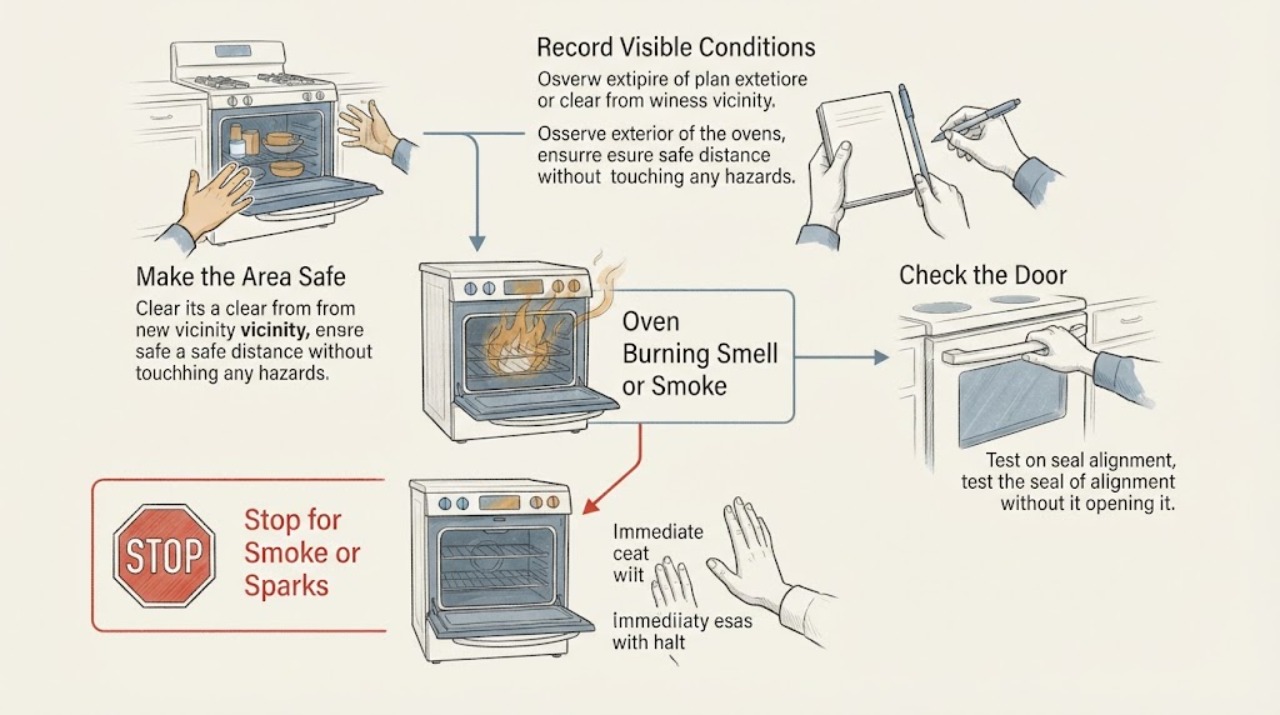
Work through in order
Diagnostic checks
Use only checks that match the exact appliance or system and its official guide.
-
Check 1
Stop the oven and do not start another bake, broil or self-clean cycle while smoke or a strong burning odor is present. If there is an active oven fire, keep the door closed, turn the oven off if the controls respond without approaching flames, leave the area and follow the household fire emergency procedure. Do not use water on an oven fire.
Expected result: Smoke continues after the oven is turned off, flames are visible, the odor is electrical or gas-like, the control panel or cord is hot/damaged, or the smell fades promptly when the oven is off.
Next step: Keep the oven out of service and request qualified service for any persistent smoke, flame, damaged wiring, repeated breaker action or uncertain cause. Record whether the oven is gas or electric and whether the symptom began during bake, broil, self-clean or while the light was on.
Stop if: Leave the area and call emergency services if fire cannot be controlled safely, smoke is rapidly increasing, or anyone is exposed to dangerous fumes.
Why this matters
Why: Persistent smoke, flame or an electrical/gas warning is an immediate safety condition; a light is not established as the cause. A brief odor that stops may still need inspection before reuse.
-
Check 2
When the oven is cool and safe to approach, record whether it is a first-use or newly installed LG range. Look only for shipping insulation, plastic film, cardboard, zip ties or other packaging left on the appliance; remove only visible exterior packaging as LG directs, and do not open panels.
Expected result: The oven is new and still has packaging or first-use context, or it is not new/has no packaging and the smell or smoke began after normal use.
Next step: For a new, intact oven with no active hazard, follow the exact model’s break-in instructions and ventilation guidance. If it is not new, packaging is absent, smoke is heavy, or the symptom persists, do not run a self-clean or bake cycle to test it; arrange service.
Why this matters
Why: LG says a new range can produce temporary odor or smoke from ceramic-fiber insulation, leftover packaging, or factory oil on a heating element. That explanation is limited to the new-range break-in context and does not diagnose an older oven or a persistent event.
-
Check 3
After the oven is completely cool and power is safely disconnected, inspect the cavity, racks, door edge and visible bottom area for spilled food, oil or grease residue, foil, a melted object, scorch marks or a damaged heating element. Do not touch a heating element, remove panels, or scrape wiring.
Expected result: Visible food/oil residue or packaging is present, the cavity is clean but an element or wiring area is damaged, or nothing visible explains the smell.
Next step: For minor residue on a cool oven, clean only with the exact model’s permitted method and do not run the oven until all cleaner and moisture are gone. For scorch marks, damaged elements, wiring, smoke from behind the cavity, or an unexplained persistent smell, leave the oven off and request service.
Why this matters
Why: LG identifies food or oil residue as a possible cause of burning smell and identifies packaging/factory residue as a new-range cause. A clean cavity or visible damage means the light cannot be blamed from appearance alone.
-
Check 4
Treat the light as a separate hypothesis. Note whether the smell or smoke appears only when the oven light is switched on, but do not switch it on again to reproduce the symptom. If inspection is appropriate, wait for the bulb and oven to cool, disconnect power at the documented control point, and use only the exact model manual or LG light guide for any cover or bulb procedure.
Expected result: The symptom is tied only to the light, the glass cover/bulb/socket shows visible damage, or the smell occurs during heating regardless of light state.
Next step: Do not remove a cover or bulb without exact model instructions and safe power isolation. For a damaged socket, charring, repeated fuse/breaker action, or any uncertainty, keep the oven out of service and arrange qualified repair.
Stop if: Stop for a hot socket, exposed conductor, cracked bulb, arcing, smoke from the light housing, or any need to work on energized wiring.
Why this matters
Why: LG provides a separate oven-light support guide, but the supplied task has no model and the symptom alone does not identify a bulb, socket or wiring fault. A heating-related odor remains broader than a light issue.
-
Check 5
If the LG appliance is gas, do not move the range, loosen a connector, inspect internal gas parts, relight repeatedly, or attempt a gas repair. Note whether there is a gas-like odor, uneven/yellow flame, ignition failure, or a recent installation/conversion. For an electric oven, note any hot cord, outlet, breaker trip or electrical odor without opening the appliance.
Expected result: There is a gas-like odor, abnormal flame/ignition, recent gas work, electrical damage, breaker action, or none of these signs.
Next step: For a gas concern, stop using the range, close the appliance gas shutoff only if it can be reached without entering danger, leave the area for a suspected leak and contact the gas supplier/emergency service or authorized LG service. For electrical damage or repeated breaker trips, leave power off and arrange qualified service.
Stop if: Do not use a flame to check gas, do not operate the oven to see whether the odor returns, and do not perform live measurements or internal repairs.
Why this matters
Why: LG states that gas installation and service must be performed by an authorized professional and that gas leaks may not be detected by smell alone. A burning smell cannot safely distinguish gas, electrical and cooking-residue causes by itself.
Use your observations
Decision map
Find the observation that best matches what you see, then follow the next safe action.
-
PATH 01Next step
What you see
The oven is new, the symptom occurs during initial use, no flame or electrical damage is present, and packaging/factory-residue context is plausible.
Do this next
Ventilate and follow the exact model’s new-range/break-in guidance only if there is no active hazard. Stop and request service if smoke is heavy, persists beyond the documented break-in context or returns unexpectedly.
Why this path and its safety boundary
Why it matters: LG says a new range may smell or smoke while packaging residue and factory oil are removed by heat. This is a conditional first-use explanation, not proof that the assigned older or unknown oven is safe.
-
PATH 02Next step
What you see
The oven is cool and a visible food, grease or oil residue is found inside, with no smoke from wiring, no flames and no gas/electrical warning.
Do this next
Clean only with the exact model’s approved method and wait until the cavity is dry; do not use self-clean as a test for an unexplained or active smoke event. Arrange service if the odor returns or any damage is visible.
Why this path and its safety boundary
Why it matters: LG identifies food or oil residue as a possible heat-related burning smell, but that finding does not prove the light or exclude another fault.
-
PATH 03Next step
What you see
The odor or smoke was noticed only when the light was on, and the light housing, bulb or socket appears damaged or scorched.
Do this next
Leave the oven unused, isolate power safely and use the exact model manual or qualified LG service. Do not replace the bulb by generic size or operate again to confirm the theory.
Why this path and its safety boundary
Why it matters: The light assembly is a service lead, not a confirmed diagnosis; the LG light guide does not make an unknown-model bulb or socket safe to remove while hot or energized.
-
PATH 04Next step
What you see
There is active fire, persistent smoke, a gas-like odor, abnormal flame, arcing, exposed wiring, a hot/damaged cord, repeated breaker action or smoke from behind the cavity.
Do this next
Stop using the oven, keep clear of the hazard, follow fire/gas emergency procedures and contact emergency, gas-supplier, electrical or authorized LG service as appropriate. Do not test, self-clean, or open the appliance.
Why this path and its safety boundary
Why it matters: The symptom has crossed the safe user-observation boundary; a light or residue explanation is not sufficient.
Helpful context
Understand the symptom
The assigned topic is an LG oven or range with a burning smell and smoke, while the original question asks whether the light is responsible. The light is only a suspicion, not a diagnosis. A light socket, food residue, packaging, heating element, wiring, gas/combustion issue or an active fire require different decisions, so start with safety and symptom context.
LG’s first-use guidance permits a narrow normal-odor branch for a new range after packaging and shipping materials are removed. LG’s general guidance also notes that food or oil residue can smell when heated. Those explanations should not be used to justify repeated operation when the oven is older, the smoke is heavy or persistent, or there is any electrical, gas or fire warning.
When checks do not resolve it
Need a professional?
Give LG service the full model number, whether the oven is gas or electric, when the smell began, whether the light was on, the cooking mode and temperature, whether smoke was visible and where, new/old installation status, visible residue or damage, and any breaker/gas/flame history.
Common questions
FAQ
Is the LG oven light definitely causing the burning smell?
No. The light is only one hypothesis. LG also documents new-range packaging/factory residue and food or oil residue as possible odor sources, while persistent smoke, damage, gas or electrical signs require service.
Can I run self-clean to see whether the smoke goes away?
Do not use self-clean as a diagnostic test for an unexplained active smoke event. LG says self-clean can itself produce smoke/odor and may need to be cancelled or interrupted for excessive smoke or fire; inspect only after the oven is cool and safe, and use the exact model’s instructions.
What if the LG range may be leaking gas?
Stop using it and do not test with a flame or perform gas work. LG states that gas installation and service must be handled by authorized professionals and that gas leaks may not be detected by smell alone; follow the gas supplier or emergency service procedure.
Read the exact guide
Official sources
- How To Replace The Light Bulb In An LG OvenLG USA Support · Opened LG’s official oven-light page. It provides a separate light-bulb support guide with model-dependent product support context, but the task has no model and the opened page does not prove a bulb/socket failure.
- LG New Range - Strong Odor or SmokeLG USA Support · Opened LG’s official new-range page. It limits the normal smoke/odor explanation to a new range and cites insulation, packaging and factory oil; it also provides ventilation and packaging-removal guidance.
- LG Range - Troubleshooting a Burning Smell From My OvenLG USA Support · Opened LG’s official help page. It states that oil stains or food residues can smell like burning due to heat and notes the guide covers all models; it does not identify the light as the cause.
- LG Range – How to Install a Gas RangeLG USA Support · Opened LG’s official gas-range page. It says gas installation and service must be performed by authorized professionals, warns not to handle gas connections, and states gas leaks may not be detected by smell alone.
- LG Range Installation GuideLG USA Support · Opened/search-opened LG’s official installation guide PDF result. It states that gas supply should be shut off before removal and that gas leaks may not be detected by smell alone; it is used only for the gas escalation boundary.
- General Maintenance and Cleaning - Ranges and CooktopsLG USA Support · Opened LG’s official maintenance page result. It describes cleaning methods and notes that smoke/odor can occur during self-clean; it is used only to distinguish documented cleaning behavior from unexplained burning smell.
- LG Range – How to Clean Your Oven Using Self CleanLG USA Support · Opened LG’s official self-clean page. It states that self-clean generates high heat, locks the door, and may need cancellation/interruption for excessive smoke or fire; it is used to avoid recommending self-clean as an unexplained smoke test.
Community feedback
Share a repair observation
Share a plain-text repair observation. Accepted observations are published automatically; this page may take a moment to update.