
On this page
Start here
Quick answer
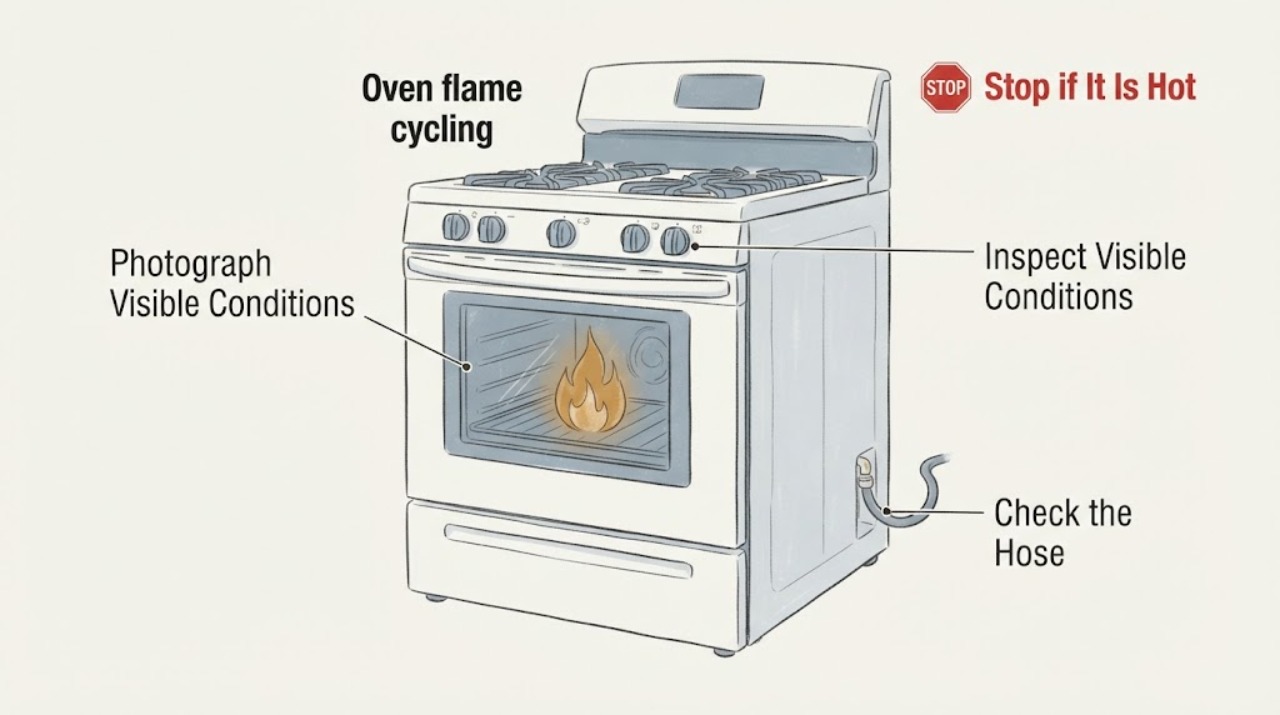
A Maytag gas oven normally reignites its bake or broil burner during a cooking cycle to maintain temperature. Maytag's opened freestanding-gas-range guide says the associated valve pop, several igniter clicks until a flame is sensed, and a poof at ignition can occur every 1–3 minutes. That is different from an igniter clicking continuously without a stable flame, repeated failed relights, no heat, yellow or noisy flames, smoke, or a gas odor. First confirm the oven is a gas model, record the exact model and the sound/flame pattern, then observe one bake or broil cycle with the door closed. If the flame establishes briefly and the oven heats normally without a safety sign, the cycling is likely normal. If ignition does not establish, the burner goes out repeatedly, the oven does not heat, or gas is smelled, stop using it and arrange qualified Maytag or gas-appliance service. Do not remove panels, adjust gas components, or test live ignition circuits.
Work through in order
Diagnostic checks
Use only checks that match the exact appliance or system and its official guide.
-
Check 1
Before running another test, read the complete Maytag model and serial label from its normal accessible location and confirm whether the appliance is a gas range/oven or an electric oven. Photograph the control display and write down whether you hear a single pop or poof followed by a short click sequence, a stable burner flame, continuous clicking, repeated relighting, or only a fan or relay sound.
Expected result: The unit is a gas oven with a clear short ignition event, a gas oven that keeps clicking or relighting, an electric oven with no gas burner, or the model and sound source are uncertain.
Next step: Use the exact Maytag manual for the identified model. If the appliance type or sound source is uncertain, stop code- or part-specific troubleshooting and ask Maytag or a qualified technician to identify it.
Stop if: Do not remove the outer case, storage drawer, burner cover, or control panel to find the igniter, and do not move a connected range just to read a label.
Why this matters
Why: Only a gas oven has a burner and igniter to relight. Maytag's normal-ignition description is model-scoped and applies to the short click/ignition pattern, not to continuous clicking or an electric oven being described as 'igniting'.
-
Check 2
For one normal Bake or Broil cycle, keep the oven door closed and observe from outside. Note the time between ignition events, whether each event consists of a brief click sequence followed by a stable flame and heat, whether the set temperature is reached, and whether there is any gas odor, smoke, or abnormal noise. Do not open the door repeatedly to watch the burner.
Expected result: A brief click/pop/poof occurs, the burner lights and heats, and the event repeats at intervals; or the igniter clicks continuously, the burner fails to light or goes out, the oven does not heat, or a safety symptom appears.
Next step: If every ignition establishes a stable flame and heating is normal, follow the exact manual and use the oven normally. If an ignition attempt fails, keeps repeating without heat, or is accompanied by odor or smoke, turn the oven off, leave it undisturbed, and arrange qualified service.
Stop if: Do not keep restarting the oven to count ignition attempts, bypass the flame-sensing system, or probe the igniter or gas valve.
Why this matters
Why: Maytag says bake and broil burners can ignite with several clicks and that this sound can recur every 1–3 minutes; it also says burner cycling maintains temperature. Continuous unsuccessful ignition, no heat, or a safety symptom is not established as normal cycling.
-
Check 3
If the range was just installed or reconnected, check only the accessible external conditions: the main gas valve is on, the power cord is in a suitable grounded outlet, and no hose, cord, or connection is visibly damaged or strained. If there is no gas odor and the model's installation instructions specifically permit a first-use air-purge step, follow that exact instruction or ask the installer to perform it; do not inspect the rear regulator by moving the range yourself.
Expected result: The oven is newly connected and the external gas/power conditions are normal, the gas supply or grounded power is unavailable, or the installation cannot be confirmed without moving the range or accessing the regulator.
Next step: Correct only an obvious, safe external condition once. If the oven still repeatedly attempts ignition, the installation is uncertain, or the range is hard-piped or otherwise unsafe to move, stop and contact the installer, Maytag, or a qualified gas technician.
Stop if: Do not loosen gas fittings, slide a hard-piped or heavy range, alter the regulator, use an extension cord, or continue testing after a leak, damaged connection, or gas odor is noticed.
Why this matters
Why: Maytag says air can be trapped after recent installation or reconnection, and its gas-oven support identifies gas supply, regulator shut-off, and grounded power as prerequisites for ignition. These checks do not prove a defective igniter or valve and do not replace the model installation instructions.
-
Check 4
Without removing any panel or reaching into the burner area, inspect from a safe position for visible abnormal flame or heat signs if the model makes them viewable: a yellow or noisy flame, soot, scorching, smoke, an unusual gas smell, or a flame that does not stay established. Do not attempt to adjust air shutters, gas pressure, burner ports, or ignition components.
Expected result: The visible flame is stable and blue-leaning with no odor or smoke, or it is yellow/noisy, leaves soot, repeatedly goes out, or is accompanied by odor, smoke, or abnormal heat.
Next step: For a stable normal flame, continue with the model-specific operating guidance. For abnormal flame, smoke, scorching, or repeated flame loss, turn the oven off and arrange qualified gas-appliance service. For unconfined gas odor, leave the area and follow the gas supplier or emergency instructions.
Stop if: Do not light another appliance, touch an electrical switch, use a phone inside the building, or continue testing when unconfined gas odor is present.
Why this matters
Why: Maytag describes normal gas-oven ignition and says abnormal yellow/noisy flames can be associated with gas-conversion or burner conditions requiring service. A gas odor or fire symptom takes priority over deciding whether the cycling is normal.
-
Check 5
Prepare a service record instead of selecting a part: include the exact model, gas type and market, installation or reconnection date, Bake or Broil mode, set temperature, whether the oven reaches heat, the interval and sound of each ignition attempt, flame/odor observations, and any display message. Keep the oven off if the failure repeats.
Expected result: The oven heats normally with brief periodic ignition, or the ignition attempt is continuous, unsuccessful, recurrent after a restart, or associated with no heat or a safety sign.
Next step: Use the record to contact Maytag or a qualified gas-appliance technician. Request prompt service for repeated failed ignition, no heat, smoke, abnormal flame, or recurring odor, and do not order a replacement component from the symptom alone.
Stop if: Do not open panels, test live voltage or gas pressure, bypass flame sensing or safety controls, or run repeated cycles to force a different result.
Why this matters
Why: The same symptom can involve normal temperature management, installation/supply, ignition sensing, gas flow, control, wiring, or another model-specific condition. A sound alone cannot identify an igniter, valve, sensor, relay, or control-board failure.
Use your observations
Decision map
Find the observation that best matches what you see, then follow the next safe action.
-
PATH 01Next step
What you see
The Maytag appliance is a gas oven, each Bake or Broil ignition produces a short click sequence and stable heat, the sound recurs at normal intervals such as the guide's 1–3 minute example, and there is no gas odor, smoke, abnormal flame, or loss of heating.
Do this next
Leave the door closed during preheat and use the exact model manual for operation. Monitor cooking performance rather than repeatedly restarting the oven.
Why this path and its safety boundary
Why it matters: The observed pattern is consistent with automatic burner cycling used to maintain oven temperature, not proof of a defective igniter or gas valve.
-
PATH 02Next step
What you see
The igniter keeps clicking without a stable flame, the burner lights and immediately goes out, ignition repeats without the oven heating, or the clicking is continuous rather than a brief sequence until flame is sensed.
Do this next
Turn the oven off and arrange Maytag or qualified gas-appliance service. Provide the model, mode, timing, and whether the cooktop and oven heat; do not attempt internal diagnosis.
Why this path and its safety boundary
Why it matters: This is an unsuccessful ignition or heating symptom, not the normal periodic burner-cycling pattern described by Maytag. The observation does not identify whether gas supply, ignition sensing, wiring, control, or another component is responsible.
-
PATH 03Next step
What you see
The oven was recently installed or reconnected, the cooktop may work while the oven does not, or the external gas valve, regulator shut-off, grounding, or installation identity cannot be confirmed without moving or opening the appliance.
Do this next
Check only safe accessible conditions and follow the exact installation manual or ask the installer/qualified gas technician to verify the connection. Stop if the unit is hard-piped, a connection is damaged, or any gas odor is present.
Why this path and its safety boundary
Why it matters: Maytag identifies trapped air after reconnection and separate gas-supply, regulator, and grounding prerequisites. A new installation can therefore produce a setup branch, but it does not prove a component failure or authorize moving a connected range.
-
PATH 04Next step
What you see
There is unconfined gas odor, smoke, scorching, a yellow or noisy flame, repeated electrical tripping, a hot or damaged cord, or another immediate safety sign during the ignition attempts.
Do this next
Leave the area and contact the gas supplier or emergency services from a safe location, following their instructions. For smoke or electrical danger, keep clear and obtain qualified emergency or appliance help; do not restart the oven.
Why this path and its safety boundary
Why it matters: Safety response takes priority over distinguishing normal flame cycling from an ignition fault. Maytag's gas-odor guidance says not to light appliances, touch electrical switches, or use a phone in the building when gas is smelled without an obvious intended burner source.
Helpful context
Understand the symptom
Repeated ignition is not automatically a defect on a new Maytag gas oven. The temperature control can turn the bake or broil burner off and call for it again; the control guide describes a short click sequence until the flame is sensed, a valve pop or poof, and recurrence during normal cooking. The useful distinction is whether each ignition attempt produces a stable flame and normal heat, or whether the igniter keeps trying, the flame drops out, or the oven fails to heat.
Because no Maytag model number was supplied, the checks below stay at the safe symptom level. A model-specific installation guide controls the gas type, regulator arrangement, ignition sequence, and any permitted owner checks. Keep the oven out of service for gas odor, smoke, abnormal flame, repeated failed ignition, or any condition that would require opening the cabinet or moving a connected range.
When checks do not resolve it
Need a professional?
Request Maytag or qualified gas-appliance service when the igniter clicks continuously, a burner will not remain lit, the oven does not heat, the symptom returns after a safe installation check, or any abnormal flame, smoke, scorching, gas odor, damaged connection, or electrical hazard is present.
Have this ready
- Provide the full model and serial information, market and gas type, installation or reconnection date, Bake or Broil mode, set temperature, exact ignition sound and interval, whether a stable flame appears, whether the oven heats, and any odor, smoke, flame-color, or display observations.
Common questions
FAQ
Is it normal for a new Maytag gas oven to ignite repeatedly?
Often, yes. Maytag's opened freestanding-gas-range guide says the bake or broil burner can make a valve pop, several igniter clicks until the flame is sensed, and a poof when it ignites; it says hearing this every 1–3 minutes during the cycle can be normal. The flame should establish and the oven should heat normally without gas odor, smoke, or abnormal flame.
How can I tell normal burner cycling from a failed ignition?
Normal cycling is a short ignition event that produces a stable flame and heat, then returns periodically as temperature is regulated. Continuous clicking, a flame that fails to stay lit, repeated attempts without heat, or a gas odor is a service or safety branch rather than a normal-cycle conclusion.
What should I check first if this started after installation?
From a safe accessible position, confirm the model-specific installation, main gas valve, grounded power, and visible connection condition. Maytag notes that air can be trapped after a range is installed or reconnected, but do not move a hard-piped or heavy range, loosen gas fittings, or continue testing when a connection is damaged or gas is smelled; ask the installer or a qualified gas technician to verify it.
Read the exact guide
Official sources
- Odors or SmellsMaytag Product Help · Official Maytag gas-cooking safety page opened only for the gas-odor escalation boundary; its cooktop scope does not define oven burner cycling or a model-specific repair.
- Oven Not Working - GasMaytag Product Help · Official Maytag gas-oven support page opened for the newly installed/reconnected branch; it directs model-specific and qualified service escalation when external conditions do not resolve the symptom.
- How Do Gas Stoves Work: A Complete GuideMaytag · Official Maytag educational page opened for the mechanism behind a gas oven's igniter, gas valve, burner, and flame cycling; it is general guidance, not a substitute for the exact model manual.
- Freestanding Gas Range Control GuideMaytag · Official Maytag gas-range control guide opened for the gas-oven ignition and cycling distinction; exact model matching is still required before applying any model-specific operation.
- Oven Not Working - Cooktop Working - Not ClickingMaytag Product Help · Official Maytag gas-range support page opened for the distinction between cooktop operation and oven ignition; its regulator, gas, power, and storage-drawer checks remain model and installation dependent.
- Pop or Popping Noise in Oven - RangeMaytag Product Help · Official Maytag range support page opened to distinguish an occasional normal pop during gas-valve cycling from a failed ignition; it does not define internal repair steps.
Community feedback
Share a repair observation
Share a plain-text repair observation. Accepted observations are published automatically; this page may take a moment to update.