
On this page
Start here
Quick answer
Treat a Maytag oven smell as a safety triage problem before a cleaning problem. If the odor resembles raw gas or rotten eggs, or there is hissing, delayed ignition, an abnormal flame, carbon-monoxide symptoms, smoke, fire, sparking, a hot control, or a burning-electrical smell, stop using the oven and leave the area when appropriate; do not operate switches or try another ignition test, and contact the appropriate gas, fire, or qualified service help from a safe location. If no hazard is present, a new oven may briefly smell from manufacturing materials, while food, grease, cleaner residue, foil, or a self-clean cycle can create a different odor. Identify the source and timing, let the oven cool, use only the model-approved accessible cleaning steps, and arrange service when the smell persists, returns, or cannot be confidently identified.
Work through in order
Diagnostic checks
Use only checks that match the exact appliance or system and its official guide.
-
Screen for a gas emergency before touching controls
Ask whether the odor is raw gas or rotten-egg-like, whether it is present while the oven is off, or whether you hear hissing or notice delayed ignition. Do not light the oven or another appliance, do not operate electrical switches, and do not use a phone inside the building. If safe without crossing the odor or hazard, leave and contact the gas supplier or fire department from a safe location.
Expected result: The smell is gas-like, persists when the oven is off, is accompanied by hissing, or the source cannot be confidently ruled out; alternatively, no gas-like odor is present.
Next step: For a gas-like or unexplained odor, stop all troubleshooting, keep people and pets away, and wait for the gas or emergency service to clear the area. Only continue with the article after the gas concern has been cleared and the appliance is safe.
Stop if: Stop immediately for gas odor, hissing, delayed ignition, or an abnormal flame; do not perform an ignition or leak test.
Why this matters
Why: A suspected gas leak is an emergency boundary, not a cleaning diagnosis. Maytag's gas-range instructions also warn that a leak may not always be detectable by smell.
-
Rule out fire, carbon monoxide, and electrical danger
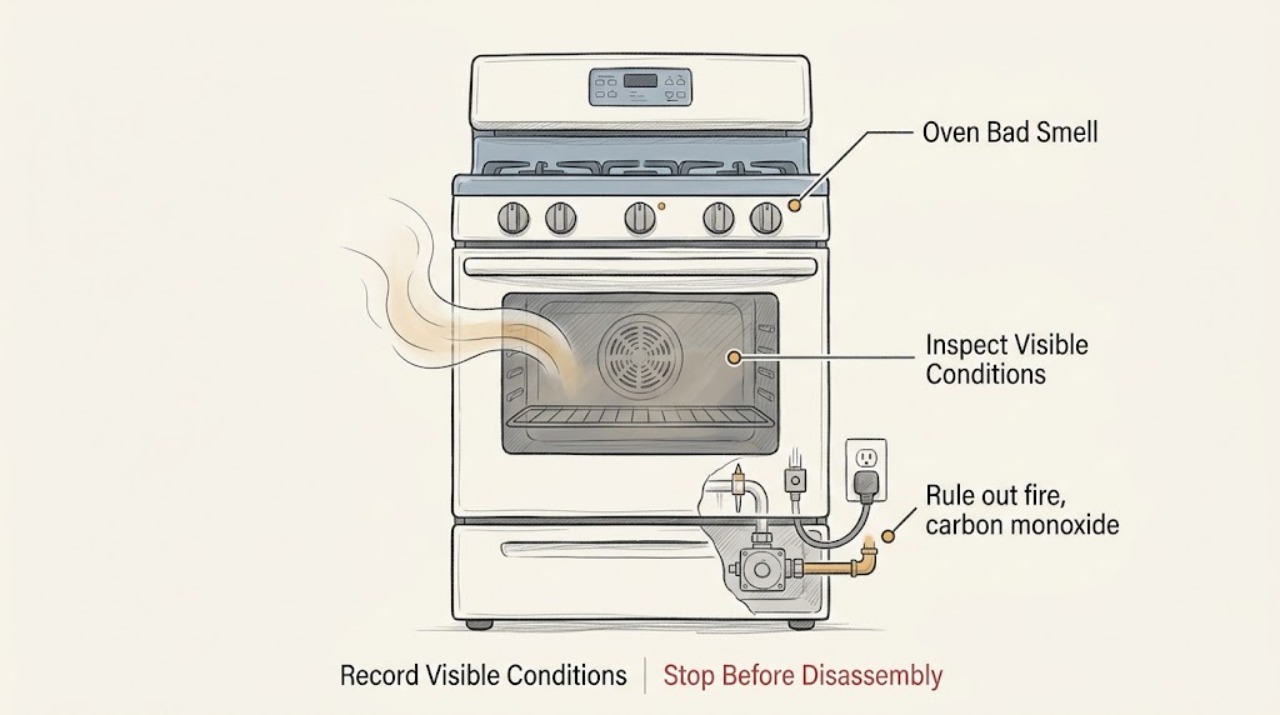
Without opening the appliance, look only from a safe position for smoke, flames, visible arcing, a glowing or damaged cord or control, a hot control area, or a breaker that trips again. Leave immediately for fire, heavy smoke, suspected carbon monoxide symptoms, or an electrical burning odor; isolate power only from a dry, safe location and only if doing so does not put you near the hazard.
Expected result: There is no smoke, fire, spark, hot or damaged control, repeated trip, or carbon-monoxide concern, and the odor is limited to the cool appliance or cooking area.
Next step: If any danger sign occurred, keep the oven off and request emergency or qualified service. If none occurred, continue by documenting when and where the odor appears.
Stop if: Do not reset a repeatedly tripping breaker, touch damaged wiring, test live voltage, or continue operating an oven that smokes, arcs, overheats, or smells electrically burnt.
Why this matters
Why: An electrical or combustion fault can make a recurring burning odor unsafe even when the oven still appears to operate.
-
Record when and where the odor appears
With the oven off, note whether the smell is present before use, only during preheat or Bake/Broil, after shutdown, during Self-Clean, near the cavity, at the vent, around the controls, or near the cooktop. Record the fuel type, whether the oven is new or recently installed, and the exact model number; do not repeat a hazardous cycle just to reproduce the smell.
Expected result: The odor has a repeatable operating stage or location, or it is intermittent and cannot be localized safely.
Next step: Use the matching branch below. If the odor cannot be classified or localised without operating the oven, leave it out of service and give these observations to a Maytag-qualified technician.
Why this matters
Why: Timing helps distinguish first-use residue, a spill or cleaner, vented self-clean smoke, gas ignition behavior, and an electrical or control fault without guessing at a part.
-
Check the new-oven and packaging branch
If the oven is new or has just been installed, wait until it is fully cool and inspect the cavity and visible edges for shipping tape, packaging, protective material, or residue. Remove only material that is clearly intended to be removed without tools, then ventilate the room; move birds to another closed, well-ventilated room because Maytag warns that some birds are highly sensitive to first-use fumes.
Expected result: The odor is slight, began on first use, no gas or electrical warning exists, and it fades after the packaging is removed and the area is ventilated.
Next step: Follow the exact model manual's first-use procedure only after the safety screen is clear; do not cook food until the manual's preparation is complete. If the odor remains strong, returns, or produces smoke beyond the documented first-use behavior, stop and arrange service.
Stop if: Stop if the odor is gas-like, electrical/burning, strong or worsening, or accompanied by smoke, flame, headache, dizziness, or other suspected carbon-monoxide symptoms.
Why this matters
Why: Maytag identifies new parts, insulation, manufacturing oil, and shipping tape as possible first-use odor sources that should dissipate after initial uses.
-
Inspect for food, grease, cleaner, or foil residue while cool
After the oven is completely cool and the emergency screen is clear, use a light to look at the cavity floor, racks, door area, and visible vent opening for spilled food, grease, cleaner residue, or foil/liner material. Do not scrape hot surfaces, disassemble the door, disturb the gasket, or reach into a hidden vent or burner area.
Expected result: A visible spill or residue is present and the smell is limited to cooking; or the cavity is clean but the odor persists or comes from behind the controls or vent.
Next step: For visible residue, follow the model's routine-cleaning instructions with a soft cloth and approved mild cleaning method after cooling. If the source is hidden, recurring, or near controls, stop and request service.
Stop if: Do not use foil as a liner, spray cleaner into vents or burners, or combine cleaning chemicals. Stop for damaged enamel, a damaged gasket, smoke, or a burning smell.
Why this matters
Why: Maytag says trapped spills and debris, including under foil or liners, can cause odors; a clean cavity with a recurring odor points away from a simple spill.
-
Clean only the confirmed non-hazardous residue
When the oven is cool and the smell has been identified as food or compatible cleaner residue, wipe accessible interior surfaces using the exact model instructions, a soft damp cloth, and the permitted mild cleaner. Keep products out of openings, wipe away residue, and allow the cavity to dry before any later normal use.
Expected result: The odor is gone after the residue is removed, or it returns on the next normal use despite a clean cavity.
Next step: If the smell returns, stop using the oven and provide the technician with the cleaner used, the location of the residue, and the operating stage when it returned. Never use an oven-cleaner product unless the model manual explicitly allows it.
Stop if: Stop for chemical fumes, a reaction between products, eye or breathing irritation, smoke, gas odor, or any need to remove panels or burners.
Why this matters
Why: An odor that clears with safe cleaning supports a surface contamination cause; a returning odor suggests residue in an inaccessible area or a heating, gas, vent, or electrical fault.
-
Handle the Self-Clean branch as a documented cycle, not a test
If the odor started during or after Self-Clean, stop adding food or cleaner and let the oven cool. Confirm that vents were not blocked and that the door gasket was not cleaned, moved, or damaged. Use Self-Clean again only if the exact manual calls for it and there is no gas, electrical, smoke, or fire concern; never use that cycle to investigate an unexplained smell.
Expected result: The odor was limited to a documented high-temperature cleaning cycle and subsides with ventilation and cooling, or it persists during ordinary cooking.
Next step: For a normal documented self-clean odor, follow the manual's ventilation and care instructions. For persistent odor, excessive smoke, damaged gasket, or odor during ordinary cooking, keep the oven off and arrange service.
Stop if: Stop for heavy smoke, fire, gas-like or electrical odor, visible gasket damage, blocked vent, or any need to force the locked door open.
Why this matters
Why: Maytag states that high-temperature Self-Clean can produce heat, odors, and smoke, while blocked vents or a disturbed gasket are not conditions to ignore.
-
Separate an installation or fuel-supply issue
If the smell began after installation, reconnection, fuel conversion, or a move, compare the model number and fuel type with the installation documents. Confirm only the user-accessible main gas shutoff and household power status described by the manual; do not slide a hard-piped range, adjust a regulator, kink a flexible line, or open a gas connection.
Expected result: The oven was recently connected, the cooktop works but the oven does not, the fuel type is uncertain, or the odor appeared after handling the appliance.
Next step: Stop the appliance and ask a certified gas or appliance technician to verify installation, fuel configuration, regulator, connector, and ignition safely. Give them the model, fuel type, installation date, and odor timing.
Stop if: Stop for any gas odor, hissing, damaged or stretched connector, uncertain fuel conversion, or any need to access a regulator or gas fitting.
Why this matters
Why: Maytag notes that an oven regulator shutoff can differ from the home's main gas valve and that a range may not be safe to slide when hard-piped; recent reconnection can also leave air in a gas line.
-
Make the service handoff precise
Before contacting service, write down the exact model number, gas or electric configuration, odor description, where it was strongest, whether the oven was on or off, cycle and temperature setting if already observed safely, any smoke or code, recent cleaning or installation, and whether the breaker or gas supply changed. Do not keep running the appliance for more evidence.
Expected result: The odor persists, returns after a safe cleaning or documented first-use condition, comes from behind the controls or vent, or cannot be classified.
Next step: Keep the oven out of service and request Maytag or qualified appliance service. Use emergency gas or fire help instead if the symptom is an active gas, smoke, fire, carbon-monoxide, or electrical hazard.
Stop if: Do not bypass an interlock, remove panels, replace a gas or electrical part, or perform a live test to confirm a suspected component.
Why this matters
Why: A repeatable or unexplained smell can involve a burner/igniter, gas-control path, venting, heating element, wiring, sensor, or control; those are model- and fuel-specific service diagnoses.
Use your observations
Decision map
Find the observation that best matches what you see, then follow the next safe action.
-
PATH 01Next step
What you see
The odor resembles raw gas or rotten eggs, occurs while the oven is off, or is accompanied by hissing, delayed ignition, or an abnormal flame.
Do this next
Do not ignite anything or operate electrical switches; leave the area and contact the gas supplier or fire department from a safe location. Do not re-enter until cleared.
-
PATH 02Next step
What you see
Smoke, fire, visible arcing, a hot or damaged control, a burning-electrical odor, repeated breaker trips, or suspected carbon-monoxide symptoms are present.
Do this next
Stop use, leave when appropriate, and seek emergency or qualified service assistance. Do not reset and retry the appliance.
-
PATH 03Next step
What you see
A new oven has a slight odor only on first use, with packaging removed, no hazard signs, and the odor fading with ventilation.
Do this next
Follow the exact model's first-use procedure and keep food out until it is complete; stop if the smell persists or changes character.
-
PATH 04Next step
What you see
A cool cavity shows food, grease, cleaner residue, foil, or a liner and there is no gas or electrical warning.
Do this next
Use only the model-approved routine cleaning method after cooling. Do not mix products or spray into openings.
-
PATH 05Next step
What you see
The odor is limited to Self-Clean and subsides after cooling and ventilation, with clear vents and an undisturbed gasket.
Do this next
Treat it as a documented high-temperature cleaning effect and follow the model manual; do not repeat Self-Clean as an odor diagnostic.
-
PATH 06Next step
What you see
The odor began after installation, reconnection, fuel conversion, or moving the range, or the fuel type is uncertain.
Do this next
Leave the gas path and range position alone and arrange certified installation or appliance service.
-
PATH 07Next step
What you see
The odor persists, returns during ordinary cooking, comes from behind controls or the vent, or cannot be classified safely.
Do this next
Keep the oven out of service and request qualified Maytag appliance service with the model and symptom timeline.
Helpful context
Understand the symptom
A bad smell does not identify one failed part. The safe order is to screen for gas, fire, carbon monoxide, and electrical danger; then separate a first-use manufacturing odor from food or cleaner residue and from a repeatable operating fault. The exact model manual controls which fuel system, cleaning cycle, and service procedure apply.
Do not use an empty heated cycle to investigate a gas-like or electrical smell. Do not keep relighting a burner, open a gas fitting, move a hard-piped range, or remove panels. If the smell is strong, unexplained, or returns after the low-risk checks below, leave the oven out of service.
When checks do not resolve it
Need a professional?
Request qualified Maytag or appliance service for any recurring, unexplained, electrical, burning, or non-first-use odor; odor from behind the controls or vent; an odor that returns after safe cleaning; installation or fuel uncertainty; visible damage; or any fault that trips protection. For suspected gas, fire, smoke, carbon monoxide, or active electrical danger, leave when safe and contact the appropriate emergency or gas service from a safe location.
Common questions
FAQ
Is a smell from a new Maytag oven normal?
A slight first-use odor or small amount of smoke can come from new parts, insulation, manufacturing oil, or shipping tape and should dissipate. Remove packaging, ventilate, follow the model's first-use instructions, and stop for a gas-like, electrical, worsening, or unexplained odor.
What should I do if my Maytag oven smells like gas?
Do not light the oven or another appliance, touch electrical switches, or use a phone inside. Leave the area and contact the gas supplier or fire department from a safe location; do not return until it is cleared.
Can food or foil cause a Maytag oven odor?
Yes. Maytag says spills and debris trapped under foil or liners can cause odors. Once the oven is fully cool and no hazard is present, use the model-approved cleaning method and do not line the oven bottom with foil or other materials.
Why does Self-Clean make my Maytag oven smell?
Maytag explains that high-temperature Self-Clean can produce heat, odors, and smoke. Ventilate, keep vents clear, protect the gasket, and follow the exact manual; do not use Self-Clean to test an unexplained or gas-like odor.
When should I stop using a Maytag oven that smells bad?
Stop for raw-gas odor, hissing, delayed ignition, abnormal flame, smoke, fire, arcing, a burning-electrical smell, overheating, repeated breaker trips, suspected carbon-monoxide symptoms, or a smell that persists or cannot be identified. Arrange appropriate emergency or qualified service help.
Read the exact guide
Official sources
- Cleaning and Maintenance of RangeMaytag Product Help · Official Maytag range-care guidance; gas-emergency instructions control if the odor is gas-like.
- How to Check the Gas Regulator Shut-Off Valve on an OvenMaytag Product Help · Official Maytag installation support; not a gas-odor DIY procedure.
- GAS RANGE Use & Care GuideMaytag · Official Maytag gas-range owner manual for the documented manual family; the exact installed model manual controls.
- Odors or SmellsMaytag Product Help · Official Maytag gas-cooking guidance applied to a gas oven or range when the odor source is uncertain.
- Odors or Smells - RangeMaytag Product Help · Official Maytag range guidance; it does not clear a raw-gas or electrical odor.
- Odors and Smells of Newly Installed Range or OvenMaytag Product Help · New Maytag range or oven first-use context only; it does not clear a gas-like or recurring smell.
- Oven Not Working - GasMaytag Product Help · Official Maytag gas range or oven operation guidance; exact model installation instructions control.
Community feedback
Share a repair observation
Share a plain-text repair observation. Accepted observations are published automatically; this page may take a moment to update.