
On this page
Start here
Quick answer
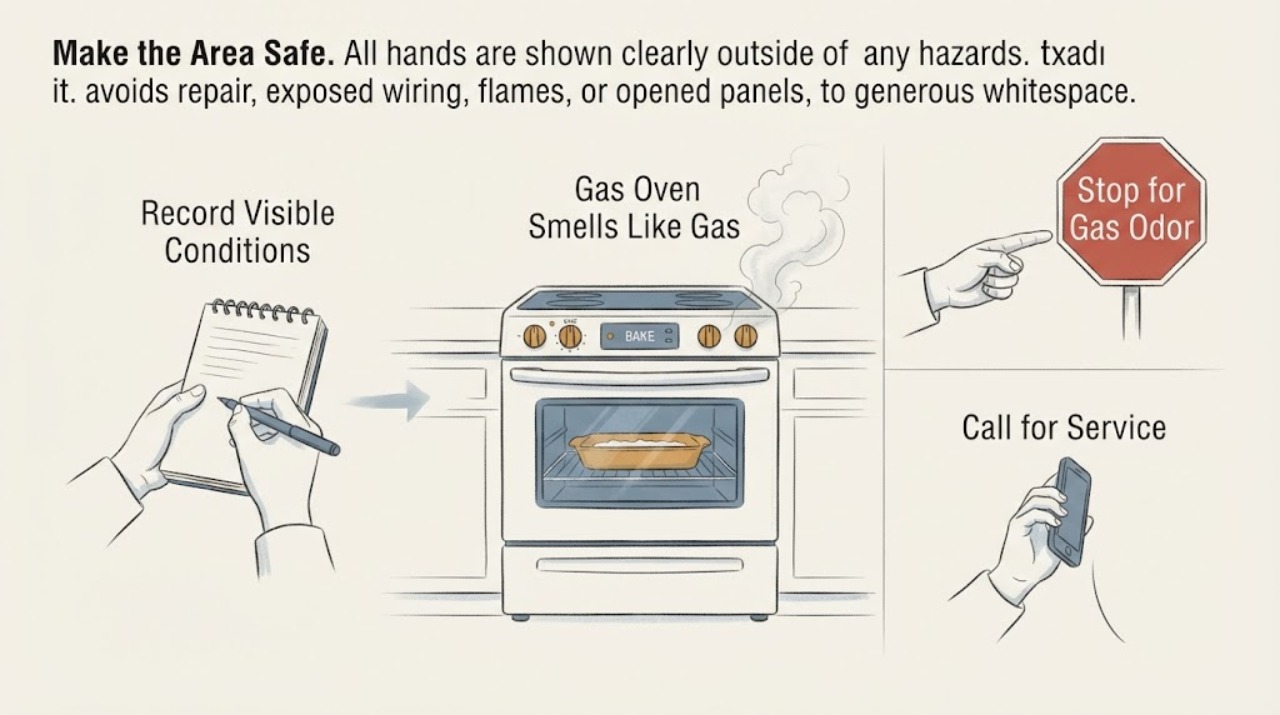
Stop using a Maytag gas oven if a gas odor persists or returns during baking. Do not relight the appliance, operate electrical switches, use a phone inside, or try to locate the leak. Leave the building and call the gas supplier or fire department from a safe location. Maytag says a faint odor during initial burner ignition or preheating should fade quickly; an odor that lingers or returns every few minutes needs qualified gas-appliance service after the area is declared safe.
Work through in order
Diagnostic checks
Use only checks that match the exact appliance or system and its official guide.
-
Check 1
If you smell gas during the bake, stop the cooking attempt and move people and pets away from the range. Do not relight any burner, restart the oven, touch electrical switches, use a phone inside, or try to locate the leak. Leave the building if the odor is strong, persists, or is accompanied by hissing, a sulfur or rotten-egg smell, headache, or dizziness.
Expected result: The odor is persistent or recurrent, or any hissing, sulfur smell, headache, dizziness, or other gas-leak warning sign is present.
Next step: From outside or another safe location, call the gas supplier immediately; if the supplier cannot be reached or anyone is in danger, call the fire department or emergency services. Follow their instructions and do not return or operate the oven until cleared.
Why this matters
Why: These observations cannot distinguish an appliance fault from a gas-supply leak and must be treated as a potentially hazardous gas release.
-
Check 2
After the gas supplier or emergency responders have declared the area safe, record when the odor occurs without running another bake: only at initial ignition, throughout preheating, every few minutes after the burner cycles, or even when the oven is off. Also record whether the oven heats normally and the full model number.
Expected result: The odor was only a brief faint smell at ignition, or it lingered/returned during baking or was present while the oven was off.
Next step: Do not repeat the bake to confirm the pattern. Give the timing, heating behavior, model number, and any safety observations to the gas supplier and a qualified Maytag or gas-appliance technician.
Why this matters
Why: Maytag describes a brief ignition or preheat odor as something that should fade quickly. A lingering, recurring, or off-cycle odor falls outside that normal description and may involve the appliance or gas supply; the observation does not identify a failed part.
-
Check 3
Only when the appliance is cool, the gas hazard has been ruled out by the responsible gas professional, and there is no continuing odor, make an external visual note of the control knobs, oven vent opening, and cavity floor. Do not remove panels, reach into the burner area, test ignition, or use a flame or leak-search spray.
Expected result: A knob is not fully off, foil or an oven mat covers an approved vent path, or food residue is visible; alternatively, the exterior is clear and the symptom was not explained.
Next step: If a knob is not off, do not manipulate it while gas odor remains; report it to the gas professional. After safe clearance, remove only loose, accessible residue as the exact manual permits. If the exterior is clear or the odor recurs, keep the oven out of service and arrange qualified diagnosis.
Why this matters
Why: Maytag identifies an accidentally on surface burner, blocked vent, foil, or food spill as possible odor contributors in limited situations, but these checks do not rule out a gas leak or prove an internal fault.
-
Check 4
Provide the service provider with the model and serial numbers, fuel type if known, whether the unit is a range or wall oven, odor timing, whether the oven was preheating or cycling, heating performance, and the actions already taken. Do not order an igniter, valve, regulator, burner, or other part from the smell alone.
Expected result: The odor returns after professional clearance, the oven does not heat correctly, or a qualified technician identifies an ignition, combustion, or supply problem.
Next step: Leave the oven unused until a qualified installer, service agency, or gas supplier has inspected it and authorized operation. Follow the gas supplier's or technician's instructions rather than performing a component replacement yourself.
Why this matters
Why: A recurring odor needs model- and installation-specific diagnosis; the symptom alone cannot distinguish an igniter issue from a supply, combustion, valve, or installation problem.
Use your observations
Decision map
Find the observation that best matches what you see, then follow the next safe action.
-
PATH 01Next step
What you see
Gas odor is strong or persistent, returns during the bake, is present with the oven off, or occurs with hissing, sulfur smell, headache, or dizziness.
Do this next
Leave without operating switches or phones inside, call the gas supplier or emergency services from a safe location, and do not re-enter or relight until cleared.
Why this path and its safety boundary
Why it matters: The pattern is a potential gas-supply or appliance leak and is outside owner troubleshooting.
-
PATH 02Next step
What you see
A gas professional has ruled out an active leak and the record shows only a faint odor at ignition or early preheat that fades quickly.
Do this next
Do not add a new test cycle if the odor is uncertain; use the exact model manual and ask qualified service if the odor becomes stronger, lasts longer, or returns after the initial ignition.
Why this path and its safety boundary
Why it matters: That limited timing matches Maytag's description of a transient ignition/preheat odor more closely than a recurring odor during baking.
-
PATH 03Next step
What you see
The odor recurs every few minutes after the area is cleared, or the oven heats abnormally, but no active gas leak has been cleared by the gas professional.
Do this next
Keep the oven out of service and arrange inspection by a qualified Maytag service agency, gas appliance technician, or the gas supplier as directed.
Why this path and its safety boundary
Why it matters: The symptom remains unresolved and may involve ignition, combustion, appliance adjustment, or the gas supply; no component is confirmed by the odor alone.
-
PATH 04Next step
What you see
Only a whoosh or poof is heard at burner ignition and there is no gas odor, no abnormal heating, and no safety symptom.
Do this next
Use the exact model documentation for sound guidance, but treat any actual recurring gas odor under the gas-smell branch and seek professional safety assessment.
Why this path and its safety boundary
Why it matters: Maytag describes recurring ignition noise as potentially normal; that evidence does not excuse or explain a gas smell.
Helpful context
Understand the symptom
Treat a recurring odor as a safety event
A brief smell when a gas burner first ignites is different from gas odor that remains or returns during the bake. Maytag's gas-oven guidance says the brief smell should fade quickly and directs professional help when it lingers. The supplied symptom—smell every few minutes during a bake—should not be investigated by repeated test cycles or by opening the appliance.
Do not confuse burner cycling with an odor diagnosis
Maytag documents that a whoosh or poof can occur every 1–3 minutes when the bake or broil burner ignites. That normal-sound article concerns ignition noise, not a gas smell. It does not make a recurring odor safe, and it does not identify an igniter, valve, burner, or air-fuel fault for a particular model.
When checks do not resolve it
Need a professional?
Stop using the oven and obtain qualified gas-appliance service or gas-supplier inspection for any odor that lingers, recurs during baking, is present when the oven is off, accompanies abnormal heating, or returns after the area has been cleared. Emergency gas symptoms require the gas supplier, fire department, or emergency services first.
Have this ready
- Provide the full model and serial, range or wall-oven type, fuel type if known, odor timing, whether it occurred at ignition or during cycling, heating behavior, and any hissing, sulfur smell, dizziness, or prior professional clearance.
Common questions
FAQ
Is a gas smell every few minutes during baking normal?
Maytag says a faint odor during initial ignition or preheating should fade quickly. An odor that returns every few minutes or lingers during baking is not covered by that normal description; stop use and have the gas supplier or a qualified technician assess it.
Should I relight the oven to see whether the smell returns?
No. Maytag's gas-range safety instructions say not to try to light any appliance when gas is smelled. Do not repeat the bake or try to identify the leak; leave and call the gas supplier or emergency services from a safe location.
Could the smell prove that the igniter is bad?
No. Maytag mentions a faulty igniter as one possible explanation for an odor that lingers while cooking, but the smell alone cannot confirm an igniter or any other part. A qualified technician must diagnose the appliance after gas safety has been addressed.
Read the exact guide
Official sources
- Odors or Smells - RangeMaytag Product Help · Applies mainly to new-oven and cooking-odor conditions; it does not clear a recurring gas odor and is used here only for the restricted post-clearance external checks.
- Why Does My Oven Smell Like Gas?Maytag · Maytag's general gas-oven guidance; exact diagnosis and service steps remain model-specific.
- Freestanding Gas Range Owner's ManualMaytag · Safety language applies to the gas-range family covered by this manual; use the exact model manual for appliance-specific controls and service information.
- Whoosh or Poof Noise in Oven - RangeMaytag Product Help · Applies to the Maytag range noise guidance page; it addresses sound, not gas-odor safety or a particular model's component diagnosis.
- Installation InstructionsMaytag · Official installation guidance for the range family covered by the document; do not transfer dimensions or component procedures to an unknown model.
Community feedback
Share a repair observation
Share a plain-text repair observation. Accepted observations are published automatically; this page may take a moment to update.