
On this page
Start here
Quick answer
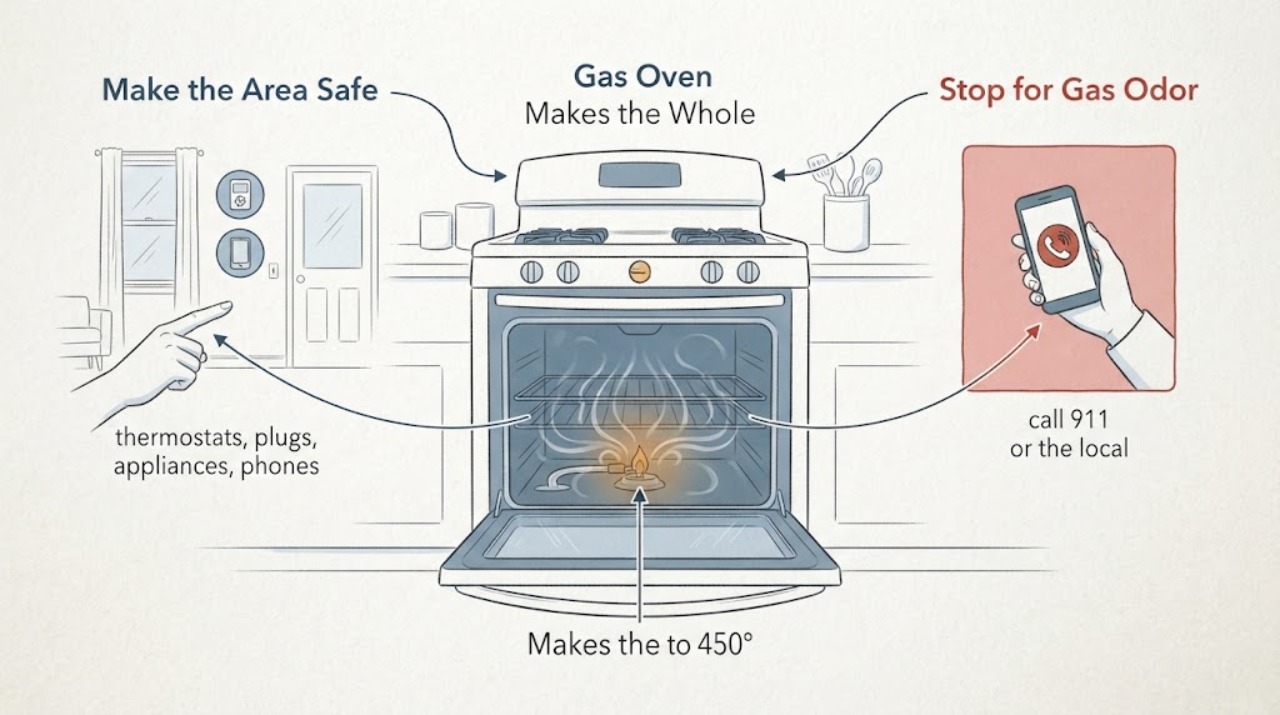
A brief, faint odor right when a gas oven ignites can occur, but a smell that spreads through the house must be treated as a possible gas leak or unsafe combustion condition. Do not continue preheating to see whether it fades, do not relight or test the oven, do not operate switches or other electrical equipment, and do not search for the leak. Leave the house and call 911 or the gas supplier from outside or another safe location; follow the responder's instructions. Maytag says a lingering odor while the oven runs needs professional attention, and GE says unburned-gas odor in the home is not normal.
Work through in order
Diagnostic checks
Use only checks that match the exact appliance or system and its official guide.
-
Check 1
Stop the preheat if it can be stopped without touching a switch or control in the odor-filled area; otherwise leave immediately. Warn everyone in the home to leave, take pets if they can be moved without delay, and do not spend time locating the source.
Expected result: The smell is confined to a brief faint odor at the oven, or it spreads through rooms or remains after the oven is no longer being used.
Next step: For the assigned whole-house symptom, evacuate immediately. Do not restart the oven to compare rooms or wait for the smell to fade.
Why this matters
Why: A whole-house or lingering odor is not safely distinguishable at home from a supply leak, delayed ignition, or another combustion problem. The reported distribution is enough to use the gas-emergency response.
-
Check 2
Once outside or otherwise well away from the odor, call 911 or the local gas supplier from a phone in the safe location. Tell them that a Maytag gas oven produced a gas smell throughout the house during preheat and whether anyone has symptoms or whether you heard hissing.
Expected result: Emergency responders or the gas supplier provide instructions, or the call cannot be reached immediately.
Next step: Follow the responder's instructions and do not re-enter, relight, reset, or use the appliance until the responsible authority says it is safe.
Why this matters
Why: The gas supplier or emergency service must determine whether the supply should be shut off, whether the building is safe to re-enter, and who may inspect the appliance. A user cannot clear the hazard by resetting the oven.
-
Check 3
Do not operate light switches, thermostats, plugs, appliances, phones or other equipment while inside the suspected gas-filled area; do not smoke, use a flame, or start a vehicle in an attached garage. Do not attempt a soapy-water test, sniff test, panel removal, igniter inspection, burner adjustment or gas-line repair.
Expected result: A switch, flame, electrical smell, hissing sound, headache, dizziness or other emergency sign is present, or none of these is known.
Next step: Remain at a safe distance and leave diagnosis and repair to the gas supplier, fire department and qualified appliance professional.
Why this matters
Why: The absence of a second sign does not rule out a leak. Electrical or flame sources can ignite accumulated gas, and opening the oven can expose a person to hot, gas or electrical hazards.
-
Check 4
After the gas supplier or emergency authority clears the property, give the appliance professional the Maytag model and fuel type, the preheat setting, how long the odor lasted, whether it occurred with the oven off, whether the oven heated, and any responder findings. Do not interpret these details as permission to test the oven yourself.
Expected result: The odor occurred only briefly at ignition and was cleared as normal, or it lingered, recurred, occurred with the oven off, or was associated with poor heating or other symptoms.
Next step: Keep the oven out of service until the qualified professional or responsible gas authority authorizes use. Do not order or install a part from the odor description alone.
Why this matters
Why: Maytag says a lingering smell while cooking can be associated with an ignition or air-to-fuel problem, but the odor pattern does not identify a failed igniter, valve, burner or line without professional inspection.
Use your observations
Decision map
Find the observation that best matches what you see, then follow the next safe action.
-
PATH 01Next step
What you see
The smell spreads through the house, remains after preheat stops, or resembles rotten eggs/sulfur.
Do this next
Leave immediately, avoid switches and flames, and call 911 or the gas supplier from outside or another safe location. Do not re-enter until cleared.
Why this path and its safety boundary
Why it matters: This matches the possible unburned-gas emergency boundary rather than a harmless brief ignition odor.
-
PATH 02Next step
What you see
A faint odor occurs only at burner ignition and disappears within the first few minutes, with no whole-house smell, symptoms, hissing or recurrence.
Do this next
Do not deliberately repeat the test. Record the model and ask Maytag or a qualified gas-appliance professional whether the observed behavior is expected for that model.
Why this path and its safety boundary
Why it matters: Maytag says a brief odor can occur as a gas oven starts combustion, but this does not validate the assigned whole-house report or prove the appliance is safe after a recurrence.
-
PATH 03Next step
What you see
The odor lingers while cooking, the oven heats poorly, or the odor recurs after the property is cleared.
Do this next
Keep the oven off and arrange qualified gas-appliance service. Do not relight, adjust, bypass or replace an igniter, valve, burner or regulator yourself.
Why this path and its safety boundary
Why it matters: Maytag identifies professional evaluation as appropriate when an odor lingers and notes that ignition/air-to-fuel issues may be involved; the exact component cannot be diagnosed from smell alone.
-
PATH 04Next step
What you see
Anyone has headache, dizziness, breathing difficulty, or other illness during the odor event, or a responder identifies a leak or unsafe combustion.
Do this next
Stay outside and tell 911 or the gas supplier about the symptoms. Seek medical help as directed, and do not return to the property until emergency personnel clear it.
Why this path and its safety boundary
Why it matters: There may be an immediate health or fire hazard beyond an appliance troubleshooting question.
Helpful context
Understand the symptom
A whole-house gas smell changes the decision
Maytag notes that a gas oven may produce a faint smell for the first few minutes of preheating, but it also says a lingering smell while cooking may indicate a problem that needs professional attention. The assigned symptom is stronger: the entire house smells like gas. Treat that as a possible leak or unsafe combustion event, not as a normal preheat observation. Leave first and make calls from a safe location.
Do not turn a safety report into a home gas test
A rotten-egg or sulfur-like odor, hissing, headache or dizziness can accompany a gas leak, but you do not need to identify which sign is present before leaving. Do not use the oven, relight a burner, operate a switch, use a phone inside, open panels, close a valve unless directed by responders from a safe position, or try to locate and repair the leak. The model, setpoint and suspected igniter do not make an in-home test safe.
When checks do not resolve it
Need a professional?
For the reported whole-house gas smell, leave immediately and call 911 or the local gas supplier from outside or another safe location. After the property is cleared, keep the Maytag oven out of service and use qualified gas-appliance service for any lingering, recurring or unexplained odor.
Common questions
FAQ
Is a gas smell during Maytag oven preheat always normal?
Maytag says a faint odor may occur for the first few minutes as a gas oven ignites, but a lingering odor, a smell with the oven off, or a whole-house odor must not be treated as normal. Leave and call from a safe location rather than repeating the preheat.
Should I open windows or turn off the gas myself?
Do not operate switches, use a phone inside, or attempt to locate or repair a leak. Leave first and follow the gas supplier's or emergency responders' instructions from a safe location; they will direct any shutoff or re-entry steps.
Could a bad igniter cause the smell?
Maytag says a lingering smell while the oven runs may be associated with an ignition or air-to-fuel problem, but smell alone cannot identify the igniter or any other part. Keep the oven off and have a qualified professional inspect it after the property is cleared.
Can I preheat again to see whether the smell fades?
No. A whole-house gas smell requires evacuation and an outside call. Do not restart, relight or test the oven until the gas supplier, emergency authority or qualified professional says it is safe.
Read the exact guide
Official sources
- Why Does My Oven Smell Like Gas?Maytag · Used for the distinction between brief ignition odor and lingering/whole-house odor, evacuation, outside calling, and professional service boundaries. It is not used to diagnose a specific Maytag model or declare an igniter failure.
- Gas Range - Gas OdorsGE Appliances · Used only for the general gas-emergency boundary: unburned-gas odor is not normal, avoid electrical switches/flames, and call the gas supplier from outside. It is not used to diagnose or transfer GE parts to the Maytag oven.
Community feedback
Share a repair observation
Share a plain-text repair observation. Accepted observations are published automatically; this page may take a moment to update.