
On this page
Start here
Quick answer
Do not keep testing an Estate gas oven because the smell might be normal. Whirlpool's opened gas-odor guidance says a quick, faint whiff during ignition can fade within a few minutes, but a strong or persistent odor, gas smell while the oven is off, hissing, delayed ignition, abnormal flame, smoke, headache, dizziness, or a carbon-monoxide alarm must be treated as a possible leak or combustion hazard. Leave the apartment immediately, do not light anything or operate switches, and contact the gas utility or emergency service from outside; notify the landlord or property manager once you are safely away. Estate is not a complete model number, so the exact gas type, installation, and manual cannot be confirmed here. Do not relight the oven, move it, remove panels, search for the leak, or adjust a valve. A qualified gas-appliance professional must clear the appliance before it is used again.
Before you begin
Safety first
- Do not light the oven, operate electrical switches during a gas odor, search for a leak with a flame or household test, move the range, remove panels, disconnect the connector, adjust the gas valve or regulator, or repeat ignition to reproduce the smell. Leave the apartment for a strong, persistent, off-state, or symptomatic odor.
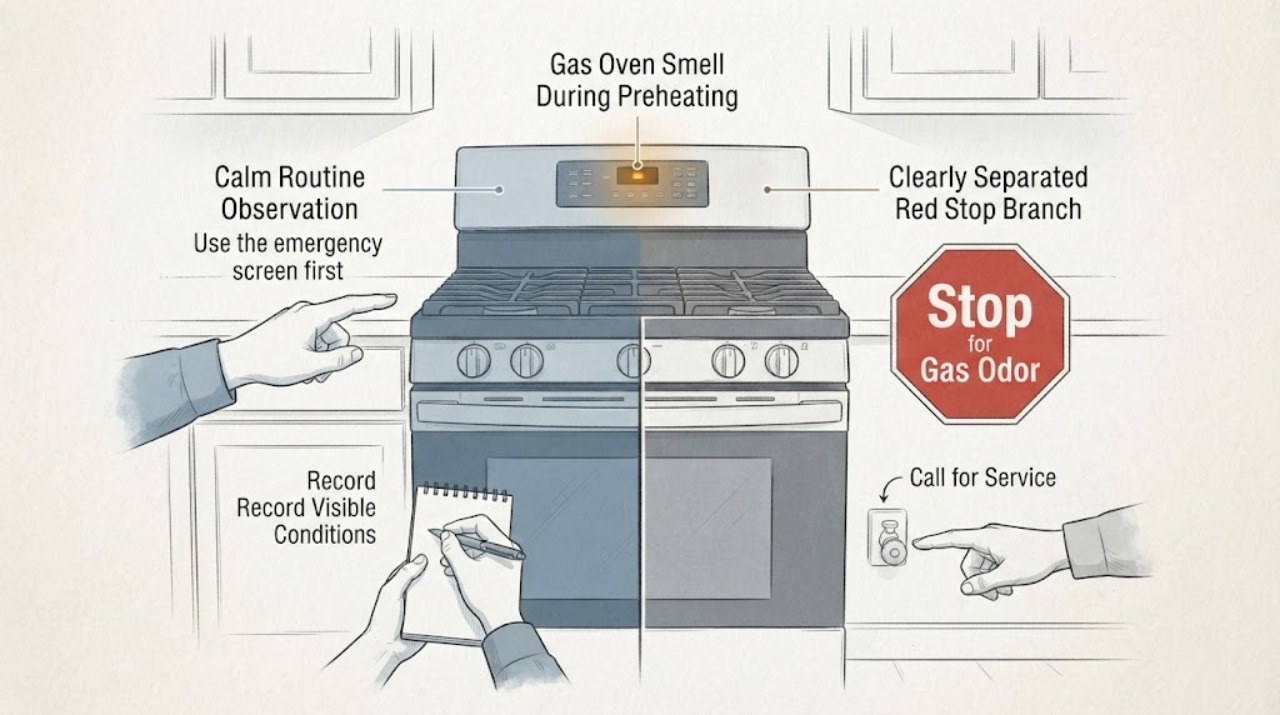
Work through in order
Diagnostic checks
Use only checks that match the exact appliance or system and its official guide.
-
Check 1
Use the emergency screen first. If the gas odor is strong, persistent, worsening, present while the oven is off, or accompanied by hissing, a delayed whoosh or boom, smoke, an abnormal flame, headache, dizziness, nausea, or a carbon-monoxide alarm, leave the apartment immediately. From outside, contact the gas utility or emergency service and follow its instructions; notify the landlord or property manager after you are safe.
Expected result: The smell continues or is strong, the oven is off but the odor remains, anyone feels ill, a detector alarms, or there is hissing, smoke, flame, or an ignition sound that was not normal.
Next step: Stay outside and use the gas or emergency route. Keep the appliance out of service until the gas utility, fire authority, landlord's qualified contractor, or another qualified professional clears it.
Stop if: Do not light a match, relight the oven, operate lights or other electrical switches, use an ignition source, search for the leak, or return for the model label while the odor or symptoms remain.
Why this matters
Why: These findings are compatible with a gas leak, delayed ignition, incomplete combustion, fire, or carbon-monoxide hazard. They are not a cue to inspect the burner or try another ignition.
-
Check 2
If the area has been declared safe and the odor has completely cleared, record the event from a safe position without restarting the oven: whether it happened only during preheating, how long it lasted, whether the oven was actually lit, whether it returned after cancellation or while off, and whether there was smoke, soot, a delayed ignition, or an unusual flame.
Expected result: The odor was one brief faint whiff during ignition and fully cleared, or it persisted, recurred, occurred while off, or followed an ignition attempt.
Next step: Use the brief-and-cleared result only to describe the event to the landlord and qualified service; use every other result as a reason to keep the oven off and obtain gas or emergency assistance.
Stop if: Do not start another cycle to measure the duration, wait for the odor to return, or treat a single cleared episode as permission to keep cooking.
Why this matters
Why: Whirlpool says a quick preheat whiff can fade after a few minutes, while an off-state, recurring, or persistent gas smell needs leak or service handling. Timing alone cannot prove that a particular Estate igniter, valve, or regulator is at fault.
-
Check 3
After the apartment is safe, identify the appliance only from an already visible rating label or lease/installation record. Record the complete model and serial number, whether the fuel is natural gas or propane, and whether the unit is a range or wall oven. Do not move the appliance or remove a drawer or panel to find the label.
Expected result: A complete Estate model and fuel type are available, only the word Estate is known, or the label and installation record disagree.
Next step: Give the complete identity to the landlord, gas utility, and qualified appliance service. If the identity remains incomplete, keep the oven off and use only general gas-safety guidance.
Stop if: Do not infer the gas type, adjust a regulator, convert fuel, or borrow instructions from another Estate, Whirlpool, or range model.
Why this matters
Why: Estate is not enough to select a manual, ignition sequence, fuel conversion, or compatible part. Whirlpool's support guidance relies on the model number, and a mismatched manual can turn a normal-odor explanation into an unsafe instruction.
-
Check 4
From outside the appliance and only after the odor is gone, note whether the oven was newly installed or recently reconnected, whether packaging, tape, foil, a liner, or visible food residue is present, and whether a range hood or vent is available. Do not heat the oven, clean it with a flame or solvent, remove a liner while gas safety is unresolved, or use a self-clean cycle to chase the odor.
Expected result: The event was limited to first use and visible packaging or residue is present, or no benign new-installation context is visible and the odor was persistent, recurrent, or unexplained.
Next step: Report any packaging or installation concern to the landlord and have the matching manual and installation checked by a qualified professional. Keep the oven unused if the odor returns or the source cannot be established safely.
Stop if: Do not pull the range out, inspect the gas connector, relight the burner, run an empty bake cycle, or adjust ventilation hardware as a diagnostic experiment.
Why this matters
Why: Whirlpool says new parts, protective coatings, shipping material, or residue can create temporary odors, and that foil or liners can trap debris or affect combustion. Those possibilities do not explain away a continuing gas odor or authorize a tenant to test the burner.
-
Check 5
Ask the landlord or property manager to arrange a qualified gas-appliance inspection before reuse. Provide the complete model if known, fuel type, installation or reconnection date, odor timing, any symptoms or alarm, and whether the odor was present with all controls off. Ask the inspector to check the gas supply, connector and shutoff, ignition and combustion, venting, and the installation against the exact manual and local requirements.
Expected result: The inspector documents a safe, model-matched installation and normal ignition with no leak or combustion concern, finds a defect, or cannot establish the source or safety of the odor.
Next step: Follow the gas utility, fire authority, landlord, and qualified service provider's written clearance or repair decision. If the source remains uncertain, do not use the oven and request a second qualified assessment.
Stop if: Do not approve a burner, igniter, valve, regulator, or connector replacement solely from the odor or authorize a tenant repair.
Why this matters
Why: A qualified inspection can separate a brief ignition context or new-installation residue from a supply, delayed-ignition, combustion, or appliance fault. An unverified visual opinion or a successful single ignition does not prove the gas path is safe.
-
Check 6
Until professional clearance, keep the oven and all gas cooking functions off. If food, clothing, or other combustible material was exposed to unusual heat, smoke, or combustion fumes, leave it aside and ask the responsible authority or food-safety professional how to handle it; do not stay in the apartment to clean during a gas event.
Expected result: The odor has returned, there is any smoke or soot, the flame or heat was abnormal, a carbon-monoxide alarm sounded, or no hazard was found and the cleared event was limited to a brief first-use odor.
Next step: Use the emergency route for any return or alarm; otherwise follow the landlord's and qualified professional's exact model-specific instructions before cooking.
Stop if: Do not normalize a recurring smell, cook through it, open panels, adjust the gas valve, or use a detector or household test as a substitute for professional clearance.
Why this matters
Why: A return, combustion symptom, or alarm moves the case back to emergency or qualified service handling. A fully cleared first-use odor may be consistent with new parts or residue, but Estate's incomplete identity prevents a model-specific user procedure.
Use your observations
Decision map
Find the observation that best matches what you see, then follow the next safe action.
-
PATH 01Safety boundary
What you see
The gas smell is strong, persistent, present while the oven is off, or paired with hissing, delayed ignition, abnormal flame, smoke, headache, dizziness, nausea, or a carbon-monoxide alarm.
Do this next
Leave immediately, avoid electrical switches and ignition sources, and contact the gas utility or emergency service from outside. Notify the landlord after reaching safety.
Why this path and its safety boundary
Why it matters: Treat the apartment and appliance as a possible gas, fire, combustion, or carbon-monoxide hazard; do not continue ordinary oven troubleshooting.
Safety stop: No relighting, leak search, panel removal, range movement, valve adjustment, or return indoors before the responsible authority says it is safe.
-
PATH 02Safety boundary
What you see
The smell was one brief, faint whiff only during a normal preheat or ignition, it completely cleared within the expected short period, and there was no smoke, abnormal flame, delayed ignition, off-state odor, health symptom, or alarm.
Do this next
Report the event and incomplete model identity to the landlord, obtain the exact manual and professional confirmation of the installation, and monitor only under their instructions. Keep the oven off if the smell returns.
Why this path and its safety boundary
Why it matters: Whirlpool describes this as a context that can occur during gas ignition, but it is not a guarantee for an unidentified Estate appliance or a reason to repeat the ignition yourself.
Safety stop: Do not perform extra cycles to prove the distinction or cook while the odor is still noticeable.
-
PATH 03Safety boundary
What you see
The appliance is new or newly connected and a brief odor was accompanied only by visible packaging, protective residue, foil, or food residue, with no current gas odor or combustion warning.
Do this next
Have the landlord or qualified installer verify removal of packaging, fuel type, venting, and the exact manual. Follow only their approved cool-appliance cleaning or commissioning instructions.
Why this path and its safety boundary
Why it matters: A new-installation or residue explanation is possible, but the source does not establish the exact Estate model or authorize a tenant to clean, ignite, or alter gas hardware while the identity or safety is unresolved.
Safety stop: Do not use self-clean, an open flame, a solvent, a moved range, or a repeated bake cycle to identify or remove a gas odor.
-
PATH 04Safety boundary
What you see
The model is incomplete, the odor source is uncertain, or the event does not fit a brief, fully cleared ignition odor.
Do this next
Keep the oven out of service and request a qualified gas-appliance inspection through the landlord or gas utility. Provide the complete rating-label identity when safely available.
Why this path and its safety boundary
Why it matters: The available evidence cannot safely distinguish supply leakage, delayed ignition, incomplete combustion, installation error, residue, or a component fault at the Estate-family level.
Safety stop: Do not select an igniter, gas valve, regulator, or connector from the smell alone and do not try another ignition.
Helpful context
Understand the symptom
A brief ignition odor is not the same as a continuing leak
Whirlpool's gas-odor article separates a quick whiff during preheating that fades after a few minutes from a gas smell that continues, returns with the oven off, or comes with hissing, headache, or dizziness. The distinction is about timing and associated danger signs, not about whether the appliance has an Estate badge. If there is any doubt that the smell is brief and fully cleared, use the emergency branch and do not continue troubleshooting in the apartment.
Why the new-apartment setting matters
A new apartment can mean a newly installed or reconnected range, an unknown natural-gas or propane configuration, packaging or residue left in the oven, or an installation issue outside the tenant's control. Whirlpool provides family-level guidance that a new oven may have a temporary odor, while its gas-range safety material assigns installation and service to qualified professionals. The tenant should report the event to the landlord or property manager and provide the full model from the rating label only after the area is safe; the tenant should not adjust gas hardware or prove the cause by relighting the oven.
When checks do not resolve it
Need a professional?
Use the gas utility or emergency service first for a possible leak, smoke, hissing, delayed ignition, abnormal flame, carbon-monoxide alarm, or health symptom. After the scene is safe, involve the landlord or property manager and a qualified gas-appliance installer or service agency; the incomplete Estate model requires exact identity confirmation before model-specific work.
Safety scope: Do not light the oven, operate electrical switches during a gas odor, search for a leak with a flame or household test, move the range, remove panels, disconnect the connector, adjust the gas valve or regulator, or repeat ignition to reproduce the smell. Leave the apartment for a strong, persistent, off-state, or symptomatic odor.
Have this ready
- Provide the complete model and serial number if safely visible, fuel type, apartment and installation or reconnection context, selected mode, whether the oven was on or off, odor duration and recurrence, ignition sounds, flame or smoke observations, alarms or symptoms, and any packaging, foil, residue, or vent context.
Common questions
FAQ
Is a gas smell during preheating always dangerous?
No, Whirlpool says a quick, faint whiff during ignition may fade after a few minutes. But a strong, persistent, recurring, off-state, or unexplained odor, or any hissing, delayed ignition, abnormal flame, smoke, headache, dizziness, or alarm requires leaving and calling gas or emergency authorities. Do not run another cycle to decide which case it is.
What should I do if I smell gas in a new apartment?
Leave immediately if the odor continues or is uncertain. Do not light anything or operate switches, and contact the gas utility or emergency service from outside. Notify the landlord or property manager once safe and keep the oven off until a qualified professional clears the installation.
Can I check whether the Estate oven is natural gas or propane?
Only use an already visible rating label or installation record after the area is safe. Do not move the range or adjust a regulator. Estate is not a complete model number, so the fuel type, conversion status, and matching manual must be confirmed by the landlord, gas utility, or qualified installer.
Should I remove packaging or clean the oven to get rid of the smell?
Not while an unexplained gas odor is present. Whirlpool notes that new parts, protective coatings, packaging, or residue can cause temporary first-use odors, but those possibilities do not rule out a leak. Have the landlord or qualified installer verify the installation and provide the exact cool-appliance cleaning instructions.
Read the exact guide
Official sources
- Why Does My Oven Smell Like Gas? | WhirlpoolWhirlpool · Official Whirlpool guidance for gas-oven odor at the symptom level; not an exact Estate model manual or a diagnosis of this apartment's appliance.
- Oven Not Working - Gas - Product Help | WhirlpoolWhirlpool · Official Whirlpool gas-range support at family level; used to establish that recent installation or reconnection and the exact model matter, not to authorize tenant ignition testing during an odor event.
- CPSC Warns of Generator, Carbon Monoxide and Fire Hazards Ahead of Hurricane SeasonU.S. Consumer Product Safety Commission · Government emergency guidance applicable to leaving a home for a gas leak or carbon-monoxide danger; it is not Estate or Whirlpool appliance diagnosis.
- Use & Care GuideWhirlpool · Opened Whirlpool gas-range manual used only for general gas-safety instructions: shutoff awareness, no flame leak search, no ignition or switch operation during gas odor, and qualified installation/service. It is not an exact Estate model manual.
- Odors or Smells - Range - Product Help | WhirlpoolWhirlpool · Official Whirlpool product-help guidance for new ranges and ovens at a general family level; it does not identify a particular Estate model or clear an active gas odor.
Community feedback
Share a repair observation
Share a plain-text repair observation. Accepted observations are published automatically; this page may take a moment to update.