
On this page
Start here
Quick answer
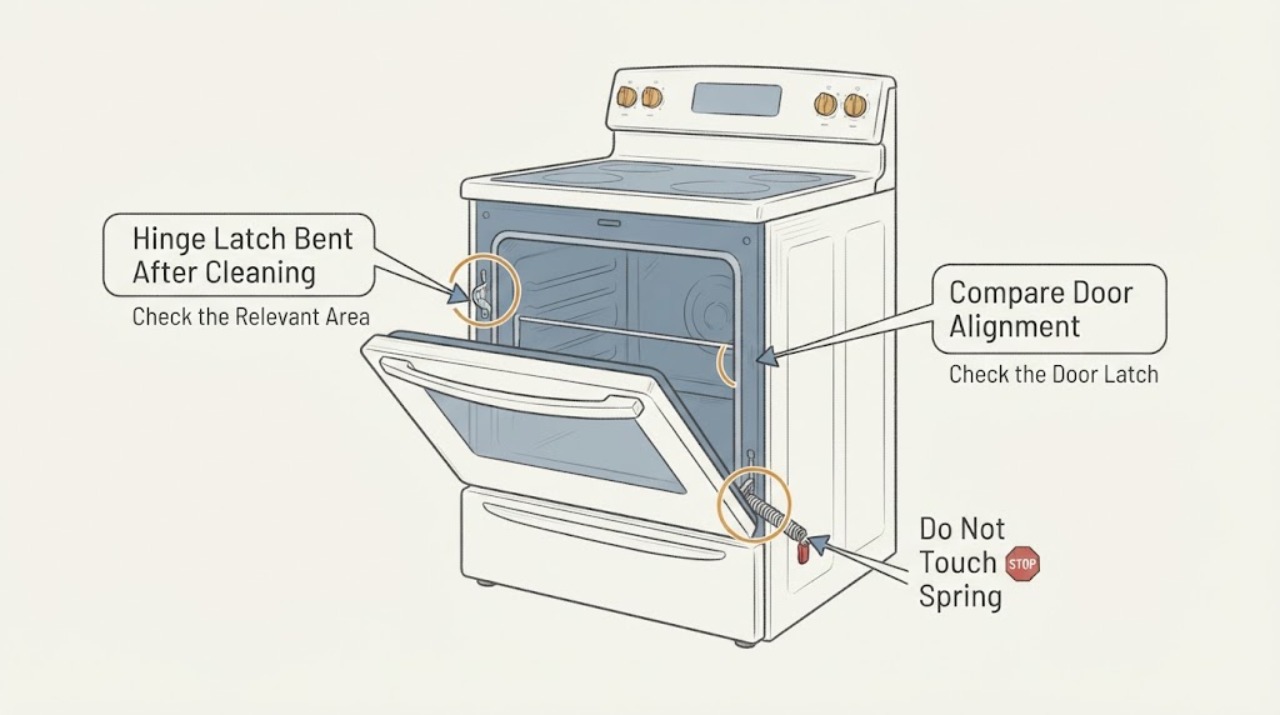
Do not heat the Maytag MGRH865QDS if a door hinge latch is visibly bent, a hinge arm or spring is out of position, the door hangs low, or the door cannot close evenly without force. Maytag identifies MGRH865QDS as a 30-inch self-cleaning freestanding gas range, and its door guidance says the hinge-latch arrangement and the exact model literature control how a door is removed and replaced. Let the range cool, keep hands and tools away from the hinge hardware, and make only an outside visual check for a loose obstruction, a shifted rack, or food or soil around the latch. Do not pry the door, straighten the latch, remove hinge pins, restrain or release a spring, or keep the gas oven operating with a gap or misaligned heavy door. If the latch is actually bent or the door does not close squarely, leave the range off and have a qualified appliance technician verify the door, hinge, latch, frame, gasket, gas-safety interlock, and anti-tip condition using MGRH865QDS-specific information. The Maytag owner page currently identifies the exact model but shows no documents, so do not substitute a part number or a door-removal procedure from another range.
Before you begin
Safety first
- Keep the range and oven off when the door cannot close evenly or any hinge, latch, spring area, gasket, glass, or frame is damaged. Do not pry or force the door, straighten a latch, remove hinge pins, release a spring, disassemble the door, open wiring or gas components, move the heavy range, or perform a live electrical or gas test.
Work through in order
Diagnostic checks
Use only checks that match the exact appliance or system and its official guide.
-
Check 1
Turn the oven and burners off and let the range cool completely before approaching the door. Do not touch the hinge corners, pull on a spring or hinge arm, or attempt another cleaning cycle. If there is a gas odor, hissing, smoke, scorching, or an electrical smell, leave the area without operating switches or flames and contact the appropriate gas or emergency service from a safe location.
Expected result: The range is fully cool with no odor or smoke, or there is a gas odor, hissing, smoke, scorching, or another immediate hazard.
Next step: Continue only with the dry, outside-only checks when there is no hazard. For gas odor or smoke, keep the range off, leave if needed, and use qualified emergency or gas service; do not relight or test the oven.
Stop if: Stop immediately for gas odor, hissing, flames where they should not be, smoke, scorching, a hot or damaged cord, or any condition that makes the area unsafe.
Why this matters
Why: A cool, odor-free range permits a limited outside inspection. Gas odor, smoke, or overheating is an immediate safety branch and is not a door-adjustment problem.
-
Check 2
Photograph the door from straight on and from both hinge corners without opening panels, then read the rating plate and record the complete model as MGRH865QDS if that is what the appliance shows. Record whether the damage appeared while cleaning, while the door was being removed or replaced, or after the door was forced. Keep the model, serial, purchase, and service history for the technician.
Expected result: The rating plate confirms MGRH865QDS and the timeline is clear, or the plate/model is different or the damage occurred during forceful handling.
Next step: Use the confirmed model in the Maytag owner and service request. If the model does not match, pause the repair decision until the identity is corrected; do not order a latch or hinge from a similar-looking range.
Stop if: Do not remove the rating plate, open the control area, or rely on a model number copied from a listing or another appliance.
Why this matters
Why: The exact model controls the door design and compatible hardware. A different or incomplete model makes any hinge or latch identification unreliable; a force-related timeline makes structural inspection more important than a generic alignment tip.
-
Check 3
With the range cold, inspect only the visible door-to-frame gap, both upper hinge corners, the latch opening, and the gasket. Compare left and right sides for a hanging corner, a new gap, exposed or twisted metal, a displaced gasket, or a latch that does not sit in the same position as the other side. Do not press the door closed, straighten metal, insert a tool, or handle a hinge spring.
Expected result: The door is square with an even gap and no visible damage, or one side hangs, a gap remains, metal is bent, the latch is displaced, or the gasket or frame is damaged.
Next step: If the door is visibly damaged or cannot close squarely without force, leave the gas oven off and arrange qualified appliance service. Do not continue to the burner or bake test.
Stop if: Stop and keep the range off for any bent hinge or latch, loose hinge hardware, spring displacement, sharp glass or metal, door-frame distortion, or seal damage.
Why this matters
Why: An even cold gap makes a grossly displaced door less likely; a hanging side, uneven gap, bent metal, or damaged gasket indicates a structural or sealing fault that external cleaning cannot repair safely.
-
Check 4
Check for only plainly visible, cool obstructions around the latch and door path: packing material, a rack out of position, oversized bakeware left in the cavity, or food and soil buildup. Remove a loose surface obstruction with the range cold and without levering against the latch; do not scrape, bend, or disassemble the hinge area.
Expected result: A loose obstruction or buildup is visible, or the path is clear but the latch remains bent or the door still will not close.
Next step: If a loose obstruction is removed and the door then closes evenly without force, keep the range off until the gasket and latch remain stable and the exact manual permits normal use. If the latch remains bent or the door does not close, stop and request service.
Stop if: Do not force the door past a blocker, use a screwdriver or pliers, remove a hinge pin, or operate the oven with a blocked or damaged latch.
Why this matters
Why: Maytag lists packing material, bakeware, a displaced rack, and food or soil buildup as common blockers. A clear path with a bent latch or persistent gap is not explained by a cleaning obstruction.
-
Check 5
If the door was removed during cleaning and no metal, spring, gasket, or frame damage is visible, compare the hinge-latch arrangement with the exact MGRH865QDS documentation before any reseating attempt. Maytag's general guidance says doors with hinge latches use both corner latches and must be aligned with the cavity slots, fully opened, and locked; because the exact model page currently has no documents, stop if the door design or latch position does not clearly match.
Expected result: The exact model documentation matches the observed door type and shows a simple, unforced reseating path, or the documentation is unavailable/mismatched or the hardware is bent.
Next step: Only follow a matching model instruction when the door and hardware are undamaged and the action is gentle and explicitly supported. Otherwise leave the range off and have a qualified technician reset or replace the correct door hardware.
Stop if: Do not attempt reseating against resistance, hold or release a spring, remove the door alone, take apart the door, or substitute another Maytag range's procedure.
Why this matters
Why: A door that was not fully seated can look crooked or leave an uneven gap, while a bent hinge or latch is a different condition. Generic Maytag instructions cannot prove the correct procedure or part for MGRH865QDS.
Use your observations
Decision map
Find the observation that best matches what you see, then follow the next safe action.
-
PATH 01Next step
What you see
There is gas odor, hissing, smoke, scorching, or an electrical hazard near the range.
Do this next
Do not light burners, run the oven, operate electrical switches near a gas odor, or test the door. Leave or isolate the area only as safely possible and contact emergency or qualified gas/electrical service.
Why this path and its safety boundary
Why it matters: This exceeds door alignment troubleshooting and may involve a fuel, fire, or electrical hazard.
-
PATH 02Next step
What you see
The door hangs on one side, has an uneven gap, will not close squarely, or the hinge/latch, spring area, gasket, glass, or frame is visibly bent or damaged.
Do this next
Keep the gas oven off and arrange qualified appliance service with the exact MGRH865QDS model and photographs. Ask the provider to inspect the hinge, latch, hinge mounts, door frame, gasket, and door-related safety functions before selecting a part.
Why this path and its safety boundary
Why it matters: The fault is structural and may prevent a safe seal or load-bearing door from operating normally; a cleaning obstruction is not a sufficient explanation.
-
PATH 03Next step
What you see
A plainly loose rack, bakeware item, packing remnant, or food/soil buildup blocks the latch path, and the door becomes square only after that cool obstruction is removed without force.
Do this next
Leave the range off while confirming the gasket and latch remain undamaged and the door closes evenly. If any gap, drag, latch shift, or damage remains, stop and call service rather than trying to bend the hardware back.
Why this path and its safety boundary
Why it matters: The immediate cause may be a visible blockage, which Maytag lists as a common reason a range door will not close.
-
PATH 04Next step
What you see
The door was removed, the hardware looks undamaged, and the exact MGRH865QDS documentation explicitly matches the observed door design and gives a gentle reseating procedure.
Do this next
Follow only that model-matched instruction; stop at the first resistance or misalignment and transfer the job to qualified service. Do not use the generic Maytag page as proof that a different hinge or latch fits.
Why this path and its safety boundary
Why it matters: Improper seating can create a crooked door or an uneven gap, but the result is only a setup branch when the exact model procedure and undamaged hardware agree.
-
PATH 05Next step
What you see
The model is confirmed, the path is clear, the range is cold, but the latch still looks bent or the door cannot close and stay aligned without force.
Do this next
Leave the range off and have a qualified appliance technician diagnose and repair the exact door assembly. Do not run a bake cycle to see whether it still heats; an oven that heats does not make a damaged door safe.
Why this path and its safety boundary
Why it matters: A damaged hinge/latch or mount remains the leading actionable category, but the public Maytag pages do not establish an MGRH865QDS-specific replacement part or authorize owner disassembly.
Helpful context
Understand the symptom
A bent hinge latch after cleaning is a door-structure and safety problem, not an oven-temperature adjustment. On this gas range, the door must sit squarely and close without force so heat is contained and the door hardware is not loaded further. A latch that only looks out of position after a door was removed is different from metal that is actually bent; the outside checks below are designed to separate those possibilities without putting hands near a loaded hinge or opening the range.
Maytag's generic door page documents more than one door design, while the MGRH865QDS owner page does not currently expose model documents. Use the exact rating-plate model and its matching manual or service documentation for any removal, hinge reset, replacement, or part decision. If a hinge, latch, spring, door frame, or gasket is damaged, stop at the external inspection boundary and use qualified service rather than forcing the door back into place.
When checks do not resolve it
Need a professional?
Use Maytag or an authorized appliance provider for the confirmed MGRH865QDS. Use qualified gas or emergency service for gas odor, hissing, fire, smoke, or an unsafe fuel condition.
Safety scope: Keep the range and oven off when the door cannot close evenly or any hinge, latch, spring area, gasket, glass, or frame is damaged. Do not pry or force the door, straighten a latch, remove hinge pins, release a spring, disassemble the door, open wiring or gas components, move the heavy range, or perform a live electrical or gas test.
Have this ready
- Provide the complete rating-plate model and serial, the purchase and service history, when the door was removed or cleaned, photographs of both hinge corners and the closed-door gap, whether the door hangs low or resists closing, any gasket/frame/glass damage, and any gas odor or smoke history.
Common questions
FAQ
Can I bend the Maytag oven hinge latch back after cleaning?
No. Do not straighten, pry, clamp, or force a bent latch or hinge. Keep the gas oven off and have a qualified technician identify the exact MGRH865QDS door hardware and inspect the hinge mount, spring-loaded mechanism, frame, gasket, and safety functions.
How can I tell whether the Maytag oven door is just mis-seated?
With the range cold, look for an even door gap and compare both hinge corners without forcing the door. Maytag says a removed door must be reset correctly and that an improperly installed door can show a notch or space; use that guidance only when the exact MGRH865QDS documentation confirms the same door design. A visible bend, spring displacement, persistent gap, or resistance is a service condition.
Can I use the Maytag gas oven if the door still closes but the hinge latch looks bent?
No. A door that closes only with pressure, sits crooked, has an uneven gap, or has visibly bent hardware should not be tested by heating. Leave the range off and arrange qualified service; use emergency or gas service for gas odor, hissing, smoke, or fire risk.
Read the exact guide
Official sources
- Door Not Closing - RangeMaytag Product Help · Official Maytag range troubleshooting guidance used for safe external obstruction and alignment branches; it does not authorize bending or replacing damaged hinge hardware.
- Oven Door Not Aligned - RangeMaytag Product Help · Official Maytag range guidance used to interpret a door that was removed and is now crooked; it is not a model-specific MGRH865QDS hinge-part confirmation.
- Owner's Manual: Slide-In Gas RangesMaytag · Official Maytag gas-range manual, not confirmed as the exact MGRH865QDS manual. It is used only for general safety boundaries and not for model-specific hinge, latch, spring, or part conclusions.
- Removing and Replacing the Oven DoorMaytag Product Help · Official Maytag general guidance. It documents two door types and hinge-latch alignment concepts, but the exact MGRH865QDS owner page must control model-specific door work.
- Oven Not Working - Gas and Dual Fuel RangeMaytag Product Help · Official Maytag gas-range guidance used only for the boundary that the door must close and gas/electrical issues belong with qualified service; it does not diagnose a bent hinge latch on MGRH865QDS.
- MGRH865QDS | MaytagMaytag · Official Maytag US owner page that identifies MGRH865QDS as a 30-inch self-cleaning freestanding gas range; the page currently reports that no documents are available, so it does not establish a model-specific hinge part or door procedure.
Community feedback
Share a repair observation
Share a plain-text repair observation. Accepted observations are published automatically; this page may take a moment to update.