
On this page
Start here
Quick answer
A Maytag oven element may cycle on and off while the oven maintains a set temperature, so seeing an element off briefly at 350°F does not by itself prove that it is broken only at that temperature. First repeat the bake with the correct cycle, full preheat, rack position, pan spacing, and unobstructed airflow. Then use the exact model's bake-performance or calibration instructions; the Maytag Product Help page warns against treating one instantaneous thermometer reading as the oven's true temperature, while the Maytag calibration article gives model-dependent calibration guidance. A persistent, repeatable failure after those checks needs appliance service rather than an element diagnosis from appearance alone.
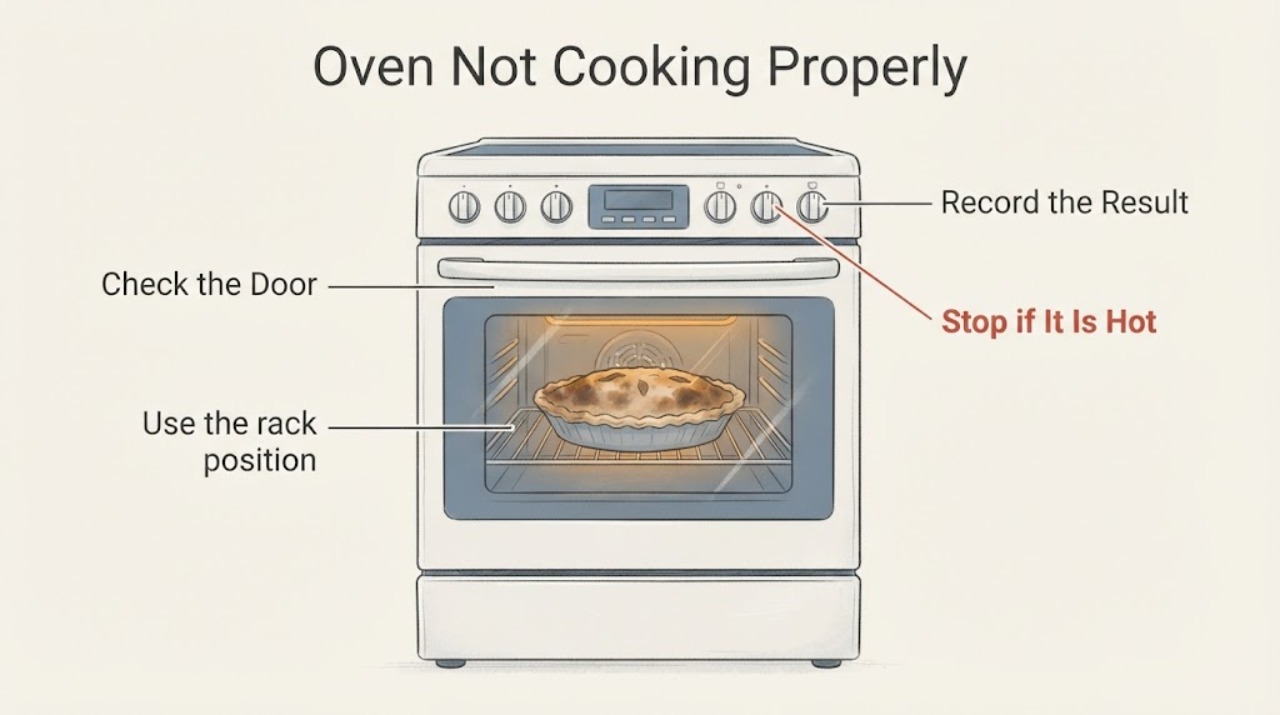
Work through in order
Diagnostic checks
Use only checks that match the exact appliance or system and its official guide.
-
Check 1
Repeat the test using the exact Bake cycle, set to 350°F, with the oven fully preheated and food placed promptly after the preheat signal; keep the door closed until the recipe's minimum time.
Expected result: The result improves when the correct cycle and full preheat are used, or food is still consistently under- or overcooked.
Next step: Continue with rack, pan, and airflow checks if the result remains wrong. Do not diagnose an element from a single slow preheat or one batch of food.
Why this matters
Why: A wrong cycle, incomplete preheat, or heat loss from opening the door can mimic a temperature fault; a repeatable problem under controlled conditions deserves a calibration or service check.
-
Check 2
Use the rack position and bakeware called for by the recipe, keep the pan centered with clearance from the oven walls, and remove unused racks if the model guidance allows it.
Expected result: The pan touches a wall, multiple pans block circulation, the rack is at an unsuitable height, or the setup has the documented clearance and position.
Next step: Correct only the external arrangement and repeat the same recipe. If the same pattern appears with the documented setup, move to a model-specific bake-performance or calibration check.
Why this matters
Why: Pan placement, bakeware, rack position, and restricted airflow can create uneven browning or local hot spots without a heating-element failure.
-
Check 3
Look through the door during a bake cycle and note whether the element cycles, whether the oven reaches the preheat signal, and whether the problem is a local browning difference or a whole-oven timing problem.
Expected result: The element cycles on and off after preheat, or it never appears to heat and the oven does not reach the expected preheat state.
Next step: Do not keep opening the door to watch the element. If the oven cannot reach preheat or the fault repeats with a controlled setup, arrange qualified appliance service.
Why this matters
Why: Cycling after preheat is expected temperature-control behavior; failure to heat or failure to reach preheat is a broader fault pattern, but visual observation still cannot identify the failed component.
-
Check 4
Run the exact model's repeatable bake-performance check from its owner manual, such as the Maytag guidance for a consistent test food, rather than judging the temperature from one instant while the elements are cycling.
Expected result: The controlled test finishes evenly within the recipe's time range, or it repeatedly finishes too early, too late, or unevenly.
Next step: If the result is consistently wrong, use the model manual to determine whether calibration is supported. If the manual does not match the controls or calibration does not help, stop and request service.
Why this matters
Why: A repeatable result separates an expectation or setup issue from a persistent bake-performance issue; it does not by itself identify an element, sensor, or board.
-
Check 5
Identify whether the oven uses analog or digital controls and open the matching Maytag owner documentation before changing calibration.
Expected result: The model manual documents a calibration control, or no matching calibration method is found for the oven's controls.
Next step: Apply only the documented model procedure and retest. If the oven is a gas model with analog controls, or the control method is unclear, use a certified appliance technician instead of experimenting.
Why this matters
Why: Calibration is model-dependent; a digital adjustment, analog knob screw, and gas-oven service boundary are not interchangeable procedures.
Use your observations
Decision map
Find the observation that best matches what you see, then follow the next safe action.
-
PATH 01Next step
What you see
The element cycles off after preheat but the controlled bake finishes normally.
Do this next
Keep the documented rack, pan, and preheat routine; do not replace an element based on the visual cycle alone.
Why this path and its safety boundary
Why it matters: The observed cycling is consistent with maintaining the set temperature and does not establish a broken element.
-
PATH 02Next step
What you see
The controlled setup still produces repeatable undercooking, overcooking, or uneven browning at 350°F.
Do this next
Use the exact owner manual's bake-performance and calibration path, then arrange appliance service if the result remains wrong.
Why this path and its safety boundary
Why it matters: A calibration or service issue remains possible, but the recipe result does not distinguish element, sensor, control, or airflow causes.
-
PATH 03Next step
What you see
The oven never reaches its preheat state, or the heating behavior is absent rather than cycling after preheat.
Do this next
Stop repeated cooking tests and arrange qualified appliance service. Do not remove panels or test high-voltage components from the visual symptom.
Why this path and its safety boundary
Why it matters: This is a broader heating or control symptom, not evidence that an element fails only at 350°F.
-
PATH 04Next step
What you see
The oven is gas with analog controls, or the calibration procedure does not match the controls.
Do this next
Do not adjust the control by trial and error; use the exact manual or a certified technician.
Why this path and its safety boundary
Why it matters: Maytag identifies gas analog calibration as a case that may require more expertise, and a mismatched procedure can create a new temperature problem.
Helpful context
Understand the symptom
An element being off at 350°F is not a diagnosis
Oven elements cycle to maintain temperature, and a new oven can cook faster or slower than a previous oven. The task does not provide a model, so an element appearance, a single thermometer reading, or a recipe result cannot identify a failed element, sensor, or control board. Start with the repeatable cooking conditions that Maytag documents for bake performance.
Use the model manual for calibration
Maytag calibration controls vary between analog and digital ovens. Product Help lists model-specific calibration methods and the Maytag calibration article sends digital-control owners to the use-and-care guide; gas ovens with analog controls may require certified service. Do not turn a knob, change a calibration offset, or replace a heating component without the exact manual.
When checks do not resolve it
Need a professional?
Arrange qualified appliance service when the oven cannot reach preheat, the controlled bake remains consistently wrong after the documented calibration path, the procedure does not match the controls, or a gas analog oven needs calibration expertise.
Have this ready
- Provide the Maytag model number, oven type and control style, selected cycle, preheat behavior, rack and pan setup, recipe result, and whether the element cycles after preheat.
Common questions
FAQ
Can a heating element be broken only at 350°F?
An element can cycle off while the oven maintains temperature, so being off at one moment does not prove a temperature-specific failure. A repeatable failure to heat or cook correctly needs the model-specific bake test and service diagnosis.
Should I use an oven thermometer to prove the element is bad?
Do not treat one instantaneous thermometer reading as proof. Maytag Product Help warns that elements cycle and thermometer readings may not represent the controlled oven temperature; follow the exact model's bake-performance guidance.
What else can make food cook poorly at 350°F?
Maytag lists preheat timing, rack position, pan placement, bakeware, and blocked airflow as factors. Correct those conditions and repeat the same recipe before diagnosing a component.
Can I calibrate any Maytag oven the same way?
No. Calibration controls vary by model and by analog or digital design. Use the exact owner manual; gas analog controls may require a certified technician.
Read the exact guide
Official sources
- Possible Causes for Poor Baking ResultsMaytag Product Help · Maytag Product Help guidance for poor baking results; supports preheat, rack, bakeware, and airflow checks without identifying an internal component.
- HOW TO CALIBRATE YOUR OVEN TEMPERATUREMaytag · Maytag brand guidance for oven temperature calibration; exact procedure varies by model and controls, and no model-specific part or heating diagnosis is claimed.
- Oven Temperature Incorrect (Too Hot or Too Cold)Maytag Product Help · Maytag Product Help guidance for ovens that are too hot or too cold; model-specific calibration and service boundaries remain required.
Community feedback
Share a repair observation
Share a plain-text repair observation. Accepted observations are published automatically; this page may take a moment to update.