
On this page
Start here
Quick answer
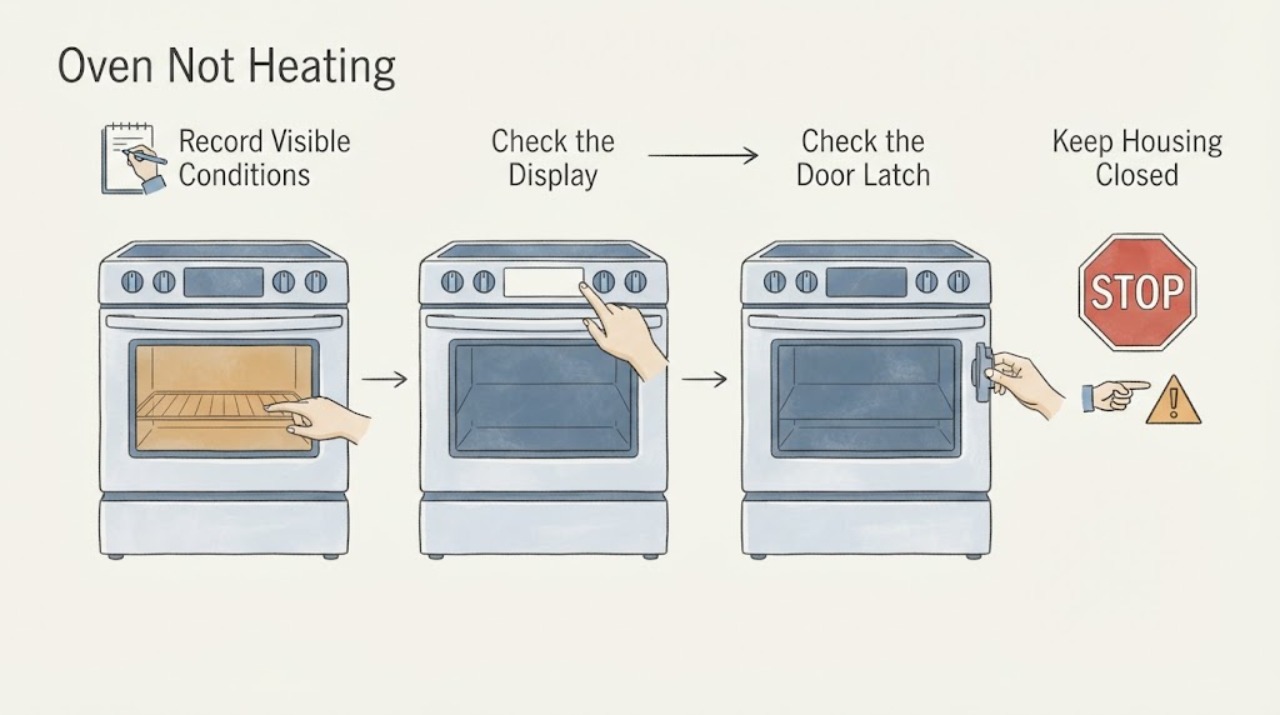
Maytag's exact parts list identifies MER8700DS1 as a 30-inch freestanding electric convection range and lists a separate Bake element, Bake pan, and oven bottom. Do not assume the bottom heater is an exposed coil that can be touched or tested through the cavity. First record whether the display is active, select the model-approved Bake cycle and temperature, and allow a full preheat with the door closed. Maytag's electric-range guidance gives about 20 minutes plus or minus 5 minutes to reach 350°F for ovens with a hidden bake element; a slow preheat is not the same as no heat. Check only the visible control state, door/airflow, and accessible breaker once if safe. If a valid Bake attempt remains cold, the breaker trips, or there is smoke, burning odor, arcing, or uncontrolled heat, stop using the range and arrange qualified appliance or electrical service rather than exposing the bottom or ordering an element from the symptom.
Work through in order
Diagnostic checks
Use only checks that match the exact appliance or system and its official guide.
-
Check 1
From a cool, dry, safe position, read the full label and confirm MER8700DS1, then record that this is an electric freestanding convection range. Note whether the display is blank, partly active, showing Bake or Preheat, showing Delay Start or Control Lock, or showing an exact code; do not remove trim or a control cover.
Expected result: The full model is MER8700DS1 and the display is active, partly active, blank, delayed/locked, or displaying a code; the label differs or the energy type is uncertain.
Next step: Use only the exact Maytag literature for the confirmed model. If the suffix or energy type cannot be confirmed, stop part selection and give the label and display wording to qualified service.
Stop if: Do not remove panels, pull the range apart, access terminal wiring, or operate with exposed conductors or damaged insulation.
Why this matters
Why: The exact parts list applies to MER8700DS1 as an electric convection range. A different suffix, a gas/dual-fuel appliance, or an unconfirmed code would change the applicable branch, while a control or display state can prevent heating without proving a failed element.
-
Check 2
With the cavity cool and free of flammable items, cancel any delay or lock state shown by the control, select the model-approved Bake cycle, enter the desired temperature, close the door fully, and allow one complete preheat indication without repeatedly opening the door or using Self-Clean or Broil as a stress test.
Expected result: Bake begins and reaches its preheat indication, takes longer than expected but warms, stays at Preheat without warming, or remains completely cold.
Next step: Record the selected cycle, set temperature, elapsed time, preheat indication, and whether any warmth is evident without touching hot parts. If the oven is still cold after one valid attempt, move to the safe power and service branch.
Stop if: Do not repeatedly cycle the controls, run Self-Clean to test heat, leave an abnormal oven unattended, or touch the cavity floor or any heater.
Why this matters
Why: Maytag says controls in demo mode, Control Lock, or Delayed Start can prevent operation. Its electric-range guidance gives about 20 minutes plus or minus 5 minutes to reach 350°F for a hidden bake element; a slow cycle can therefore be different from a no-heat condition.
-
Check 3
When the range is cool, look only at visible, user-accessible conditions: the door closes completely, the gasket and latch area have no obstruction, racks and pans are not blocking the vent, and no foil or liner covers the oven bottom or a full rack. Do not remove the oven bottom or try to see the Bake element.
Expected result: The door is blocked or damaged, foil/liner blocks airflow, a rack or pan is misplaced, or the cavity is correctly closed and unobstructed.
Next step: Correct only a loose, cool, visible placement issue using the model's literature, then make no more than one normal Bake check. Request service for a damaged door, a cavity that remains cold, or any condition requiring removal of a panel or floor.
Stop if: Do not force the door, remove hinges, run with a damaged seal, touch a hot surface, or expose the heater to verify operation.
Why this matters
Why: Maytag notes that an open door can prevent elements from coming on on some models and that covering the oven bottom or a rack can block airflow. The exact parts list separates the Bake element from the oven bottom and Bake pan, so a visible cavity-floor check cannot safely diagnose the heater.
-
Check 4
If the display is active but the oven does not heat, inspect only the accessible household power status from a dry, safe position. If a breaker or fuse is visibly open and there is no odor, smoke, damaged cord, or other hazard, reset protection once as the installation instructions permit; do not measure voltage or open the terminal block.
Expected result: The display is dead, only part of the range is active, the breaker remains on, the breaker trips again, or the range was recently installed or rewired.
Next step: If power is stable, do not keep testing: give the exact model, cycle, timing, and display behavior to appliance service. For a repeat trip, suspected miswire, or inaccessible connection, leave the range off and use licensed electrical or qualified appliance service.
Stop if: Do not reset repeatedly, use an adapter or extension cord, remove a terminal cover, touch wiring, or perform a live-voltage test.
Why this matters
Why: Maytag's electric-oven guidance treats new-installation connection and terminal wiring as a power-supply issue. A partial supply can leave controls active while the heating circuit cannot operate; a repeat trip or uncertain connection is an electrical service boundary, not evidence for a particular element or relay.
-
Check 5
Stop and observe only from a safe position for smoke, burning odor, electrical arcing, a hot or damaged cord, sparks, uncontrolled heating, or a breaker that trips again. If any appears, cancel operation only when safe and isolate power from a dry accessible control or breaker without approaching a gas or fire hazard.
Expected result: There is only a cool or slow oven, or there is smoke, burning smell, arcing, a hot cord, sparks, uncontrolled heat, or a repeated trip.
Next step: For smoke, fire, or arcing, leave the area and use emergency guidance from a safe location. For a safe but persistent no-heat condition, arrange qualified appliance service with the exact model and the preheat record; use licensed electrical service for supply concerns.
Stop if: Do not operate switches near smoke or a burning smell, keep running the oven to reproduce the fault, open the chassis, touch hot parts, or order a component from the symptom alone.
Why this matters
Why: A cool oven permits limited setting and external-power checks; fire, heat, or electrical warning signs override troubleshooting. The hidden Bake element and other heat-system parts are not safely identified by a consumer visual or touch test.
Use your observations
Decision map
Find the observation that best matches what you see, then follow the next safe action.
-
PATH 01Next step
What you see
MER8700DS1 reaches the Bake preheat indication within the model-appropriate time, but food cooks slowly or unevenly.
Do this next
Record the recipe, rack, set temperature, preheat time, and whether the door stayed closed; follow Maytag's placement and preheat guidance. Request service if measured results remain abnormal after correct operation.
Why this path and its safety boundary
Why it matters: This is not proof that the bottom Bake element is dead. Rack position, pan/foil placement, door opening, temperature setting, and the normal cycling of an electric oven can affect results.
-
PATH 02Next step
What you see
The controls are active but the display is locked, in demo mode, delayed, or not actually set to Bake.
Do this next
Use the exact MER8700DS1 literature to clear the state and make one normal Bake selection. If the state returns or the oven remains cold, stop and arrange service.
Why this path and its safety boundary
Why it matters: Maytag says these control states can prevent an electric oven from operating without establishing a heater failure.
-
PATH 03Next step
What you see
One valid Bake attempt remains cold after the display, door, airflow, and accessible power checks are normal.
Do this next
Leave the range off and arrange qualified Maytag appliance service with MER8700DS1, the cycle and temperature, elapsed preheat time, display state, and any partial-power observations.
Why this path and its safety boundary
Why it matters: A Bake element, thermal fuse, sensor, control, wiring, or another internal heat-system fault is possible, but the exact parts list does not turn the symptom into a safe consumer part diagnosis.
-
PATH 04Next step
What you see
A breaker trips again, the range was newly installed with uncertain wiring, or only part of the range operates.
Do this next
Keep the range off and call licensed electrical or qualified appliance service. Provide the installation date, breaker behavior, and exact model without opening the terminal area.
Why this path and its safety boundary
Why it matters: This points to a supply or installation concern that can be hazardous and cannot be distinguished from the controls by resetting or touching wiring.
-
PATH 05Next step
What you see
Smoke, burning odor, sparks/arcing, a hot cord, uncontrolled heating, or another fire/electrical warning occurs.
Do this next
Stop using the range, leave the area for an active fire or smoke concern, and contact emergency, electrical, or appliance professionals from a safe location.
Why this path and its safety boundary
Why it matters: This is an immediate safety boundary, not a slow-preheat branch.
Helpful context
Understand the symptom
What the exact model evidence establishes
Maytag's opened Owner's Center identifies the MER8700DS base model as a 30-inch electric range with convection. The model-specific Maytag repair-parts list names MER8700DS1 in the stainless variant and shows a Bake element, a separate Bake pan, an oven bottom, a door switch, a thermal fuse, and a temperature sensor. This supports an electric-range troubleshooting path, but the parts list is not a consumer repair procedure and does not authorize removing the oven floor or opening the chassis.
Hidden heat is a timing question before it is a parts question
Maytag's electric-range guidance gives a different preheat expectation for hidden versus visible bake elements: roughly 20 minutes plus or minus 5 minutes to reach 350°F for a hidden element, with longer times at higher temperatures or with a 208-volt installation. Do not use the cavity floor, a brief warm feeling, or a single visual observation to identify an element failure. If the oven remains cold after the correct cycle and a complete preheat attempt, preserve the timing and display information for service.
When checks do not resolve it
Need a professional?
Arrange qualified appliance service when MER8700DS1 remains cold after one model-approved Bake attempt and the visible controls, door, airflow, and accessible power status are normal; when the display code persists; or when a component, wiring, or hidden Bake-area fault is suspected. Use licensed electrical service for a repeat breaker trip, uncertain supply, or installation wiring concern. Stop immediately for smoke, burning odor, sparks, arcing, a hot cord, uncontrolled heat, or a damaged door/seal.
Common questions
FAQ
Does a slow preheat prove the hidden Bake element is bad?
No. Maytag's electric-range guidance gives about 20 minutes plus or minus 5 minutes to reach 350°F for an oven with a hidden Bake element, with longer times at higher temperatures or on 208 volts. Record the full preheat result before treating the oven as completely cold, and do not expose the heater to inspect it.
Is the bottom Bake element exposed on MER8700DS1?
Maytag's exact parts list shows a separate Bake element, Bake pan, and oven bottom for MER8700DS1, rather than giving a consumer procedure to expose the element. Maytag also describes hidden bake trays as sealed under an oven floor in its parts guide. Treat the bottom heat area as inaccessible unless an exact service document and a qualified technician establish otherwise; do not lift the floor or touch it to test heat.
Why can the display work when the oven does not heat?
Maytag's electric-oven guidance separates control states and electrical connection checks from the heater diagnosis. A partial supply or an active lock/demo/delay state can leave a display active without producing a valid Bake cycle. Check only the visible state and accessible breaker once when safe; do not open the terminal area or measure live power.
What should I tell the Maytag technician?
Give the full MER8700DS1 model, the exact cycle and temperature, the display wording, the elapsed preheat time, whether the oven warmed at all, whether the door closed and airflow was unobstructed, and any breaker, smoke, odor, spark, or noise observation. Do not remove the oven bottom or control covers to gather more evidence.
Read the exact guide
Official sources
- Long Preheat - Electric RangeMaytag Product Help · Maytag electric-range preheat timing, hidden-element timing, foil/airflow, and 208V context
- Oven Not Heating - Powering On - ElectricMaytag Product Help · Maytag electric oven no-heat checks for door position, installation connection, Control Lock/demo mode, and Delayed Start
- MER8700DS | Maytag Owner's CenterMaytag · Maytag MER8700DS base-model owner support and electric convection range identity
- 30-inch Free-Standing Electric Convection Range Repair Parts List W10707132 Rev. BMaytag · Maytag MER8700DS1 exact stainless electric convection range parts and chassis layout
- Parts of an Oven: Gas & Electric Oven ComponentsMaytag · Maytag general distinction between electric bake elements, hidden bake trays, oven floors, and model-specific part variation
Community feedback
Share a repair observation
Share a plain-text repair observation. Accepted observations are published automatically; this page may take a moment to update.