
On this page
Start here
Quick answer
The phrase Maytag oven not igniting normally applies to a gas or dual-fuel oven; an electric oven has no gas ignition sequence and should be diagnosed as a no-heat problem instead. First record the exact model, fuel type, display, selected cycle, and whether the surface burners work. Confirm Bake, Start, door closure, Control Lock, demo mode, Delayed Start, and safe accessible power settings. On a gas model, check only clearly labeled external supply positions that the model instructions identify, and do not use a flame to test gas or open the regulator. If the igniter clicks without flame, ignition is delayed, a flame is abnormal, gas odor or a bang is present, or smoke, CO concern, arcing, or a breaker trip occurs, stop, leave the area when appropriate, and use qualified gas, electrical, appliance, or emergency help from a safe location.
Before you begin
Safety first
- This article covers settings and ordinary-access observations only. Do not open panels, test live wiring, dismantle gas components, relight after abnormal ignition, or operate a hazardous oven.
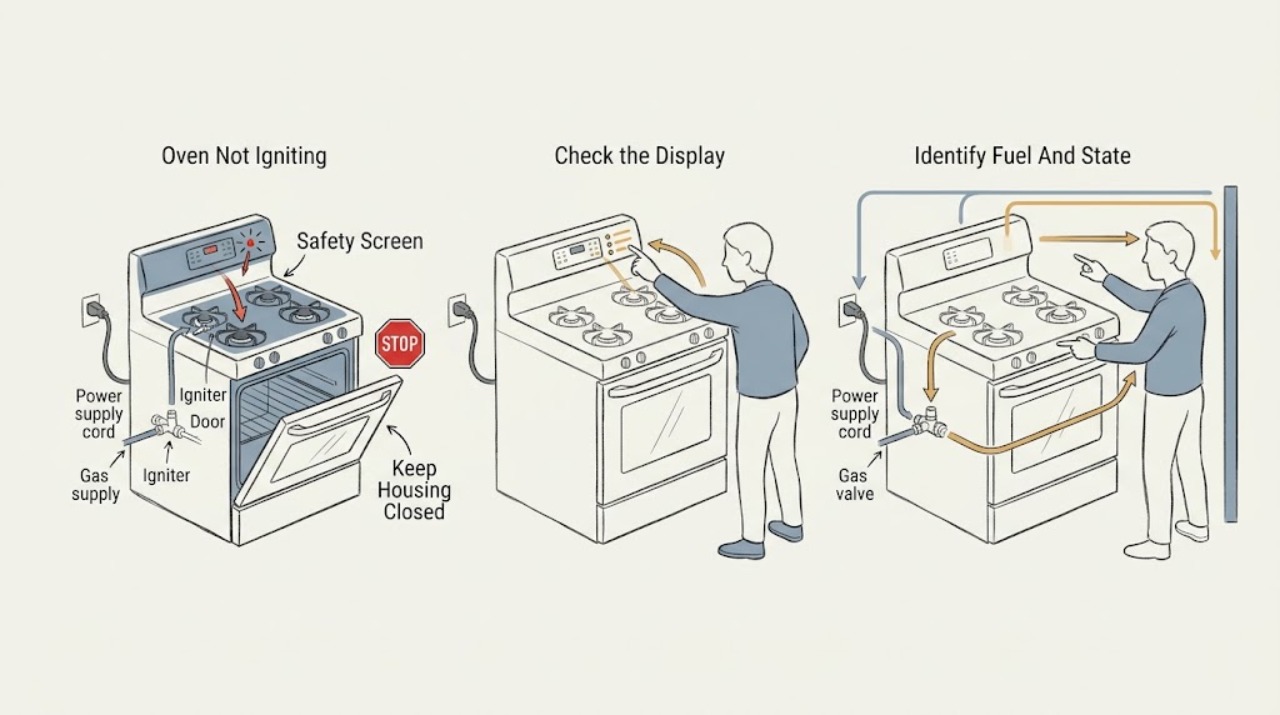
Work through in order
Diagnostic checks
Use only checks that match the exact appliance or system and its official guide.
-
Check 1
Stop the oven and observe from a safe position for gas odor, delayed ignition or a bang, abnormal flame, smoke, CO concern, burning smell, electrical arc, hot cord or outlet, uncontrolled heat, or a breaker that trips again.
Expected result: Record whether the appliance is simply failing to ignite, or whether gas, fire, heat, smoke, or electrical danger is present.
Next step: For gas odor, smoke, fire, or CO concern, leave the area and contact the appropriate emergency or gas response from a safe location. For an electrical hazard, keep clear, isolate power only if safe, and arrange qualified help.
Stop if: Do not operate switches near gas odor, relight the oven, use a flame to find a leak, reset a tripped breaker repeatedly, or open a hot or energized oven.
Why this matters
Why: A no-ignition symptom without a hazard permits only low-risk setting and external checks. Any gas, fire, smoke, CO, arcing, or repeated-trip symptom is a stop condition.
-
Check 2
Read the model and rating label from safe access and record whether the oven is gas, electric, dual-fuel, or a wall oven; note the display, exact error code, selected cycle, Start state, and whether surface burners operate if present.
Expected result: Classify the issue as a gas oven with no click, gas oven clicking without flame, electric oven with no heat, no power, or a control, demo, lock, delayed-start, or error state.
Next step: Use the exact Maytag owner's manual and model-specific support page; follow only the branch that matches the fuel type and display state.
Stop if: Do not remove trim, pull a wall oven, open a terminal cover, access a gas regulator, or continue with a damaged cord, insulation, door, or control.
Why this matters
Why: Only gas or dual-fuel oven configurations have the ignition branch. An electric oven's no-heat circuit must not be described as a failed gas igniter, and surface-burner operation does not prove the oven gas path works.
-
Check 3
With the oven cool enough for safe ordinary access, confirm the intended Bake cycle and temperature, press or hold Start as the model requires, make sure the door closes fully, and check the display for Control Lock, demo mode, Delayed Start, or an exact error message.
Expected result: Record whether the control accepts the setting, whether the door or latch is blocked, whether a lock or demo indication clears using the model instruction, and whether ignition or heating begins.
Next step: Correct only the model-documented setting and make one normal Bake selection; if it still will not ignite or heat, continue to the matching power or gas branch without removing a cover.
Stop if: Do not force the door, bypass a lock or latch, use self-clean as a test, or continue if gas odor, smoke, abnormal flame, arcing, or uncontrolled heat appears.
Why this matters
Why: A locked, demo, delayed, incomplete, or open-door state can prevent the oven from entering a heat cycle. A valid cycle with no ignition or no heat after the control state is corrected points to the applicable supply or heat system.
-
Check 4
Only for a gas oven with no gas odor and safe access, start the model-approved Bake cycle once and observe from outside the cavity for the documented ignition sequence; do not put hands near the burner and do not repeat attempts if the flame does not appear promptly.
Expected result: Record no click, clicking with no flame, flame that lights and goes out, delayed ignition or bang, stable flame, abnormal color or shape, and whether the oven reaches heat.
Next step: Cancel and arrange qualified gas-appliance service for no flame, repeated clicking, flame instability, or any abnormal result; do not expose the burner or adjust a gas component.
Stop if: Stop immediately for gas odor, a bang, flame rollout, smoke, soot, abnormal flame, continuous sparking, or any heat reaching controls or cabinetry.
Why this matters
Why: A stable flame after short clicks supports normal ignition. No click can involve power, control, or igniter operation; clicking without flame can involve gas supply or ignition components; delayed ignition or abnormal flame is unsafe and requires service.
-
Check 5
For an electric or dual-fuel appliance, inspect only the accessible display, plug where the model uses one, and household breaker or fuse position; if there is no hazard and a breaker is open, reset it once as the model instructions permit.
Expected result: Record whether the display is blank or partly active, whether a breaker trips again, whether the oven was newly installed, or whether a wall-oven supply or grounding concern is suspected.
Next step: If power is stable, make one model-approved Bake selection. If the breaker trips again or wiring and rating are uncertain, leave the oven off and arrange licensed electrical or appliance service.
Stop if: Do not remove terminal covers, test live voltage, use a two-prong adapter or extension cord, reset protection repeatedly, or handle a wet or damaged connection.
Why this matters
Why: A partial or incorrect supply can leave controls active while an electric heater or gas igniter cannot operate. A repeat trip or uncertain wiring is an electrical-service issue, not a reason to test ignition again.
-
Check 6
Only for a gas or dual-fuel range with no gas odor, verify the clearly labeled main gas valve and, where the model instructions expose it, the oven-specific pressure-regulator shutoff position; do not remove storage drawers or panels to reach it.
Expected result: Record whether the main supply is on, the oven-specific shutoff is in the documented position, the range was recently connected, and surface burners work while the oven does not ignite.
Next step: If the position is unclear, the appliance was reconnected, or the oven still will not ignite, stop using it and arrange qualified gas-appliance service; do not purge or adjust the gas path yourself.
Stop if: Do not smell-test, light a match, purge gas, adjust a regulator, open tubing, repeatedly attempt ignition, or continue after odor, delayed ignition, abnormal flame, or a bang.
Why this matters
Why: Maytag notes that recently connected gas lines can contain air and that an oven-specific regulator shutoff can block oven gas while surface burners still work. A correct external position with no ignition points to qualified diagnosis.
-
Check 7
Only when the appliance is cool, dry, odor-free, and not repeatedly tripping, perform the single power reset documented for the exact model, then select Bake once and observe from a safe distance; do not open the oven or control cabinet.
Expected result: Record whether the display and ignition return, a code returns, the oven remains cold, or heat continues after Cancel.
Next step: Stop using the oven and give the technician the model, fuel type, cycle, exact code, click or flame observation, accessible supply result, and any safety symptom.
Stop if: Do not repeat resets, operate through a recurring error, touch hot or energized parts, or continue if smoke, gas odor, abnormal flame, arcing, or uncontrolled heating appears.
Why this matters
Why: A one-time reset may clear a control state after an outage, but it does not prove a failed igniter, element, sensor, gas valve, or control is repaired. Persistent no-ignition or uncontrolled heat requires service.
Use your observations
Decision map
Find the observation that best matches what you see, then follow the next safe action.
-
PATH 01Safety boundary
What you see
Gas odor, delayed ignition bang, abnormal flame, smoke, CO concern, burning smell, electrical arc, hot cord, uncontrolled heat, or repeated breaker trip is present.
Do this next
Do not operate the appliance. Leave the area for gas, smoke, fire, or CO concerns and contact appropriate emergency or gas response from a safe location; arrange qualified electrical or appliance help for electrical hazards.
Why this path and its safety boundary
Why it matters: The oven may present immediate gas, fire, heat, or electrical danger; the ignition diagnosis must stop.
Safety stop: Do not operate switches near gas odor, relight, use a flame to find a leak, reset protection repeatedly, or open the appliance.
-
PATH 02Safety boundary
What you see
The model is electric or has an electric oven, with no gas supply or flame system, and the cavity stays cold after a valid Bake and preheat selection.
Do this next
Check only settings, door, airflow, and accessible power, then arrange qualified appliance or electrical service for the heater circuit.
Why this path and its safety boundary
Why it matters: The wording is an electric no-heat problem, not a failed gas ignition; power, element, sensor, fuse, relay, or control can be involved.
Safety stop: Do not invent a gas igniter, open element covers, test live wiring, or continue after arcing, smoke, burning smell, or a repeat trip.
-
PATH 03Safety boundary
What you see
Control Lock, demo mode, Delayed Start, an incomplete Start command, a blocked door, or a model error state prevents the oven from entering the heat cycle.
Do this next
Use the exact model manual to clear the state, close the door without force, and make one normal Bake selection; request service if the state returns.
Why this path and its safety boundary
Why it matters: The control or door state can prevent ignition or heating without proving a gas component has failed.
Safety stop: Do not bypass the lock or latch, force the door, use self-clean as a test, or ignore a recurring code.
-
PATH 04Safety boundary
What you see
A gas oven emits short clicks, a stable flame appears promptly, and there is no odor, abnormal flame, smoke, or delayed bang.
Do this next
Allow the documented cycle to run and monitor temperature and flame behavior without opening panels; request service if the flame fails, clicks become continuous, or the oven does not heat.
Why this path and its safety boundary
Why it matters: Maytag describes short ignition clicks while the flame is detected, including periodic clicks during a cycle; the observed stable flame supports normal ignition.
Safety stop: Do not treat a delayed bang, soot, unstable flame, or gas odor as normal clicking.
-
PATH 05Safety boundary
What you see
A gas oven clicks without flame, has no click, or surface burners work while the oven does not ignite, with no gas odor and safe external checks completed.
Do this next
Stop repeated ignition attempts and arrange qualified gas-appliance service with the model, fuel type, flame or click result, and valve observations.
Why this path and its safety boundary
Why it matters: The supply, oven-specific shutoff, grounded power, igniter, sensor, valve, control, or burner may be involved; the symptom does not identify one part.
Safety stop: Do not adjust gas pressure, open tubing, replace an igniter by guesswork, or keep operating a gas oven that fails to light.
-
PATH 06Safety boundary
What you see
Settings, door, power, and applicable external gas checks are correct, but the oven remains cold or the igniter, element, sensor, or control behaves abnormally.
Do this next
Stop using the oven and arrange qualified appliance service; provide the exact model, cycle, code, preheat result, and sequence observation.
Why this path and its safety boundary
Why it matters: An internal heat or ignition system fault is possible and cannot be isolated safely through further home tests.
Safety stop: Do not remove panels, test live voltage or continuity, open the gas path, or order a component before model-specific diagnosis.
Helpful context
Understand the symptom
Make sure the wording matches the appliance
A gas oven uses an igniter to light a burner. An electric oven uses heating elements and has no gas flame to ignite. A dual-fuel range can combine an electric oven with gas surface burners, so surface-burner behavior does not prove that the oven itself is gas. Record the model and rating information before opening the owner's manual or choosing a troubleshooting branch.
A clicking igniter is not the same as a failed ignition
Maytag describes short clicks from gas-oven igniters while a flame is being detected, including recurring clicks during a cycle. The useful observation is whether the flame appears promptly and remains stable, not whether a click is heard alone. Repeated clicking without ignition, a delayed bang, an abnormal flame, or any gas odor ends user testing.
Use only safe external checks for gas, controls, and power
With no gas odor and safe access, confirm the selected Bake cycle, Start command, fully closed door, and any Control Lock, demo, or Delayed Start state. For a gas range, Maytag also identifies the main gas valve, grounded outlet, and an oven-specific pressure-regulator shutoff as possible external causes. Do not adjust a regulator, open tubing, remove a burner panel, or test a leak with a flame.
No ignition after the safe checks is a service diagnosis
The igniter, burner, sensor, valve, control, wiring, or gas pressure may require model-specific testing. For an electric oven, a failed element, fuse, relay, sensor, or supply can produce a similar no-heat complaint. These are not safe live-appliance checks. Preserve the model, code, cycle, click or flame observation, and any power or gas history for a qualified technician.
Safety boundary
Stop conditions
- Stop immediately for gas odor, delayed ignition bang, abnormal flame, smoke, CO concern, burning smell, electrical arcing, hot cord or outlet, uncontrolled heating, or a repeated breaker trip.
- Do not relight, smell-test, purge, adjust, or dismantle gas tubing, the regulator, burner, valve, or igniter; do not test for a leak with a flame.
- Do not remove panels, element covers, terminal blocks, wall-oven trim, or wiring, and do not measure live voltage or continuity as a home check.
- Do not repeatedly attempt ignition or reset protection, use an adapter or extension cord, or operate with a damaged door, gasket, insulation, or exposed conductor.
- Do not use self-clean, broil, or a prolonged cycle as a stress test, and do not continue after heat remains on when Cancel is pressed.
Only after diagnosis
Potential parts
- gas oven igniter or burner component
Consider this category only after qualified diagnosis confirms an ignition or burner fault for the exact gas or dual-fuel model.
Confirm the exact model, fuel configuration, igniter or burner type, and manufacturer's fit information; do not open gas tubing or repeatedly attempt ignition. - bake or broil heating element
Consider this category only after qualified diagnosis confirms an electric element failure or visible damage for the exact model.
Confirm the exact model, element position, rating, connector, and manufacturer's fit information before ordering; do not remove an element cover or test live wiring. - oven temperature sensor or control component
Consider this category only after a qualified technician links persistent no-heat, temperature, or code behavior to the sensor or control rather than settings, supply, or ignition.
Confirm the exact model and diagnosis before ordering; sensor and control parts are not interchangeable without model documentation.
When checks do not resolve it
Need a professional?
Arrange qualified appliance service when a gas oven clicks without flame, has no ignition, has a delayed or abnormal flame, or stays cold after safe model-specific setting and supply checks; for an electric oven, arrange service when a valid Bake cycle stays cold after power, door, control, and preheat checks. Use licensed electrical service for uncertain wiring, incorrect supply, or repeat breaker trips. For gas odor, delayed ignition, abnormal flame, smoke, or CO concern, leave the area and use the appropriate emergency or gas response from a safe location.
Safety scope: This article covers settings and ordinary-access observations only. Do not open panels, test live wiring, dismantle gas components, relight after abnormal ignition, or operate a hazardous oven.
Common questions
FAQ
Why does my Maytag gas oven click but not ignite?
First rule out danger, then record whether the oven has gas, whether the door is closed, the selected cycle and Start command are correct, and whether an exact model-specific control or power state is active. Maytag describes short clicks while an igniter detects a flame, but clicking without a stable flame needs qualified gas-appliance diagnosis. Do not repeat ignition attempts or open the gas path.
Can a Maytag oven be electric if my range has gas burners?
Yes. A dual-fuel or mixed appliance can have gas surface burners and an electric oven. Read the model and rating label before using a gas-ignition procedure. An electric oven that stays cold has a power, control, element, sensor, or related no-heat problem rather than a gas igniter problem.
Why do the surface burners work but the Maytag oven will not ignite?
Maytag notes that a gas range can have an oven-specific pressure-regulator shutoff that blocks oven gas while surface burners work. With no gas odor and safe access, check only a clearly labeled position against the exact installation instructions. If the position is unclear or ignition still fails, stop and arrange qualified service.
Could Control Lock or demo mode stop a Maytag oven from igniting?
Yes. Maytag says Control Lock can disable the controls and demo mode can allow features to be shown without the oven operating. Also check Delayed Start, Start, the selected cycle, and complete door closure using the exact manual. Do not bypass a lock or use a stress cycle to test the oven.
Should I replace the igniter in a Maytag oven that will not light?
Do not replace it from the symptom alone. No click, clicking without flame, a weak or delayed flame, missing gas, poor grounding, a sensor, valve, control, or wiring fault can look similar. A qualified technician should diagnose the exact model and fuel system before selecting a part.
When is a Maytag oven ignition problem an emergency?
Stop immediately for gas odor, delayed ignition or a bang, abnormal flame, smoke, CO concern, burning smell, electrical arcing, a hot cord, uncontrolled heating, or a repeated breaker trip. Do not operate switches near gas odor or relight the oven; leave the area and contact the appropriate emergency or gas professional from a safe location.
Read the exact guide
Official sources
- Click or Clicking Noise in Oven - RangeMaytag Product Help · Maytag gas range oven clicking guidance; exact model and flame behavior control whether the sound is normal.
- Locked, Lock or Loc - RangeMaytag Product Help · Maytag ranges with a Lock or LOC control message; exact model manual controls the button sequence.
- Oven Not Pre-Heating - Wall OvenMaytag Product Help · Maytag wall ovens; electrical ratings and connection procedures are model-specific and service-level when inaccessible.
- Maytag Product HelpMaytag · Official Maytag support entry point for locating the owner's manual and service path for a specific model.
- Oven Not Working - Cooktop Working - Not ClickingMaytag Product Help · Maytag gas ranges where surface burners work but the oven does not; model installation instructions control valve location and handling.
- Oven Not Heating - Powering On - ElectricMaytag Product Help · Maytag electric range and oven support; exact model documentation controls the procedure.
- Oven Not Working - GasMaytag Product Help · Maytag gas ranges and ovens; fuel and installation instructions for the exact model control.
- Oven Not Working - ElectricMaytag Product Help · Maytag electric range and oven support; codes and reset intervals vary by model.
Community feedback
Share a repair observation
Share a plain-text repair observation. Accepted observations are published automatically; this page may take a moment to update.