
On this page
Start here
Quick answer
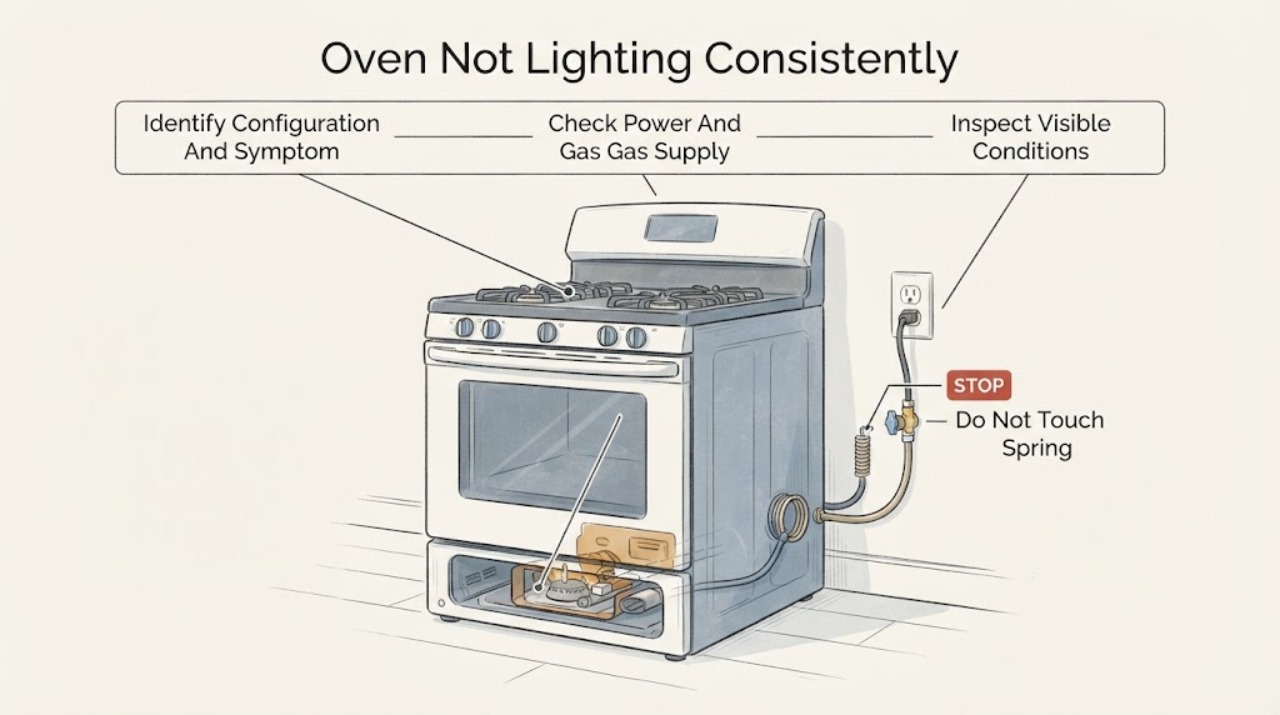
First confirm whether this is a Maytag gas oven/range and record whether the igniter clicks or glows, whether a flame appears, how long ignition takes, and whether any gas odor remains. Maytag’s gas-oven guidance supports checking the grounded power connection and main gas valve, while model-specific instructions may also identify a pressure-regulator shutoff or a recent gas-line reconnection as relevant. Make only one normal start attempt under the exact manual; if the burner does not light, cancel the oven and do not keep releasing gas or repeatedly retrying. A brief odor during ignition should fade, but a lingering sulfur or rotten-egg smell, hissing, headache, dizziness or suspected leak requires leaving the home and contacting emergency or gas professionals from a safe location. Do not clean, adjust, replace or bypass an igniter or gas component without model-matched service.
Work through in order
Diagnostic checks
Use only checks that match the exact appliance or system and its official guide.
-
Check 1
Record the complete Maytag model number and determine whether the appliance is gas or electric. Note whether the display works, whether the oven clicks or glows, whether a flame appears, the approximate delay and any gas odor; do not start repeated ignition attempts to collect data.
Expected result: The oven is gas and has clicking/glow with delayed or missed flame, has no ignition activity, or is actually an electric model.
Next step: Use the gas branches only for a confirmed gas model and use the exact manual for any timing or control instruction; route an electric model through its model-specific heating support.
Why this matters
Why: Gas ignition and gas-supply checks cannot be transferred to an electric oven. Within a gas model, the observation separates a no-ignition symptom from a flame that lights late or goes out.
-
Check 2
For a confirmed gas model, with controls off and no gas odor, verify that the power cord is connected to a grounded operational outlet and that the main gas valve is on. If the range was recently installed or reconnected, note that air may be present in the gas line; do not loosen fittings or alter the line.
Expected result: The outlet is not operational, the main gas valve is closed, the appliance was recently reconnected, or both external supplies are already correct.
Next step: Correct only an obvious external supply condition when safe and use one normal model-approved startup attempt. If supply is uncertain, contact a qualified electrician or gas professional rather than testing live wiring or gas fittings.
Why this matters
Why: Maytag says oven igniters require a good electrical ground path and lists the main gas valve and recent reconnection as relevant conditions. A correct supply does not identify an internal ignition part.
-
Check 3
Using the exact manual, make one normal bake start while remaining at a safe distance and observing only the expected indicator/click/glow and whether ignition occurs. If the burner does not light within the model’s documented startup behavior, press Cancel or Off; do not repeat the start to accumulate gas.
Expected result: The flame lights normally, lights only after an unusual delay, fails to light, or gas odor remains after the attempt.
Next step: For delayed or failed ignition, cancel and arrange authorized Maytag service. For persistent gas odor or leak signs, leave immediately and follow the gas-emergency branch instead of making another attempt.
Why this matters
Why: A normal flame supports a transient or external-condition branch. Delayed or failed ignition does not distinguish an igniter, valve, regulator or control fault without professional testing, and unburned gas or persistent odor is a safety condition.
-
Check 4
When the oven is cool and no gas odor is present, check only visible conditions named by Maytag: the door is closed as the model requires, no foil or liner covers the oven bottom, and a storage drawer is not overloaded or contacting the igniter area. Do not remove panels or burner parts.
Expected result: A door, foil/liner or storage-drawer obstruction is present, or the visible path is clear but ignition remains intermittent.
Next step: Remove only the visible obstruction, then follow the exact manual for one normal attempt. If the symptom returns, stop using the oven and request service.
Why this matters
Why: Maytag says these conditions can interfere with burner airflow or the igniter on applicable ranges. Clearing a visible obstruction does not establish that the igniter or gas valve is sound.
-
Check 5
If the exact Maytag gas-range manual identifies a pressure-regulator shutoff valve, verify its labeled position from the accessible instructions without disassembling the range or changing gas pressure. Do not assume every Maytag oven has this control or borrow a location from another model.
Expected result: The manual identifies an applicable regulator shutoff and it is not in the required position, or the manual/model does not identify one and ignition still fails.
Next step: Follow only the exact manual’s external instruction. If the position is correct or unclear, leave gas adjustments to a qualified technician and do not keep trying the oven.
Why this matters
Why: Maytag explains that on applicable gas ranges a regulator shutoff can allow cooktop gas while withholding oven gas. Model and manual scope are essential; this is not a universal Maytag diagnosis.
-
Check 6
Stop using the oven immediately if gas odor lingers, there is hissing, sulfur/rotten-egg odor, headache, dizziness, smoke, flashback, repeated delayed ignition or a burner that will not light. Do not switch lights, use electrical devices, relight, adjust gas controls or open the appliance.
Expected result: The odor fades promptly with normal ignition and no hazard remains, or the odor persists/returns or ignition remains unsafe or unreliable.
Next step: For suspected leak signs, leave the home and contact emergency/gas professionals from a safe location. For repeated ignition failure without leak signs, keep the oven off and arrange qualified Maytag service.
Why this matters
Why: Maytag distinguishes a brief ignition odor from signs that can indicate a gas leak or unsafe combustion. Persistent or hazardous symptoms exceed owner checks.
Use your observations
Decision map
Find the observation that best matches what you see, then follow the next safe action.
-
PATH 01Next step
What you see
The appliance is confirmed electric rather than gas.
Do this next
Use the exact Maytag electric-oven manual and support path; do not apply gas troubleshooting or lighting instructions.
Why this path and its safety boundary
Why it matters: Gas igniter, gas valve and gas-odor guidance do not apply to the appliance.
-
PATH 02Next step
What you see
A gas model was recently installed or reconnected, and the main gas valve and grounded power are otherwise correct.
Do this next
Follow the exact installation/manual startup once; if ignition remains unreliable, cancel the oven and arrange qualified gas-appliance service.
Why this path and its safety boundary
Why it matters: Maytag says air can be trapped in a recently reconnected gas line, while the igniter also needs a good electrical ground path.
-
PATH 03Next step
What you see
The igniter clicks or glows but the oven burner lights late, fails to light, or needs repeated attempts.
Do this next
Cancel the oven and stop repeated starts. Use model-matched Maytag service for diagnosis rather than adjusting gas or replacing a part by appearance.
Why this path and its safety boundary
Why it matters: This confirms only an ignition symptom; it does not identify the igniter, valve, regulator or control as the failed part.
-
PATH 04Next step
What you see
The oven has a lingering gas odor, hissing, sulfur/rotten-egg smell, headache or dizziness.
Do this next
Leave immediately, avoid switches and electrical devices, and contact emergency or gas professionals from outside or another safe location.
Why this path and its safety boundary
Why it matters: Maytag treats these as possible gas-leak signs rather than a routine ignition problem.
-
PATH 05Next step
What you see
A visible door, foil/liner, drawer or applicable regulator-shutoff condition is corrected and one normal startup succeeds.
Do this next
Monitor without repeated testing and arrange service if delayed or failed ignition returns.
Why this path and its safety boundary
Why it matters: The result is consistent with that external condition but does not prove the ignition system is healthy.
Helpful context
Understand the symptom
Confirm gas ignition before using gas-specific checks
“Not lighting consistently” is meaningful only after identifying the appliance configuration. Record the full Maytag model, whether it is a gas range, gas wall oven or electric oven, whether the display works, whether you hear clicking, whether the igniter glows, whether a flame appears, the delay before ignition, and any odor. The gas guidance below applies only to a gas model; do not transfer it to an electric oven.
Use one model-approved startup observation
Maytag’s gas-range manual says the bake igniter should glow and the burner may take up to 60 seconds to light under some conditions, then directs the user to cancel the oven if the burner does not light. That timing is a manual-family example, not a universal timer for every Maytag oven. Do not keep retrying an oven that releases gas without ignition or continue operating it with delayed ignition.
Check only accessible supply and airflow conditions
Maytag’s product-help pages support checking a grounded operational outlet, the main gas valve and, on applicable gas ranges, the pressure-regulator shutoff. They also warn that an open door, foil or a loaded storage drawer can interfere with burner operation or airflow. These checks can explain an intermittent symptom without proving that the igniter, gas valve or regulator needs replacement.
Treat gas odor or repeated delayed ignition as a stop condition
Maytag says a brief smell during initial ignition should fade quickly. A smell that lingers, hissing, sulfur/rotten-egg odor, headache or dizziness may indicate a gas leak. Leave immediately, avoid lights, switches and other electrical sources, and contact emergency or gas professionals from outside or another safe location. Do not test the igniter, adjust gas pressure, relight repeatedly or open the appliance.
When checks do not resolve it
Need a professional?
Request qualified Maytag gas-appliance service when ignition remains intermittent after the exact manual’s external checks, the burner lights late or not at all, the applicable regulator position is unclear, the oven will not heat, or any internal gas/electrical diagnosis is needed. Do not choose an igniter, valve, regulator, sensor or control part from this symptom alone.
Common questions
FAQ
How long should a Maytag gas oven take to light?
The opened Maytag double-oven gas-range manual says the bake or broil burner may take up to 60 seconds under certain conditions, but that timing is scoped to that manual family. Use the exact model manual; if the burner does not light, cancel the oven instead of repeatedly retrying.
Can I keep using the oven if it sometimes smells like gas?
A brief smell during initial ignition should fade quickly. Maytag says a lingering odor, hissing, sulfur/rotten-egg smell, headache or dizziness can indicate a leak; leave the home, avoid electrical switches and contact emergency or gas professionals from a safe location.
Does intermittent lighting prove the igniter is bad?
No. Maytag’s external checks include grounded power, gas valves, recent reconnection, door/airflow conditions and, on applicable ranges, the pressure-regulator shutoff. Continued failure needs model-matched professional diagnosis rather than a guessed replacement part.
Read the exact guide
Official sources
- Oven Not Working - Cooktop Working - Not ClickingMaytag Product Help · Official Maytag gas-range page. It supports visible door/foil/storage-drawer checks, applicable pressure-regulator and main gas shutoff checks, and grounded-power verification; it does not establish a universal part failure.
- Why Does My Oven Smell Like Gas?Maytag · Official Maytag safety article. It distinguishes a brief ignition odor from persistent odor/leak signs and directs evacuation and professional/emergency response; it does not authorize user gas-leak testing or repair.
- Oven Not Working - GasMaytag Product Help · Official Maytag product-help guidance for gas models. It supports checking recent reconnection, grounded operational power and the main gas valve; it does not diagnose a specific ignition component.
- Owners Manual - Double Oven Freestanding Gas and Dual Fuel RangeMaytag · Official Maytag manual for the named double-oven freestanding gas/dual-fuel family only. It documents the igniter-to-burner sequence, up-to-60-second startup under some conditions, supply checks and cancel/service boundary; it is not a universal manual for every Maytag oven.
Community feedback
Share a repair observation
Share a plain-text repair observation. Accepted observations are published automatically; this page may take a moment to update.