
On this page
Start here
Quick answer
The task model is YMER8850DS0; the Maytag product page opened for this research is labeled YMER8850DS, while the title hint drops the zero after YMER885. Keep the full rating-plate model as the identity and do not assume the shortened title or a neighboring range is the same unit. Maytag identifies the YMER8850DS base listing as an electric freestanding convection oven. A slow preheat is not automatically a failed element: Maytag says preheat time depends on element type, oven size, temperature, rack count, door opening, room conditions, and 208V versus 240V supply. First record whether the display is simply showing low temperature or preheat, such as “Lo” or “Pre” where that message applies, then select the model's documented Bake cycle and wait for its preheat signal with the door closed. Do not use a thermometer, self-clean, repeated door openings, live voltage measurement, or a guessed element. If the oven consistently exceeds the applicable preheat range, never reaches the signal, trips protection, shows smoke/odor/arcing, or cooks unevenly after a valid preheat, leave it off and arrange qualified appliance or electrical service; calibration is only a later model-manual option when the oven heats but the measured cooking result is consistently offset.
Before you begin
Safety first
- No user live-voltage or continuity testing, terminal-cover or control-panel removal, element-cover removal, range extraction, gas work, repeated breaker resets, self-clean stress testing, or improvised part substitution. Keep the range out of service for odor, smoke, arcing, hot wiring, uncontrolled heat, cracked elements, or repeated protection trips.
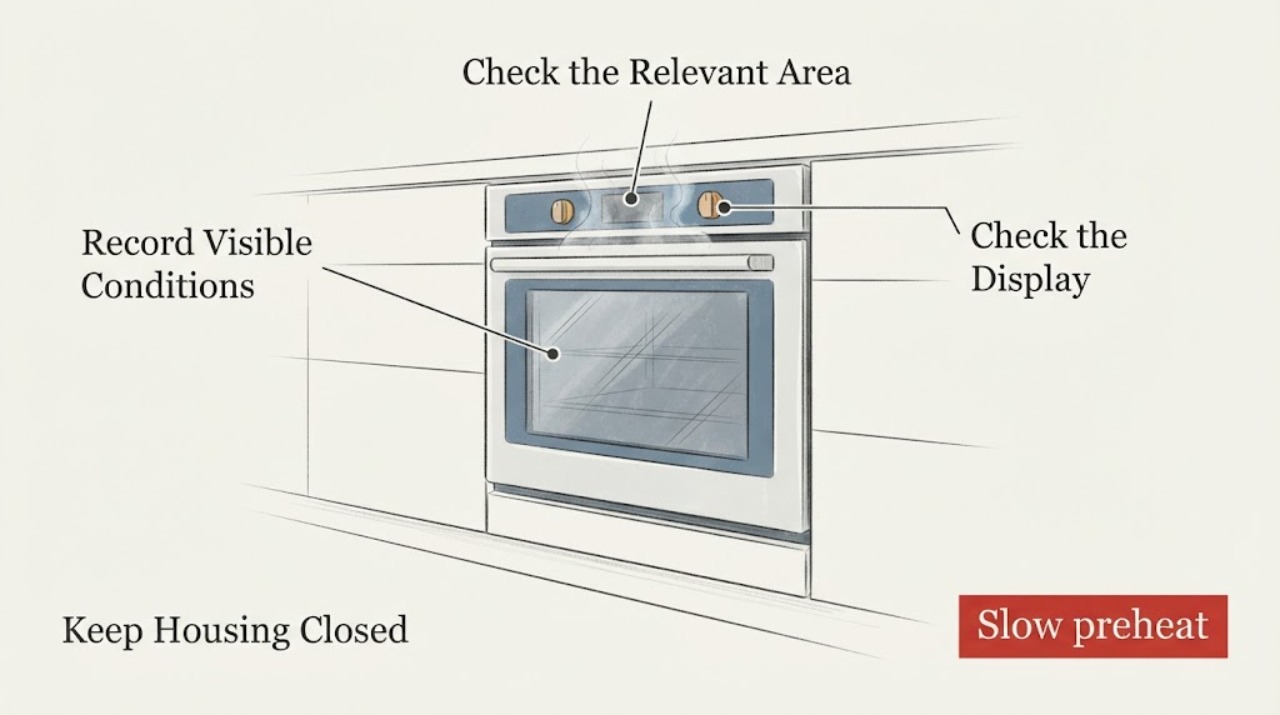
Work through in order
Diagnostic checks
Use only checks that match the exact appliance or system and its official guide.
-
Check 1
Stop the range and record the exact rating-plate model, including whether it reads YMER8850DS0, YMER8850DS, or another suffix. From a safe position, note smoke, gas odor, burning or electrical odor, sparks, arcing, a cracked or visibly damaged element, uncontrolled heat, a hot cord, or a breaker that trips again.
Expected result: The rating plate matches the assigned suffix, shows only the Maytag base model without the final zero, or cannot be read; no hazard is present or a hazard is present.
Next step: Use the full rating-plate identity for the manual and service request. If a hazard is present, leave the oven off, isolate power only from a safe accessible point, leave the area for smoke or gas concerns, and obtain qualified emergency, electrical, gas, or appliance help as appropriate.
Stop if: Do not operate switches near a gas odor, relight anything, open panels, touch a hot element, or repeatedly reset a breaker.
Why this matters
Why: The missing/extra character changes which manual and service parts can be trusted. Any smoke, odor, arcing, exposed conductor, uncontrolled heat, or repeated protection trip overrides preheat troubleshooting.
-
Check 2
With the oven cool and free of flammable items, select the exact model's Bake cycle and enter the intended temperature. Keep the door closed until the documented preheat tone or indication, and write down whether the display says Pre, Lo, preheat, a temperature, or remains inactive; do not repeatedly open the door or use self-clean as a test.
Expected result: The display shows a low-temperature/preheat state, reaches a preheat signal, remains in preheat unusually long, or never begins a valid Bake cycle.
Next step: Compare the observed display and signal with the exact YMER8850DS0/YMER8850DS manual. If a valid Bake cycle never heats or the display never progresses, stop and arrange service rather than opening the oven or selecting a part.
Stop if: Do not use broil or self-clean as a stress test, leave an abnormal oven unattended, or continue after odor, smoke, arcing, or uncontrolled heat.
Why this matters
Why: On Maytag models using those messages, “Lo” or “Pre” can be normal while the oven is below the display threshold or preheating. A valid preheat signal means the next question is cooking accuracy; failure to begin or complete preheat keeps settings, supply, and heating-system branches open.
-
Check 3
For one controlled preheat observation, note the target temperature, number of racks inside, whether any rack is unused, room conditions, when the door was opened, and whether foil or a liner covers an entire rack or the oven bottom. Correct only cool, visible placement issues.
Expected result: Unused racks remain inside, the door was opened repeatedly, the room is unusually cold, foil blocks a rack or oven bottom, or the cavity is correctly arranged and the preheat is still slow.
Next step: Remove only unused racks and prohibited foil/liners when cool, follow the exact model's rack placement, and make one normal Bake observation. If the time remains excessive or the door, hinge, or gasket is damaged, stop and request service.
Stop if: Do not force or remove hinges, touch hot surfaces, line the cavity, or run with a door that cannot close and seal normally.
Why this matters
Why: Maytag says these factors can add preheat time or alter airflow. A corrected arrangement that reaches the signal narrows the complaint to setup; a persistent delay with correct placement is not proof of a failed element but justifies supply and service review.
-
Check 4
Classify the result against Maytag's electric-range guidance without measuring live voltage: for a 350°F target, record whether the oven is in the approximate range for its element arrangement, and ask whether the home is a 208V installation, such as some buildings with elevators. Do not open a terminal cover or pull the range out.
Expected result: The preheat delay is consistent with the applicable element/rack/temperature conditions, the home may have 208V service, or the oven is far beyond the applicable range and the supply is known to be correct.
Next step: Document the measured installation facts for the technician or electrician. If a stable, correctly installed supply is confirmed but preheat remains far outside the applicable range or never reaches the signal, leave the oven off and request qualified service.
Stop if: Do not test voltage, alter wiring, use an adapter, remove the range, or repeatedly reset an electrical protection device.
Why this matters
Why: Maytag says visible-element ovens with racks may take about 12–15 minutes plus or minus 5 minutes to reach 350°F, hidden-element ovens about 20 minutes plus or minus 5 minutes, and 208V installations take longer than 240V. These are approximate guidance values, not an internal component diagnosis.
-
Check 5
If the oven reaches its preheat signal but food is consistently too pale, too dark, or uneven, keep the door closed during baking, use the exact rack and pan spacing guidance, and record the recipe, rack, cycle, target temperature, and result. Do not change calibration from a single bake or from a thermometer reading alone.
Expected result: The oven reaches preheat but the cooking result is consistently offset, the result changes with rack/pan placement, or the oven never reaches the preheat signal.
Next step: Use the exact owner manual's bake-performance and calibration instructions only after the result is repeatable. If calibration does not apply, the oven cannot reach temperature, or performance remains abnormal, request qualified service.
Stop if: Do not use a generic calibration sequence, place a thermometer on a hot element, open panels, or infer a sensor/control fault from uneven food alone.
Why this matters
Why: Maytag separates cooking-performance factors and calibration from a preheat failure. A repeatable offset after correct preheat can justify a model-specific calibration procedure; a no-signal or cold-cavity condition remains a heat-system or supply concern.
-
Check 6
Prepare a service record with the full model suffix, display text, selected cycle and temperature, preheat start and signal behavior, rack count, door-opening history, room/installation notes, breaker behavior, and whether the complaint is slow preheat, no heat, or inaccurate cooking. Do not name an element, sensor, control, or other part unless the exact model documentation or technician identifies it.
Expected result: The valid Bake cycle remains cold, preheat is repeatedly far outside the applicable range, a protection device trips, the model suffix cannot be resolved, or only a repeatable temperature offset remains after correct preheat.
Next step: Leave the range off and request qualified Maytag/appliance service; use licensed electrical service for supply or repeated-breaker concerns. Ask the provider to confirm the exact rating-plate model before quoting a part or procedure.
Stop if: Do not perform continuity or live-voltage tests, remove the control or element cover, bypass a safety device, or order a replacement part from the title typo or symptom alone.
Why this matters
Why: The safe checks have separated display/setup and calibration questions from a likely supply or internal heat-system diagnosis. User observations cannot distinguish an element, sensor, control, wiring, or other component.
Use your observations
Decision map
Find the observation that best matches what you see, then follow the next safe action.
-
PATH 01Next step
What you see
The rating plate confirms the task identity or its exact base/suffix is resolved, the display shows a normal low-temperature/preheat state, and the oven reaches the model's preheat signal after a correctly arranged Bake setup.
Do this next
Use the exact rack and recipe guidance, keep the door closed, and record cooking results. If results remain consistently offset after valid preheat, evaluate model-specific calibration rather than replacing a heater by guesswork.
Why this path and its safety boundary
Why it matters: The displayed state and preheat process are functioning; a reported long time may be explained by rack count, door openings, target temperature, room conditions, or the applicable element arrangement rather than a proven failed part.
-
PATH 02Next step
What you see
The electric range is correctly arranged and the preheat is consistently beyond the applicable approximate range, never reaches the preheat signal, or remains cold after one valid Bake attempt.
Do this next
Leave the oven off and arrange qualified Maytag/appliance service; have an electrician assess supply when the installation or voltage is uncertain. Do not test live circuits or order a component from the symptom.
Why this path and its safety boundary
Why it matters: Setup explanations are less likely. A supply issue or internal heat-system fault is possible, but the timing alone cannot identify an element, sensor, control, or wiring component.
-
PATH 03Next step
What you see
The home or building may supply 208V, or the installation history suggests the range was connected under a different rating; there is no smoke, odor, arcing, or repeated trip.
Do this next
Have a licensed electrician verify the supply and installation against the rating plate and local requirements. Do not open the terminal area or measure voltage yourself.
Why this path and its safety boundary
Why it matters: Maytag says 208V makes an electric range preheat more slowly than 240V while performance after reaching temperature is not necessarily affected. This is an installation/supply question, not proof of a failed heater.
-
PATH 04Next step
What you see
The oven reaches a valid preheat signal but repeatable food results remain too hot, too cool, or uneven after correct cycle, rack, pan, and door practice.
Do this next
Use only the exact owner manual's calibration instructions if the model's evaluation supports it. If calibration is unavailable or does not correct the repeatable offset, request service; do not replace a sensor from a single result.
Why this path and its safety boundary
Why it matters: This is a bake-performance/calibration branch rather than proof that the oven cannot heat. Maytag says calibration is model-specific and should follow a bake-performance evaluation.
-
PATH 05Next step
What you see
There is smoke, burning or gas odor, electrical arcing, a hot cord, a cracked element, uncontrolled heat, or a breaker that trips again, or the full model identity cannot be matched.
Do this next
Stop immediately and leave the oven out of service. From a safe location obtain emergency, gas, electrical, or qualified appliance help as appropriate, and provide the rating-plate photo without opening or moving the range.
Why this path and its safety boundary
Why it matters: The appliance is outside safe preheat troubleshooting, and the model ambiguity prevents a reliable part or procedure match. The symptom may involve fire, electrical, gas, or heat-system danger.
Helpful context
Understand the symptom
There is a model-label discrepancy to resolve before ordering anything: the assigned identity is YMER8850DS0, the title hint says YMER885DS0, and Maytag's opened product/support listing is YMER8850DS. The official listing describes the YMER8850DS base model as an electric freestanding convection oven with a 6.2-cu.-ft. cavity. Use the rating-plate model, including every suffix, for the owner's manual and service request; the shortened title is not evidence that a different model or part fits.
A long preheat and a cold oven are not the same observation. Maytag says “Lo” or “Pre” can simply mean the oven is below the display threshold or is preheating on models using that message. Its electric-range guidance also gives approximate 350°F preheat ranges that vary with visible versus hidden elements, racks, target temperature, door openings, room temperature, and 208V versus 240V supply. Those are decision aids, not permission to diagnose a component by time alone.
Maytag recommends model-specific calibration only after a bake-performance evaluation and says not to use a thermometer as a simple substitute for the oven's cycling behavior. Calibration cannot restore heat when the oven never reaches temperature, and changing it before confirming the cycle, door, racks, and supply can hide the real fault.
When checks do not resolve it
Need a professional?
Arrange qualified Maytag or appliance service when YMER8850DS0 (or the exact rating-plate suffix) fails to complete a valid Bake preheat, remains cold, or stays far outside the applicable preheat guidance after cool rack, door, pan, and cycle checks. Use licensed electrical service for a suspected 208V/240V mismatch, uncertain connection, or repeated breaker trip. Consider model-specific calibration only for a repeatable temperature offset after the oven reaches preheat. Stop immediately for smoke, gas or burning odor, arcing, a hot cord, cracked element, uncontrolled heat, or any condition that cannot be safely isolated. Do not open the control or element covers, measure live voltage, remove the range, use self-clean as a test, or select a replacement part from the title typo or slow-preheat symptom alone.
Safety scope: No user live-voltage or continuity testing, terminal-cover or control-panel removal, element-cover removal, range extraction, gas work, repeated breaker resets, self-clean stress testing, or improvised part substitution. Keep the range out of service for odor, smoke, arcing, hot wiring, uncontrolled heat, cracked elements, or repeated protection trips.
Common questions
FAQ
Is YMER885DS0 the same model as Maytag YMER8850DS0?
Do not assume that. The assigned identity is YMER8850DS0, the title hint omits a zero, and Maytag's opened product listing is YMER8850DS without the final task suffix. Read the rating plate and use its complete model for the manual, compatibility, and service request.
Does “Lo” or “Pre” mean the Maytag oven is broken?
Not necessarily. Maytag says those messages can simply indicate that the oven temperature is below the display threshold or that it is preheating on models that use those messages. Confirm the exact model's display behavior and whether the oven reaches its preheat signal.
How long should an electric Maytag oven take to preheat?
Maytag's general electric-range guidance says a visible-element oven with all racks may reach 350°F in about 12–15 minutes plus or minus 5 minutes, while a hidden-element oven may take about 20 minutes plus or minus 5 minutes; higher targets, extra racks, a cold room, door openings, and 208V service can extend that. Apply the range only after the exact model and setup are confirmed.
Should I calibrate the oven or replace a sensor for slow heating?
Not from slow heating alone. Maytag treats calibration as a model-specific response to a repeatable temperature offset after bake-performance evaluation; an oven that never reaches preheat needs supply or appliance diagnosis. Do not open panels, measure live circuits, or order an element, sensor, or control by guesswork.
Read the exact guide
Official sources
- Oven Temperature Incorrect (Too Hot or Too Cold)Maytag Product Help · Official Maytag explanation of temperature cycling, preheat factors, rack/pan/airflow effects, 208V versus 240V, and model-specific calibration. It is not a live-testing or part-identification guide.
- Lo or Pre - RangeMaytag Product Help · Used only to explain the possible normal display meaning; the message is not asserted to appear on YMER8850DS0 unless the rating-plate manual confirms it.
- Oven Too Cold - Already Calibrated - RangeMaytag Product Help · Official Maytag guidance for door-closed preheat, correct cycle, foil/airflow, and model-specific calibration boundaries. It does not authorize a generic calibration sequence for the assigned range.
- Long Preheat - Electric RangeMaytag Product Help · Official electric-range guidance for approximate preheat timing and external factors; it is not used to identify an internal part or certify an exact suffix.
- YMER8850DS Electric Freestanding Oven with Convection Heating - 6.2 cu. ft.Maytag · Exact opened Maytag product/support listing for the YMER8850DS base model. It confirms electric freestanding convection form and the model-specific support route, but does not prove that the task's trailing-zero suffix is identical without reading the appliance label.
Community feedback
Share a repair observation
Share a plain-text repair observation. Accepted observations are published automatically; this page may take a moment to update.