
On this page
Start here
Quick answer
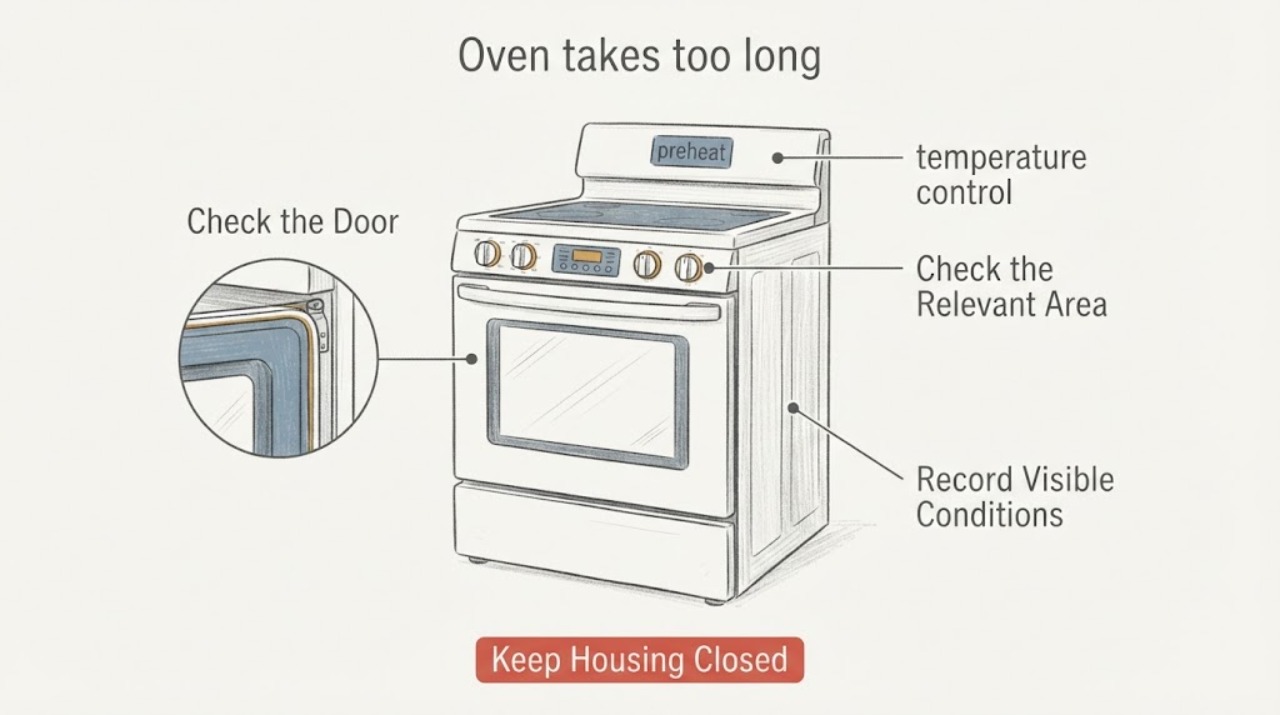
For a Maytag MER8600DS0 that heats very slowly, start with one cold, empty-oven timing check: select the ordinary Bake cycle and the recipe temperature, press Start, keep the door closed, and record when the preheat tone or ready indication occurs. Maytag says 350°F preheat is commonly about 12–15 minutes for a visible bake element or about 20 ± 5 minutes for a hidden bake element; higher settings, unused racks, a cold room, an open door, foil covering the rack or oven bottom, and a 208-volt installation can add time. The official product page identifies the MER8600DS electric-range family, but the final “0” suffix is not shown there, so use the complete model number to select its manual before applying any model-specific display or calibration sequence. If the oven remains far beyond the applicable range, never signals ready, or cannot maintain heat, stop repeated baking tests and arrange qualified service rather than guessing an element or control part.
Before you begin
Safety first
- Do not remove panels, test live voltage, touch heating elements, bypass controls, alter the door gasket, or order a bake element, sensor, relay, or control board from the symptom alone.
Work through in order
Diagnostic checks
Use only checks that match the exact appliance or system and its official guide.
-
Check 1
Verify the rating-plate text before comparing behavior. Record MER8600DS0 exactly, then with the oven cold and empty select the ordinary Bake cycle, enter the intended temperature, press Start, and record the start time, the display wording, and the time of the preheat tone or ready indication. Keep the door closed until that signal.
Expected result: The complete suffix is confirmed and the oven gives a ready indication, shows a progressing temperature, remains at a preheat message, or never signals ready.
Next step: Save a photo of the model label and display, and continue to the timing comparison only if there is no smoke, sparking, burning odor, exposed wiring, damaged element, uncontrolled heat, or repeated breaker trip. If any of those hazards is present, leave the oven off and arrange service.
Why this matters
Why: A complete model identity prevents a family-level manual or calibration sequence from being applied to the wrong control. A ready signal makes the elapsed-time comparison useful; a persistent preheat state or no signal is a performance fault to document rather than a reason to guess a component.
-
Check 2
Repeat the same cold, empty-oven test once at 350°F with only the racks needed for normal baking. Compare the recorded time with Maytag's public guidance: roughly 12–15 minutes plus or minus 5 minutes for a visible bake element, or roughly 20 minutes plus or minus 5 minutes for a hidden bake element. Do not use a higher target to establish the baseline because settings above 350°F take longer.
Expected result: The time is within the applicable range, modestly longer, far longer, or the oven never produces the ready indication.
Next step: Keep the time, target, display behavior, room conditions, and rack count with the service notes. If the oven is far outside the range or never signals ready, stop repeated cooking tests and request qualified service.
Why this matters
Why: A range within the applicable guidance makes normal design and conditions more likely than a failed part. A repeatable result far outside the range or no ready signal means the oven's heating, sensing, power, or heat-loss path needs model-specific diagnosis; it is not proof of a particular element or board.
-
Check 3
With the oven cool, check only the conditions that can be seen without moving the range: remove racks that are not needed, confirm the door was not left open, and check that no foil, liner, or other material covers the entire rack or oven bottom. Note whether the room is unusually cold.
Expected result: Unused racks, a fully covered rack or oven floor, repeated door opening, or a cold room is present, or none of these conditions is present.
Next step: Remove only a cool, plainly loose obstruction and repeat the same timing test once. Do not cover the rack or floor, alter the gasket, scrape wiring, or remove panels.
Why this matters
Why: Maytag says unused racks, heat escaping through an open door, blocked airflow from full-surface foil, and low room temperature can lengthen preheat. If those conditions are absent and the long timing repeats, a simple setup explanation is less likely.
-
Check 4
Consider the installation supply without opening an electrical enclosure. If the range is in a building where a 208-volt supply is possible, ask the building manager, installer, or a qualified electrician to verify the installation against the rating plate; do not measure the receptacle or terminal block yourself.
Expected result: A qualified person confirms a 208-volt installation, confirms the rated supply, or cannot confirm the supply from safe records.
Next step: Record the confirmed supply with the service notes. If the supply is correct but preheat remains far outside the guidance, request appliance service; if the supply is uncertain, have the installation checked by a qualified person.
Why this matters
Why: Maytag states that 208V takes longer to preheat than 240V, while performance is not affected once the set temperature is reached. An unconfirmed supply remains an installation question, not evidence that an oven element or relay has failed.
-
Check 5
If preheat completes normally but baking is still generally too hot or too cool, use only the MER8600DS0 owner's manual's temperature-control instructions. Do not use a generic button sequence, repeatedly change calibration, or use a consumer thermometer as proof of a heating repair.
Expected result: The oven reaches ready in a repeatable time but the whole cavity cooks consistently high or low, or the timing and temperature behavior remain abnormal.
Next step: Follow the exact manual only for a supported calibration adjustment. Arrange qualified service if the manual does not support the step, the controlled result stays abnormal, or the next step would require opening the range.
Why this matters
Why: Maytag separates overall temperature calibration from a long-preheat diagnosis and says calibration methods vary by model. A normal preheat followed by a consistent whole-cavity offset is a different branch from an oven that cannot preheat; uneven zones or abnormal timing still need service assessment.
-
Check 6
After the preheat timing is resolved, run one ordinary bake with the manual-recommended rack position, suitable bakeware, and clearance around the pan. Record whether the result is evenly cooked or whether the same area remains hot or cool; do not use food placed before the ready signal to judge preheat performance.
Expected result: The controlled bake is even, remains spatially uneven, or the oven again fails to maintain heat after the ready indication.
Next step: Document the mode, rack, pan, ready time, and location of any difference. Stop repeated tests and request qualified service for a repeatable fixed area, abnormal heat loss, or visible damage.
Why this matters
Why: An even bake after normal preheat keeps the earlier problem in the timing/setup branch. A persistent fixed hot or cool area, or heat loss after the ready signal, shifts the issue to distribution, sensing, heating, power, or door-seal service rather than a slow-preheat setting.
Use your observations
Decision map
Find the observation that best matches what you see, then follow the next safe action.
-
PATH 01Next step
What you see
The empty oven reaches its ready signal within the applicable Maytag range after unused racks and full-surface foil are removed, and baking is even when food is inserted after preheat.
Do this next
Use the complete model manual for ordinary baking and keep the recorded timing. Have a qualified person verify the supply if 208V remains plausible.
Why this path and its safety boundary
Why it matters: The report is consistent with normal preheat design or a correctable condition such as rack mass, airflow obstruction, door opening, cold room, or a lower-voltage installation; it does not justify a replacement heating part.
-
PATH 02Next step
What you see
The same empty-oven test remains far beyond the applicable range or never reaches the ready indication, while the door is closed and no rack, foil, room, or supply explanation has been confirmed.
Do this next
Leave the oven off for qualified diagnosis and provide the exact model suffix, target temperature, start-to-ready time, display behavior, room conditions, and any supply information. Do not open the range or continue high-temperature tests.
Why this path and its safety boundary
Why it matters: A repeatable whole-oven preheat problem is more likely than a recipe or uneven-browning issue. Power, heating, sensing, control, or heat-loss causes remain possible, but the observation does not identify one part.
-
PATH 03Next step
What you see
The oven preheats normally, but a controlled bake remains consistently too hot or too cool throughout the cavity rather than showing a fixed location difference.
Do this next
Use only the exact MER8600DS0 manual's supported calibration instructions; if the result remains abnormal or the manual is unavailable, arrange service.
Why this path and its safety boundary
Why it matters: This is an overall temperature-control or calibration branch, not proof of slow preheat or a specific failed element. Maytag's calibration method is model-dependent.
-
PATH 04Next step
What you see
Smoke, sparking, burning odor, exposed wiring, a damaged element or door seal, uncontrolled heating, or a breaker that trips again appears at any point.
Do this next
Turn the oven off, keep clear of hot or electrical parts, and arrange qualified service; do not re-energize the range to reproduce the symptom.
Why this path and its safety boundary
Why it matters: The situation has crossed from an ordinary timing check into an immediate fire, electrical, or hot-surface safety boundary.
Helpful context
Understand the symptom
Slow preheating is not the same decision as uneven browning. First establish whether this exact range reaches its ready indication on a repeatable, empty-oven test; only then use food results to judge rack position or bakeware. Maytag's public range guidance gives useful comparison ranges, but the complete MER8600DS0 manual remains the authority for its display wording and any model-specific control sequence.
Do not open the door repeatedly to check progress, line the entire rack or oven floor with foil, remove panels, test live voltage, touch a heating element, or order a replacement part from the symptom alone. Stop for smoke, sparking, a burning smell, exposed wiring, a damaged element, uncontrolled heat, or a breaker that trips again.
When checks do not resolve it
Need a professional?
Call qualified service when the exact-model timing test is far outside the applicable Maytag range, the oven never signals ready, the supply is correct but heating remains abnormal, a fixed hot or cool area persists, or any visible damage, smoke, sparking, burning odor, uncontrolled heat, or repeat breaker trip occurs.
Safety scope: Do not remove panels, test live voltage, touch heating elements, bypass controls, alter the door gasket, or order a bake element, sensor, relay, or control board from the symptom alone.
Have this ready
- Provide the complete MER8600DS0 rating-plate text, country or building supply information if known, cycle and target temperature, start-to-ready time, display wording, rack count, door-opening history, room conditions, and the result of the single controlled bake.
Common questions
FAQ
Is a long preheat automatically a failed bake element?
No. Maytag lists oven size, visible versus hidden bake-element design, unused racks, room temperature, door opening, full-surface foil, and 208V installation as factors that can lengthen preheat. A repeatable result far outside the applicable range or a missing ready signal needs service diagnosis, but it does not identify one part by itself.
Can I use a generic Maytag calibration button sequence on MER8600DS0?
Do not assume one. Maytag publishes several calibration methods and says the correct method is specific to the range or oven. Use the complete MER8600DS0 owner's manual, and only consider calibration after a normal preheat with a consistent whole-cavity temperature offset.
Does an apartment's electrical supply affect preheat time?
It can. Maytag states that an oven installed on 208V takes longer to preheat than one on 240V, although performance is not affected once the set temperature is reached. Have the installation checked by a qualified person rather than measuring an energized range yourself.
Read the exact guide
Official sources
- Long PreheatMaytag Product Help · Opened Maytag Product Help page for preheat timing and user-safe external causes; it is not a substitute for the exact MER8600DS0 owner's manual.
- Oven Temperature Incorrect (Too Hot or Too Cold)Maytag Product Help · Opened Maytag Product Help page for the distinction between overall temperature, bakeware/airflow, and preheat behavior.
- Appliance Manuals and Literature | MaytagMaytag · Opened Maytag's official manual lookup page to preserve the exact-model boundary; the page requires entering the complete model number and does not itself provide a MER8600DS0 manual in the opened view.
- Lo or Pre - RangeMaytag Product Help · Opened Maytag display guidance for the meaning of a preheat status; wording and thresholds can vary by model.
- Oven Too Cold - Needs to Be Calibrated - RangeMaytag Product Help · Opened Maytag calibration guidance to establish the exact-manual boundary; it does not authorize a generic sequence for MER8600DS0.
- Service & Support Owners Center | MaytagMaytag · Opened Maytag Owner Center support page for rating-plate/model identification and qualified service routing.
- MER8600DS | MaytagMaytag · Opened Maytag's official Owner Center page, which identifies the MER8600DS electric range family; the public page does not display the task's final 0 suffix, so suffix-specific behavior must be confirmed in the complete manual.
Community feedback
Share a repair observation
Share a plain-text repair observation. Accepted observations are published automatically; this page may take a moment to update.