
On this page
Start here
Quick answer
First identify whether the washer side, the dryer side, or both parts of your Maytag washer-dryer are not working. For a blank washer display, check the grounded power connection and accessible household breaker or GFCI conditions. For a washer with a lit display, check Control Lock, the latched lid or door, the selected cycle, and whether Start must be held. For the dryer, confirm power, a fully latched door, the correct cycle, a dry control panel, and any Controls Locked indicator. If the washer stops while filling, draining, or spinning, inspect the water supplies, drain hose, load balance, and detergent conditions using the model manual. Stop for burning odor, smoke, damaged wiring, repeated breaker trips, uncontrolled water, or unsafe access; after one manual-approved reset, arrange qualified service for a persistent fault.
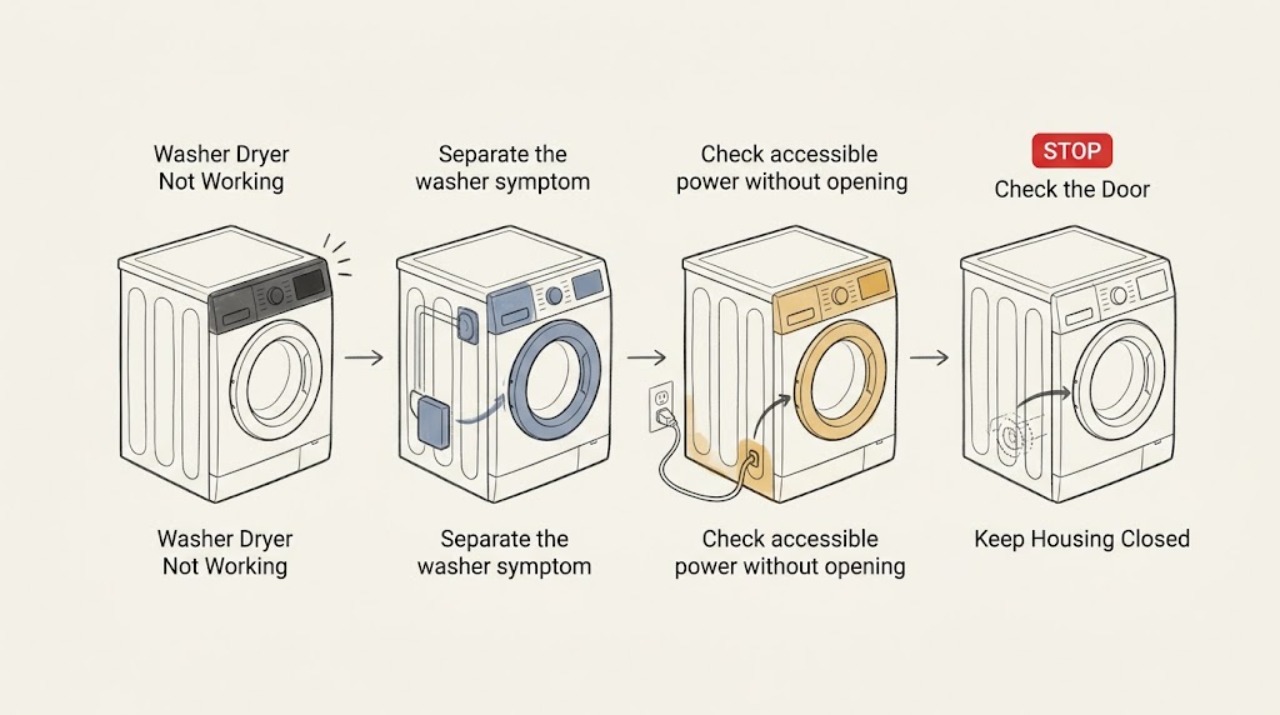
Work through in order
Diagnostic checks
Use only checks that match the exact appliance or system and its official guide.
-
Separate the washer symptom from the dryer symptom
Record which side is affected and what it does: no display, controls that ignore touch, a cycle that will not start, no water fill, no drain, no spin, no dryer tumble, or no heat. Note any blinking light, Controls Locked indicator, code, door or lid state, and whether the other side has power.
Expected result: A blank panel suggests a power path issue, while a lit panel that will not start points toward a lock, latch, option, cycle, water, or error state. A washer that fills but stops and a dryer that tumbles without heat are different branches.
Next step: If there is smoke, burning odor, damaged wiring, repeated breaker operation, or uncontrolled water, stop and arrange service. Otherwise follow the matching washer or dryer checks below and do not run both appliances to compare symptoms.
Why this matters
Why: The two appliances share a laundry area but do not share every control or operating component, so the first decision is which branch to follow.
-
Check accessible power without opening the appliance
For the washer, confirm the power cord is fully seated in the required grounded outlet and do not use an extension cord. Check only the accessible household breaker or GFCI condition described in the Maytag manual. For the dryer, check its supply and the applicable household fuse or breaker arrangement without removing a panel.
Expected result: If the affected control panel and light return after an obvious power issue is corrected, the no-operation symptom may have been external. If the outlet or breaker is repeatedly losing power, or the panel stays blank with confirmed supply, the issue needs electrical or appliance service.
Next step: Make one normal start attempt after a safe power correction. If the breaker trips again or the display remains blank, stop using the appliance and consult a qualified electrician or appliance technician rather than resetting repeatedly.
Why this matters
Why: Maytag documents power checks separately for washers and dryers; a dryer can have a different supply arrangement from a washer even when they are installed together.
-
Start the washer with its lock and lid or door state correct
On the washer, check whether Control Lock is lit and use the model-specific unlock sequence. Close the lid or door completely, remove any clothing caught in the latch, select a valid cycle, and press or hold Start for the duration required by the model. Never force a locked lid or door.
Expected result: Maytag says an active Control Lock prevents touch commands, the lid must be closed and latched for the washer to operate, and some models require holding Start rather than tapping it. If the washer starts after one correction, the control state—not a failed motor—caused the symptom.
Next step: Make one start attempt after correcting the state. If the lid or door will not latch, the lock light cannot be cleared, or the washer ignores Start, keep it out of use and arrange service.
Why this matters
Why: A washer can have power and still appear dead when a lock, latch, or start-input condition blocks the cycle.
-
Start the dryer with controls and door confirmed
On the dryer, use a dry fingertip on the electronic controls if the model has a touch panel, select the model's Automatic or Timed cycle, close the door until its latch engages, and press or hold Start as specified in the owner's manual. Check that Controls Locked is not active and that clothing is not trapped in the latch area.
Expected result: Maytag identifies a moist panel, incorrect cycle, unlatched door, or Controls Locked indicator as reasons a dryer may not start even when it has power. If the dryer starts after the panel is dry and the door and cycle are corrected, no part replacement follows from the original symptom.
Next step: Make one supervised start attempt. If the dryer still does not start, turns off immediately, or the door will not latch, stop using it and arrange qualified dryer service.
Why this matters
Why: The dryer start command depends on a valid cycle, responsive controls, and a closed door; its start logic differs from the washer's lid and fill sequence.
-
Check washer water and drain conditions when a cycle stops
If the washer powers on but stops while filling or leaves water in the tub, verify that both hot and cold supply valves are open, inlet hoses are not kinked, and the drain hose is not kinked or blocked. Follow the model manual for any accessible pump-filter or drain procedure and prepare for standing water. Do not open a hose connection or filter without making the appliance safe first.
Expected result: Maytag links incomplete operation to restricted water supply, an incorrectly installed drain hose, a dirty pump filter on some front-load models, excessive suds, or a load that cannot spin. A full tub or a repeated drain message is not a reason to force the lid or door.
Next step: Correct only an obvious external hose, supply, detergent, or load issue allowed by the manual, then run one supervised model-approved test. If water remains, leaks, or the pump is silent or grinding, call service.
Why this matters
Why: A washer can appear not to work because it is waiting for water, unable to drain, or protecting itself during an unbalanced or suds-affected cycle.
-
Check load balance and cycle selection before blaming a drive part
For a washer that fills but will not agitate or spin, redistribute an overloaded or tightly packed load and select a cycle and spin speed suitable for the fabric. For a dryer that tumbles poorly or stops, remove excess items and confirm the selected cycle is valid. Do not continue operating if the drum makes metal-on-metal grinding or the appliance shakes violently.
Expected result: Maytag explains that an unbalanced or overloaded washer can reduce spin or stop the cycle, while a dryer may not start or tumble when the cycle, door, or drive system is not valid. Wet clothes after a washer cycle do not by themselves prove a failed pump or motor.
Next step: Run one supervised washer drain-and-spin or dryer cycle only after the load and controls are correct. Stop and arrange service for repeat imbalance, loud grinding, no drum movement, or a cycle that stops again.
Why this matters
Why: A corrected load or cycle changes the next step toward normal operation; persistent symptoms with an empty or correctly loaded appliance need component diagnosis.
-
Record codes and use one model-approved reset
Write down the exact code, display message, and point in the cycle where the appliance stopped. Compare it with the model's owner's manual. If there is no safety symptom and the manual allows it, perform one documented control reset; do not use a reset to bypass a lock, clear a leak, or keep a dryer running with a heat or electrical concern.
Expected result: If the display and cycle return to normal after one reset, a transient control state may have cleared. If the same code returns, the panel remains unresponsive, the washer still has water, or the dryer stops again, the fault is persistent.
Next step: Stop after one attempt and arrange qualified service for a recurring code or no-operation condition. Provide the code and the exact washer or dryer behavior instead of ordering a guessed part.
Why this matters
Why: A reset can clear a temporary control condition but cannot repair a door or lid interlock, inlet valve, pump, motor, heater, control, or wiring fault.
Use your observations
Decision map
Find the observation that best matches what you see, then follow the next safe action.
-
PATH 01Next step
What you see
Only the washer is blank or unresponsive.
Do this next
Follow the washer power, Control Lock, lid or door, Start, and model-reset checks. If power is present but the panel stays blank, arrange service.
-
PATH 02Next step
What you see
Only the dryer is blank or will not start.
Do this next
Follow the dryer supply, dry-control, cycle, door-latch, Start, and Controls Locked checks. Stop for a repeated breaker or fuse issue.
-
PATH 03Next step
What you see
The washer powers on but stops while filling, draining, or spinning.
Do this next
Check water supply, hose routing, accessible drain path, detergent, load balance, and the exact code. Do not force the door or continue if water leaks.
-
PATH 04Next step
What you see
The dryer powers on but does not tumble, stops immediately, or makes loud grinding or metal-on-metal noise.
Do this next
Stop using the dryer and arrange service for latch, drive, motor, control, or other model-specific diagnosis.
-
PATH 05Next step
What you see
Both sides lose power, a breaker trips again, or there is smoke, burning odor, damaged wiring, uncontrolled water, or unsafe access.
Do this next
Stop immediately, keep clear of the laundry pair, and obtain qualified electrical or appliance help from a safe location.
Helpful context
Understand the symptom
A washer-dryer has two different operating paths
A washer that will not fill, agitate, spin, or drain needs a different diagnosis from a dryer that will not tumble or heat. Start by observing which control panel is blank or unresponsive and whether the other appliance still works. Do not assume one shared symptom means one failed part.
Water, heat, and electrical safety boundary
Keep water away from outlets and controls. Stop immediately for a burning smell, smoke, damaged cord or wiring, repeated breaker trips, uncontrolled filling or leaking, or unusual heat. Do not bypass a door or lid interlock, remove electrical covers, reach into a moving drum, or continue operating a malfunctioning dryer.
Only after diagnosis
Potential parts
- washer door or lid interlock
Consider this only when the washer has power, the door or lid closes, and a qualified diagnosis finds that the lock state is not being recognized.
Interlocks and connectors are model-specific; verify the exact model before ordering and never bypass the safety device. - washer drain pump or inlet valve
Consider either component only after water supplies, hoses, filters, and the model-approved cycle checks pass and a technician identifies the fault.
Pump, valve, filter housing, and hose fittings vary by model; do not substitute by appearance or code alone. - dryer drive motor or electronic control
Consider these only when a qualified technician confirms that the dryer has valid power, a latched door, and a persistent drive or control failure.
Dryer motor and control fit are model-specific; heating and electrical diagnosis should remain within qualified service.
When checks do not resolve it
Need a professional?
Arrange qualified Maytag washer or dryer service when the affected appliance remains inactive after the correct power, lock, latch, cycle, water, load, and one model-approved reset checks; when a washer retains water or repeatedly stops; or when a dryer will not tumble or stops immediately. Stop immediately for burning odor, smoke, damaged wiring, repeated breaker trips, uncontrolled water, loud grinding, or unsafe access. Do not bypass interlocks, remove electrical panels, or keep operating a malfunctioning dryer.
Common questions
FAQ
Why is my Maytag washer-dryer not working when the display is on?
Check the affected side's Control Lock, door or lid latch, selected cycle, Start input, and any message. For the washer also check water and drain conditions; for the dryer check its cycle, door, dry controls, and Controls Locked indicator.
What should I check if my Maytag washer has no power?
Confirm the cord is seated in the required grounded outlet and check the accessible breaker or GFCI condition described by the manual. If power is present but the washer stays blank, or the breaker trips again, arrange qualified electrical or appliance service.
Why does the washer fill but then stop?
A kinked drain hose, blocked drain path, unbalanced load, excessive suds, or a cycle-specific condition can interrupt later stages. Check only the manual-approved external and user-accessible items, and call service for retained water, leaks, a returning code, or a silent or grinding pump.
Why will my Maytag dryer not start even though it has power?
Maytag lists an incorrectly used Start control, moisture on touch controls, an unlatched door, the wrong cycle, or Controls Locked as possible causes. Correct one obvious condition and make one supervised attempt; arrange service if it still will not start.
Read the exact guide
Official sources
- How To Repair A Washing Machine: 7 Possible Problems and SolutionsMaytag · Washer load, level, water supply, drain hose, spin, detergent, noise, and service considerations
- Not Starting - WasherMaytag Product Help · Control Lock, lid latch, Start input, one control reset, and service path for a washer that will not start
- No Power - WasherMaytag Product Help · Grounded power connection, household breaker or GFCI, Control Lock, and electrician or service escalation
- Dryer Not Starting or No OperationMaytag Product Help · Dryer power, Start input, touch controls, door latch, cycle selection, and Controls Locked state
Community feedback
Share a repair observation
Share a plain-text repair observation. Accepted observations are published automatically; this page may take a moment to update.