
On this page
Start here
Quick answer
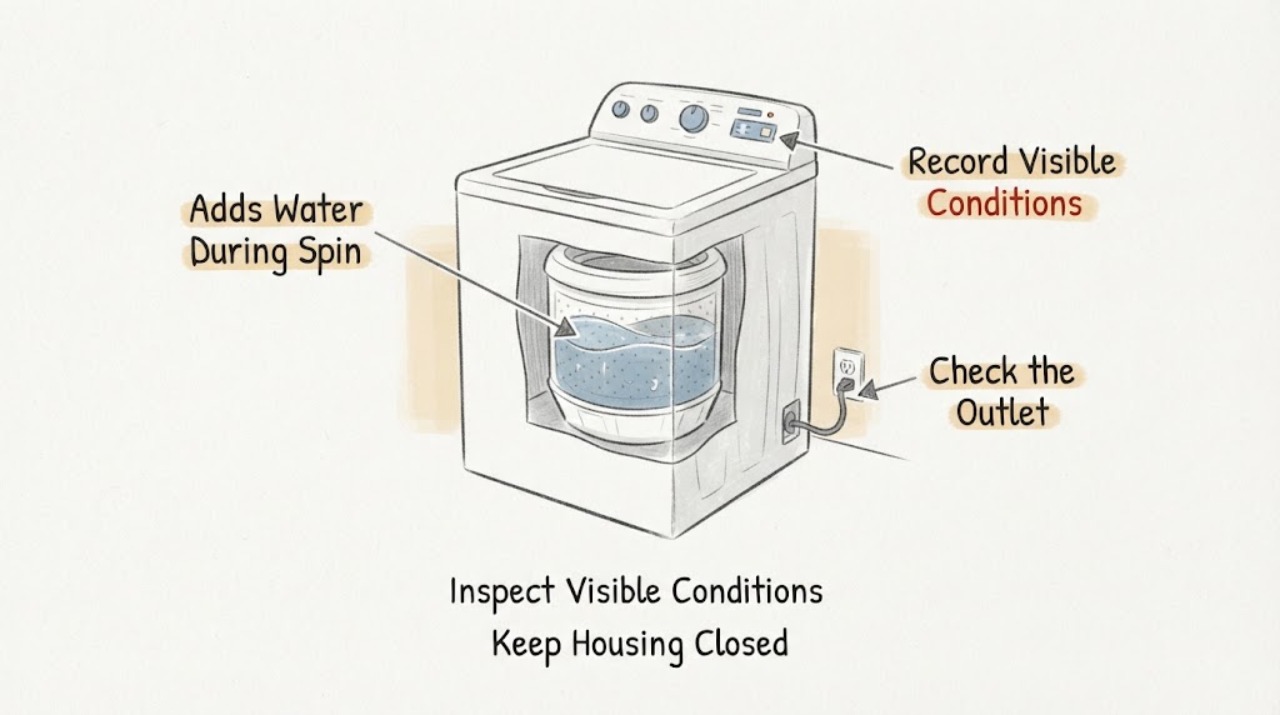
On the Maytag MVWX655DW0, a short burst of water while the basket is slowing, redistributing a load, or running a rinse can be intentional. Maytag says some top-load washers refill and gently rotate when they detect an out-of-balance load, and some rinse phases add water while the basket spins. Do not call that a failed inlet valve from sound or timing alone. First stop the cycle safely and note whether the water stops, whether the load is bunched or a single heavy/water-resistant item, whether the selected cycle includes a rinse, and whether water continues after the washer is stopped. If water keeps entering with the washer off, the tub is flooding, the lid will not unlock after motion stops, or water reaches electrical parts, close both supply faucets from a dry position, keep clear, and arrange qualified service. Do not open the console, enter diagnostics, test a valve live, or keep running cycles to reproduce the symptom.
Before you begin
Safety first
- User checks are limited to stopping the cycle, closing accessible supply faucets from a dry position, observing timing and water level, inspecting the stationary load and visible drain route, and recording settings. Do not open the console or cabinet, probe live wiring, bypass the lid lock, tilt or move the washer, loosen pressurized hoses, or run diagnostic/manual tests.
Work through in order
Diagnostic checks
Use only checks that match the exact appliance or system and its official guide.
-
Check 1
If the washer is filling continuously, flooding, or water is near the cord, outlet, or other electrical parts, stop the cycle without reaching into the machine. From a dry position, close the hot and cold supply faucets if they are safely accessible; do not touch a wet plugged-in appliance or unplug it while standing in water.
Expected result: Water stops when both faucets are closed; water continues or the tub is overflowing; or the floor, plug, cord, or outlet is wet.
Next step: Keep the washer off and arrange qualified Maytag appliance service; use plumbing help if the wall-side supply or faucet is the evidence-supported source. For flooding, shock, smoke, arcing, or a hot electrical connection, keep people clear and obtain emergency or qualified electrical help.
Stop if: Do not restart to see whether the fill returns, loosen a pressurized hose, open the console, or reach under the cabinet.
Why this matters
Why: A fill that stops at the faucets is an immediate water-supply isolation issue, while continued water or wet electrical parts require a safety response before diagnosis. This does not identify the inlet valve, pressure system, or control as the failed part.
-
Check 2
With the basket stopped and the lid closed, record when the water appears: during initial sensing, the wash, a labeled rinse phase, the final spin, immediately after the load begins to accelerate, or while the washer is idle. Note whether it is a short spray or a sustained fill and whether the water level rises beyond what the cycle normally uses.
Expected result: A short addition occurs in a rinse or sensing stage; a brief addition follows slow basket reversals or an off-balance attempt; a large or repeated fill occurs late in final spin; or water appears while idle.
Next step: Continue only with the matching load, setting, and drain observations. If filling continues after the cycle should be finished or while idle, close the faucets and leave the machine off.
Stop if: Do not lift the lid during high-speed motion, watch repeated cycles solely to reproduce the fill, or touch the inlet assembly.
Why this matters
Why: Maytag documents water during some spray rinses and refilling during out-of-balance correction. A late, large, repeated, or idle fill is not explained by those normal descriptions and needs model-specific service rather than a guessed valve diagnosis.
-
Check 3
After all motion stops, inspect the load from above without reaching into a moving basket. Look for a single heavy absorbent item, a blanket or rug, water-resistant items, tightly wrapped sheets, or clothing gathered on one side. Do not add water manually and do not remove a lid lock or run a manual test.
Expected result: The load is bunched or one large item is carrying most of the water; the load is loose and mixed; or the basket is empty/near empty when the late fill occurs.
Next step: For a stopped machine with no leak or electrical hazard, redistribute the load loosely and evenly, use the cycle intended for bulky items when appropriate, and try one normal or model-authorized drain-and-spin run. Stop if the fill recurs or the washer moves violently.
Stop if: Do not reach into a moving basket, pull connected hoses to move the washer, add manual water, or continue with a torn lid, broken lock, or violent movement.
Why this matters
Why: Maytag says an uneven load can create an out-of-balance condition during spin and that the washer may refill and gently rotate to redistribute it. A balanced or empty basket with a repeated late fill makes load correction less likely, but still does not prove a specific component.
-
Check 4
Review the selected cycle and options before changing anything. Check whether the load is in a rinse-related cycle, whether an extra rinse or fabric-softener option is selected, and whether the washer is using an automatic water-level or bulky-load behavior. Compare the phase label and water amount with the matching Maytag manual, not with an older full-fill washer.
Expected result: The water appears during a documented rinse or sensing interval; an extra rinse/fabric-softener or bulky setting is active; or the same excessive fill occurs in a cycle that should be drain-and-spin only.
Next step: Use the cycle intended for the load and remove only an option that the exact control panel clearly shows as active. If the symptom persists in a matching, otherwise normal cycle, stop and provide the cycle and phase record to service.
Stop if: Do not assume a control knob position from another Maytag model, enter diagnostics, or keep changing options while the washer is filling unexpectedly.
Why this matters
Why: Maytag explains that some rinse cycles spray water while the basket spins and that water level varies by cycle. A setting can therefore explain a brief addition, but a whole-tub fill or repeated fill in a drain-focused operation is not established as normal for this exact suffix.
-
Check 5
With the washer off and not being moved, inspect the visible drain hose and household standpipe for a kink, loose placement, backup, or water flowing back after discharge. Look only from the outside; do not tape the drain opening, pour chemicals into it, remove the pump, or tilt the machine.
Expected result: Water remains in the tub, the standpipe backs up, the drain hose is kinked or too deeply inserted, or the drain path looks normal while the late fill continues.
Next step: Correct only a clearly visible routing problem allowed by the exact model instructions; use plumbing service for a backing-up standpipe. If the route is normal or water appears underneath, keep the washer off and arrange appliance service.
Stop if: Do not pull the washer forward, reach below it, disconnect a drain hose with water in the tub, or run another cycle to confirm a suspected restriction.
Why this matters
Why: Maytag links standing water and water return to drain-hose routing, restrictions, or a household drain problem. Poor draining can make clothes remain wet and can be confused with water being added during a later spin, but it does not justify naming a pump or inlet valve without further diagnosis.
-
Check 6
Create a service record instead of selecting a replacement part: model MVWX655DW0, selected cycle and options, exact phase and timing, brief versus sustained water, load type and balance, whether clothes remain soaked, drain-hose observations, whether closing the supply faucets stops the water, and any fault lights or unusual motion. Take photos only from a dry, stationary position.
Expected result: A single balanced-load correction resolves the symptom; the same behavior returns; the tub overfills; water enters while idle; the washer cannot drain; or no safe external check explains it.
Next step: Leave the machine off for a recurring, excessive, idle, or unexplained fill and arrange qualified Maytag service. Give the technician the exact suffix and the phase record; do not perform live tests or use a component substitution as a diagnostic.
Stop if: Do not open panels, bypass the lid lock, enter service diagnostics, probe wiring, or reconnect the washer to reproduce a hazard.
Why this matters
Why: A recurring pattern can involve load sensing, balance correction, drain flow, inlet control, pressure sensing, or the control path. The symptom record helps a technician separate these possibilities; it cannot establish a compatible valve, sensor, timer, or control board by itself.
Use your observations
Decision map
Find the observation that best matches what you see, then follow the next safe action.
-
PATH 01Next step
What you see
The water is a brief addition during a documented rinse or sensing interval, the load remains controlled, and the fill stops without flooding or an idle drip.
Do this next
Use the correct cycle and observe one normal run without opening the lid during motion. Arrange service if the amount becomes excessive, the tub overfills, or the behavior appears in an incompatible phase.
Why this path and its safety boundary
Why it matters: Maytag documents spray-rinse water while the basket spins and water-level sensing that adds water in stages. This pattern is compatible with programmed operation, although the exact cycle manual remains the authority for MVWX655DW0.
-
PATH 02Next step
What you see
Water is added after the load bunches, the washer slows or reverses, or the basket shows an uneven single-item or bulky load, then the machine resumes or stops adding water after redistribution.
Do this next
After motion stops, redistribute the load loosely and evenly and use the cycle intended for bulky items if applicable. If the washer still repeatedly refills, moves violently, or leaves the load soaked, stop and arrange service.
Why this path and its safety boundary
Why it matters: This matches Maytag's documented out-of-balance self-correction branch, in which the washer can refill and gently rotate to redistribute clothing. It does not prove a failed inlet valve.
-
PATH 03Next step
What you see
The washer adds a large amount of water late in final spin, repeats the fill on a balanced or empty load, leaves clothes very wet, or behaves similarly in a drain-focused cycle.
Do this next
Keep the washer off after one safe observation, document the phase and settings, and arrange qualified Maytag service. Do not run diagnostics, replace a valve, or substitute a control board based on the symptom alone.
Why this path and its safety boundary
Why it matters: A normal rinse or balance explanation is no longer sufficient. Poor draining, an incorrect cycle state, water-level sensing, inlet control, or another platform fault may be involved, but the evidence does not identify one part.
-
PATH 04Next step
What you see
Water continues entering while the washer is stopped or idle, the supply faucets are the only way to stop it, the tub is overflowing, or water reaches electrical parts.
Do this next
Close both supply faucets from a dry, safe position, keep people away from the wet appliance, and arrange qualified appliance or emergency/electrical service as appropriate. Do not reconnect or restart it.
Why this path and its safety boundary
Why it matters: This is a continuing water-inlet and electrical-safety condition, not a normal balance correction. A stuck valve is possible, but it must be confirmed by qualified service rather than assumed.
Helpful context
Understand the symptom
The MVWX655DW0 is a Maytag top-load, low-water washer. On this platform, water appearing near a spin phase can have more than one meaning: Maytag documents an out-of-balance self-correction that may refill and gently rotate the load, and it also documents spray-rinse water while the basket spins. The useful distinction is whether the fill is brief and tied to a recoverable load or rinse stage, versus continuous, excessive, or present when the machine should be idle.
The exact MVWX655DW0 owner document was not exposed by the current Maytag Owner Center page, which lists the MVWX655DW family but reports no documents available there. The Maytag product-help behavior is therefore used for platform-level reasoning, while the exact model suffix is kept explicit and the Reddit report is treated as an anecdotal symptom record—not as proof of a component or a repair procedure.
When checks do not resolve it
Need a professional?
Call qualified Maytag appliance service for a persistent or excessive fill, water entering while idle, a balanced-load repeat, poor draining, soaked clothing after a normal cycle, or any suspected inlet, pressure, sensor, pump, control, or wiring fault. Use plumbing service when the household drain or wall-side water supply is the evidence-supported source.
Safety scope: User checks are limited to stopping the cycle, closing accessible supply faucets from a dry position, observing timing and water level, inspecting the stationary load and visible drain route, and recording settings. Do not open the console or cabinet, probe live wiring, bypass the lid lock, tilt or move the washer, loosen pressurized hoses, or run diagnostic/manual tests.
Have this ready
- Provide model MVWX655DW0, the exact cycle and options, whether the lid was opened, the phase and timing of each water addition, brief versus sustained fill, load composition and balance, whether the tub drained, clothing dryness, drain-hose observations, fault lights, and whether closing the supply faucets stopped the water.
Common questions
FAQ
Why does my Maytag MVWX655DW0 add water during spin?
A brief addition can occur during a rinse or an out-of-balance correction. Maytag says an unbalanced load can trigger refilling and gentle rotation to redistribute clothes. A large, repeated, late, or idle fill is not explained by that alone and needs service diagnosis.
Is water during the final spin always normal on this Maytag washer?
No. A short programmed rinse or balance correction can be normal, but water that fills the tub, returns repeatedly on a balanced load, enters while idle, or leaves clothes soaked should be treated as an unresolved fault. Do not keep running cycles to test it.
Should I replace the inlet valve when the washer adds water during spin?
Not from this symptom alone. Load balance, rinse behavior, drain flow, water-level sensing, inlet control, and the cycle state can produce different patterns. If closing the supply faucets is required to stop continuous water, keep the washer off and have the inlet path diagnosed by qualified service.
What should I do if the washer keeps filling after it stops?
Close both water supply faucets from a dry, safe position, keep clear of wet electrical parts, and do not restart the washer. Arrange qualified appliance service; use emergency or electrical help for flooding, shock, smoke, sparks, or damaged power parts.
Read the exact guide
Official sources
- MVWX655DW Owner Center | MaytagMaytag · Exact Maytag model-family owner page opened; it identifies MVWX655DW as a 4.3-cu.-ft. washer and routes owners to model-specific troubleshooting and literature. The page currently reports no documents available, so it is not used to assert an unavailable suffix-specific cycle instruction.
- Not Spinning - Washer - Product Help | MaytagMaytag · Official Maytag top-load guidance opened for the balance-correction and drain distinctions; it is used at platform level and does not by itself prove an MVWX655DW0 component fault.
- Maytag washer adding water during spinReddit r/appliancerepair · Exact Reddit post opened; it is anecdotal and contains conflicting community suggestions. It is used only to verify the exact suffix symptom context and distinguish a late-water observation from a proven cause or repair.
- Rinse Light On - Product Help | MaytagMaytag · Official Maytag support page opened for the narrow rinse observation; it states that certain cycles spray-rinse while the basket spins, but it does not prove that every late fill on MVWX655DW0 is normal.
- Water Levels by Cycle - Washer - Product Help | MaytagMaytag · Official Maytag top-load guidance opened to distinguish cycle-dependent water levels and sensing fills; exact cycle availability must be checked against the MVWX655DW0 documentation.
- Maytag Manuals & LiteratureMaytag · Official Maytag manual-lookup page opened to support the model-specific documentation boundary; no unsupported MVWX655DW0 procedure is inferred from it.
- Auto Sensing in a Top Load HE Washer - Product Help | MaytagMaytag · Official Maytag top-load HE guidance opened for sensing-spin and staged-fill meaning; it does not authorize live diagnosis or transfer a part diagnosis to MVWX655DW0.
Community feedback
Share a repair observation
Share a plain-text repair observation. Accepted observations are published automatically; this page may take a moment to update.