
On this page
Start here
Quick answer
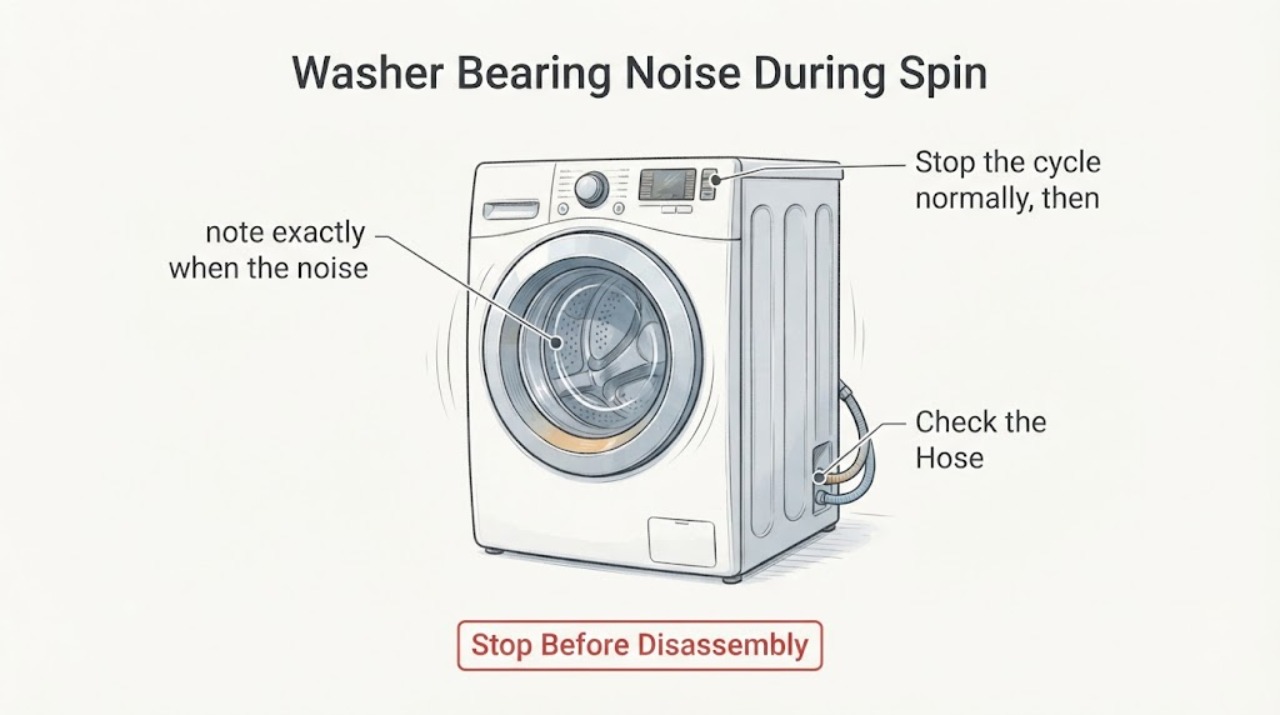
A Maytag washer's rumbling or grinding during spin does not prove a failed bearing. First identify when the sound starts, redistribute the load, check the washer's level and visible external objects, and follow the model's installation and owner instructions. Maytag says worn drum bearings are one possible cause of loud spin noise, but also describes normal drive sounds, imbalance, leveling, hoses, a drain pan, and foreign objects as other possibilities. If the noise is metal-on-metal, the basket looks off-center or loose, the washer walks, or the sound persists after safe external checks, stop using it and arrange professional service rather than opening the cabinet or ordering a bearing by symptom alone.
Work through in order
Diagnostic checks
Use only checks that match the exact appliance or system and its official guide.
-
Check 1
From a safe distance, note exactly when the noise appears: filling, agitation, the change into spin, or sustained high-speed spin. Do not put hands near a moving basket.
Expected result: A brief clunk occurs only as the drive changes modes, or a grinding/rumbling noise continues as speed rises.
Next step: If the sound is brief and the washer is stable, continue with load and installation checks. If it is sustained, metallic, or worsening, stop using the washer and arrange service.
Why this matters
Why: Maytag describes a clunk during the shift between agitation and spin as part of normal operation; persistent grinding or rumbling is a different pattern that may need service.
-
Check 2
Stop the cycle normally, then redistribute clothing loosely around the basket. Remove an overload and avoid testing with one heavy or bulky item by itself; use the model's manual for loading guidance.
Expected result: The noise and shaking reduce with a smaller, evenly distributed load, or they remain unchanged.
Next step: Use balanced loads if the symptom clears. If the same noise returns with ordinary balanced loads, continue only with safe external checks and prepare for service.
Why this matters
Why: An off-balance or overloaded load can make the basket move, producing spin noise, vibration, reduced spin, or wet clothes. Improvement does not establish a bearing problem.
-
Check 3
With the washer stopped, inspect the visible drum and the area around the cabinet. Remove only an obvious loose pocket item, and check that drain or inlet hoses and nearby household objects are not striking the cabinet.
Expected result: A coin, object, hose, or nearby item is visibly contacting the washer, or nothing external is found.
Next step: Secure or remove the visible external source and observe whether the noise stops during ordinary use. If no external source is visible, do not open the cabinet to search for one; continue to leveling and service boundaries.
Why this matters
Why: Maytag identifies pocket objects and hoses or items leaning against the cabinet as sources of rattling or clunking that can be mistaken for an internal fault.
-
Check 4
Check whether the washer rocks diagonally and whether all four feet are firmly on the floor. If the washer is newly installed or was moved, consult its exact installation instructions about leveling and shipping materials; do not guess at model-specific adjustments.
Expected result: The washer rocks, a foot is not firmly planted, the floor or pedestal is unstable, or the setup is stable.
Next step: Correct only the clearly documented leveling or installation issue using the matching manual. If the washer is stable and the bearing-like noise remains, arrange professional assessment instead of dismantling it.
Why this matters
Why: Maytag says an unlevel washer can make loads unbalanced and increase spin noise and vibration. Shipping materials or an unstable pedestal can also create severe vibration after installation.
-
Check 5
With power disconnected and the washer empty, look through the opening to see whether the basket or drum is visibly centered. Apply only gentle movement that the owner's manual permits; do not force it, remove parts, or run the machine with panels open.
Expected result: The basket appears loose or off-center, or it looks centered and the noise is still reported during spin.
Next step: If the basket is loose, visibly off-center, or the noise is metal-on-metal, keep the washer out of service and contact Maytag or a qualified technician. Do not order a bearing without the exact model and a service diagnosis.
Why this matters
Why: Maytag says an old washer with loud spin banging or clanging may have worn shock absorbers or drum bearings, but a loose basket is a service finding, not a confirmed diagnosis from sound alone.
Use your observations
Decision map
Find the observation that best matches what you see, then follow the next safe action.
-
PATH 01Next step
What you see
The sound is a brief clunk only when the washer changes between agitation and spin, and the machine remains stable.
Do this next
Monitor the washer with correctly balanced loads and follow the exact owner's manual; seek service if the sound becomes sustained, metallic, or accompanied by movement.
Why this path and its safety boundary
Why it matters: Maytag describes that drive transition as a normal operating sound on the relevant washer guidance.
-
PATH 02Next step
What you see
Noise and shaking improve after a bulky or uneven load is removed and redistributed.
Do this next
Use smaller, evenly distributed loads and do not run repeated unbalanced tests.
Why this path and its safety boundary
Why it matters: The observed change supports a load-balance or loading issue rather than proving a bearing fault.
-
PATH 03Next step
What you see
The washer rocks, a foot is not firmly planted, or the symptom began after installation or moving the washer.
Do this next
Use the matching installation instructions to correct the documented setup issue; call service if the machine remains unstable.
Why this path and its safety boundary
Why it matters: Leveling, pedestal, or shipping-material conditions can amplify spin vibration and noise.
-
PATH 04Next step
What you see
The basket looks loose or off-center, or persistent grinding, rumbling, or metal-on-metal noise remains with a balanced load and stable installation.
Do this next
Stop using the washer and arrange a qualified Maytag service assessment. Do not open the cabinet or buy a part from the symptom alone.
Why this path and its safety boundary
Why it matters: An internal issue is possible, but the evidence does not distinguish a bearing from other drive, suspension, tub, or foreign-object problems.
-
PATH 05Next step
What you see
The washer leaks, smells burned, moves violently, shows visible damage, or repeatedly makes severe metal-on-metal noise.
Do this next
Stop the cycle, disconnect power only if safe and dry to do so, keep clear of moving or wet areas, and obtain professional service.
Why this path and its safety boundary
Why it matters: Continued operation can increase water, electrical, or mechanical risk.
Helpful context
Understand the symptom
Why a spin noise is not automatically a bearing diagnosis
Maytag's own guidance separates normal drive sounds and load or installation problems from persistent grinding, rumbling, or metal-on-metal noise. The task has no Maytag model number, so this guide does not select a bearing, tub, shock, belt, clutch, or other part. Use the sound pattern and visible results to decide whether the next step is a safe setup correction or service.
Stop before internal work
Do not remove panels, reach under a moving washer, or run a deliberately unbalanced test load. Unplug the washer before any hands-on inspection of the empty basket or external objects. If there is a burning smell, leaking water, visible damage, violent movement, or metal grinding, stop using it and arrange qualified service.
What to record
Note whether the noise occurs during filling, agitation, the transition into spin, or only at high speed. Record whether the washer shakes, walks, leaves clothes wet, or shows a message, and copy the model number before using a manual or ordering parts.
When checks do not resolve it
Need a professional?
Call Maytag or a qualified appliance technician when the basket or drum appears loose, the noise is persistent grinding or rumbling, the washer walks or moves violently, setup and load checks do not change the sound, or any leak, burning smell, visible damage, or metal-on-metal noise is present.
Common questions
FAQ
Does a rumbling noise during spin prove the Maytag washer bearing failed?
No. Maytag lists drum bearings as one possible cause, but also lists normal drive sounds, imbalance, leveling, hoses, a drain pan, and foreign objects. A bearing cannot be confirmed from the sound alone.
Can I keep using the washer if it only clunks during the change into spin?
Maytag describes a clunk during the shift between agitation and spin as normal on its product-help guidance. Stop and seek service if the sound becomes sustained, metallic, louder, or is paired with walking, a loose basket, a leak, or burning odor.
Should I buy a bearing before I know the model?
No. The task has no model, and the noise does not identify a bearing or its fit. Record the exact model and have a qualified technician assess the washer before selecting an internal part.
Read the exact guide
Official sources
- How to Stop a Washing Machine from Shaking | MaytagMaytag · Maytag's general washer guide; model-specific instructions govern installation and internal work.
- Grinding or Rubbing Noise - Washer - Product Help | MaytagMaytag Product Help · Maytag front-load product-help page; it supports sound differentiation and external checks, not a cross-model bearing diagnosis.
- Knocking or Thumping - Noise - Product Help | MaytagMaytag Product Help · Maytag top-load washer noise page; use for general external checks only because no exact model was supplied.
- Why is My Washing Machine Making Loud Noises? | MaytagMaytag · Maytag's official general noise guide; it presents bearings as a possible cause and stresses that exact model instructions and professional service govern internal work.
- Sounds: Clunk or Clunking Noise During Spin - Product Help | MaytagMaytag Product Help · Maytag product-help guidance covering top-load washer clunking, load balance, foreign objects, normal drive transitions, leveling, and manual/service escalation.
Community feedback
Share a repair observation
Share a plain-text repair observation. Accepted observations are published automatically; this page may take a moment to update.