
On this page
Start here
Quick answer
On the Maytag MVW6230HW, F9E1 is Maytag's top-load "Long Drain" code. Start with the visible drain path: keep the washer stopped if water remains, check the hose for a kink or blockage, and verify that it is not pushed too far into the standpipe or altered with tape. A pump that continues running with an empty tub after a new pump was installed does not prove that another pump is needed; once the external path is clear, record when the pump command occurs and arrange model-specific service for the control, water-level feedback, wiring, or another internal cause.
Before you begin
Safety first
- Do not open the cabinet, probe live wiring, bypass controls, reach into moving parts, or repeatedly run the washer with standing water. Stop immediately for leaks, water near electrical parts, smoke, burning odor, a hot or damaged cord, repeated breaker trips, or uncontrolled fill.
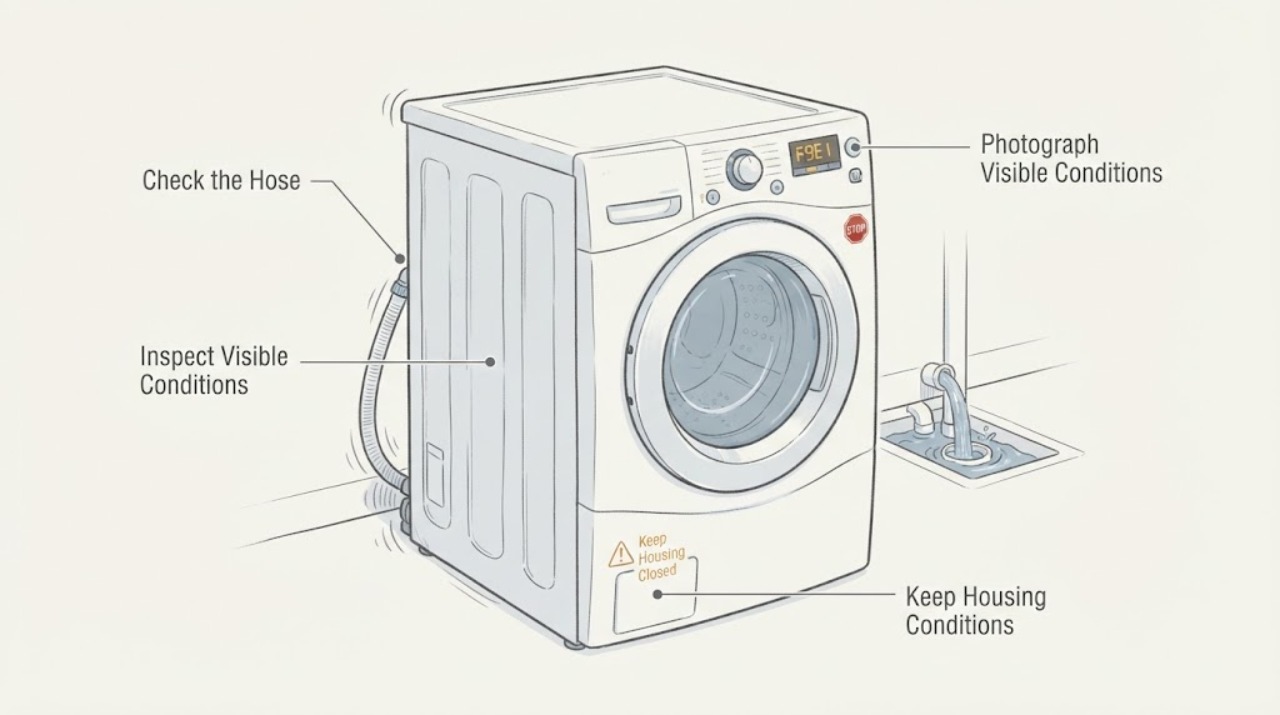
Work through in order
Diagnostic checks
Use only checks that match the exact appliance or system and its official guide.
-
Check 1
Photograph the complete display and record F9E1 exactly as shown. Write down the full model from the rating label, confirm that this is a top-load washer, and note whether the pump starts immediately, during a drain phase, after canceling a cycle, or after the tub should already be empty.
Expected result: The display is F9E1 on an MVW6230HW, or the code, model, or timing is different or uncertain.
Next step: Keep the record before clearing anything. If the identity is uncertain, stop at the exact-model manual lookup rather than applying a different Maytag code table.
Stop if: Do not continue a cycle merely to recreate the noise if there is standing water, a leak, burning odor, smoke, or a tripped breaker.
Why this matters
Why: Maytag calls F9E1 Long Drain in its top-load guidance, but a different display or appliance identity cannot safely use that interpretation. Pump timing also separates an apparent drain restriction from a persistent command that needs service diagnosis.
-
Check 2
With the washer stopped, inspect only the visible tub and floor area and the accessible drain-hose route. Look for standing water, a wet connection, a kinked or crushed hose, a hose that has slipped out, or a household standpipe or utility sink that is backing up. Do not reach into moving parts or remove a wet connection.
Expected result: Water remains in the tub, the hose or connection is visibly damaged, or the household drain backs up; otherwise the tub is empty and the visible route looks open.
Next step: If water remains or the household drain backs up, keep the washer stopped and arrange safe appliance or plumbing service. If the area is dry and safe, continue to the hose-position check without disassembly.
Stop if: Stop immediately for water near electrical parts, a leak that cannot be contained, or any need to open the cabinet or pump area.
Why this matters
Why: Standing water or a visible restriction is consistent with the long-drain path Maytag tells users to check. An empty tub and normal visible route do not prove the pump is good or bad; they move the decision toward the next hose-installation and service branch.
-
Check 3
Compare the visible drain-hose installation with the exact Maytag guidance: the hose must not be kinked or clogged, must not be pushed too far down the standpipe, and must not be taped or otherwise altered to the drain pipe. Do not pull apart the pump or plumbing to investigate a suspected internal blockage.
Expected result: The hose is too deep, taped or altered, kinked, or obstructed; or it is positioned as shown and the household drain accepts water without backup.
Next step: Correct only an obvious external hose position or blockage that can be handled without wet disconnection or disassembly, then document whether F9E1 returns. If the route is already correct, do not order another pump; proceed to service handoff.
Stop if: Stop if correcting the route would require moving a loaded or water-filled washer, opening a panel, or working around exposed wiring.
Why this matters
Why: Maytag warns that incorrect depth or an altered hose can cause siphoning or water to drain back into the tub and can contribute to slow or failed draining. A correctly positioned, clear external path makes another pump replacement an unsupported next step.
-
Check 4
After the visible checks, do not perform a live electrical test or install another part. Instead, document the replacement-pump date and part identity if known, whether the tub was empty when the pump kept running, and whether the behavior began before a cycle, only during draining, or after a cancellation.
Expected result: The tub is empty and the pump still runs outside a normal drain phase, or the pump runs only while water remains or the external path is restricted.
Next step: For the empty-tub pattern, stop parts swapping and request qualified Maytag or appliance service with the model, code, timing, hose observations, and replacement history. For the water/restriction pattern, correct the safe external condition or arrange plumbing/appliance service if it returns.
Stop if: Do not open the cabinet, bypass a control, probe wiring, or run repeated cycles to force a diagnosis.
Why this matters
Why: Pump operation tied to standing water or a restricted route keeps the long-drain path in play. Pump operation that persists with an empty tub after a replacement is a distinct service branch: it may involve the washer's control or water-level feedback state, wiring, or another internal condition, but the observation does not select one failed component.
-
Check 5
Prepare the service handoff: provide the complete MVW6230HW model, a photo of F9E1, the cycle stage and pump timing, whether water was present, the drain-hose and standpipe observations, and what changed—or did not change—after the pump replacement.
Expected result: The same F9E1 or continuous-pump behavior returns after the safe external path is correct, or the appliance has a leak, electrical symptom, or persistent standing water.
Next step: Keep the washer stopped and arrange qualified service; use a plumber as well when the household standpipe or sink backs up independently of the washer.
Stop if: Do not restart the washer when water is near electricity, there is smoke or burning odor, a hot or damaged cord, repeated breaker operation, or uncontrolled leakage.
Why this matters
Why: The official F9E1 guidance has reached its user-accessible drain-path boundary. Repetition after a new pump means a technician should diagnose the complete drain command and feedback path before selecting another part; it is not evidence for a second pump.
Use your observations
Decision map
Find the observation that best matches what you see, then follow the next safe action.
-
PATH 01Next step
What you see
F9E1 appears while water remains, the hose is kinked or obstructed, the hose is too deep in the standpipe, or the household drain backs up.
Do this next
Keep the washer stopped, correct only the plainly visible hose condition allowed by Maytag's guidance, and arrange appliance or plumbing service if water remains or the path cannot be made safe without disassembly.
Why this path and its safety boundary
Why it matters: This pattern keeps a long-drain or external plumbing path problem more likely than a proven pump failure.
-
PATH 02Next step
What you see
The tub is empty, the visible hose and household drain are clear and correctly positioned, and the pump continues running after a new pump was installed.
Do this next
Stop repeated cycles and parts replacement; give a qualified technician the exact model, F9E1 photo, timing, empty-tub observation, and pump replacement history for an internal control/level-feedback diagnosis.
Why this path and its safety boundary
Why it matters: The external long-drain checks do not explain the symptom. This is a distinct observation-to-service branch, but it does not prove a control board, pressure sensor, wiring fault, or any single replacement part.
-
PATH 03Next step
What you see
The display is not F9E1, the model is not confirmed as MVW6230HW, or the pump behavior occurs with smoke, burning odor, water near electricity, a hot or damaged cord, or repeated breaker trips.
Do this next
Stop using the washer. Disconnect power only if it is safely accessible, close the water supply when leakage or uncontrolled fill is present, and arrange qualified service using the exact identity and observed symptoms.
Why this path and its safety boundary
Why it matters: The Maytag top-load F9E1 explanation is not established, or the situation has crossed the ordinary external-check boundary.
-
PATH 04Next step
What you see
The hose route is corrected and the household drain is clear, but F9E1 returns or the pump again stays on during a normal cycle.
Do this next
Arrange Maytag or qualified appliance service and ask the provider to verify the drain command, water-level feedback, wiring, and other model-specific causes before authorizing a part.
Why this path and its safety boundary
Why it matters: A recurrence after the official external checks is not a reason to keep replacing the pump; the exact washer needs a broader diagnosis.
Helpful context
Understand the symptom
What F9E1 establishes—and what it does not
Maytag's top-load support page labels F9E1 as Long Drain and points first to the drain hose and household drain path. That is a system-level symptom, not a confirmation that the drain-pump motor is defective. The MVW6230HW is a Smart Top Load Washer with Extra Power, so do not borrow a code definition or test procedure from a front-load washer or a different Maytag model.
Why a replacement pump changes the next decision
If the same continuous-pump behavior remains after a pump replacement, the useful question is whether the washer is still detecting or responding to a drain condition—not which pump to buy next. Separate a real restriction, siphoning or backup from an empty tub with a persistent pump command. That second pattern needs a qualified diagnosis of the exact washer; it does not identify a particular control, pressure component, or wire as failed by itself.
Only after diagnosis
Potential parts
- drain-system component
Consider a component only after a qualified diagnosis identifies the failed part after the drain hose, standpipe, control response, and water-level feedback have been assessed; F9E1 and continuous pump operation alone do not justify another pump.
Confirm the complete MVW6230HW model and the manufacturer's fit information before ordering; do not infer compatibility from a similar Maytag top-load washer.
When checks do not resolve it
Need a professional?
Arrange qualified Maytag or appliance service when F9E1 returns after the visible drain-hose checks, when the pump continues with an empty tub, when a replacement pump did not change the behavior, or when the external path cannot be corrected without disassembly. Use plumbing service when the household standpipe or sink backs up independently of the washer.
Safety scope: Do not open the cabinet, probe live wiring, bypass controls, reach into moving parts, or repeatedly run the washer with standing water. Stop immediately for leaks, water near electrical parts, smoke, burning odor, a hot or damaged cord, repeated breaker trips, or uncontrolled fill.
Have this ready
- Provide the complete MVW6230HW model, display photo, cycle stage, pump timing, water level, drain-hose and standpipe observations, any leak or electrical symptom, and the date and identity of the replacement pump if known.
Common questions
FAQ
What does F9E1 mean on a Maytag MVW6230HW?
Maytag's top-load support page labels F9E1 as Long Drain. Check the visible drain hose and household drain path first, and keep the model identity exact. The code does not by itself prove that the pump motor has failed.
Why would the Maytag drain pump keep running after I replaced it?
If the tub is empty and the hose and household drain are clear, continued pump operation after replacement is a service branch rather than proof that another pump is needed. A technician should evaluate the drain command, water-level feedback, wiring, and other model-specific causes without assuming one component.
Should I keep resetting or running the washer to clear F9E1?
Do not use repeated cycles to recreate a continuously running pump. Photograph the code and record the timing first; stop for standing water, leaks, electrical symptoms, smoke, burning odor, or a tripped breaker, and arrange qualified service when the external drain path is not the clear cause.
Read the exact guide
Official sources
- F9E1 - Error Code - Product Help | MaytagMaytag Product Help · Directly applicable to the assigned top-load washer's F9E1 branch; the page labels F9E1 Long Drain and gives drain-hose placement, kink, blockage, and service guidance.
- Smart Top Load Washer with Extra Power - 4.7 cu. ft. MVW6230HW | MaytagMaytag · Directly applicable to the assigned MVW6230HW model; the page identifies the appliance as a Smart Top Load Washer with Extra Power and describes its Power agitator, Auto Sensing, and belt-drive platform.
Community feedback
Share a repair observation
Share a plain-text repair observation. Accepted observations are published automatically; this page may take a moment to update.